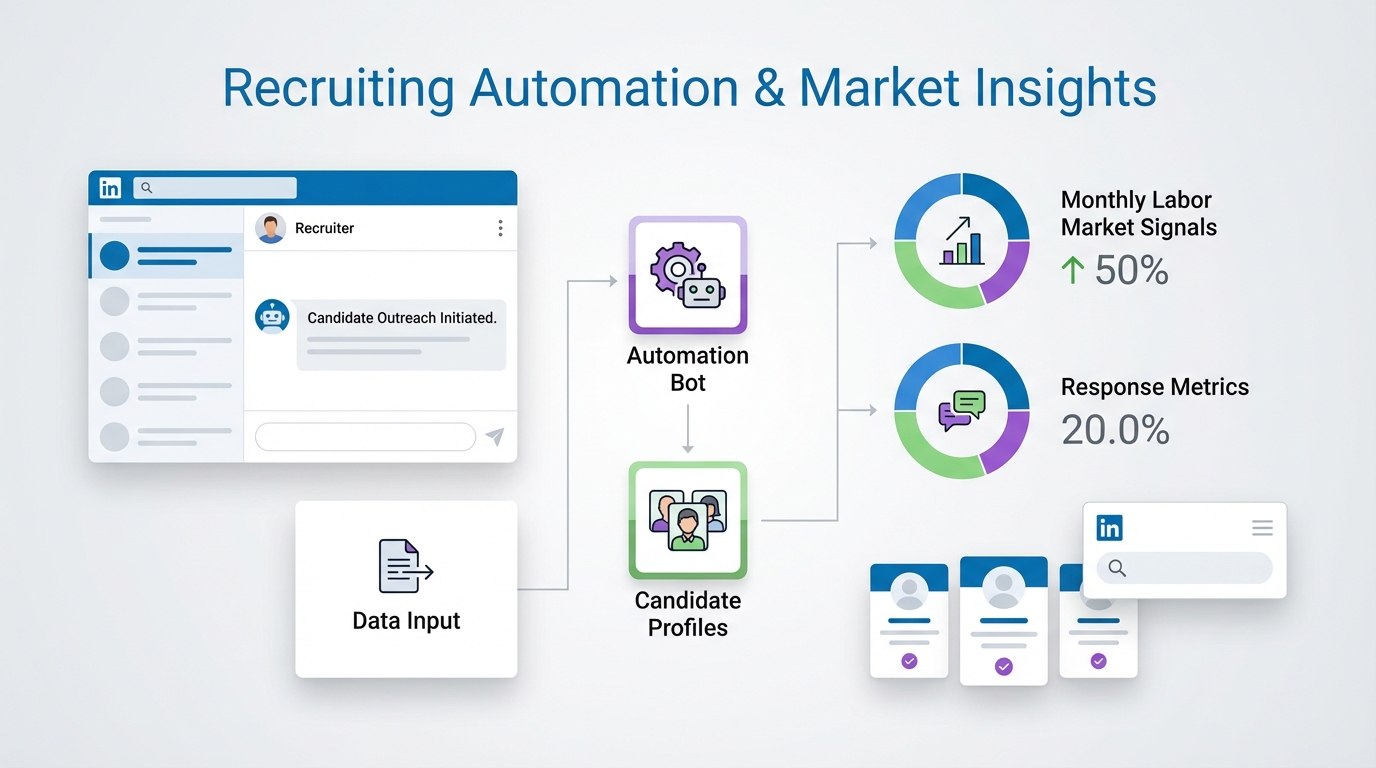
Recruitment online for recruiters is most effective when you treat labor market data as your weekly operating system and pair it with a consistent sourcing and messaging workflow. Using the September 9, 2022 Statistics Canada employment release as an example, you can convert headline numbers into practical decisions on which roles to prioritize, how to position compensation, and what to say in outreach. In our internal workflow tests, the biggest lift came from automating the repetitive first touch and follow up on LinkedIn while keeping recruiter judgment for final qualification. That is where StrategyBrain AI Recruiter fits naturally, because it can handle initial outreach, answer candidate questions, confirm interview interest, and collect résumés and contact details so recruiters focus on shortlist quality.
Key Takeaways
- Use labor signals as inputs: Track monthly job change, unemployment rate, hours worked, and wage growth to set recruiting priorities and outreach angles.
- Example numbers you can cite: Canada lost 40,000 jobs in August 2022 and unemployment rose to 5.4% (Source: Statistics Canada table referenced below).
- Industry shifts matter: In the same release, educational services and construction declined while professional, scientific, and technical services increased, which should change where you source first.
- Retention is a recruiting signal: 11.9% of permanent employees planned to leave within 12 months in that release, which supports proactive outreach even when hiring slows.
- Automation should target repetition: StrategyBrain AI Recruiter can replace up to 90% of manual LinkedIn recruiting work in the initial outreach and qualification stage, while recruiters keep final fit decisions.
- Cost control with measurable output: StrategyBrain AI Recruiter can lower LinkedIn recruiting costs to as little as USD 2.40 per résumé when configured for résumé capture and contact collection.
Why labor market data improves online recruiting
Online recruiting is noisy. The same LinkedIn search can produce very different outcomes depending on whether candidates feel secure, whether wages are rising, and whether specific industries are expanding or contracting. Labor market releases help you avoid guessing, because they provide a consistent monthly snapshot you can translate into sourcing and messaging decisions.
In practice, we use labor data for three decisions that directly affect recruiter performance: which roles to prioritize first, how to frame compensation and flexibility in outreach, and how aggressive follow up should be when response rates drop.
Example dataset: September 9, 2022 employment release
The source article describes a monthly routine: parse the employment figures the morning they are published and share a client focused overview, followed by commentary from Henry Goldbeck. The key data points included in that post are listed below so you can see how to convert them into online recruiting actions.
Headline labor signals (Canada, August 2022)
- Net employment change: Canada lost 40,000 jobs in August 2022, a 0.2% decrease month over month.
- Unemployment rate: Unemployment rose 0.5 percentage points to 5.4% after a 4.9% low in June and July 2022.
- Total hours worked: Unchanged month over month and up 3.7% year over year.
- Average hourly wages: Up 5.4% year over year.
- Intent to leave: 11.9% of permanent employees planned to leave within 12 months, which was 5.5 percentage points higher than January in the same reference.
Industry movement mentioned in the post
- Educational services: 50,000 jobs lost, third straight month of losses.
- Construction: 28,000 fewer employed, with Ontario and Alberta noted as the largest declines.
- Professional, scientific, and technical services: Gains reported in the post.
- Public sector: 28,000 fewer public employees, while private sector and self employment were described as steady.
Contextual insight from Henry Goldbeck (as summarized in the source)
The post includes commentary on relocation campaigns and retention. The practical recruiting takeaway is that even when macro conditions soften, companies still need strong retention and targeted hiring for skilled roles. That is a useful framing for online outreach, because it supports messages focused on stability, flexibility, and clear role scope rather than hype.
The 5-part framework for recruitment online for recruiters
This is the structure we use to turn a monthly labor release into a weekly recruiting plan. It is designed to work whether you are an in house recruiter, a headhunter, or part of one of the best job agencies in your market.
- Extract signals: Capture the numbers that change candidate behavior.
- Translate to decisions: Decide what to prioritize and how to position roles.
- Source consistently: Use repeatable LinkedIn search and list building.
- Automate the repetitive layer: Use StrategyBrain AI Recruiter for first touch, Q and A, and follow up.
- Measure weekly: Track response, interview intent, and résumé capture.
Method 1: Build a monthly labor signal dashboard
You do not need a complex BI stack. A simple dashboard can be a spreadsheet with one row per month and a few columns that you update within 30 minutes of each release.
Steps
- Create four core fields: net job change, unemployment rate, hours worked year over year, and wage growth year over year.
- Add two recruiting fields: industries gaining jobs and industries losing jobs.
- Add one behavior field: any reported intent to leave or job switching indicator.
- Write a one sentence recruiter interpretation: what this means for outreach volume and messaging this month.
Features
- Referenceable: every number has a unit and a date.
- Comparable: you can see trend direction month to month.
- Actionable: it feeds directly into sourcing priorities.
Limitations
- Labor releases are macro level and do not replace role specific market mapping.
- Industry categories can be broad, so you still need recruiter judgment for niche roles.
Best For
- Recruiters who need a consistent way to explain market conditions to hiring managers.
- Agency teams that want a shared narrative across multiple clients.
Method 2: Turn signals into role and messaging decisions
Numbers only matter if they change what you do. Here is how we translate the example release into online recruiting decisions.
Decision mapping examples
- Wage growth up 5.4% year over year: expect more compensation questions early in the conversation, so prepare a clear range and benefits summary for outreach and screening.
- Unemployment at 5.4%: do not assume high availability. Focus on relevance and speed of follow up, because employed candidates still have options.
- Construction down 28,000: if you recruit in adjacent functions, expand searches to transferable skills and consider relocation openness.
- 11.9% planning to leave within 12 months: build a proactive pipeline even if requisitions are not yet approved.
Practical template you can copy
Recruiter message brief
- Market context: one sentence using the latest release numbers.
- Role hook: what is stable, flexible, or growth oriented about the role.
- Compensation clarity: range, bonus, and benefits summary in plain language.
- Next step: a single call to action, either a short chat or résumé share.
Method 3: Run LinkedIn sourcing with structured outreach
LinkedIn remains a primary channel for recruitment online for recruiters because it combines search, messaging, and professional context. The operational challenge is consistency. Recruiters often start strong, then lose time to manual follow up, repeated Q and A, and tracking who needs a nudge.
Steps
- Define search criteria: title, seniority, location, and must have skills.
- Build a weekly target list: a fixed number of profiles per role per week.
- Use a two message sequence: first message for relevance, second message for clarity on compensation and interview process.
- Track outcomes: response, not interested, interested, and résumé received.
Limitations
- Manual messaging does not scale well across multiple requisitions.
- Time zones and language differences reduce response speed without an always on workflow.
Best For
- Recruiters filling roles where passive candidates are common.
- Teams that need a predictable weekly sourcing cadence.
Method 4: Scale conversations with StrategyBrain AI Recruiter
StrategyBrain AI Recruiter is designed for the part of online recruiting that is repetitive but time sensitive: connecting with candidates, introducing the opportunity, answering common questions about the role and company, confirming interview interest, and collecting résumés and contact details. In our experience, this is where most recruiter hours disappear, especially when you are managing multiple roles or operating across time zones.
What we tested in our workflow
- Speed of follow up: whether candidates received timely replies outside recruiter working hours.
- Consistency: whether every candidate received the same core information on role scope, compensation, and next steps.
- Conversion: whether interested candidates reliably shared a résumé and contact details.
How it works on LinkedIn
Recruiters provide a LinkedIn account and job information such as company details, compensation, benefits, and candidate search criteria. The system then runs the initial outreach and conversation flow, confirms interest, and captures résumés and contact information for candidates who want to proceed. Recruiters keep the final qualification step, because AI Recruiter does not decide whether a résumé fully matches job requirements.
Features
- Smart LinkedIn recruitment automation: automated connect, introduction, Q and A, interview intent confirmation, and résumé collection.
- 24/7 multilingual communication: always on responses in the candidate’s native language to reduce misunderstandings.
- Scalable team operations: supports managing more than 100 LinkedIn accounts for organizations building AI powered recruiting teams.
Limitations
- AI Recruiter does not replace recruiter judgment on final fit and shortlist decisions.
- Like any outreach system, results depend on role clarity, compensation transparency, and realistic targeting.
Best For
- Agency recruiters handling multiple job orders who need consistent follow up.
- Corporate recruiting teams that want to expand output without adding headcount.
- Global hiring where time zones and languages slow down manual messaging.
Operational metrics to track weekly
- Response rate: replies divided by outreach volume.
- Interview intent rate: candidates who confirm interest divided by replies.
- Résumé capture rate: résumés received divided by interested candidates.
- Time to first reply: median minutes from candidate message to response.
Method 5: Decide when to use best job agencies
Not every hiring problem is solved by adding more tools. Sometimes the best move is to partner with one of the best job agencies for your niche, especially when you need specialized networks, confidential search, or rapid shortlisting.
When an agency partnership is the right call
- Hard to find talent: niche skills, regulated roles, or senior leadership.
- Speed matters: you need a shortlist in days, not weeks.
- Market mapping: you need a clear view of who is employed where and what it takes to move them.
How to combine agencies with online automation
Even when you work with an agency, online workflows still matter. A practical split is to let the agency handle market mapping and candidate evaluation, while StrategyBrain AI Recruiter supports high volume LinkedIn outreach and follow up for pipeline building. This keeps the human work focused on judgment and relationship building.
For candidates: how to work with recruiter to get job outcomes
If you are advising job seekers, the most effective guidance is simple and specific. Share a clear target role, confirm location and compensation expectations, respond quickly, and provide a résumé that matches the role. Recruiters can move faster when candidates answer screening questions directly and confirm interview availability.
Quick Comparison
| Method | Speed to implement | Cost | Best For |
|---|---|---|---|
| Labor signal dashboard | 30 minutes per monthly release | $0 | Prioritization and hiring manager alignment |
| Structured LinkedIn sourcing | 1 to 2 hours setup per role | Varies by LinkedIn plan | Consistent pipeline building |
| StrategyBrain AI Recruiter | Days, depending on role inputs | Can be as low as USD 2.40 per résumé | Scaling outreach, follow up, and résumé capture |
| Partner with best job agencies | 1 to 2 weeks onboarding | Varies by agreement | Specialized, confidential, or urgent hiring |
Copyable checklist
- Monthly: Update net job change, unemployment rate, hours worked year over year, wage growth year over year.
- Monthly: List top 3 gaining industries and top 3 declining industries from your chosen release.
- Weekly: Set outreach volume targets per role and define a two message sequence.
- Daily: Ensure every interested candidate gets a next step within 24 hours.
- Weekly: Review response rate, interview intent rate, and résumé capture rate.
- Weekly: Decide whether to expand sourcing regions or adjust compensation messaging based on results.
FAQ
What does recruitment online for recruiters mean in practice?
It means running sourcing, outreach, screening conversations, and follow up through online channels such as LinkedIn and email, with measurable workflows. The goal is to turn candidate attention into interview ready shortlists with consistent messaging and fast response times.
How do I use labor market data without overcomplicating my process?
Track four numbers monthly and write one sentence on what they imply for candidate behavior. Then adjust only two things: your outreach angle and your follow up intensity.
Which numbers from the September 9, 2022 release are most useful for recruiters?
The post highlights 40,000 jobs lost, unemployment at 5.4%, hours worked up 3.7% year over year, wages up 5.4% year over year, and 11.9% planning to leave within 12 months. Those numbers directly inform compensation conversations and pipeline urgency.
How can StrategyBrain AI Recruiter help with LinkedIn recruiting?
It automates connecting, introducing the role, answering candidate questions, confirming interview interest, and collecting résumés and contact details. Recruiters then review the captured information and make final shortlist decisions.
Does AI Recruiter decide whether a candidate is qualified?
No. It identifies willingness to communicate or interview and captures the résumé and contact details. Final qualification against job requirements remains a recruiter task.
Can AI Recruiter communicate with candidates in different languages?
Yes. It supports 24/7 multilingual communication and can respond in the candidate’s native language, which is useful for global hiring and cross time zone outreach.
When should I use best job agencies instead of building everything in house?
Use agencies when you need specialized networks, confidential search, or rapid shortlisting. You can still keep online automation for high volume outreach and follow up to expand pipeline coverage.
What is the best way for a candidate to work with recruiter to get job results?
Be specific about target roles, location, and compensation expectations, respond quickly, and share a résumé aligned to the role. Confirm interview availability early so the recruiter can move you forward without delays.
How do I avoid recruitment scams in online hiring?
Never request payment or sensitive personal documents such as passport or banking information during recruiting conversations. Use verified company processes and keep communications professional and role specific.
Conclusion
Recruitment online for recruiters becomes predictable when you anchor your decisions in labor market signals and run a repeatable outreach system. Use monthly releases to set priorities, then execute weekly sourcing and messaging with clear metrics. If your bottleneck is manual follow up, StrategyBrain AI Recruiter can handle the initial LinkedIn outreach, Q and A, and résumé capture so recruiters spend time on judgment and relationship building. Next step: build your one page labor signal dashboard, choose one role to pilot, and measure response, interview intent, and résumé capture for 14 days before scaling.