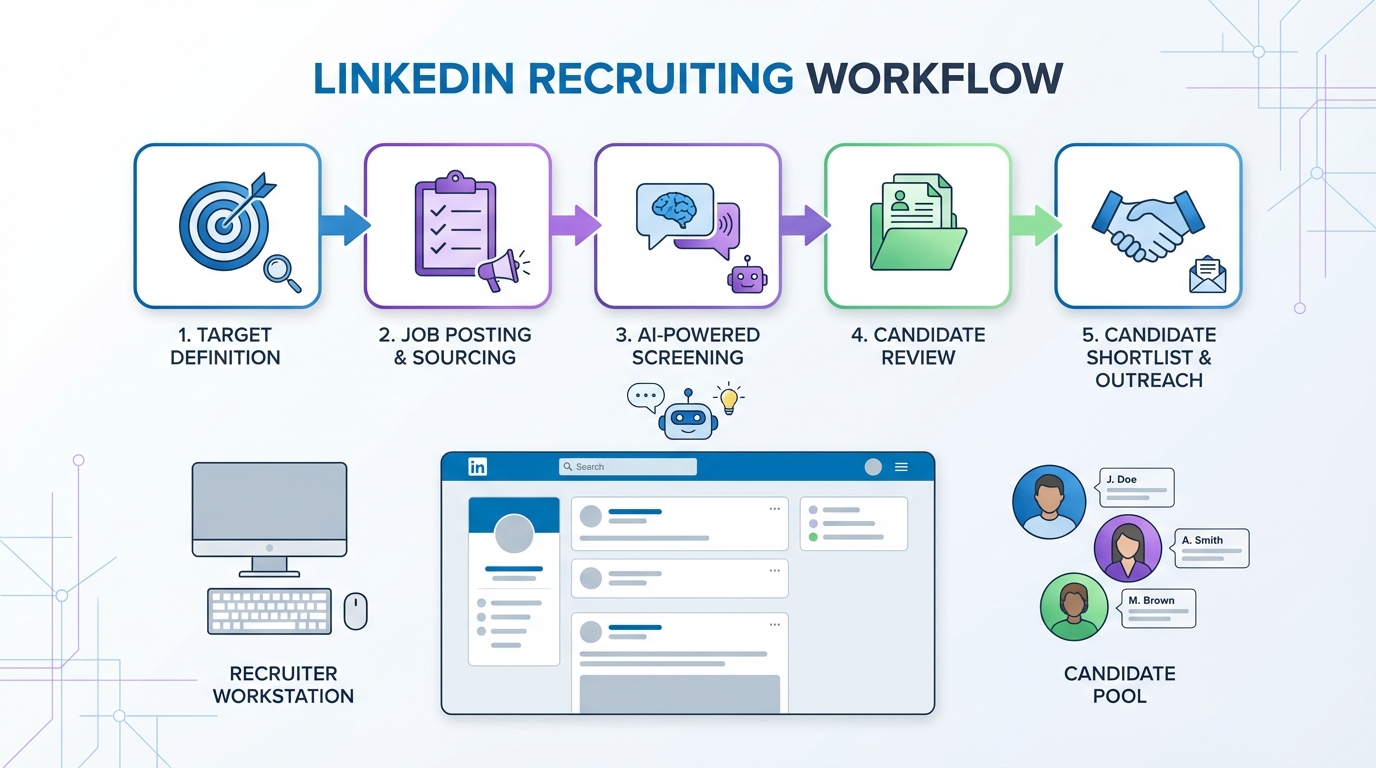
Recruitment online for recruiters is most effective when you treat it as a repeatable system: define a narrow target profile, run structured screening that verifies real outcomes, and keep candidate engagement consistent until you have a qualified shortlist. In the Creative at Home search, recruiter Alessia Pagliaroli filled a niche senior sales role by validating whether candidates truly had relationships with builders, designers, and architects, and by positioning the employer’s expansion story to attract high level talent. In modern workflows, StrategyBrain AI Recruiter can support the same playbook on LinkedIn by automating initial outreach and follow up, answering role and compensation questions in real time, and collecting resumes and contact details so recruiters can spend their time on final qualification and interviews.
Table of Contents
- Case context: Creative at Home and the niche sales requirement
- Why this online search was hard
- A repeatable recruitment online workflow recruiters can copy
- Where StrategyBrain AI Recruiter fits in a LinkedIn first workflow
- Quick comparison: manual vs AI assisted online recruiting
- Quality checklist for professional hiring solutions
- FAQ
- Conclusion and next steps
Case context: Creative at Home and the niche sales requirement
Creative at Home, a manufacturer of hardwood flooring, needed a senior sales person who could make an immediate impact. The requirement was specific: the hire needed an existing portfolio of clients and established relationships with builders, designers, and architects.
Alessia Pagliaroli took on the assignment and focused on finding a candidate who could truly operate in that relationship driven niche. The outcome was a placement of a well connected individual with several years of sales experience who could start producing quickly.
Why this online search was hard
Online recruiting is often framed as a sourcing problem, but this case shows the harder part: verification. Well connected salespeople are in high demand, and some candidates overstate the strength of their networks.
The practical risk for recruiters is clear. If you cannot validate relationships early, you can waste interview cycles and damage client trust. In this search, the differentiator was not more inbound applicants. It was better screening questions that surfaced real evidence of relationships.
A repeatable recruitment online workflow recruiters can copy
This is the workflow we recommend when you need professional hiring solutions for a niche commercial role. It is designed to be channel agnostic, so you can apply it to LinkedIn, referrals, and targeted outreach.
Step 1: Define “proof of network” before you source
- Write down the exact buyer groups the candidate must influence, such as builders, designers, and architects.
- Define what counts as proof, such as named account types, deal cycles, and repeatable referral paths.
- Decide what does not count, such as vague claims of “strong connections” without examples.
Step 2: Use structured screening questions that force specificity
In this case, the key was asking the right questions to reveal whether a candidate was truly well connected. To make that reproducible, use a structured set of prompts that require concrete detail.
- Relationship mapping: Ask the candidate to describe the last 3 stakeholder types they sold to and how the relationship started.
- Deal narrative: Ask for a step by step description of a recent deal cycle, including who influenced the decision.
- Portfolio reality check: Ask what portion of revenue came from repeat buyers versus new logos in the last 12 months.
- Reference readiness: Ask who can speak to the candidate’s relationships and what context they can share.
Step 3: Differentiate the employer with a credible story
Alessia amplified a concrete differentiator: the client was building a second manufacturing facility. For senior candidates, that kind of operational growth can signal stability, investment, and opportunity.
For recruiters running recruitment online, the lesson is to lead with a verifiable narrative. Avoid generic employer branding. Use specific business facts that matter to the target profile.
Step 4: Keep follow up consistent until you have a shortlist
Online recruiting breaks down when follow up is inconsistent. Candidates ask questions about role scope, company context, and compensation, and delays can cause drop off.
This is where an AI assistant can support recruiters without replacing judgment. StrategyBrain AI Recruiter can handle the repetitive first touch and follow up on LinkedIn, respond 24/7 in the candidate’s language, and collect resumes and contact details from interested candidates. Recruiters then review the collected information and proceed with interviews and final qualification.
Step 5: Decide when to use agencies versus in house execution
Some teams evaluate top recruitment agencies in usa when roles are niche, urgent, or high impact. A practical decision rule is to use an agency when you need specialized networks and market calibration, and use in house execution when you already have strong sourcing channels and can run structured screening at scale.
In either model, online execution quality still depends on the same fundamentals: target definition, verification, and follow up discipline.
Where StrategyBrain AI Recruiter fits in a LinkedIn first workflow
StrategyBrain AI Recruiter is an automated AI powered recruitment tool built for LinkedIn hiring. It is designed to replace the initial outreach and qualification conversation, not the recruiter’s final assessment of fit.
What it can automate
- Candidate outreach: Automatically connects with candidates who match your search criteria.
- Role introduction: Introduces the opportunity and shares company context you provide.
- Candidate Q and A: Answers questions about the role, company, and compensation based on your inputs.
- Interest confirmation: Confirms whether the candidate wants to proceed.
- Information capture: Collects resumes and contact details from interested candidates.
What it does not do
- Final qualification: It does not determine whether a resume fully matches job requirements. Recruiters still make that decision after reviewing the resume.
Why this matters for recruitment online for recruiters
In practice, the bottleneck in online recruiting is often not sourcing volume. It is the time spent on repetitive messaging, follow up, and early stage Q and A. By automating those steps, recruiters can apply the same “ask the right questions” discipline from the Creative at Home case, while keeping response times consistent across time zones.
Quick comparison: manual vs AI assisted online recruiting
| Approach | Speed to first response | Consistency of follow up | Best for |
|---|---|---|---|
| Manual recruiter led outreach | Depends on recruiter availability | Varies by workload | High touch roles, complex stakeholder alignment |
| AI assisted outreach with StrategyBrain AI Recruiter | 24/7 messaging coverage | High, based on configured workflow | Scaling LinkedIn outreach, early stage Q and A, resume and contact capture |
Note: The table reflects workflow characteristics based on product capability descriptions provided for StrategyBrain AI Recruiter and common operational constraints in recruiter led outreach. It does not claim universal performance outcomes.
Quality checklist for professional hiring solutions
Use this checklist to keep your recruitment online process defensible and repeatable, especially when hiring for roles where “network strength” is a core requirement.
- Target profile is explicit: Buyer groups and relationship expectations are written down.
- Screening is structured: Every candidate gets the same verification questions.
- Employer story is specific: You lead with concrete business facts, not generic culture claims.
- Follow up is time bound: You define response time expectations and escalation rules.
- Data handling is careful: You avoid collecting unnecessary sensitive data and store candidate information securely.
FAQ
What does recruitment online for recruiters mean in practice?
It means running the sourcing, screening, and engagement workflow through digital channels such as LinkedIn and email, with structured steps for verification and follow up. The goal is not just more applicants, but a faster path to a qualified shortlist.
How do you verify a candidate is truly well connected?
Use structured questions that require specific examples of stakeholder relationships, deal cycles, and repeatable referral paths. In the Creative at Home case, asking the right questions was the key to separating real networks from exaggerated claims.
When should I consider top recruitment agencies in usa?
Consider agencies when the role is niche, urgent, or high impact and you need specialized networks and market calibration. If you already have strong sourcing channels, you may get better ROI by improving screening and follow up execution internally.
How does StrategyBrain AI Recruiter help with LinkedIn recruiting?
It automates initial outreach and conversation steps on LinkedIn, introduces the role, answers candidate questions based on the information you provide, confirms interest, and collects resumes and contact details. Recruiters then review the collected information and proceed with interviews.
Does StrategyBrain AI Recruiter replace recruiters?
No. It is designed to replace repetitive early stage tasks such as outreach, follow up, and basic qualification conversations. Final qualification and hiring decisions remain with the recruiter and hiring team.
Can it communicate with candidates in different languages?
Yes. StrategyBrain AI Recruiter is designed for 24/7 multilingual communication so candidates can interact in their native language, which can reduce misunderstandings in global hiring workflows.
What information do I need to provide to run an AI assisted workflow?
You provide job details such as company context, compensation, benefits, and candidate search criteria. The AI uses that information to personalize outreach and respond accurately to candidate questions.
What is the biggest risk in online recruiting for relationship driven sales roles?
The biggest risk is mistaking confidence for proof. Without structured verification, you can advance candidates who sound connected but cannot demonstrate real relationships that translate into revenue.
What should I do if candidates stop responding mid process?
Shorten response times, clarify the value proposition, and use a consistent follow up cadence. If you use automation, ensure messages remain role specific and that candidates can easily ask questions about scope and compensation.
Conclusion and next steps
This case reinforces a simple truth about recruitment online for recruiters: success comes from verification and positioning, not just reach. Alessia Pagliaroli filled a niche senior sales role for Creative at Home by validating real relationships and differentiating the employer with a credible growth story.
Next steps: document your “proof of network” criteria, standardize your screening questions, and set a follow up cadence you can actually maintain. If LinkedIn outreach volume is the constraint, consider adding StrategyBrain AI Recruiter to automate initial outreach, candidate Q and A, and resume and contact capture so your team can focus on final qualification and interviews.