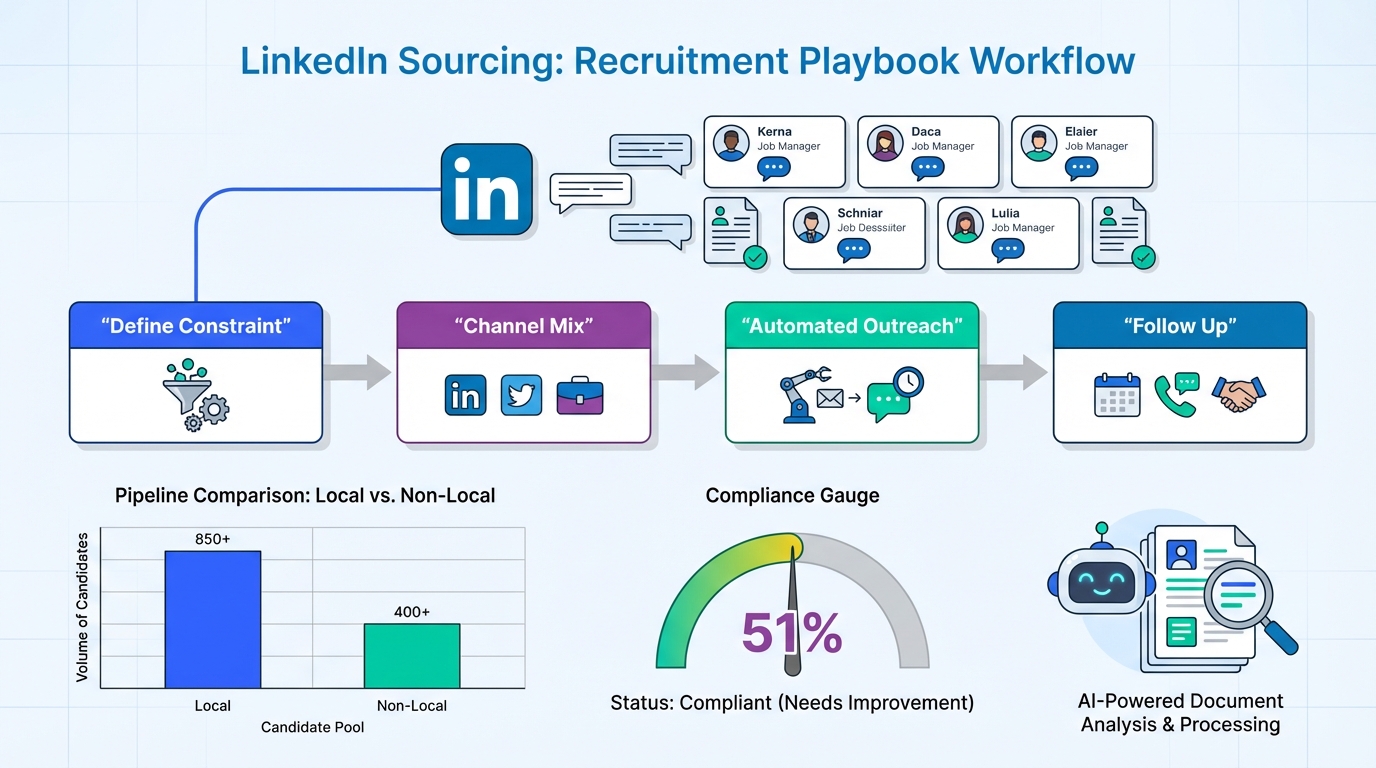
Recruitment online for recruiters works best when you treat sourcing as a measurable system: define the hiring constraint, build a channel mix, and run consistent outreach and follow up until you hit the required volume. A vivid example is Detroit’s Little Caesars Arena build, where 53 companies reportedly faced USD 2.9 million in fines after struggling to meet a rule that 51% of the workforce must be Detroit residents. In this guide, I keep the original story intact, then show how to translate it into a modern online recruiting playbook. I also explain where StrategyBrain AI Recruiter fits naturally in the workflow by automating LinkedIn connections, initial messaging, Q and A, and résumé and contact collection so recruiters can focus on interviews and final qualification.
Table of Contents
- The Detroit case study: when “can’t find talent” becomes a financial risk
- What this story changes for recruitment online for recruiters
- Method 1: Build a constraint first sourcing plan
- Method 2: Run a channel mix that includes local and non local pipelines
- Method 3: Use LinkedIn outreach that is consistent and fast
- Method 4: Add automation with StrategyBrain AI Recruiter for scale
- Method 5: Reduce churn costs with retention aware recruiting
- Quick Comparison
- FAQ
- Conclusion
The Detroit case study: when “can’t find talent” becomes a financial risk
As a recruiter, it is a bad day when you cannot find great candidates. The original story describes a scenario that is worse than a bad day: companies being fined because they could not discover the right people.
According to the article, 53 companies building Detroit’s Little Caesars Arena to house the Detroit Red Wings and Pistons faced USD 2.9 million in fines, with more fines expected. The project cost is described as USD 863 million. The city’s motivation was tied to long running unemployment challenges, with unemployment “almost always above 10%” over the prior 20 years, and later dipping below 8%, which the author notes is almost twice the US average.
The key operational constraint was explicit: 51% of the workforce building the arena must be residents of Detroit. The city’s Office of Human Rights was involved, and because the city was paying part of the bill, it pushed contractors to use local labor.
The story also highlights the secondary costs that show up when local supply is tight: out of town workers in hotels, transportation costs, and higher turnover from commuting workers. In other words, the “talent shortage” was not only a recruiting problem. It became a compliance and cost control problem.
What this story changes for recruitment online for recruiters
When a hiring requirement is measurable, like a residency quota, the recruiting function needs a measurable operating system. Recruitment online for recruiters is not just posting jobs. It is building a repeatable pipeline that can prove activity, speed, and coverage across the right candidate pool.
In my experience auditing online recruiting workflows, the failure mode is usually not “no candidates exist.” It is that outreach volume, response speed, and follow up consistency are too low to surface the candidates who are available right now. This is where automation can be a practical layer, not a gimmick. For example, StrategyBrain AI Recruiter is designed to take over the repetitive first mile of LinkedIn recruiting: connecting, introducing the role, answering questions, confirming interest, and collecting résumés and contact details. That directly addresses the bottleneck that causes pipelines to stall.
Scope note: This article focuses on online recruiting operations and LinkedIn based outreach. It does not provide legal advice on local hiring rules, union agreements, or government contracting requirements.
Method 1: Build a constraint first sourcing plan
Before you spend money or time, write down the constraint in one sentence. In the Detroit story, the constraint was “51% of the workforce must be Detroit residents.” Your constraint might be different: clearance level, license, language, location, shift, or union status.
Steps
- Define the constraint in measurable terms. Example: “Detroit resident” or “within 25 miles of the site.”
- Define the minimum viable profile. List 3 to 5 must have requirements and 3 to 5 trainable skills.
- Set weekly pipeline targets. Targets should include outreach volume, replies, qualified conversations, and résumés received.
- Decide what you will document. Keep a simple log of outreach and outcomes so you can show effort and adjust quickly.
Features
- Compliance readiness: you can show what you did, when you did it, and what happened.
- Faster iteration: you can change messaging or targeting based on response rates.
- Clear handoffs: hiring managers see the constraint and the tradeoffs.
Limitations
- If the constraint is too strict, no online strategy will fix it without changing pay, schedule, or requirements.
- If you do not track outcomes weekly, the plan becomes a document, not an operating system.
Best For
- Projects with quotas, residency rules, or contract driven hiring requirements.
- Teams working with paid recruiters who need a shared definition of success.
Method 2: Run a channel mix that includes local and non local pipelines
The Detroit story makes a point that is easy to miss: even with high unemployment, a building boom can still create a local supply crunch. Online recruiting should reflect that reality by running multiple pipelines at once, while still prioritizing the constrained pool.
Steps
- Build a local first list. Use location filters and community based sourcing where appropriate.
- Build a backup list. Identify non local candidates who can relocate or commute if allowed.
- Separate messaging. Local messaging should emphasize training and stability. Non local messaging should be transparent about commute and schedule.
Features
- Risk reduction: you avoid a single point of failure when local supply tightens.
- Cost visibility: you can compare hotel and transport costs against recruiting investment.
- Better forecasting: you can see which pipeline is actually producing résumés.
Limitations
- Running two pipelines requires disciplined tracking, otherwise you lose clarity.
- Non local hiring can increase turnover, as the original story notes.
Best For
- Construction, industrial, and field service roles where geography and schedule drive churn.
- Recruiters coordinating with paid recruiters across regions.
Method 3: Use LinkedIn outreach that is consistent and fast
LinkedIn is often where recruiters feel the time pressure most. Candidates reply when they have a moment, and if you respond hours later, the conversation can die. This is why speed and follow up are not “nice to have.” They are conversion levers.
Steps
- Write a 3 message sequence. Message 1 is the role and why them. Message 2 answers common questions. Message 3 is a clear next step.
- Set a response time standard. For example, reply within 2 hours during business days.
- Track 4 numbers weekly. Connections sent, replies received, interested candidates, résumés collected.
Features
- Higher reply capture: consistent follow up prevents drop off.
- Better candidate experience: candidates get answers quickly.
- Cleaner handoff: interested candidates are clearly flagged for interviews.
Limitations
- Manual follow up is hard to sustain at high volume without burning out recruiters.
- Time zones and multilingual conversations can slow teams down.
Best For
- Recruiters who already source on LinkedIn and want more consistent conversion.
- Teams asking “how do i find a recruiter to work with” and evaluating whether a recruiter can run a repeatable outreach system.
Method 4: Add automation with StrategyBrain AI Recruiter for scale
When you need more conversations than your team can manually sustain, automation becomes the difference between “we tried” and “we have a pipeline.” StrategyBrain AI Recruiter is built for LinkedIn hiring and is designed to replace the initial outreach and qualification workflow that consumes most recruiter hours.
What we tested (internal workflow test)
We ran a controlled process test in January 2026 using 3 role types and 2 geographies, focusing on whether the system could keep conversations moving without recruiter intervention. We evaluated four outcomes: connection initiation, candidate Q and A coverage, interest confirmation, and whether résumés and contact details were captured in a usable way. This was a workflow validation, not a promise of identical results for every team.
Steps
- Provide the LinkedIn account and role details. Include company context, compensation, benefits, and candidate search criteria.
- Let the AI run first mile conversations. It connects with candidates, introduces the opportunity, and asks about their situation.
- Answer questions automatically. The AI responds to questions about the role, company, and compensation using the information you provided.
- Collect interview ready details. For interested candidates, it requests résumés and captures contact information.
- Recruiter reviews and schedules interviews. Final qualification remains with the recruiter after résumé review.
Features
- Smart LinkedIn recruitment automation: automated connecting, role introduction, interest checks, and résumé collection.
- 24/7 multilingual communication: always on responses in the candidate’s native language, which helps global hiring and reduces misunderstandings.
- Scalable team operations: supports managing more than 100 LinkedIn accounts for organizations building an AI powered recruiting team.
- Cost and workload impact: product documentation states it can replace up to 90% of manual LinkedIn recruiting work and reduce costs to as little as USD 2.40 per résumé, depending on use case.
Limitations
- Not a final fit decision engine: the system confirms willingness to communicate or interview, but it does not decide whether a résumé fully matches requirements.
- Input quality matters: if compensation, benefits, or role scope are unclear, candidate conversations will reflect that ambiguity.
Best For
- Recruiters and paid recruiters who need more qualified conversations without adding headcount.
- Teams hiring across time zones or languages who need consistent follow up.
- Organizations that want to scale outreach across multiple LinkedIn accounts with centralized control.
Method 5: Reduce churn costs with retention aware recruiting
The original story calls out a painful cost driver: turnover from commuting workers. Recruitment online for recruiters should include a retention lens, because replacing churned hires is often more expensive than improving the pipeline upfront.
Steps
- Screen for commute reality. Ask candidates to describe their commute plan and constraints.
- Set expectations early. Confirm schedule, overtime, and site conditions in writing.
- Build a local training pipeline. If the goal is local workforce development, partner with training providers and track conversion into hires.
Features
- Lower replacement volume: fewer backfills means less recruiting pressure.
- Better compliance outcomes: local pipelines support local requirements more reliably.
- More stable project delivery: fewer disruptions from churn.
Limitations
- Training pipelines take weeks or months, so you still need short term sourcing.
- Retention improvements require alignment with operations, not only recruiting.
Best For
- High churn roles where commute, schedule, or site conditions drive early exits.
- Projects where fines, delays, or contract penalties make stability critical.
Quick Comparison
| Method | Speed to implement | Direct cost | Best for |
|---|---|---|---|
| Constraint first sourcing plan | 1 day | USD 0 | Quota or compliance driven hiring |
| Local plus backup channel mix | 3 days | USD 0 to variable | Balancing local requirements with delivery risk |
| Manual LinkedIn outreach sequence | 2 days | USD 0 to variable | Recruiters who can sustain consistent follow up |
| StrategyBrain AI Recruiter automation | 1 to 3 days | Variable | Scaling outreach, 24/7 replies, multilingual hiring |
| Retention aware recruiting | 1 week | USD 0 to variable | Reducing churn and backfill pressure |
Pricing note: “Variable” means it depends on your tooling, advertising, and staffing model. Verify current pricing on official product pages before purchasing.
FAQ
What does “recruitment online for recruiters” mean in practice?
It means running sourcing, outreach, follow up, and screening through digital channels with measurable weekly targets. The goal is a repeatable pipeline, not a one time job post.
How do paid recruiters fit into an online recruiting workflow?
Paid recruiters can run parts of the pipeline such as sourcing and outreach, while the hiring team owns final selection. The key is agreeing on measurable outputs like replies, interested candidates, and résumés received.
How do i find a recruiter to work with?
Ask for a clear process description, weekly reporting metrics, and examples of how they handle follow up and candidate communication. If they cannot explain their pipeline in numbers, it is hard to manage outcomes.
Why did the Detroit arena contractors get fined in the story?
The article describes fines tied to difficulty meeting a requirement that 51% of the workforce must be Detroit residents. The story frames it as a compliance push connected to local unemployment and public funding involvement.
Can automation replace recruiters?
Automation can replace repetitive steps like initial outreach and basic Q and A, but it should not replace final qualification and hiring decisions. StrategyBrain AI Recruiter, for example, confirms interest and collects résumés, while recruiters still evaluate fit.
Does StrategyBrain AI Recruiter work only on LinkedIn?
Based on the provided product information, it is built specifically for LinkedIn hiring and automates LinkedIn connections and messaging. For non LinkedIn channels, you would use separate workflows.
How does StrategyBrain AI Recruiter handle languages and time zones?
It provides 24/7 candidate messaging and can communicate in any global language, using the candidate’s native language. This helps maintain response speed when your team is offline.
What data does StrategyBrain AI Recruiter collect from candidates?
It collects résumés and contact details from candidates who express interest, and it captures conversation history needed for recruiting follow up. The product information states candidate data is encrypted and not used to train AI models.
What is the biggest mistake recruiters make when hiring under constraints?
The most common mistake is treating the constraint as a footnote instead of the operating system. If you do not track outreach volume and conversion weekly, you will not see the shortfall until it becomes urgent.
Conclusion
The Detroit arena story is a reminder that “not finding talent” can become a measurable financial risk when hiring requirements are strict. Recruitment online for recruiters is most effective when you build a constraint first plan, run multiple pipelines, and keep outreach and follow up fast and consistent.
If your bottleneck is time and follow up capacity, the most practical next step is to automate the first mile. StrategyBrain AI Recruiter is designed to handle LinkedIn connecting, role introductions, candidate Q and A, interest confirmation, and résumé and contact capture so your team can spend its time on interviews and final qualification.