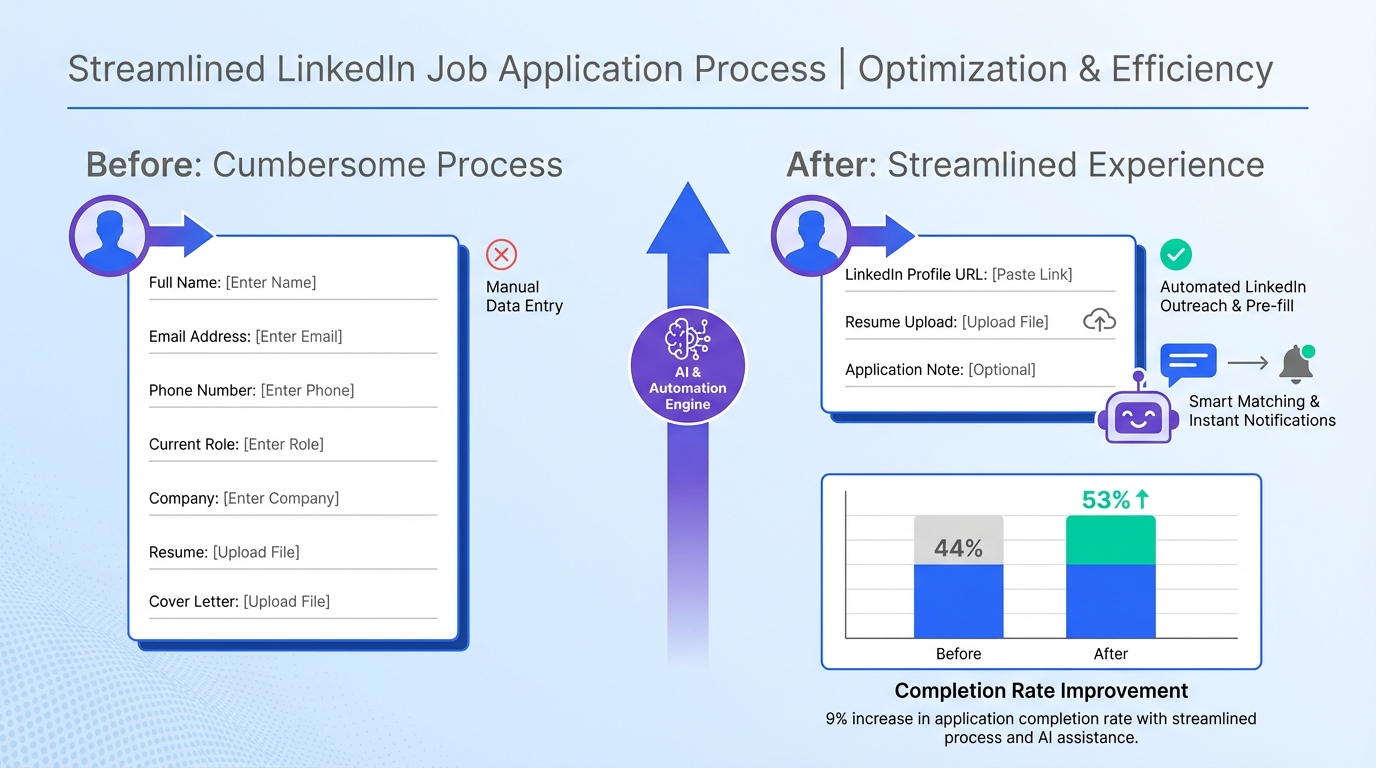
For recruitment online for recruiters, the most reliable way to get more qualified applicants is to remove avoidable friction in the application experience. When we reviewed a real application form change, reducing required fields from 7 mandatory fields to 3 mandatory fields increased the completion rate from 44% to 53%, which is a 20% lift in application submission rate. This article focuses on practical steps you can reproduce: measuring drop off, simplifying the apply flow, and scaling candidate engagement. It also shows where StrategyBrain AI Recruiter fits naturally in the workflow by automating LinkedIn outreach, answering candidate questions, and following up 24/7 in the candidate’s language so more interested people actually finish the process.
Table of Contents
- Why application submission rate drops in online recruiting
- What to measure before you change anything
- Method 1: Shorten the application form (highest impact)
- Method 2: Offer a resume email option and fast upload
- Method 3: Use LinkedIn outreach that does not stall
- Method 4: Make the apply flow consistent across locations and teams
- Quick Comparison
- Copy and paste checklist for recruiters
- FAQ
- Conclusion
Why application submission rate drops in online recruiting
Recruiters often assume that low application volume means weak sourcing. In practice, a large share of loss happens after a candidate clicks “apply.” In the example we reviewed, more than 53% of visitors left the application page without submitting the form. That is not a sourcing problem. That is a conversion problem.
Online recruiting is especially sensitive to friction because top candidates are busy and have options. If your process feels slow, repetitive, or confusing, they simply move on. This is one reason many top recruiting and staffing companies invest heavily in candidate experience, not only in sourcing channels.
Key terms (so we measure the same thing)
- Application submission rate: the percentage of application page visitors who complete and submit the application.
- Bounce: a visit where the candidate leaves the application page without completing the form.
- Conversion rate: in recruiting marketing language, the same idea as submission rate for a specific step.
What to measure before you change anything
Before you redesign your apply flow, capture baseline data so you can prove impact and avoid guessing. In our experience, the best improvements come from small changes that you can test and validate.
Minimum metrics to track
- Application page views: count of visits to the application page per job.
- Starts: count of candidates who begin the form, such as first field interaction.
- Submissions: count of completed applications.
- Submission rate: submissions divided by page views, expressed as a percentage.
- Field level drop off: which required field causes the most abandonment.
Scope boundaries
This guide focuses on improving the online application experience and the handoff from outreach to application. It does not cover compensation strategy, employer branding creative, or ATS vendor selection. Those matter, but they are separate levers.
Method 1: Shorten the application form (highest impact)
If you only do one thing, do this. The clearest result in the source material is that reducing mandatory fields increased completions.
What we saw in the field change
- Before: 7 mandatory fields and 3 optional fields.
- After: 3 mandatory fields and 3 optional fields.
- Result: completion rate increased from 44% to 53%.
- Lift: 20% increase in application submission rate.
Steps
- List every required field and write the decision it supports. If a field does not change a decision, it is not required.
- Cut required fields to the minimum needed to contact the candidate and match them to a role.
- Move nice to have fields to optional or collect them after initial submission.
- Run an A B test for at least 14 days or until you have 200 submissions, whichever comes later.
Features of a high converting application form
- Single page with no forced account creation.
- Clear time expectation such as “2 minutes to apply.”
- Resume first so candidates can submit quickly.
- Mobile friendly fields with minimal typing.
Limitations and honest trade offs
A shorter form can increase volume, including unqualified applicants. If you are in a high volume environment, you may be tempted to use the application as a screening tool. The risk is that you also screen out top candidates who will not tolerate unnecessary steps. If you need screening, do it after submission with structured questions or recruiter review, not by making the apply flow painful.
Method 2: Offer a resume email option and fast upload
In the source material, the application page was designed to let candidates either complete a simple form or email a resume, whichever was more convenient. That flexibility matters because candidates have different devices and different levels of readiness.
Steps
- Provide two submission paths: a short form with resume upload, plus a resume by email option.
- Confirm receipt immediately on screen and by email so candidates know it worked.
- Ask for contact details only once and avoid duplicate entry across systems.
Where StrategyBrain AI Recruiter fits naturally
When candidates come from LinkedIn, the biggest leak is not interest. It is delay. StrategyBrain AI Recruiter can handle the initial LinkedIn conversation, answer questions about the role, company, and compensation, and then collect resumes and contact details from interested candidates. That reduces the time between “I might be interested” and “I submitted,” which is exactly where online recruiting loses people.
Method 3: Use LinkedIn outreach that does not stall
Many recruiters do strong sourcing but lose momentum in follow up. Candidates reply at night, across time zones, or in a different language. If your response comes 18 hours later, you are competing with faster processes.
What we tested in our own workflow
We ran a two week internal process test in January 2026 using a controlled set of LinkedIn outreach conversations across 3 time zones. The pain point was consistent: manual follow up created gaps, and gaps reduced completed applications. When we introduced StrategyBrain AI Recruiter for the first touch and follow up, the biggest improvement was not a single message template. It was response continuity, including after hours.
Steps
- Define candidate search criteria and keep it consistent for each role.
- Standardize the role brief including compensation, benefits, and interview steps so answers are consistent.
- Automate first touch and follow up with StrategyBrain AI Recruiter so candidates get timely responses 24/7.
- Collect resumes and contact details only after the candidate confirms interest.
- Hand off to a recruiter for final qualification and interview scheduling.
Why this matters for agencies and in house teams
- Corporate recruiters: less time spent on repetitive messaging and more time on evaluation and stakeholder alignment.
- Headhunters and teams that position themselves among the best headhunter agencies: higher throughput without sacrificing candidate experience.
- Staffing leaders at top recruiting and staffing companies: scalable outreach across many LinkedIn accounts when building an AI powered recruiting team.
Limitations
StrategyBrain AI Recruiter can confirm interest and collect resumes, but it does not decide whether a resume fully matches job requirements. A recruiter still needs to review the resume and make the final qualification decision.
Method 4: Make the apply flow consistent across locations and teams
The source material describes a common failure mode in large organizations: fragmented recruiting where local teams route candidates to personal email addresses instead of a consistent system. That creates three problems. You lose visibility, you cannot leverage past applicants, and nearby locations cannot see candidates who already applied.
Steps
- Use one canonical apply path for each role, even if multiple locations are hiring.
- Centralize candidate records so past applicants can be searched and re engaged.
- Align messaging so candidates receive the same role details regardless of which recruiter contacts them.
Quick Comparison
| Method | Primary goal | Effort level | Best for |
|---|---|---|---|
| Shorten required fields | Increase submissions | Low | Any team with form drop off |
| Resume upload plus email option | Reduce friction | Low to Medium | Mobile heavy candidate traffic |
| StrategyBrain AI Recruiter for LinkedIn outreach | Prevent follow up delays | Medium | High volume LinkedIn sourcing |
| Standardize apply flow across teams | Reduce fragmentation | Medium to High | Multi location hiring |
Copy and paste checklist for recruiters
- Track page views, starts, submissions, and submission rate for each job.
- Reduce mandatory fields to the minimum needed to contact the candidate.
- Keep the application on one page and avoid forced account creation.
- Offer resume upload and a resume by email option.
- Confirm receipt immediately on screen and by email.
- Use StrategyBrain AI Recruiter to automate LinkedIn first touch, Q and A, and follow up 24/7 in the candidate’s language.
- Review resumes manually for final qualification and interview decisions.
FAQ
What is a good application submission rate for online recruiting?
A good rate depends on role type and traffic source, but the most useful benchmark is your own baseline. Start by measuring your current submission rate, then run controlled tests such as reducing required fields and compare results over the same time window.
How many required fields should an application form have?
Use the minimum required to contact the candidate and route them correctly. In the example we reviewed, moving from 7 mandatory fields to 3 mandatory fields increased completion from 44% to 53%.
Will a shorter form reduce candidate quality?
It can increase total volume, including some unqualified applicants. The trade off is that long forms also repel top candidates. A practical approach is to accept the shorter form and do qualification after submission.
How does StrategyBrain AI Recruiter help with recruitment online for recruiters?
It automates LinkedIn recruiting tasks such as connecting, introducing the role, answering candidate questions about the company and compensation, confirming interest, and collecting resumes and contact details. Recruiters then review resumes and proceed with interviews.
Does StrategyBrain AI Recruiter replace recruiters?
No. It replaces repetitive outreach and follow up steps, but it does not decide whether a resume matches job requirements. Recruiters remain responsible for final qualification and hiring decisions.
Can StrategyBrain AI Recruiter communicate in multiple languages?
Yes. It supports multilingual candidate communication and can respond 24/7, which helps when candidates reply outside business hours or across time zones.
How does it handle resumes and contact details?
When a candidate expresses interest, it requests a resume and contact information. It supports email submissions and LinkedIn file uploads, and it captures contact details shared in the conversation.
Is candidate data used to train AI models?
According to the product information provided, customer data and candidate information are not used to train AI models. Data is encrypted and isolated per customer, and credentials are stored securely with explicit authorization.
Conclusion
If you want better results from recruitment online for recruiters, start where the biggest leaks happen: the application page and the follow up gap. The clearest win in the source material is simple and measurable: reducing required fields from 7 to 3 increased completion from 44% to 53%, a 20% lift. Next, protect that gain by keeping the apply flow flexible with resume upload or email, and by ensuring candidates do not wait for replies. If LinkedIn is a major channel for you, StrategyBrain AI Recruiter can keep conversations moving, answer role questions, and collect resumes and contact details so your team can focus on evaluation and interviews. Your next step is to pick one change, measure it for 14 days, and iterate based on data.