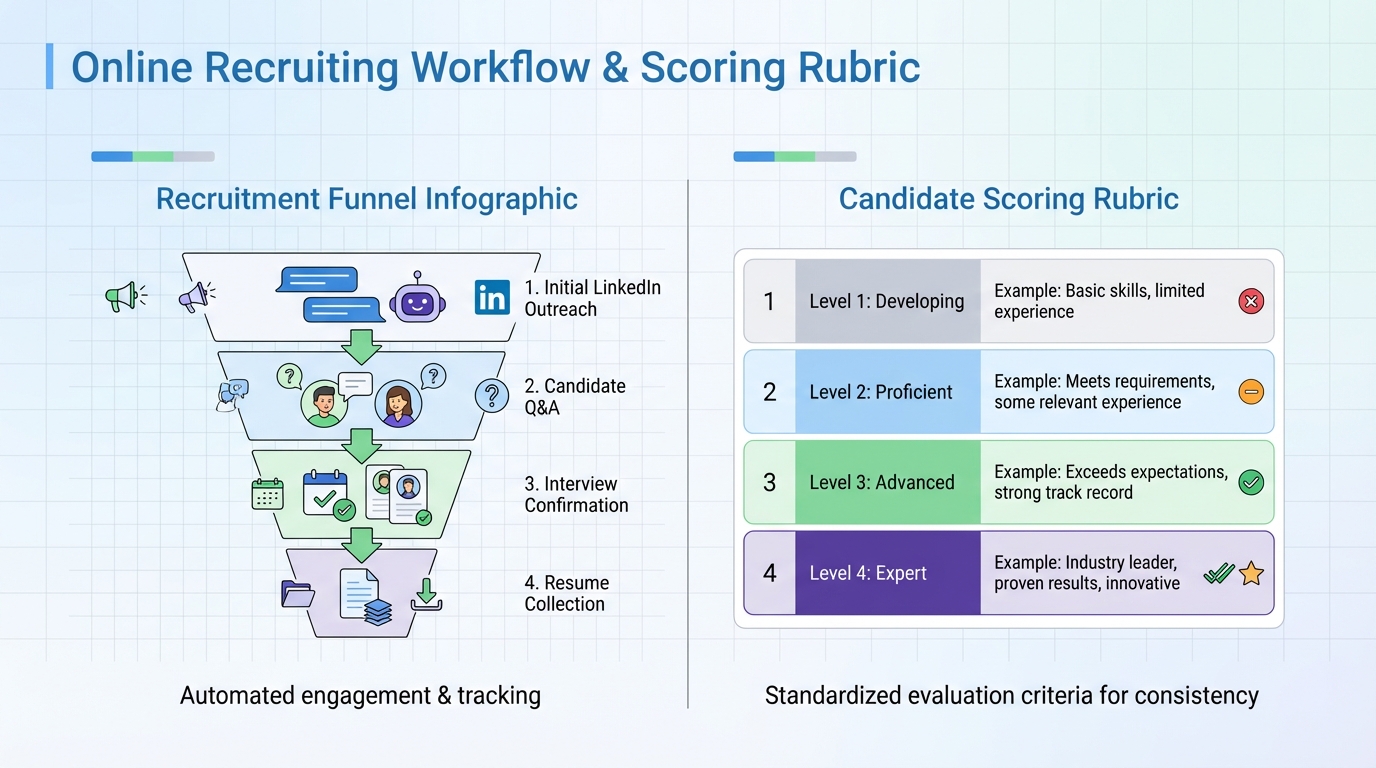
Recruitment online for recruiters works best when you standardize how you evaluate candidates and then automate the repetitive outreach and follow up. In practice, that means using a consistent interview question framework to compare candidates fairly, and using StrategyBrain AI Recruiter to handle first touch messaging, answer role questions, confirm interest, and collect re9sume9s and contact details at scale. This guide breaks down the most common interview questions, what employers are actually trying to learn, and how recruiters can use the same structure across remote hiring, job agency for remote work searches, and workflows with paid recruiters. Scope: interview question intent, evaluation rubrics, and an online recruiting workflow. Not covered: legal advice, compensation benchmarking, or role specific technical assessments.
Key Takeaways
- Use one scoring rubric for every candidate: a 4 point scale per question improves consistency across recruiters and time zones.
- Ask for evidence, not adjectives: require 1 concrete example per answer to reduce vague responses in remote interviews.
- Automate the front of funnel: StrategyBrain AI Recruiter can handle initial LinkedIn outreach, Q and A, interest confirmation, and re9sume9 collection so recruiters focus on final qualification.
- Multilingual messaging reduces drop off: 24/7 native language responses help keep candidates engaged when hiring globally.
- Scale with account teams: AI Recruiter supports managing more than 100 LinkedIn accounts for high volume pipelines.
- Be transparent about limits: AI Recruiter confirms willingness to interview but does not decide if a re9sume9 matches requirements, recruiters still make the final call.
Table of Contents
- Why these questions show up in almost every interview
- A simple online recruiting setup for consistent evaluation
- Question 1: Tell me about yourself
- Question 2: What interests you about this position
- Question 3: What is your biggest weakness
- Question 4: Why did you leave your last employer
- Question 5: What achievement are you most proud of
- Quick Comparison: Manual vs AI assisted front of funnel
- FAQ
- Conclusion
Why these questions show up in almost every interview
When we review interview notes across different roles, we keep seeing the same core questions because they test the same fundamentals: communication, motivation, self awareness, professionalism, and evidence of performance. Online interviews make this even more important because you have fewer informal signals than in person meetings.
For recruitment online for recruiters, the goal is not to collect perfect answers. The goal is to collect comparable evidence so you can make a defensible decision, especially when multiple stakeholders or paid recruiters are involved.
A simple online recruiting setup for consistent evaluation
Before you decode any answer, set up a repeatable structure. This is the part that makes your process scalable whether you are an internal team, a job agency for remote work, or a solo consultant.
Use a 4 point rubric for every core question
- 4 Strong: specific example, clear impact, relevant to role, concise.
- 3 Good: example present, impact somewhat clear, mostly relevant.
- 2 Weak: vague, limited evidence, unclear relevance.
- 1 Risk: evasive, unprofessional, or contradicts role requirements.
Where StrategyBrain AI Recruiter fits in the workflow
In our day to day recruiting operations, the biggest time sink is not the final interview. It is the repeated first messages, the back and forth questions about the role, and the follow up needed to confirm interest. StrategyBrain AI Recruiter is designed to automate that front of funnel on LinkedIn by connecting with candidates that match your search criteria, introducing the opportunity, answering questions about the role, company, and compensation, confirming interview interest, and collecting re9sume9s and contact information from interested candidates.
This matters because it keeps your human interview time focused on what humans do best: assessing fit, validating skills, and making the final qualification decision.
Question 1: Tell me about yourself
This is usually one of the first questions because it breaks the ice and reveals how a candidate structures information. In remote interviews, it also tests whether they can communicate clearly without relying on room presence.
What interviewers are trying to learn
- Relevance: do they highlight experience that matches the role.
- Clarity: can they summarize without rambling.
- Confidence: do they own their achievements without exaggeration.
What a strong answer includes
- Present: current role or focus in 1 sentence.
- Past: 1 to 2 relevant achievements with outcomes.
- Future: why this role is the next logical step.
Recruiter tip for online screening
If you are using StrategyBrain AI Recruiter for initial outreach, you can ask candidates to share a short summary of their current situation and what they are open to next. The AI can capture that context before the interview so your first live question can go deeper than a generic introduction.
Question 2: What interests you about this position
This question checks motivation and preparation. It is also a quick filter for candidates who applied broadly without understanding the role.
What interviewers are trying to learn
- Intent: are they genuinely interested or just job hunting.
- Research: do they understand the company and role.
- Alignment: do their goals match what the role offers.
What a strong answer includes
- One specific reason tied to the company or team.
- One role specific reason tied to responsibilities.
- One personal driver such as growth, impact, or domain interest.
How AI Recruiter supports this step
In recruitment online for recruiters, candidates often ask the same clarifying questions before they can express real interest. StrategyBrain AI Recruiter can answer common questions about the role, company, benefits, and compensation during LinkedIn conversations, then confirm whether the candidate wants to interview. That reduces no show risk because the candidate enters the interview with fewer unknowns.
Question 3: What is your biggest weakness
This question is not a trap when used correctly. It is a test of self awareness and whether the candidate can manage a limitation responsibly.
What interviewers are trying to learn
- Honesty: do they acknowledge a real weakness.
- Judgment: do they choose a weakness that is not a deal breaker.
- Growth: do they have a plan to mitigate it.
Common weak patterns to watch for
- Overused reframes: perfectionism as a disguised strength.
- No mitigation: naming a weakness without a coping system.
- Role conflict: weakness directly blocks core job tasks.
How to score it with the rubric
- 4 Strong: names a real weakness and explains a specific system to manage it.
- 2 Weak: vague weakness and generic improvement statement.
- 1 Risk: blames others or shows no accountability.
Question 4: Why did you leave your last employer or why are you looking
This question checks professionalism and stability. The key is to get a clear reason without inviting gossip or negativity.
What interviewers are trying to learn
- Professionalism: can they explain change without attacking others.
- Consistency: does the story match the timeline and role history.
- Risk signals: repeated conflict, unclear reasons, or evasiveness.
What a strong answer includes
- One clear reason such as growth, relocation, or role change.
- Neutral tone with no personal attacks.
- Forward focus on what they want next.
Remote hiring note
For a job agency for remote work, this question also helps you validate whether the candidate understands remote expectations such as async communication and self management.
Question 5: What achievement are you most proud of
This is the candidatee28099s chance to show impact and values. It also reveals what they consider meaningful, which is useful for culture fit.
What interviewers are trying to learn
- Impact: did they move a metric, deliver a project, or solve a problem.
- Ownership: what part did they personally drive.
- Values: what they choose to highlight tells you what motivates them.
High signal follow up questions
- What was the starting point and what changed after your work.
- What was the hardest constraint and how did you handle it.
- What would you do differently if you repeated it.
Quick Comparison: Manual vs AI assisted front of funnel
| Workflow area | Manual recruiter led | With StrategyBrain AI Recruiter |
|---|---|---|
| Initial outreach | Recruiter writes and sends messages one by one | AI automatically connects and introduces the opportunity based on your criteria |
| Candidate Q and A | Recruiter answers repeated questions in chat | AI answers questions about role, company, and compensation in conversation |
| Interest confirmation | Recruiter follows up multiple times | AI confirms interview interest and routes interested candidates forward |
| Re9sume9 and contact capture | Recruiter requests files and copies details manually | AI requests re9sume9s and captures contact details from interested candidates |
| Language coverage | Limited to recruiter language skills and working hours | 24/7 multilingual communication in the candidatee28099s native language |
| Final qualification | Recruiter reviews re9sume9 and decides fit | Recruiter still decides fit, AI does not determine re9sume9 match |
FAQ
How does recruitment online for recruiters change interview structure
It increases the need for consistency because different interviewers and time zones can create uneven evaluations. A shared rubric and standardized core questions make remote decisions more defensible.
Can StrategyBrain AI Recruiter replace interviews
No. It automates initial outreach, conversation, interest confirmation, and re9sume9 and contact collection. Recruiters still conduct interviews and make the final qualification decision.
Is AI Recruiter only for corporate teams
No. It can support corporate recruiters, headhunters, and paid recruiters by reducing repetitive LinkedIn tasks and freeing time for higher value assessment and client management.
How does AI Recruiter handle multilingual candidates
It provides 24/7 messaging and can communicate in the candidatee28099s native language to reduce misunderstandings and keep conversations moving across time zones.
How many LinkedIn accounts can be managed
StrategyBrain AI Recruiter supports managing more than 100 LinkedIn accounts, which enables teams to scale outreach capacity while keeping workflows centralized.
How does AI Recruiter collect re9sume9s and contact details
When a candidate expresses interest, the AI requests a re9sume9 and contact information. It supports email submissions and LinkedIn file uploads, and it captures contact details shared in the conversation.
Does AI Recruiter help a job agency for remote work
Yes. Agencies often manage multiple roles and pipelines at once, so automating first touch and follow up can reduce response delays and improve candidate engagement before interviews.
What should I avoid when asking these common questions
Avoid accepting vague answers without evidence, and avoid inconsistent scoring across interviewers. Ask for one concrete example and score it using the same rubric every time.
Conclusion
The fastest way to improve recruitment online for recruiters is to treat common interview questions as a structured evaluation tool, not casual conversation. Standardize the questions, score answers with a simple rubric, and require evidence in every response. Then use StrategyBrain AI Recruiter to automate the repetitive LinkedIn outreach, Q and A, interest confirmation, and re9sume9 collection so your human time goes to final qualification and decision making.
Next step: pick the 5 questions above, add the 4 point rubric to your interview notes, and run your next remote hiring cycle with AI assisted front of funnel messaging so you can spend more time on high signal interviews.