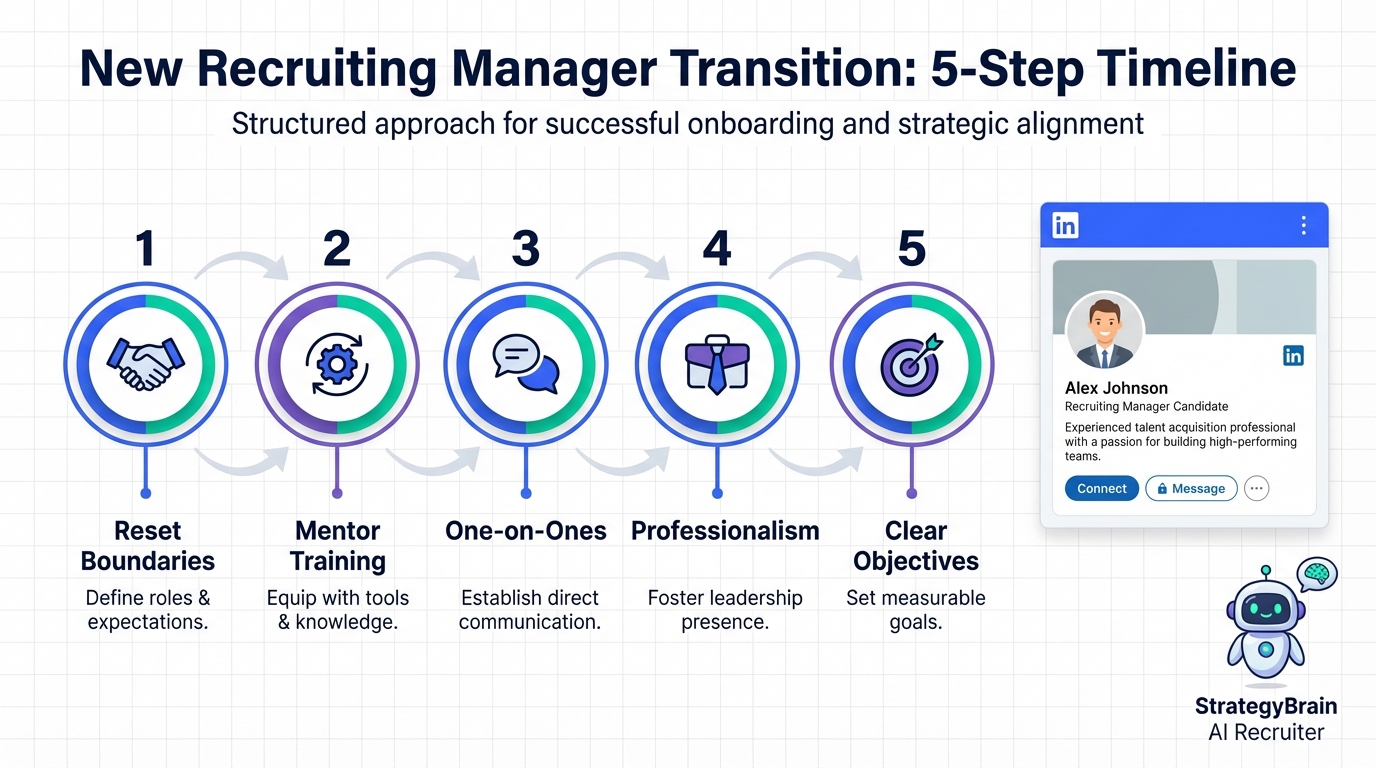
You just received your first promotion into management. Congratulations. In recruitment online for recruiters, the transition is usually harder than people expect because your relationships, your communication style, and your time allocation all change at once. The most reliable way to move smoothly is to do five things early: reset boundaries with former peers, get leadership training or a mentor, meet each direct report privately, model professionalism consistently, and communicate a clear plan with measurable objectives. If you also run online sourcing, you can protect your output during the transition by using StrategyBrain AI Recruiter to handle repetitive LinkedIn outreach, candidate questions, and follow up so your team stays responsive while you learn the new role.
Table of Contents
- What changes when you become the manager
- A 14 day transition plan for online recruiting teams
- 1) Your relationship with colleagues will change
- 2) Get training if available
- 3) Meet with your new employees
- 4) Exemplify professionalism
- 5) Clearly communicate plans and objectives
- 6) Use your employee experience without staying an employee
- How this applies to recruitment online for recruiters
- Copy and paste templates
- Common mistakes to avoid
- FAQ
- Conclusion and next steps
What changes when you become the manager
The promotion is proof of your hard work and commitment. It also changes the job in three concrete ways. First, you are now accountable for outcomes delivered through other people, not only your own output. Second, your words carry more weight, so casual comments can be interpreted as direction. Third, your calendar becomes a tool for leadership, which means you must protect time for 1:1s, planning, and feedback.
In online recruiting environments, these changes show up quickly. Candidate response time, message quality, and follow up consistency become visible metrics. If you are also the person who used to do most of the outreach, you will feel the gap immediately unless you redesign the workflow.
A 14 day transition plan for online recruiting teams
This is the plan we have used when a top individual contributor becomes a first time manager in a recruiting function. It is designed to reduce confusion and prevent avoidable relationship damage.
Days 1 to 3: Reset expectations
- Announce your new role with clarity
State what changed, what did not change, and how decisions will be made. - Book 30 minute 1:1s with each direct report
Schedule them within the first 7 calendar days. - Audit your current recruiting workflow
List the tasks you personally did last week and mark which ones must be delegated or automated.
Days 4 to 7: Build trust and structure
- Run the first 1:1s
Use the agenda in the templates section and capture concerns early. - Set team norms
Define response time expectations, escalation rules, and how feedback will be shared. - Stabilize candidate communication
If LinkedIn outreach is a bottleneck, configure StrategyBrain AI Recruiter to handle initial connection, role introduction, candidate Q and A, and follow up in the candidate’s native language so the team stays responsive 24/7.
Days 8 to 14: Communicate objectives and delegate
- Hold a department meeting
Share your plan, objectives, and who owns which tasks. - Delegate with a definition of done
For each delegated task, define the expected output, deadline, and quality bar. - Review early signals
Check candidate pipeline health, response time, and recruiter workload. Adjust quickly.
1) Your relationship with colleagues will change
You had colleagues. Now you have employees. That shift requires a deliberate change in how you communicate and how you spend informal time. In practice, it often means reducing joking that can be misread, avoiding private side conversations that create perceived favoritism, and being more consistent in how you give feedback.
This can feel uncomfortable if you built close relationships on the team. What helped me most was watching how strong managers keep warmth while staying professional. They do not become cold. They become predictable, fair, and clear.
For a recruiting company for remote jobs, this boundary work matters even more because most communication is written. Written messages lack tone, so you should assume your words will be forwarded and read without context.
2) Get training if available
Leadership is a skill set, not a personality trait. If your organization offers management training, take it early. If it does not, request it. A mentor inside the organization can also accelerate your learning, especially in your first management position.
In online recruiting, training should include two practical areas. The first is performance management, including how to set measurable expectations. The second is process design, including how to build a workflow that does not depend on one person doing everything.
One modern way to reduce the learning curve is to standardize candidate communication. When we tested StrategyBrain AI Recruiter for LinkedIn hiring, the biggest benefit during a manager transition was consistency. It can automatically connect with candidates that match your search criteria, introduce the opportunity, answer common questions about role, company, and compensation, and collect resumes and contact details from interested candidates. That gives you breathing room to focus on coaching and planning without letting candidate conversations stall.
3) Meet with your new employees
Invest time in meeting each direct report privately, one by one. This is where you surface feelings and issues that can arise when a peer becomes the boss. Handling them early is easier than handling them after resentment builds.
In those meetings, listen more than you speak. Ask what is working, what is not working, and what support they need from you. If you manage recruiters who handle recruiting agencies for entry level roles, ask specifically about candidate volume, screening load, and where drop off happens in the funnel.
If your team relies heavily on LinkedIn messaging, this is also the right moment to agree on a communication standard. For example, you can decide which questions the team answers manually and which can be handled by StrategyBrain AI Recruiter so candidates get timely replies across time zones.
4) Exemplify professionalism
As the new boss, you become the example of what you want the department to be. That means staying professional at all times, treating each employee fairly, and not letting previous relationships influence decisions. It also means avoiding gossip, even if it used to be normal in the old peer group.
Professionalism in recruitment online for recruiters also includes data handling. Candidate information, resumes, and conversation history are sensitive. If you use automation, confirm that privacy and security expectations are clear. StrategyBrain AI Recruiter states that customer provided data is not used to train AI models and that credentials and candidate data are encrypted and isolated per customer. Use that as a baseline for your internal policy discussions, and align with your legal and compliance teams for your jurisdiction.
5) Clearly communicate plans and objectives
Your team needs to know what is expected and how you will measure progress. Within the first few weeks, hold a department meeting to share your plan, present objectives, and delegate tasks. Clear communication and transparency are essential to good leadership.
For online recruiting teams, objectives should be tied to observable outcomes. Examples include time to first response, number of qualified conversations started, interview acceptance rate, and resume capture rate. If you use StrategyBrain AI Recruiter, you can also define what the AI handles and what humans handle. For example, the AI can manage initial outreach and interest confirmation, while recruiters do final qualification after reviewing resumes, since the tool is designed to identify willingness to communicate or interview rather than determine full fit.
6) Use your employee experience without staying an employee
Moving from employee to manager gives you a valuable perspective. Remember what it felt like to be managed. Did you prefer detailed guidance or autonomy. Use that memory to become the type of manager you would want.
At the same time, do not fall into the trap of doing the work for the team. Your job is to build a system where the team can succeed. In recruitment online for recruiters, that system often includes a mix of process, coaching, and automation. When we were onboarding new managers, we found that using an AI assistant for repetitive LinkedIn tasks reduced the temptation to jump back into individual contributor mode.
How this applies to recruitment online for recruiters
The original advice about relationships, training, 1:1s, professionalism, and objectives still holds. What changes in 2026 is the operating environment. Remote work increases written communication. Global hiring increases language and time zone complexity. Candidate expectations for fast replies are higher.
That is why many teams pair human recruiters with automation. StrategyBrain AI Recruiter is built for LinkedIn hiring workflows and can provide 24/7 multilingual communication, which helps reduce cultural friction and missed messages. It also supports managing more than 100 LinkedIn accounts for organizations that build AI powered recruitment teams. If you are stepping into management, that scalability matters because it lets you increase output without immediately increasing headcount.
Copy and paste templates
1:1 meeting agenda template
- What is going well: One win from the last 7 days.
- What is blocked: One obstacle you want me to remove.
- Workload check: What feels too heavy or too light.
- Candidate pipeline: Where candidates are dropping off and why.
- Support needed: Coaching, tools, or process changes.
- Next 7 days: One priority and one measurable outcome.
Delegation checklist
- Task: What exactly needs to be done.
- Owner: Who is responsible.
- Definition of done: What finished looks like.
- Deadline: Date and time.
- Quality bar: Examples of acceptable output.
- Escalation rule: When to ask for help.
Common mistakes to avoid
- Trying to stay everyone’s friend: It delays hard conversations and creates confusion.
- Over correcting into distance: You can be professional and still be human.
- Skipping 1:1s: Problems surface late and feel personal instead of operational.
- Vague objectives: If you cannot measure it, you cannot manage it.
- Doing the outreach yourself to prove you can: In online recruiting, that often becomes a bottleneck. Use systems, including tools like StrategyBrain AI Recruiter, to keep candidate communication consistent while you lead.
FAQ
How do I manage former peers without damaging relationships?
Start by naming the change directly and setting consistent boundaries. Then be fair and predictable in decisions and feedback. Over time, clarity reduces awkwardness more than trying to keep everything the same.
What should I do in my first week as a recruiting manager?
Schedule 1:1s with every direct report, audit your workflow, and set team norms for communication and escalation. If candidate messaging is a bottleneck, stabilize it quickly so response times do not slip.
How can I keep candidate response times fast while I learn management?
Standardize templates, delegate ownership, and consider automation for repetitive outreach and follow up. StrategyBrain AI Recruiter can handle initial LinkedIn connection, role introduction, candidate questions, and follow up 24/7 in the candidate’s language, while recruiters focus on final qualification and interviews.
Does StrategyBrain AI Recruiter replace recruiter judgment?
No. It is designed to identify willingness to communicate or interview and to collect resumes and contact details. Recruiters still review resumes and decide fit against job requirements.
Is it realistic to hire globally with a small team?
Yes, but only if you design for time zones and language. Always on multilingual communication reduces missed opportunities, and clear objectives keep the team aligned.
How do I communicate objectives without micromanaging?
Define outcomes and timelines, then let people choose the method when appropriate. Use regular check ins to remove blockers rather than to control every step.
What is the biggest professionalism risk in online recruiting?
Inconsistent written communication and poor data handling. Set standards for tone, response time, and privacy. Confirm that any tools you use meet your security and compliance requirements.
How do I run a department meeting that actually helps?
Share a short plan, define 3 to 5 objectives, assign owners, and confirm how progress will be tracked. End with time for questions and a clear next update date.
Conclusion and next steps
A smooth transition from employee to manager comes down to deliberate relationship resets, early training, private 1:1s, consistent professionalism, and clear objectives. In recruitment online for recruiters, you can make the transition easier by stabilizing candidate communication and follow up so your team stays responsive while you learn to lead. Next, pick one action for today: schedule your 1:1s, draft your first team objectives, and decide which parts of LinkedIn outreach you will standardize or automate with StrategyBrain AI Recruiter.