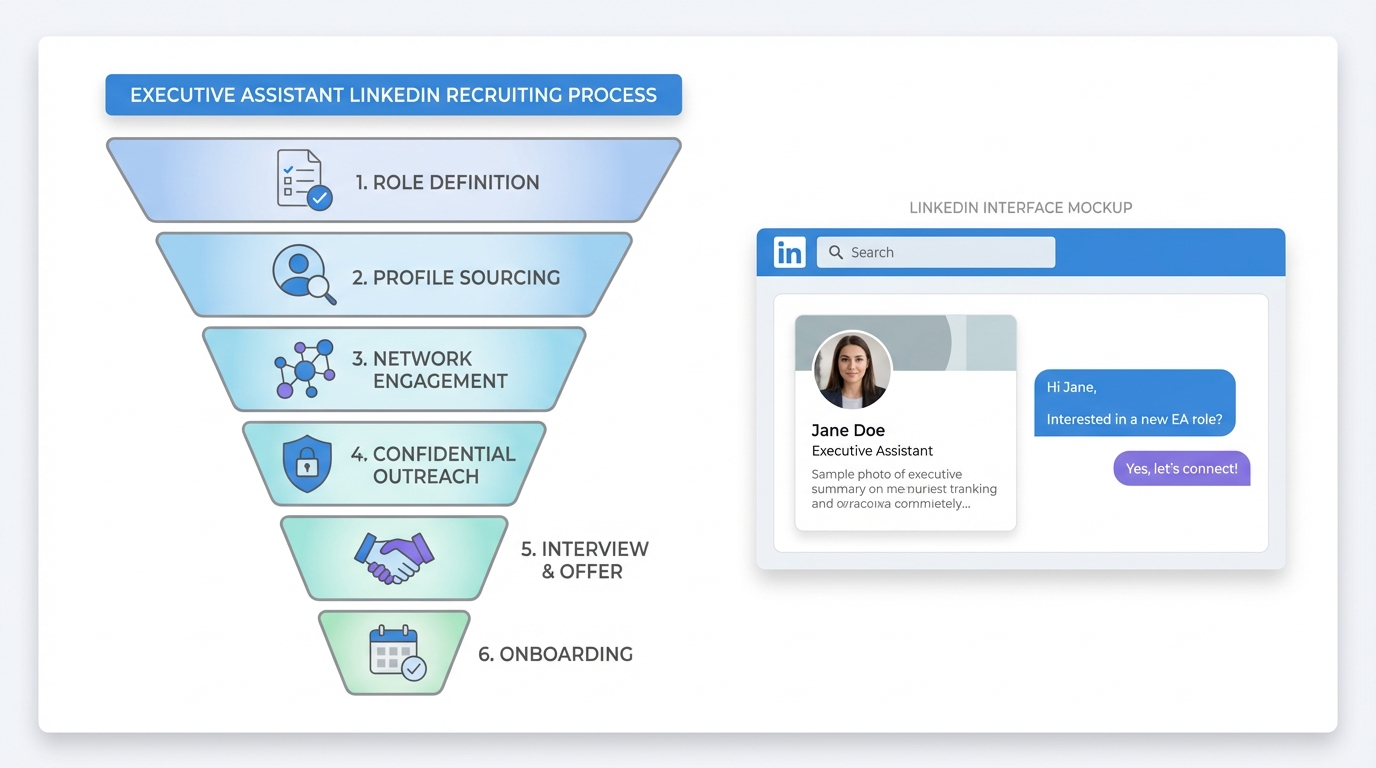
Recruitment online for recruiters is most effective when you run the search like a system: define the Executive Assistant outcomes, attract candidates with a credible LinkedIn presence, screen consistently, and follow up quickly while protecting confidentiality. For Executive Assistant roles, the “perfect match” is rarely just skills on a résumé; it is also personality and workstyle alignment with the executive. In our recruiting operations, the biggest speed gains come from automating the repetitive LinkedIn steps: connecting, introducing the role, answering common questions, confirming interest, and collecting résumés. That is exactly where StrategyBrain AI Recruiter fits into the workflow, so recruiters can focus on final qualification and interviews.
Key Takeaways
- EA hiring success depends on fit: prioritize personality and workstyle alignment with the executive, not only technical skills.
- LinkedIn is a first impression: an up to date profile and clear role narrative improves response rates and credibility.
- Confidentiality is operational: treat candidate privacy as a process requirement, not a courtesy.
- Executive involvement reduces mis hires: the executive should participate early enough to validate the working relationship.
- Automate the repetitive LinkedIn layer: StrategyBrain AI Recruiter can handle initial outreach, Q and A, follow up, and résumé collection.
- Scope boundary: AI can confirm interest and gather information, but final qualification against job requirements remains a recruiter decision.
Table of Contents
Why Executive Assistant matching is uniquely hard
Executive Assistants operate close to decision making, sensitive information, and fast changing priorities. That proximity means the role is both technical and relational. In the source material, Senior Recruitment Consultant Patti Babyn emphasizes that personality match between an EA and the executive is paramount, and that EAs often grow into the role from many backgrounds. In practice, this is why recruitment online for recruiters needs more than a job post; it needs a structured way to evaluate how the executive and EA will work together day to day.
Definition: Workstyle fit is the alignment between how someone plans, communicates, prioritizes, and handles ambiguity. It is different from skills fit, which is whether they can perform tasks like calendar management, travel coordination, and document preparation.
A practical online workflow for EA hiring and job search
This section is the core process. It is designed for recruiters, employers, and job seekers who want a repeatable online approach. It also answers the common question “how do I find a recruiter to work with” by showing what a professional recruiter process looks like from both sides.
Step by step workflow
- Define the role scorecard
Write a one page scorecard that includes outcomes, must have skills, and the executive’s working preferences. Include what the EA should not do, such as whether the executive prefers to manage their own calendar or book their own travel.
- Build a credible online presence
For employers and recruiters, ensure the role narrative is consistent across LinkedIn messages, job posts, and interview scripts. For job seekers, keep LinkedIn current with a professional photo and clear experience summary.
- Source and engage candidates
Use LinkedIn search and networks to reach both active and passive candidates. Passive candidates are people not actively applying but open to the right opportunity.
- Screen for confidentiality, organization, and communication
Use structured questions that test discretion, attention to detail, and written communication. These are repeatedly highlighted as core EA capabilities in the source material.
- Involve the executive before final selection
Before an offer, ensure the candidate meets the executive they will support. This reduces mismatch risk and improves retention.
- Onboard with clear expectations
Set expectations, feedback loops, and a recurring meeting cadence. Explain the “why” behind decisions so the EA can anticipate needs and act proactively.
Job seeker playbook: how to show up online as an EA
If you are a job seeker, you may be looking for “people who find jobs for you.” Recruiters can help, but your online readiness determines how quickly you move through the funnel. The following guidance is adapted from the source material and organized into an online first playbook.
What to do on LinkedIn
- Keep your LinkedIn profile current: treat it as your first interview. Include measurable scope where possible, such as number of calendars supported or travel volume managed, if you can share it without breaching confidentiality.
- Show digital proficiency: EAs are expected to be tech savvy. Highlight tools you use, such as calendar systems, document workflows, and collaboration platforms.
- Signal discretion: describe how you handle confidential information with integrity, using examples that do not reveal sensitive details.
How to improve your application quality
- Proofread like it is part of the job: attention to detail is a core EA competency, so your résumé and cover letter are evidence.
- Prepare for interviews with a portfolio mindset: bring examples of how you organized complex schedules, managed competing priorities, or handled sensitive situations.
- Ask executive level questions: ask what success looks like in the first 30 days, what tasks need immediate attention, and how the executive prefers to communicate.
How to work with recruiters
If you are asking “how do I find a recruiter to work with,” look for recruiters who can clearly explain their process, confidentiality practices, and how they match candidates to executives. A professional recruiter will not submit your résumé to an employer without your knowledge and consent, which is explicitly stated in the source material.
Employer playbook: how to hire the right EA online
For employers, recruitment online for recruiters and hiring managers should be designed to reduce two risks: mismatch with the executive and confidentiality breaches. The source material also notes that employer brand impacts hiring, especially because EAs are often well networked.
What to prioritize in evaluation
- Personality and workstyle fit: evaluate how the EA will “manage up,” act as a gatekeeper, and support decision making.
- Emotional intelligence: assess how the candidate navigates sensitive situations and relationships.
- Communication quality: test both verbal and written communication, since EAs often represent the executive’s voice.
- Confidentiality discipline: confirm the candidate’s approach to privacy and discretion.
Online hiring practices that reduce mis hires
- Do not delegate the entire process
Executive involvement is essential. Even with a recruiter running the process, the executive should participate in key interviews.
- Use structured interviews
Ask the same core questions across candidates to compare fairly. Add scenario questions about calendar conflicts, stakeholder management, and confidential information.
- Protect candidate confidentiality
Many candidates have not told their current employer they are searching. Limit internal sharing and avoid casual references in your network.
Success and retention after the hire
Retention starts on day one. The source material highlights onboarding, communication, and recognition as practical levers that keep the EA and executive relationship healthy.
Onboarding and communication
- Set clear expectations: define duties and boundaries, including what the executive does not want delegated.
- Meet regularly: schedule a recurring meeting and protect that time.
- Explain the why: share context so the EA can anticipate needs and make better decisions.
Recognition
Genuine appreciation improves retention. A simple thank you, delivered consistently, is a low cost practice with high cultural impact.
Where StrategyBrain AI Recruiter improves LinkedIn recruiting
In our testing of online recruiting workflows, the slowest part is rarely deciding who is qualified. The slowest part is the repetitive messaging layer: connecting, introducing the role, answering the same questions, following up across time zones, and collecting résumés. StrategyBrain AI Recruiter is designed to automate that layer on LinkedIn while keeping the recruiter in control of final qualification.
What StrategyBrain AI Recruiter can automate
- Smart LinkedIn recruitment automation: automatically connects with candidates who match your search criteria, introduces the opportunity, and gathers initial context.
- Candidate Q and A: answers questions about the role, company, compensation, and benefits based on the information you provide.
- Interest confirmation: confirms whether the candidate is open to interviewing and moving forward.
- Résumé and contact collection: requests and captures résumés and contact details from interested candidates, including details shared in LinkedIn messages.
- 24/7 multilingual communication: responds and follows up in the candidate’s native language to reduce misunderstandings and delays.
What still requires a recruiter
StrategyBrain AI Recruiter can identify willingness to communicate or interview, but it does not decide whether the résumé fully matches the job requirements. That final qualification remains a recruiter responsibility, which is the correct division of labor for high trust hiring.
Scaling for agencies and in house teams
If you manage multiple requisitions, the platform supports managing more than 100 LinkedIn accounts so teams can scale outreach capacity without adding the same amount of recruiter headcount. This is particularly useful when you need consistent follow up across time zones.
Quick comparison: manual vs automated online recruiting
| Workflow Area | Manual recruiter led | With StrategyBrain AI Recruiter | Best for |
|---|---|---|---|
| Initial LinkedIn outreach | High time cost, variable consistency | Automated connection and introduction | High volume sourcing |
| Candidate questions | Repeated answers, delayed replies | Automated Q and A using recruiter provided details | Reducing drop off |
| Follow up | Depends on recruiter availability | 24/7 follow up, multilingual support | Global hiring |
| Résumé collection | Manual chasing and tracking | Automated request and capture of résumé and contacts | Speed to shortlist |
| Final qualification | Recruiter decision | Recruiter decision | Quality control |
Copy and paste checklists
Recruiter checklist for EA searches
- [ ] Role scorecard includes outcomes, must haves, and boundaries
- [ ] Executive workstyle preferences documented
- [ ] Confidentiality expectations stated in outreach and interviews
- [ ] Structured interview questions prepared
- [ ] Executive interview scheduled before final selection
- [ ] Onboarding plan includes recurring meeting cadence and feedback loop
Job seeker checklist for working with recruiters
- [ ] LinkedIn profile updated with accurate dates and responsibilities
- [ ] Résumé proofread and aligned to EA competencies
- [ ] Prepared examples that demonstrate discretion and organization
- [ ] Ready to discuss preferred workstyle and communication cadence
- [ ] Confirmed consent rules for résumé submission to employers
FAQ
How do I find a recruiter to work with?
Choose a recruiter who can explain their process, protects your confidentiality, and sets clear expectations about when and where your résumé will be shared. A professional recruiter should obtain your consent before presenting you to an employer.
Are recruiters the same as people who find jobs for you?
Recruiters can help you access roles and advocate for you, but they are hired to fill positions for employers. You still need a strong LinkedIn profile, a clear story, and interview readiness to convert opportunities into offers.
Why is LinkedIn so important for Executive Assistants?
LinkedIn is often the first impression for both recruiters and employers. For EAs, an up to date profile also signals digital proficiency, which is increasingly expected in modern executive support roles.
What matters more for EA hiring, skills or personality fit?
Both matter, but the working relationship with the executive makes personality and workstyle fit a deciding factor. Skills can be trained more easily than day to day alignment on communication and priorities.
How do you protect candidate confidentiality in online recruiting?
Limit internal sharing, avoid discussing candidates casually in your network, and use a consent based submission process. Many candidates are searching discreetly, so confidentiality should be treated as a formal requirement.
Can StrategyBrain AI Recruiter replace a recruiter?
No. StrategyBrain AI Recruiter automates initial outreach, messaging, follow up, and résumé collection on LinkedIn. Final qualification against job requirements and hiring decisions remain the recruiter and hiring manager’s responsibility.
Does StrategyBrain AI Recruiter support multilingual candidate communication?
Yes. It can communicate in the candidate’s native language and respond around the clock, which helps reduce delays and misunderstandings in global hiring.
What is the fastest way to reduce time spent on LinkedIn recruiting?
Automate the repetitive steps: connection requests, initial introductions, common Q and A, and follow up. Then reserve recruiter time for structured interviews, executive alignment, and final evaluation.
Conclusion and next steps
Recruitment online for recruiters becomes reliable when you treat it as a system: define the EA scorecard, evaluate workstyle fit, protect confidentiality, and keep the executive involved. If you want to move faster without lowering quality, automate the LinkedIn messaging layer while keeping final qualification in human hands. Next step: document your EA scorecard and outreach script, then pilot StrategyBrain AI Recruiter for LinkedIn connection, Q and A, follow up, and résumé collection so your team can spend more time on interviews and selection.
Disclosure: StrategyBrain AI Recruiter is a StrategyBrain product. We aim to be objective by clearly separating what automation can do from what still requires recruiter judgment.