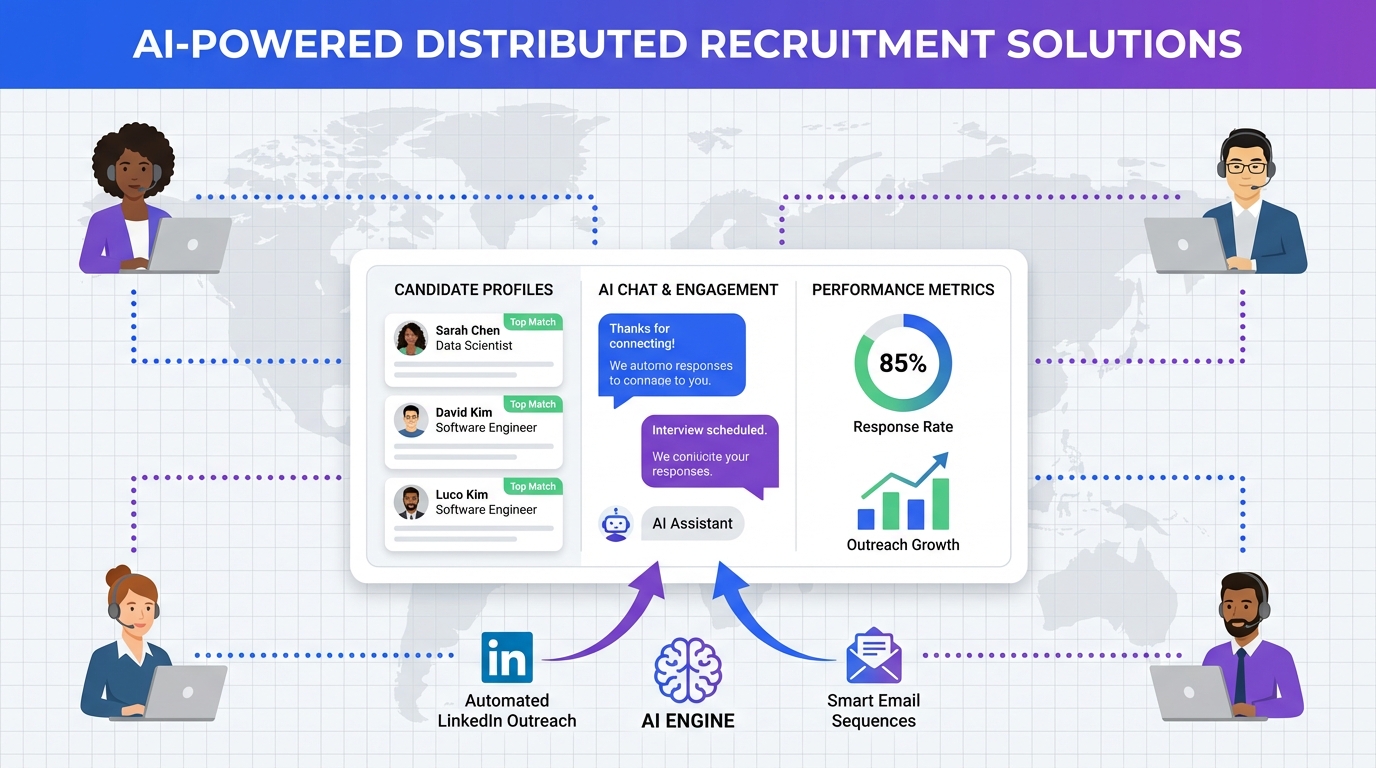
Recruitment online for recruiters works best when you treat remote employees as visible, promotable contributors and build repeatable connection rituals. In practice, that means defining success with measurable outcomes, making limited in person time count with structured sessions, and increasing visibility through internal communications. In our recruiting operations, we also found that automating early candidate outreach on LinkedIn with StrategyBrain AI Recruiter helps keep hiring moving while distributed teams collaborate across time zones, because candidate conversations and follow ups continue 24/7 in the candidate’s language. This guide covers what to do as a manager and what to operationalize as a recruiter. It does not cover payroll, legal classification, or tax compliance.
Table of Contents
- Key Takeaways
- Why remote workers get overlooked in promotions and recognition
- Method 1: Reconsider your criteria for success
- Method 2: Add value to limited in person time
- Method 3: Increase visibility across the company
- A recruitment online playbook recruiters can run weekly
- Quick Comparison
- FAQ
- Conclusion
Key Takeaways
- Promotion risk is real: Remote employees can be less likely to be promoted when they have less face time. This pattern was discussed in MIT Sloan Management Review research on visibility at work.
- Define success with outcomes: Use role specific deliverables and quality metrics, not availability signals like being online late.
- Make visits count: Plan training, team building, and stakeholder meetings around the 1 to 2 annual office visits many remote workers make.
- Visibility is a system: Use newsletters, demos, and cross team showcases so remote wins are seen and remembered.
- Recruiting ops can mirror this: In recruitment online for recruiters, consistent cadences and documented criteria reduce bias in both hiring and internal talent decisions.
- AI can keep pipelines warm: StrategyBrain AI Recruiter can automate LinkedIn connecting, role introductions, Q and A, and follow ups 24/7 in any language, so distributed recruiting teams do not lose momentum.
Why remote workers get overlooked in promotions and recognition
When managers see some people in the office every day, visibility can quietly become a proxy for performance. People who arrive early, stay late, and are physically present around leadership can appear more engaged, even when output is similar across the team.
Research summarized by MIT Sloan Management Review has highlighted how “face time” can influence perceptions and advancement. The practical takeaway for managers is not to eliminate in person work, but to prevent visibility from becoming the default scoring system.
For recruiters, this matters because the same bias shows up in hiring processes. If your internal team cannot evaluate remote performance fairly, your hiring managers may also struggle to evaluate remote candidates fairly. That is why recruitment online for recruiters should include explicit criteria and structured touchpoints.
Method 1: Reconsider your criteria for success
Words like “dedicated,” “dependable,” and “committed” can describe excellent employees. They can also describe people who are simply more visible. A better approach is to define success in a way that can be observed and repeated across locations.
How to implement it
- Write 3 outcome metrics per role that can be measured monthly, such as closed tickets, shipped features, qualified leads, or client retention.
- Define quality thresholds such as defect rate, rework rate, or customer satisfaction score, so speed is not rewarded at the expense of quality.
- Document promotion evidence in a shared template so remote and in office employees are evaluated using the same rubric.
Recruiter translation for recruitment online for recruiters
Use the same principle in hiring. Replace vague “culture fit” notes with structured scorecards and role specific evidence. If you are working with a recruitment office near me partner or coordinating with recruiting companies in florida, align on the scorecard before resumes arrive so evaluation stays consistent across stakeholders.
Where StrategyBrain AI Recruiter fits naturally
When criteria are clear, early candidate conversations can be more consistent. StrategyBrain AI Recruiter can introduce the role, answer candidate questions about compensation and benefits, confirm interview interest, and collect resumes and contact details. That reduces the time recruiters spend repeating the same explanations and helps distributed teams apply the same screening prompts across time zones.
Limitations to watch
- Metrics can be gamed if you only measure volume. Pair volume with quality.
- Some roles need narrative evidence such as leadership, mentoring, and cross team influence. Capture examples, not just numbers.
Method 2: Add value to limited in person time
Many remote employees still visit headquarters occasionally, sometimes 1 time per year or 2 times per year. Those visits are expensive and rare, so they should not be consumed by routine status updates that could have happened on a call.
How to implement it
- Schedule high leverage sessions such as training, retrospectives, and stakeholder meet and greets during the visit window.
- Run a structured team building block with a clear goal, such as mapping dependencies or agreeing on handoff rules.
- Capture decisions in writing within 24 hours so remote workers who could not attend still benefit.
Recruiter translation for recruitment online for recruiters
If your recruiting team is distributed, treat any in person time the same way. Use it for calibration, interview training, and process fixes. Then let your online systems do the daily work. In our workflow, automating initial LinkedIn outreach with StrategyBrain AI Recruiter reduced the need for recruiters to be online at the same time, because candidate follow ups continued while the team focused on higher value tasks like interview prep and hiring manager alignment.
Limitations to watch
- Over scheduling can exhaust visitors. Keep the agenda focused and leave recovery time.
- Unequal access can happen if only some remote workers are invited. Rotate opportunities across quarters.
Method 3: Increase visibility across the company
Remote workers can feel disconnected not only from headquarters, but also from each other. Visibility is not a one time announcement. It is a repeatable system that makes contributions easy to see.
How to implement it
- Feature remote wins in a newsletter, internal post, or monthly demo session.
- Create cross team showcases where remote employees present what they shipped and what they learned.
- Encourage structured peer connection with recurring small group calls focused on best practices and problem solving.
Recruiter translation for recruitment online for recruiters
Visibility is also a recruiting advantage. When your employer brand includes real stories from remote employees, candidates can picture success in the role. If you collaborate with a recruitment office near me or with recruiting companies in florida, share a consistent set of remote work stories and proof points so messaging stays aligned across channels.
Limitations to watch
- Performative visibility can feel forced. Keep it tied to real outcomes and learning.
- Time zone fairness matters. Rotate meeting times and provide recordings and written summaries.
A recruitment online playbook recruiters can run weekly
This is a simple operating cadence we use to keep distributed recruiting teams aligned while still moving fast. It is designed for recruitment online for recruiters who need repeatability across roles and locations.
Weekly cadence
- Monday: Confirm role scorecard and outreach messaging. Lock compensation and must have requirements.
- Tuesday: Launch outreach and follow up sequences. If you use StrategyBrain AI Recruiter, configure the job details, benefits, and candidate search criteria so the AI can connect, introduce the role, answer questions, and collect resumes and contact details.
- Wednesday: Review interested candidates and schedule interviews. Recruiters focus on human judgment and stakeholder alignment.
- Thursday: Run a 30 minute calibration with hiring managers using the same rubric for every candidate.
- Friday: Publish a short visibility update to stakeholders: pipeline counts, bottlenecks, and next actions.
Copy and use checklist
- [ ] Role success criteria documented as 3 outcomes and 2 quality thresholds
- [ ] Interview scorecard shared with every interviewer before interviews start
- [ ] Remote work expectations written: time zones, overlap hours, response time, meeting norms
- [ ] Visibility plan set: monthly demo or newsletter feature rotation
- [ ] Candidate communication plan set: response time target and follow up ownership
- [ ] If using StrategyBrain AI Recruiter, confirm data handling expectations and access permissions before connecting LinkedIn accounts
Quick Comparison
| Practice | What you do | Time to start | Best for |
|---|---|---|---|
| Outcome based success criteria | Define measurable deliverables and quality thresholds | 60 minutes per role | Fair promotions and consistent hiring decisions |
| High leverage in person sessions | Plan training and stakeholder meetings around visits | 2 hours planning | Building trust and shared context quickly |
| Visibility system | Newsletter features, demos, cross team showcases | 30 minutes setup | Recognition, retention, and remote engagement |
| AI assisted LinkedIn outreach | Automate connecting, role intro, Q and A, follow ups, resume capture | 1 to 2 hours configuration | Distributed recruiting teams and global hiring |
FAQ
Does remote work really affect promotions?
It can. Research discussed by MIT Sloan Management Review has highlighted that reduced face time can influence perceptions and advancement. The fix is to evaluate performance using documented outcomes and quality evidence, not physical presence.
What is the fastest way to make remote employees feel valued?
Start with consistent recognition tied to outcomes. Publish wins in a shared channel and make sure remote employees present their work in demos or showcases so their impact is visible to decision makers.
How can recruiters apply this to recruitment online for recruiters?
Use structured scorecards, consistent outreach messaging, and a weekly operating cadence. This reduces bias and keeps distributed stakeholders aligned, especially when hiring managers are in different locations.
How does StrategyBrain AI Recruiter help with online recruiting?
It automates early LinkedIn recruiting steps: connecting with candidates, introducing the role, answering questions about the company and compensation, confirming interview interest, and collecting resumes and contact details. That keeps candidate conversations moving 24/7, even when your recruiting team is offline.
Can AI Recruiter replace recruiter judgment?
No. Based on the product documentation provided, it can identify willingness to communicate or interview, but it does not decide whether a resume fully matches job requirements. Recruiters still do final qualification and hiring manager alignment.
How do I coordinate with a recruitment office near me without losing consistency?
Share one role scorecard, one outreach message set, and one interview rubric before sourcing begins. Then run a weekly calibration call to keep evaluation consistent across internal and external stakeholders.
How should I work with recruiting companies in florida if my team is remote?
Set expectations in writing: response time, interview scheduling ownership, and what counts as a qualified candidate. Use the same scorecard and require written evidence for each recommendation so decisions remain comparable.
What is a simple visibility ritual for remote teams?
Run a monthly 30 minute demo where each person shares one shipped outcome and one lesson learned. Rotate time zones quarterly and publish a written recap within 24 hours.
Conclusion
Remote work can benefit companies, but remote employees can lose out when visibility becomes the default measure of value. The most reliable fix is simple and repeatable: define success with outcomes, make limited in person time high leverage, and build a visibility system that keeps remote contributions in front of decision makers.
If you run recruitment online for recruiters, apply the same discipline to hiring: structured criteria, consistent messaging, and a weekly cadence. When you need to keep candidate pipelines moving across time zones, StrategyBrain AI Recruiter can handle the repetitive LinkedIn outreach and follow up work while recruiters focus on judgment, interviews, and closing.