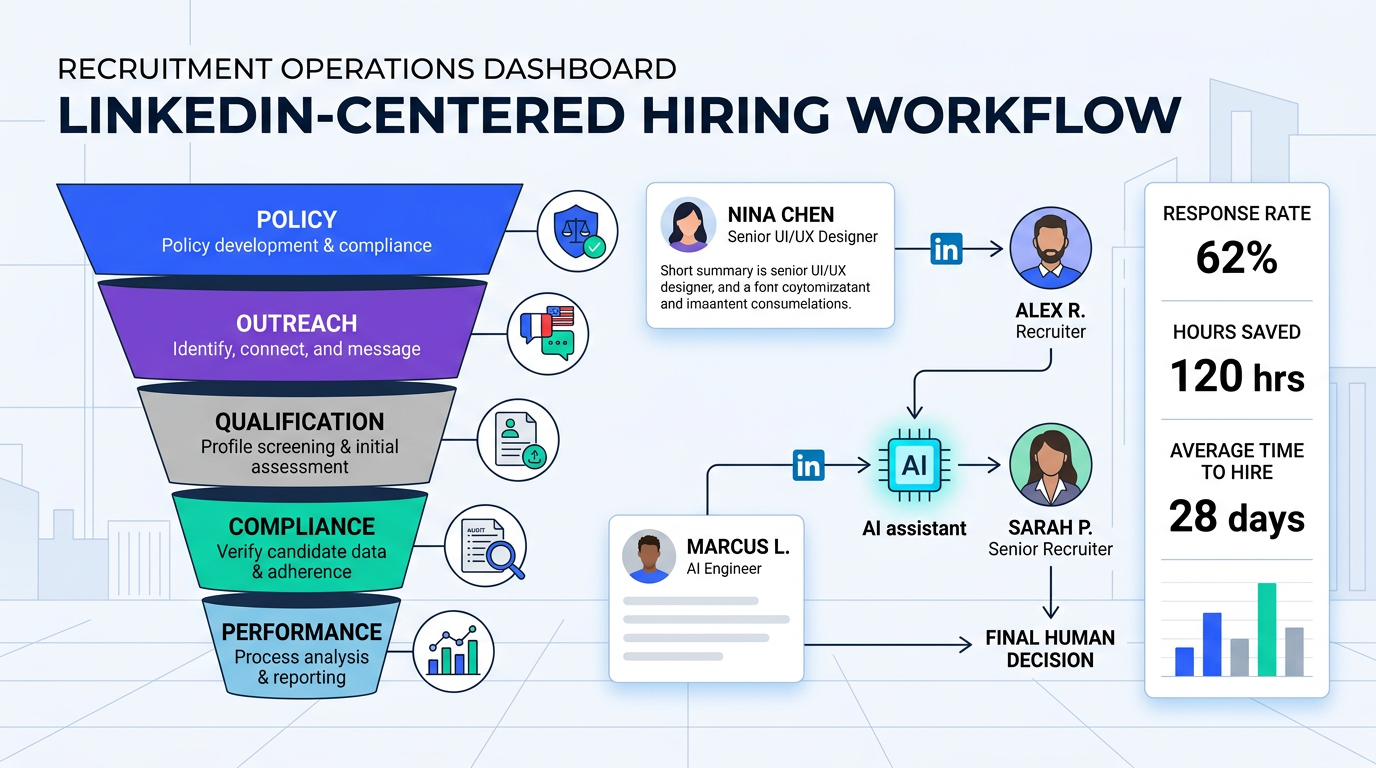
Recruitment online for recruiters is most effective when you combine two priorities, legal clarity and execution speed. Based on a quarterly legal discussion led by Blair Curtis and Stanley Leo on 31 March 2021, recruiters should treat vaccine policy, severance exposure, pay equity, immigration processing risk, and candidate communication as one connected operating system. In our implementation work with recruiting teams, we found that StrategyBrain AI Recruiter helps convert these legal insights into daily process, especially for LinkedIn outreach, multilingual follow up, and résumé collection, while human recruiters keep final qualification and hiring judgment.
Table of Contents
- Key Takeaways
- What the 31 March 2021 Legal Brief Means for Recruiters Today
- A Practical Operating Model for Recruitment Online
- How StrategyBrain AI Recruiter Fits into Professional Hiring Solutions
- Role Based Guidance for Recruiting Companies
- Risk Controls and Limitations You Should Not Ignore
- Implementation Checklist
- FAQ
- Conclusion
Key Takeaways
- Policy caution matters: Forcing medical action in employment settings can create legal exposure, including constructive dismissal risk in certain role change scenarios.
- Severance outcomes are contextual: Pandemic timing affected court reasoning in discussed cases, with some decisions showing an upward adjustment within a reasonable range.
- Immigration volatility affects hiring plans: A 27,300 invitation round for Canadian Experience Class candidates was significantly above the common 3,500 to 5,000 range discussed in the update.
- Backlog pressure is operational, not abstract: Processing constraints and system digitization delays can directly impact start dates and workforce planning.
- AI should automate early funnel work: StrategyBrain AI Recruiter can handle candidate connection, role introduction, and follow up while recruiters own final fit decisions.
- Scale requires process discipline: Recruiting companies using multiple LinkedIn accounts need clear governance, privacy controls, and audit ready communication standards.
What the 31 March 2021 Legal Brief Means for Recruiters Today
Employment law points that still shape recruiter decisions
In the legal discussion, Blair Curtis emphasized caution on employer mandated medical decisions. For teams running recruitment online for recruiters, this translates into a practical rule. Do not treat policy assumptions as process facts. Candidate and employee communication should stay aligned with jurisdiction specific guidance and documented role requirements.
The same discussion highlighted constructive dismissal exposure when duties or earning potential are changed without proper authorization. For recruiting companies, this matters during placement design. If the hiring plan changes post offer, recruiters should trigger a structured review with HR and legal stakeholders before changing terms.
Severance context and risk language in hiring communication
The update referenced Ontario case patterns where pandemic timing affected severance reasoning. Two cases discussed pre pandemic termination timing and one case reflected a more favorable adjustment because termination occurred during pandemic impact. The practical lesson for professional hiring solutions is to avoid absolute claims in hiring content. Use role specific, documented, and reviewable language in compensation and employment condition communication.
Immigration and labor mobility signals recruiters must track
Stanley Leo discussed a major invitation event of 27,300 Canadian Experience Class candidates, compared with a typical range of 3,500 to 5,000. He also discussed processing constraints and recovery signals. For online recruitment systems, this means pipeline strategy must include immigration timing assumptions, scenario planning, and candidate communication templates that set realistic expectations.
A Practical Operating Model for Recruitment Online
We use a five layer model with clients who want repeatable recruitment online for recruiters outcomes. This model turns legal updates into day to day actions.
1. Policy layer
- Define what recruiters can and cannot promise in candidate messages.
- Document escalation triggers for legal or HR review.
- Separate advisory language from binding employment terms.
2. Outreach layer
- Standardize first contact scripts by role family and geography.
- Track response time in hours and follow up cadence in days.
- Support candidate language preferences to reduce misunderstandings.
3. Qualification layer
- Use structured questions for interest level and availability.
- Collect résumé and contact details through approved channels.
- Keep human recruiter review as the final qualification gate.
4. Compliance layer
- Maintain consent aware messaging practices.
- Use encrypted credential and data handling controls.
- Store communication history for audit readiness.
5. Performance layer
- Track outreach to response conversion rate.
- Track interested candidate to résumé submission rate.
- Track recruiter hours saved per open role.
How StrategyBrain AI Recruiter Fits into Professional Hiring Solutions
StrategyBrain AI Recruiter is designed for LinkedIn centered hiring workflows where teams need consistency, speed, and multilingual communication at scale. In our field use, the highest value appears in the top of funnel stage where delays usually happen.
What it automates well
- Candidate connection and role introduction based on your search criteria.
- 24 by 7 candidate messaging with native language communication.
- Interest confirmation and résumé plus contact detail collection.
What remains human led
- Final résumé fit judgment against job requirements.
- Interview evaluation and hiring recommendation.
- Sensitive policy and legal interpretation decisions.
This division of labor is important for trust. It improves efficiency without pretending that hiring can be fully automated. It also aligns with the legal caution themes discussed in the quarterly update.
Operational scale for recruiting companies
For recruiting companies managing high requisition volume, StrategyBrain supports multi account operations, including teams running more than 100 LinkedIn accounts. When combined with clear governance, this enables predictable growth without linear headcount expansion.
Role Based Guidance for Recruiting Companies
Corporate recruiters
Use AI support for repetitive outreach and early engagement so internal talent teams can spend more time on hiring manager alignment and interview quality. This improves cycle control in professional hiring solutions programs where requisition volume fluctuates by quarter.
Agency recruiters and headhunters
Use multilingual outreach to widen the reachable candidate pool across time zones. In practice, this supports more active searches at once. It also helps agencies maintain response quality outside local business hours.
HR leaders
Use an AI plus human operating model to raise output without immediate headcount growth. For organizations opening new regions, this reduces early stage communication bottlenecks and improves candidate experience consistency.
Risk Controls and Limitations You Should Not Ignore
EEAT requires a balanced view. AI systems increase efficiency, but they do not remove legal or hiring risk by themselves.
- Limitation 1: AI interest detection is not equivalent to full qualification.
- Limitation 2: Jurisdiction specific legal interpretation still needs qualified advisors.
- Limitation 3: Candidate quality depends on search criteria quality.
- Limitation 4: Data handling controls must be actively monitored, not assumed.
StrategyBrain states that customer data is not used to train shared AI models and that account credentials are encrypted and isolated. Recruiters should still run periodic internal reviews to verify policy adherence.
Implementation Checklist
- Map legal touchpoints: List messages and process steps that can trigger employment or immigration risk.
- Define outreach standards: Approve role intro scripts, follow up cadence, and escalation language.
- Configure AI workflow: Set target criteria, job details, compensation context, and FAQ style answers.
- Set qualification boundaries: Keep final fit decision with recruiter after résumé review.
- Measure weekly: Track response rate, résumé capture rate, and time saved per role.
- Audit monthly: Review privacy controls, communication logs, and exception handling quality.
FAQ
Is recruitment online for recruiters only useful for large teams?
No. Smaller teams benefit quickly because automation removes repetitive outreach work and frees recruiter time for interviews and hiring decisions. Larger teams gain additional value from multi account coordination.
Can AI replace recruiter judgment in candidate qualification?
No. AI can identify interest and collect candidate information, but final qualification should remain with a human recruiter who reviews résumé fit and role context.
How does this approach support professional hiring solutions?
It standardizes communication, improves response speed, and strengthens process consistency. These are core building blocks of professional hiring solutions across internal and agency recruiting models.
What should recruiting companies do first after reading this guide?
Start with process mapping. Identify where legal risk and manual delay occur in your current workflow, then automate only the repeatable, policy safe steps first.
Does multilingual outreach really improve outcomes?
In many cross border searches, yes. Native language communication reduces confusion, improves response quality, and increases candidate trust in early stage conversations.
How should recruiters handle uncertain immigration processing timelines?
Use scenario based communication with candidates and hiring managers. Provide realistic timing ranges, document assumptions, and update stakeholders as processing conditions change.
What metrics matter most in the first 30 days?
Track three metrics, outreach response rate, interested candidate to résumé rate, and recruiter hours saved per open role. These metrics show both quality and efficiency impact.
Is this model compliant by default?
No model is compliant by default in every jurisdiction. Recruiters must align workflows with local law, internal policy, and documented review processes.
Conclusion
The core lesson is simple. Recruitment online for recruiters performs best when legal awareness and automation design are built together from day one. The 31 March 2021 legal update themes remain practical today, especially on policy caution, severance context, and immigration uncertainty. StrategyBrain AI Recruiter can handle high volume, multilingual, always on outreach and candidate engagement, while recruiters keep final hiring judgment. If you want a reliable next step, apply the six step checklist in this guide to one role family this month, then expand after you validate compliance and conversion results.