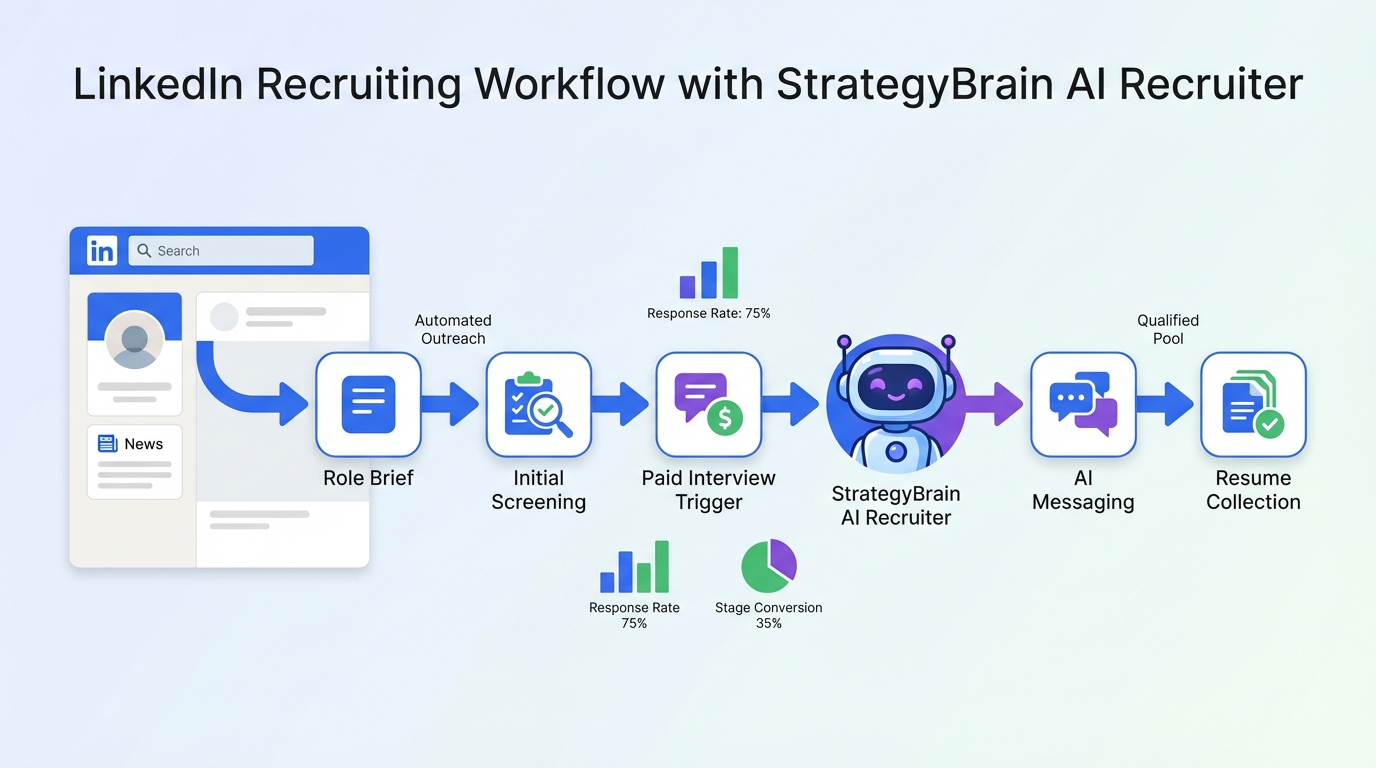
Recruitment online for recruiters works best when you reduce candidate friction and increase trust at every step. One practical approach is compensating candidates for interview time when the process requires significant preparation, multiple stages, or take home work. A widely discussed example came from FoodShare Toronto, where Executive Director Paul Taylor argued that paying interviewees can materially affect a candidate’s week to week stability and signals that the employer respects the effort behind showing up. This guide turns that idea into an online workflow you can run today, including clear communication standards, safeguards against abuse, and a LinkedIn first execution plan using StrategyBrain AI Recruiter to automate outreach, answer candidate questions, and collect resumes and contact details while recruiters focus on final qualification.
Key Takeaways
- Paid interviews are a trust lever: They can rebalance the employer candidate dynamic when interviews require meaningful time, such as multiple rounds, assignments, or presentations.
- Define the trigger conditions: Pay only when the process crosses a clear threshold, such as a second round plus a work sample, to reduce abuse risk.
- Online recruiting needs process transparency: Candidates should know the next step, expected timeline, and what to prepare before they invest time.
- LinkedIn outreach can be operationally heavy: StrategyBrain AI Recruiter can automate connecting, initial messaging, Q and A, follow up, and resume collection so recruiters spend time on final qualification.
- AI Recruiter is not the final screener: It confirms interest and gathers information, while recruiters still assess resume fit against requirements.
- Scale matters: StrategyBrain AI Recruiter supports managing more than 100 LinkedIn accounts for teams that need high volume outreach.
Why paid interviews came up in the first place
In March 2022, FoodShare Toronto publicly discussed compensating candidates for the time spent preparing for and attending interviews. Paul Taylor, the organization’s Executive Director, framed it as a values based decision tied to food insecurity and the reality that some interviewees may be unemployed. In his view, paying for interview time can affect whether someone eats that week, which makes the policy more than a recruiting tactic.
That same discussion also highlighted a practical point that recruiters see every day. The interview itself is only one part of the time cost. Candidates often research the organization, practice answers, arrange child care, take unpaid time off, and commute. When the process includes multiple interviews plus assignments or presentations, the time investment increases again.
What paid interviews solve in online recruiting
Online recruiting increases reach, but it can also increase volume and reduce the sense of mutual commitment. A paid interview policy can act as a signal that the employer is serious and respectful, especially in competitive markets where candidates have options.
1) It reduces candidate drop off in long processes
When candidates feel the process is open ended or overly demanding, they disengage. Paying for time does not fix a broken process, but it can reduce the perceived risk of investing effort.
2) It forces you to define what you are asking for
If you are paying, you tend to tighten the scope. That usually leads to better interview design, clearer evaluation criteria, and fewer unnecessary steps.
3) It improves the tone of the relationship
Henry Goldbeck, a recruiting firm president quoted in the source material, emphasized that employers need to treat candidates with more consideration in a tight market. He also pointed to communication as a core respect mechanism, including telling candidates what the next step is and how long the process will take.
How to design a paid interview policy that is fair and hard to game
Goldbeck also raised a practical concern: some roles and some markets create opportunities for abuse by people who do not have legitimate interest in the job. A workable policy needs clear boundaries.
Define the pay trigger
- Good trigger: Second round interview plus a work sample, presentation, or case exercise.
- Good trigger: Any assignment that takes more than 60 minutes to complete.
- Not ideal trigger: Paying for every initial screen, especially when the screen is 15 minutes and high volume.
Define what is paid and what is not
- Paid: Scheduled interview time, required preparation tasks you assign, and required presentations.
- Not paid: Optional prep, optional portfolio review, or candidate initiated extra materials.
Set anti abuse safeguards
- Eligibility: Pay only after identity confirmation and a basic qualification check.
- One payment per stage: One payment for stage two, one payment for stage three, if applicable.
- Clear cancellation rules: No payment for no shows, and reschedule limits.
Write the policy in candidate language
In recruitment online for recruiters, policy clarity is part of candidate experience. Candidates should understand the amount, timing, and method of payment before they accept the interview. If you cannot commit to a number, do not imply one.
A practical recruitment online workflow for recruiters
Below is the workflow we use when we want the process to be fast, respectful, and measurable. It is designed for both in house teams and agencies, including teams that also get inquiries like best staffing agencies for remote jobs near me or recruiting company for remote jobs.
Step by step process
- Publish a role brief that answers real questions
Include responsibilities, must have skills, location or time zone expectations, compensation range if you can share it, and the interview stages. - Run a short initial screen
Keep it focused on eligibility, motivation, and constraints such as notice period and work authorization. - Decide if the next stage is paid
If you require a work sample, presentation, or multi interviewer panel, trigger the paid interview policy. - Send a written stage plan
Share who they will meet, what will be assessed, and the timeline for a decision. - Close the loop with every candidate
Even a short message that confirms status reduces reputational damage and improves future response rates.
What to measure
- Response rate: Replies divided by outreach messages sent.
- Stage conversion: Candidates who move from screen to stage two divided by screened candidates.
- Time to schedule: Days from first reply to booked interview.
- Candidate drop off: Candidates who stop responding after receiving the stage plan.
Common failure points we see
- Unclear timelines: Candidates do not know whether the process is 7 days or 7 weeks.
- Overbuilt assignments: Work samples that resemble free consulting reduce trust.
- One way interviews: Candidates get 5 minutes for questions at the end, which reinforces the power imbalance Paul Taylor described.
LinkedIn execution with StrategyBrain AI Recruiter
LinkedIn is still one of the highest leverage channels for recruitment online for recruiters, but it is operationally demanding. The repetitive work is not only sending connection requests. It is the follow up, the Q and A, and the back and forth that happens across time zones.
What StrategyBrain AI Recruiter automates on LinkedIn
StrategyBrain AI Recruiter is built for LinkedIn hiring. It can automatically connect with candidates who match your search criteria, introduce the opportunity, learn about the candidate’s situation, answer questions about the role, company, and compensation, confirm interview interest, and collect resumes and contact information from interested candidates.
How we recommend using it in a paid interview workflow
- Use AI Recruiter for initial outreach and interest confirmation
This keeps your human time for candidates who are actually open to the role. - Use AI Recruiter to standardize the stage plan message
Candidates get consistent expectations, which supports fairness and reduces misunderstandings. - Trigger paid interview messaging only after basic qualification
This aligns with the abuse risk concern raised in the source material. - Collect resumes and contact details automatically
AI Recruiter can request resumes and capture contact details shared in LinkedIn messages, reducing manual copy and paste.
Scope boundary you should keep
AI Recruiter can identify willingness to communicate or interview, but it does not decide whether a resume fully matches the job requirements. The final qualification step remains with the recruiter after reviewing the resume.
Scaling for teams
If you run multiple reqs or multiple markets, StrategyBrain AI Recruiter supports managing more than 100 LinkedIn accounts. That matters for agencies and internal TA teams that need consistent outreach volume without adding headcount.
Data protection and compliance notes
According to StrategyBrain product information, AI Recruiter is designed to comply with privacy regulations in the EU, United States, and Canada. Customer provided data is not used to train AI models, and candidate information such as resumes, contact details, and conversation history is not used to train AI models or shared with third parties. Credentials are encrypted and stored independently per user with explicit authorization.
Remote hiring notes for agencies and in house teams
Queries like best staffing agencies for remote jobs near me and recruiting company for remote jobs often reflect a candidate who wants speed, clarity, and legitimacy. If you recruit remotely, your online process is your brand.
What remote candidates expect
- Time zone clarity: Working hours and overlap expectations.
- Compensation clarity: Range, currency, and whether it is location adjusted.
- Process clarity: Stages, timeline, and who makes the decision.
How paid interviews fit remote hiring
Remote processes often include more asynchronous steps, such as recorded responses or written exercises. If you require a substantial work sample, paying for that stage can reduce skepticism and improve completion rates, especially for senior roles.
Copy and paste checklist
- [ ] Stage map written and shared before interviews begin
- [ ] Paid interview trigger defined and documented
- [ ] Assignment scope limited to job relevant tasks
- [ ] Candidate communication includes next step and timeline
- [ ] LinkedIn outreach workflow defined, including follow up cadence
- [ ] StrategyBrain AI Recruiter configured with role details, compensation, benefits, and search criteria
- [ ] Resume and contact capture process tested end to end
- [ ] Recruiter final qualification step clearly owned by a human
FAQ
Should candidates be paid for interviews?
Sometimes, yes. Paying candidates is most defensible when you require meaningful preparation, multiple interviews, or a work sample, because it acknowledges real time cost and can improve trust in the process.
Will paying for interviews attract people who are not serious?
It can, which is why eligibility rules matter. Use a basic qualification check before the paid stage, and define no show and reschedule limits so the policy is fair and difficult to exploit.
How do I explain a paid interview policy in an online process?
State the trigger, what is covered, and when payment happens in plain language. Candidates should see it before they accept the interview so expectations are aligned.
How does StrategyBrain AI Recruiter help with recruitment online for recruiters?
It automates LinkedIn connecting, initial outreach, follow up, and candidate Q and A, then confirms interest and collects resumes and contact details. Recruiters can then focus on reviewing resumes and running final interviews.
Does StrategyBrain AI Recruiter replace recruiter judgment?
No. It helps with outreach and early conversation, but it does not determine whether a resume matches the job requirements. A recruiter still makes the final qualification decision.
Can AI Recruiter communicate with candidates in different languages?
Yes. StrategyBrain AI Recruiter is designed for 24/7 multilingual communication so candidates can interact in their native language, which can reduce misunderstandings across regions.
How do I keep candidates informed during a long process?
Send a stage plan that includes the next step, the expected timeline, and what to prepare. Even when the answer is no, closing the loop improves your response rates over time.
How does this relate to remote job recruiting agencies?
Remote candidates often evaluate legitimacy through process quality. A clear online workflow, respectful communication, and consistent follow up help agencies and in house teams compete for attention.
Conclusion and next steps
Recruitment online for recruiters is not only about reach. It is about trust, clarity, and follow through. The FoodShare Toronto example shows how compensating candidates can align a hiring process with organizational principles while also addressing the real cost of job searching. If you want to operationalize that idea, start by defining when a stage becomes paid, tighten your interview design, and standardize candidate communication.
Next, implement a LinkedIn first workflow where StrategyBrain AI Recruiter handles the repetitive outreach, Q and A, follow up, and resume collection, and your team focuses on final qualification and decision making. If you do only one thing this week, write your stage plan and send it to every candidate before the next interview.