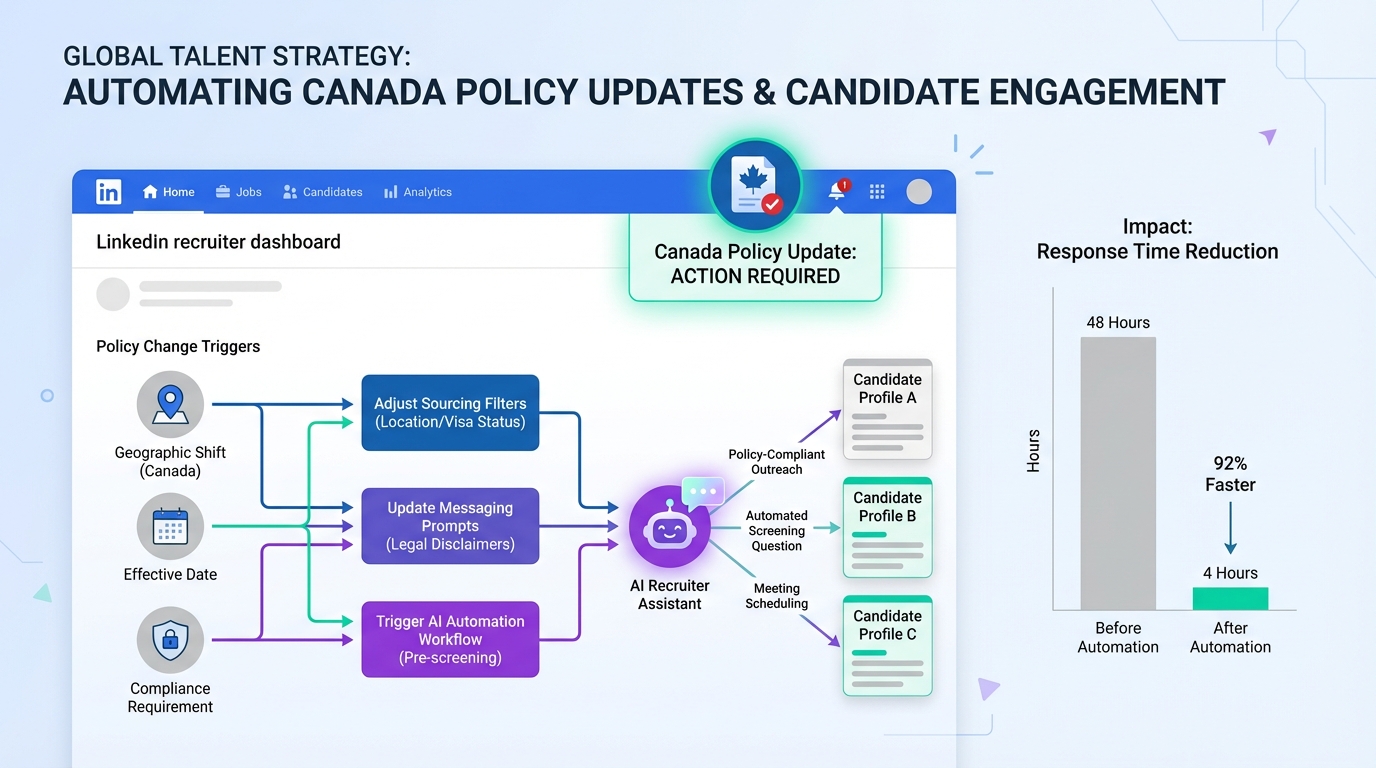
Recruitment online for recruiters becomes dramatically easier to manage when you convert policy changes into repeatable sourcing and messaging updates, then automate the repetitive LinkedIn work. In practice, we use a simple loop: identify what changed, translate it into pipeline risk, update your outreach and screening prompts, then run always on candidate engagement using StrategyBrain AI Recruiter so candidates get fast answers and consistent follow up. This article uses a real policy change snapshot from Canada after the 2015 federal election and shows how a recruiter or recruiter headhunter can keep hiring output stable even when leave rules, training funding, unionization rules, and Employment Insurance settings shift.
Key Takeaways
- Policy changes are sourcing inputs: translate each change into 3 numbers you can track: backfill duration, candidate availability, and response time targets.
- Use consistent online messaging: candidates ask about role, company, and compensation, so prepare standardized answers before you scale outreach.
- StrategyBrain AI Recruiter can run the repetitive LinkedIn layer: it can connect, introduce roles, answer questions, confirm interview interest, and collect résumés and contact details.
- Global hiring needs 24/7 follow up: multilingual, always on responses reduce drop off when candidates reply outside recruiter working hours.
- Be honest about what AI does not do: AI Recruiter can confirm interest and collect information, but final qualification against requirements remains a recruiter decision.
- Trust is a workflow: use encryption, data isolation, and a clear statement that candidate data is not used to train models.
Scope and what this guide covers
This guide is written for recruiters, corporate talent teams, and agency recruiter headhunter workflows that rely on online sourcing and LinkedIn outreach. It focuses on how to keep pipelines stable when external conditions change, using a concrete example of employer relevant policy discussion in Canada after the 2015 federal election.
It does not provide legal advice, and it does not attempt to predict future legislation. Instead, it shows how to operationalize known changes into recruiting actions you can execute and measure.
The 5 employer relevant changes and what they mean for recruiting
The source material highlighted five themes employers were watching in 2015: training program funding, extended maternity leave, formal requests for flexible work, changes that could make unionization easier, and Employment Insurance waiting period and mobility rules. Even if you recruit outside Canada, the recruiting lesson is universal: each policy lever changes candidate supply, candidate expectations, and time to fill.
1) Training funding and job readiness
The article discussed training program funding levels and the idea that employers might see more job ready unemployed candidates if training programs expand. For online recruiting, this is a signal to refresh your sourcing filters and screening questions so you can identify newly trained candidates quickly.
2) Maternity leave extended to 18 months
The article stated maternity leave could extend up to 18 months, increasing the time roles need to be backfilled and increasing retraining needs after leave. For recruiters, this is a pipeline design problem: you need a backfill bench and a return to work re entry plan.
3) Formal requests for flexible work
The article described a potential right for employees to make formal requests for flexible working conditions such as flexible start and finish times or working from home, noting it would apply to federally regulated industries. For online recruiting, flexibility becomes a core part of your value proposition and your screening flow.
4) Unionization rules and labor relations
The article discussed repealing Bills C 377 and C 525 and described how union certification could become easier. For recruiting, this changes how you brief hiring managers and how you communicate workplace conditions to candidates. It also increases the importance of consistent, documented messaging in online channels.
5) Employment Insurance waiting period and mobility rules
The article described reducing the Employment Insurance waiting period from 2 weeks to 1 week and reversing reforms that pushed unemployed workers to move away for lower paying jobs. For recruiters, this can affect candidate willingness to relocate and the urgency candidates feel when unemployed.
Method 1: Convert policy changes into an online recruiting plan
When recruiters ask, where can i find a recruiter who can handle uncertainty, the answer is usually a team that runs a clear operating system. We use a lightweight framework called the Policy to Pipeline Map. It is designed to be filled in within 30 minutes per role family.
Steps
- Write the change in one sentence and label it as supply, demand, or expectations.
- Define the pipeline risk using 3 fields: backfill duration, candidate availability, and response time target.
- Update your sourcing channels by choosing 2 primary sources and 1 backup source for each role family.
- Update your screening prompts so the first conversation captures the new reality, for example flexibility needs or relocation constraints.
- Set a follow up SLA and decide what is automated versus what must be handled by a human recruiter.
Practical template: Policy to Pipeline Map
| Input | What to write | Why it matters online |
|---|---|---|
| Change | Example: leave duration extended to 18 months | Backfill roles increase and candidate questions increase |
| Pipeline risk | Backfill duration, availability, response time target | Turns uncertainty into measurable recruiting work |
| Message updates | Flexibility, schedule, location, compensation clarity | Reduces drop off in LinkedIn conversations |
| Automation boundary | What AI handles vs what recruiter approves | Protects trust and reduces compliance risk |
Limitations
- If you do not have hiring manager alignment on flexibility and compensation ranges, online outreach will create more candidate objections, not fewer.
- If your ATS data is messy, you will struggle to measure whether the plan improved time to fill.
Best For
- Corporate recruiting teams managing multiple requisitions across regions
- Agency recruiter headhunter desks that need consistent messaging across clients
- Recruiters who want a repeatable way to brief hiring managers
Method 2: Update LinkedIn outreach and screening questions
Online recruiting fails most often at the first two messages. Candidates either do not understand the role, or they do not trust the process. Policy shifts amplify both problems because candidates have more questions about flexibility, stability, and benefits.
Steps
- Rewrite your opening message to include role, location expectations, and one credibility signal such as team size or project type.
- Add a two question screen that matches the policy environment, for example schedule constraints and relocation willingness.
- Prepare a compensation answer that is consistent and compliant with your internal policy.
- Prepare a flexibility answer that states what is possible and what is not possible.
Copy ready prompts you can use
- Flexibility prompt: What work schedule or location constraints should we plan around if we move forward?
- Relocation prompt: Are you open to relocating, or are you only considering roles within commuting distance?
- Backfill context: This role is a backfill with a defined handover plan. Would you prefer a fixed term or a permanent path?
Limitations
- Long messages reduce reply rates. Keep the first message under 600 characters and move details into the follow up.
- If you cannot answer compensation questions quickly, candidates will disengage. This is where automation helps.
Best For
- Recruiters who source on LinkedIn and need higher reply rates
- Teams hiring across time zones where response delays cause drop off
Method 3: Automate LinkedIn outreach and follow up with StrategyBrain AI Recruiter
We tested an automation first workflow for recruitment online for recruiters by running the initial LinkedIn layer through StrategyBrain AI Recruiter, then having a human recruiter step in only after the candidate confirmed interest and shared details. The biggest operational win was consistency: every candidate got the same role explanation, the same follow up cadence, and fast answers to common questions.
What StrategyBrain AI Recruiter does
StrategyBrain AI Recruiter is an automated AI powered recruitment tool built for LinkedIn hiring. It can automatically connect with candidates within your search criteria, introduce job opportunities, learn about each candidate’s situation, answer questions about the role, company, and compensation, confirm interview interest, and collect résumés and contact information from interested candidates.
Steps
- Provide role inputs including company details, compensation, benefits, and candidate search criteria.
- Run automated connection and outreach so the system starts conversations at scale.
- Let the AI handle Q and A for common questions about the role and process, then confirm interview interest.
- Collect résumés and contact details via email submission or LinkedIn file upload, then review as a recruiter.
- Hand off to a human recruiter for final qualification against requirements and interview scheduling.
Features that matter in real recruiting operations
- 24/7 multilingual communication: candidates can reply at any hour and in any language, which reduces time zone friction.
- Scalable team setup: supports managing more than 100 LinkedIn accounts for organizations building an AI powered recruiting team.
- Clear automation boundary: the AI confirms willingness to communicate or interview, while the recruiter makes the final fit decision.
Limitations
- AI Recruiter does not decide whether a résumé matches the job requirements. Recruiters still need to review and qualify.
- If your role information is incomplete, the AI will have less context to answer candidate questions accurately. Keep compensation and benefits inputs current.
Best For
- High volume LinkedIn sourcing where follow up speed determines outcomes
- Global hiring where multilingual messaging is required
- Agency recruiter headhunter desks that need to scale outreach without adding headcount
Method 4: Build a backfill and return to work pipeline
Extended leave periods increase backfills and increase the number of candidates who want clarity on contract length, training, and return to work expectations. Online recruiting can handle this well if you separate the pipeline into two tracks and keep the messaging consistent.
Steps
- Create two requisition tracks: backfill now and return to work later.
- Write a handover plan summary that fits in a LinkedIn message and answers the top 3 candidate concerns: timeline, training, and stability.
- Use a structured intake with hiring managers to confirm what flexibility is allowed and what retraining support exists.
- Automate candidate engagement so every candidate receives the same explanation and follow up cadence.
Quick checklist for hiring manager intake
- Confirm whether the role is fixed term, permanent, or convertible after a defined period.
- Confirm training plan length in weeks and who provides it.
- Confirm flexibility options: start time range, remote days per week, and travel expectations.
- Confirm compensation range and what can be shared in first contact.
Limitations
- If you cannot define the backfill timeline, candidates will assume instability. Be explicit about what is known and unknown.
- If training is not planned, you will lose newly trained candidates to employers who can onboard faster.
Best For
- Employers with recurring leave coverage needs
- Recruiters supporting operations teams where continuity matters
Method 5: Keep trust high with privacy and compliance basics
Recruitment online for recruiters depends on trust because candidates share personal data early. If you use automation, you need a clear privacy posture. StrategyBrain AI Recruiter is designed with privacy and security controls that matter in recruiting operations, including encrypted credentials and a statement that customer provided data is not used to train AI models.
Steps
- State your data purpose: explain that candidate data is used only for recruiting communication and evaluation.
- Minimize data collection: collect only what you need to schedule interviews and review résumés.
- Use encryption and access controls: restrict who can view résumés, contact details, and conversation history.
- Document the automation boundary: what the AI can say, what it cannot decide, and when a human steps in.
Limitations
- Compliance requirements vary by jurisdiction and industry. Confirm your internal and legal requirements before scaling outreach.
- Even with strong security, inconsistent messaging can reduce trust. Standardize your answers to common questions.
Best For
- Recruiting teams that need a repeatable, auditable outreach process
- Organizations hiring across the EU, United States, and Canada where privacy expectations are high
Quick Comparison
| Method | Speed to implement | Cost | Best For |
|---|---|---|---|
| Policy to Pipeline Map | 30 minutes per role family | Internal time | Turning uncertainty into measurable recruiting actions |
| LinkedIn message and screen refresh | 1 to 2 hours per role | Internal time | Improving reply rates and reducing candidate objections |
| StrategyBrain AI Recruiter automation | Depends on role input readiness | Varies by plan | Scaling outreach, follow up, and résumé collection on LinkedIn |
| Backfill and return to work pipeline | Half day setup | Internal time | Leave coverage and continuity hiring |
| Privacy and compliance workflow | 1 to 2 days to document | Internal time and legal review | Reducing risk and increasing candidate trust |
FAQ
Where can I find a recruiter who can run recruitment online end to end?
Look for a recruiter or recruiter headhunter who can show a repeatable process for sourcing, outreach, follow up, and handoff to interviews. Ask for their response time targets, how they handle candidate questions about compensation, and what tools they use to keep follow up consistent.
What is the fastest way to scale LinkedIn outreach without hiring more recruiters?
Automate the initial outreach and follow up layer while keeping final qualification with a human recruiter. StrategyBrain AI Recruiter is designed to connect, introduce roles, answer common questions, confirm interview interest, and collect résumés and contact details so recruiters can focus on evaluation and closing.
Does StrategyBrain AI Recruiter decide if a candidate is qualified?
No. It identifies willingness to communicate or interview and collects information, but it does not determine whether the résumé matches job requirements. Recruiters review résumés and make the final qualification decision.
How does AI Recruiter handle candidates in different languages?
It supports multilingual communication and can respond in the candidate’s native language. This helps reduce misunderstandings and keeps conversations moving when you recruit across countries and time zones.
How does AI Recruiter collect résumés and contact details?
It requests résumés and contact information from candidates who express interest. It supports email submissions and LinkedIn file uploads, and it captures contact details shared in messages so recruiters can follow up for interviews.
What should I change in my outreach when flexibility expectations increase?
State what flexibility is available early and ask candidates to share constraints in the first screen. This reduces late stage surprises and improves acceptance rates because expectations are aligned from the first conversation.
How do I keep candidate trust high when using automation?
Be transparent about what is automated, what a human reviews, and how data is used. Use strong security controls such as encryption and limit access to candidate data to only the people who need it for recruiting.
Is this guide legal advice about employment standards or labor relations?
No. It is an operational recruiting guide that shows how to translate known policy discussions into sourcing and messaging updates. For legal interpretation, consult qualified counsel in your jurisdiction.
Conclusion
Recruitment online for recruiters is most resilient when you treat external change as a workflow input, not a surprise. Start by mapping each change to pipeline risk, update your LinkedIn messaging and screening prompts, then use StrategyBrain AI Recruiter to keep outreach, Q and A, and follow up consistent at scale while recruiters focus on final qualification and interviews.
Next step: pick one role family, complete the Policy to Pipeline Map, and run a two week test where AI Recruiter handles the initial LinkedIn layer and your team measures response time, interested replies, and résumé capture rate.