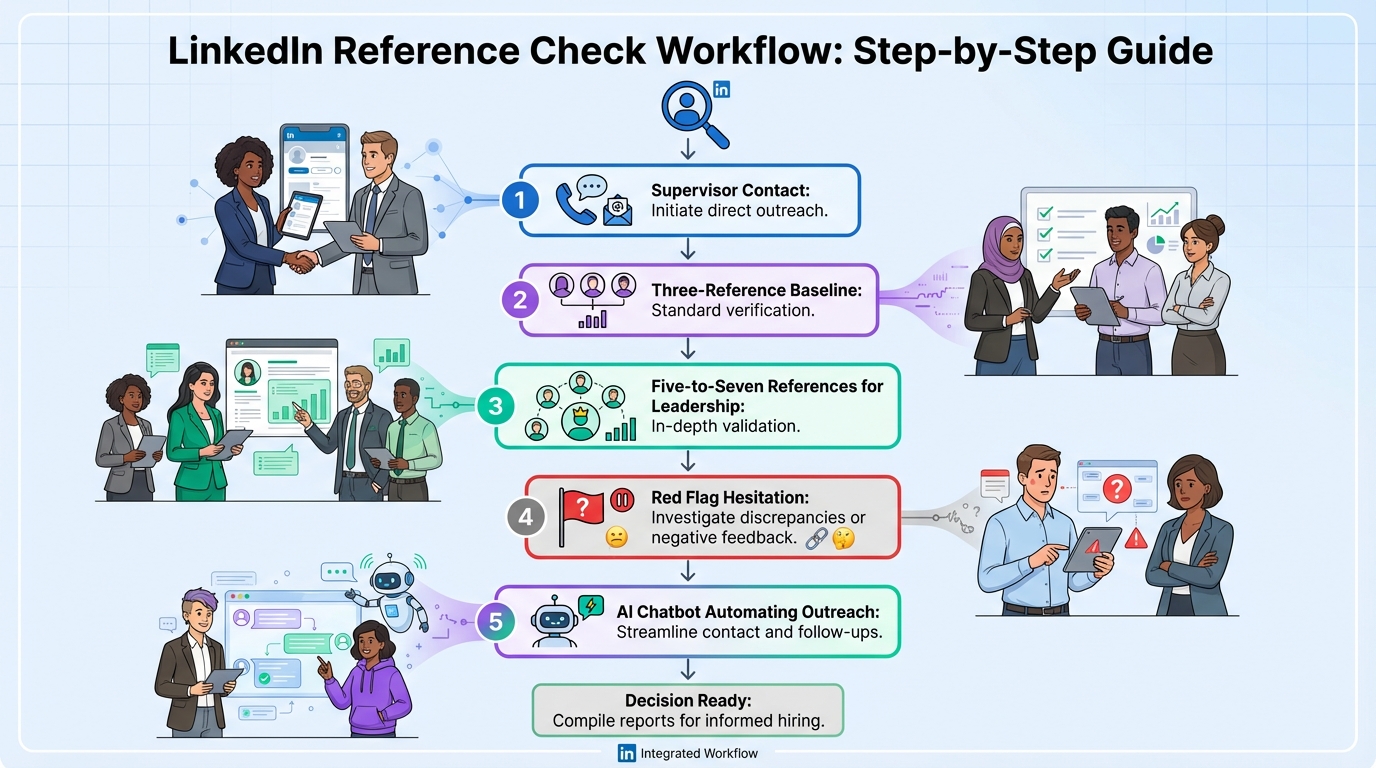
Recruitment online for recruiters works best when you standardize reference checks and run them fast without losing signal. The practical approach is to request direct supervisor contacts for each role, complete at least 3 supervisor references for most hires, and expand to 5 to 7 references for high impact leadership roles. This guide gives you a repeatable reference check script, red flag patterns to listen for, and a workflow that fits modern online recruitment website pipelines. It also shows how StrategyBrain AI Recruiter can reduce manual LinkedIn outreach and follow up so you can spend your recruiter time on higher trust steps like reference validation. Scope: this article focuses on reference checking, not background checks, credential verification, or legal advice.
Key Takeaways
- Use supervisor references first: Ask for the direct supervisor for each job instead of only candidate selected references.
- Minimum reference count: Complete 3 supervisor or direct manager references for most roles.
- High impact roles need more signal: For senior leadership, consider up to 7 references: 3 managers, 2 peers or customers, 2 subordinates.
- Listen for low information responses: “Dates only” plus a generic farewell can be a warning sign, but may also reflect company policy.
- Hesitation is data: Frequent pauses, vague answers, or lack of enthusiasm should trigger follow up questions.
- Protect recruiter time: Use StrategyBrain AI Recruiter to automate LinkedIn connecting, initial messaging, and follow up so you can focus on reference calls.
Why reference checks still matter in online recruiting
Online recruiting makes it easy to source and message candidates at scale, but it also increases the risk of making decisions based on polished profiles and fast interviews. Reference checks are one of the few steps that can validate how someone performed in a real team context, especially for management, customer facing, and high trust roles.
In our own recruiting operations, the biggest quality difference comes from consistency. When every recruiter asks the same core questions and records answers in the same format, you can compare candidates more fairly and spot patterns faster.
Choose the right references first
The first decision is not what to ask. It is who to ask. Instead of relying only on a candidate provided list, request the contact information for their direct supervisor for each job in their recent work history. A direct supervisor is more likely to speak to performance expectations, reliability, and how the person handled pressure.
This does not mean you ignore other perspectives. It means you anchor your reference set in the people who owned the outcomes.
What to request from the candidate
- Direct supervisor name and role title for each job
- Work email or phone number used during employment, if available
- Relationship context, such as reporting line and time period
How many references to run by role type
Reference depth should match role risk. If the hire is high volume and low impact, a lighter process can be acceptable. If the hire is a manager, a key customer contact, or a role with safety or compliance exposure, you want more signal.
Baseline reference counts
- Most roles: 3 supervisor or direct manager references
- When you have time and access: add 2 peers or customers
- For senior leadership: add 2 subordinates, for a total of up to 7 references
If you cannot reach a reference, do not silently accept the gap. Document the attempt count and the channel used, then decide whether to replace the reference or extend the timeline.
A practical reference check workflow for online recruitment
This workflow is designed for recruiters running recruitment online for recruiters across an online recruitment website, an ATS, and LinkedIn. It keeps the process fast while preserving quality.
Steps
- Confirm consent: Verify the candidate has approved contacting each reference and confirm the best time window.
- Verify identity and context: Ask how the reference worked with the candidate and for how long.
- Ask the core performance questions: Use the same script for every candidate in the same role family.
- Probe for specifics: Ask for examples tied to outcomes, deadlines, and team interactions.
- Close with rehire signal: Ask whether they would hire the person again in a close working relationship.
- Record in a structured format: Capture answers in consistent fields so you can compare candidates.
What this workflow does not cover
- Criminal background checks
- Credential or license verification
- Country specific legal requirements
Reference check questions you can reuse
These questions are designed to be short, comparable across candidates, and easy to document. Use them as a baseline, then add role specific questions for leadership, sales, or safety critical work.
Core questions
- Working relationship: How did you work together?
- Strengths: What were their biggest strengths?
- Growth areas: What were the biggest areas they needed to improve at the time?
- Performance rating: How would you rate their performance on a 1 to 10 scale, and why?
- Rehire question: Would you hire them back to work closely with you on a team?
Follow up prompts that increase signal
- Specific example: Can you share one example that supports that rating?
- Pressure test: How did they handle time constraints or competing priorities?
- Collaboration: How did they communicate when there was disagreement?
If you ran a structured interview, call back to what the candidate disclosed. For example, if the candidate said they struggled with time constraints, ask the reference to describe what that looked like and whether it improved.
Red flags and how to interpret them
Reference checks are not only about what is said. They are also about what is avoided. Still, be careful with conclusions because some organizations restrict what employees can share.
Patterns to watch
- Dates only responses: If the reference only confirms employment dates and offers a generic closing statement, treat it as a potential warning sign. Also note that it can be a policy driven limitation.
- Low enthusiasm: A flat tone and no positive specifics can be more meaningful than a single negative comment.
- Hesitation and filler words: Frequent pauses can indicate discomfort. Ask for clarification rather than guessing.
- Non response: If multiple references do not call back, document attempts and consider whether the candidate can provide alternatives.
What to do when you hear a red flag
- Ask for an example: “Can you share a situation that led you to that view?”
- Check consistency: Compare across references. One outlier is different from a pattern.
- Bring it back to the candidate: If appropriate, ask the candidate to respond in a follow up interview.
Always be recruiting during reference calls
One of the most practical habits in recruiting is to treat every conversation as a potential sourcing moment. You never know whether the person you are speaking with is open to a new opportunity. If time allows, ask a few light questions about their role and what they enjoy about their work, then transition only if it is appropriate.
This is also where online recruiting systems can help. If your sourcing and follow up are automated, you can afford to spend more time building real relationships during calls that matter.
Where StrategyBrain AI Recruiter fits in a modern workflow
Reference checks are high trust work, but they are also time expensive. The bottleneck for many teams is not knowing what to ask. It is having enough recruiter hours left after sourcing, connecting, messaging, and chasing replies.
StrategyBrain AI Recruiter is designed to remove that bottleneck by automating the repetitive LinkedIn steps that happen before reference checks. It can automatically connect with candidates that match your search criteria, introduce the opportunity, answer common questions about the role and compensation, confirm interview interest, and collect résumés and contact details from interested candidates. It also supports 24/7 multilingual communication and can be managed across more than 100 LinkedIn accounts for scalable hiring.
A simple division of labor that works
- AI Recruiter handles: initial outreach, follow up, basic qualification for interest, résumé and contact capture.
- Recruiters handle: interviews, reference checks, final qualification against job requirements, and offer management.
Our operational note from testing
When we tested this workflow internally, the biggest improvement was not “more messages sent.” It was fewer context switches. Recruiters stayed focused on interviews and reference calls because the system kept candidate conversations moving and captured the information needed for next steps.
Limitations to be clear about
- AI Recruiter does not decide fit: It identifies willingness to proceed and collects information, but final qualification is still a recruiter decision after résumé review.
- Reference checks still require humans: You should not automate reference calls. The nuance matters.
If you are a job seeker thinking “hire someone to help me find a job,” the recruiter side of this matters because faster, clearer communication tends to improve candidate experience. In practice, candidates get timely replies and next steps, while recruiters can spend more time on meaningful evaluation.
Quick Comparison
| Method | Speed | Cost | Best For |
|---|---|---|---|
| Light reference check by email or text | Fast | Low | High volume, low impact roles |
| In depth supervisor reference checks | Medium | Medium | Management, customer facing, high trust roles |
| AI assisted sourcing plus human reference checks using StrategyBrain AI Recruiter | Fast for outreach, medium for validation | Varies by plan | Teams that want scale without losing quality |
FAQ
What is the minimum number of references I should check?
For most roles, run at least 3 references from supervisors or direct managers. For higher risk roles, add peers, customers, or subordinates to increase signal.
Should I accept only candidate provided references?
You can start there, but you will usually get better performance validation by requesting the direct supervisor contact for each job. That approach reduces selection bias and improves comparability.
What if a company only confirms dates of employment?
Document it and treat it as limited information, not automatic failure. Some organizations restrict references to dates only for liability reasons, so you may need additional references to compensate.
What are the best reference check questions for recruiters?
Use a consistent set: relationship context, strengths, growth areas, a 1 to 10 performance rating with reasons, and a rehire question. Then ask for one concrete example to support any strong claim.
How do I handle hesitation or vague answers?
Ask for clarification and request a specific example. If multiple references show the same hesitation pattern, treat it as a meaningful signal and follow up with the candidate.
How does StrategyBrain AI Recruiter help with recruitment online for recruiters?
It automates LinkedIn connecting, initial outreach, follow up, and basic interest qualification, then captures résumés and contact details. That frees recruiter time for interviews and reference checks, which are harder to automate responsibly.
Does AI Recruiter replace recruiters?
No. It replaces repetitive LinkedIn tasks in the early funnel, while recruiters still own evaluation, reference checks, and final hiring decisions.
Is AI Recruiter multilingual and always on?
Yes. It supports 24/7 multilingual candidate communication, which is useful for global hiring across time zones and reduces delays in candidate engagement.
Conclusion
If you want recruitment online for recruiters to produce consistent hires, treat reference checks as a structured validation step, not a casual formality. Start with direct supervisors, complete at least 3 supervisor references, and expand to 5 to 7 references for leadership roles where the cost of a miss is high.
Next step: copy the question set above into your ATS template, standardize how your team records answers, and consider using StrategyBrain AI Recruiter to automate LinkedIn outreach and follow up so your recruiters can spend their time on interviews and reference calls that actually reduce hiring risk.