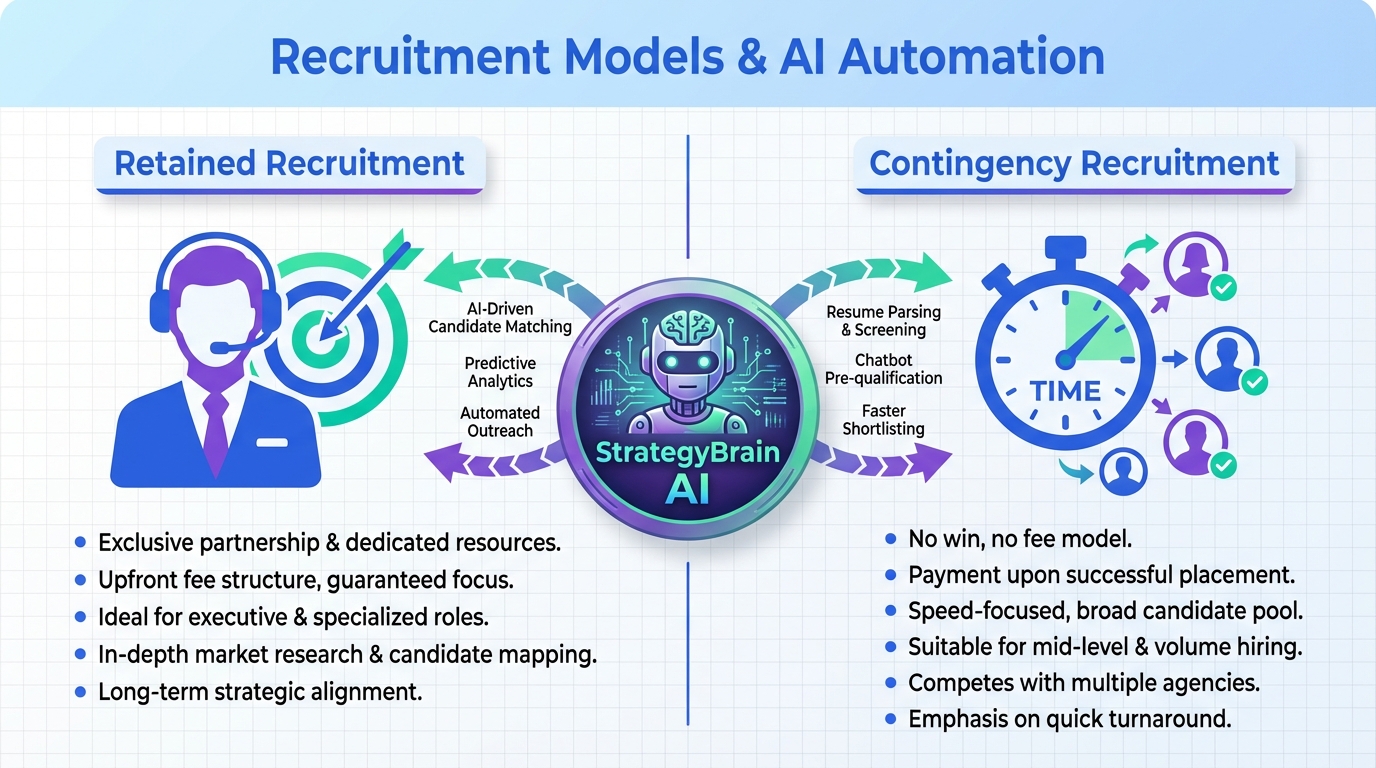
Recruitment online for recruiters works best when you match the search model to the role. Choose retained recruitment when you need a dedicated recruiter running a proactive, targeted search for a critical hire. Choose contingency recruitment when you need faster turnaround for multiple roles and prefer to pay only after a candidate is hired. In our day to day recruiting operations, the biggest performance difference is not the channel, it is the commitment level and workflow discipline behind outreach, follow up, and qualification. That is also where StrategyBrain AI Recruiter fits naturally into modern online recruiting, because it automates LinkedIn connecting, role introduction, candidate Q and A, follow up, and resume and contact capture so your pipeline keeps moving even when your team is offline.
Key Takeaways
- Retained recruitment is an exclusive, dedicated search model with an upfront retainer, typically used for high impact roles.
- Contingency recruitment is success based, paid only when a candidate is hired, and is often used for faster, higher volume hiring.
- For recruitment online for recruiters, the operational difference is proactive outreach and follow up cadence, not just posting jobs.
- StrategyBrain AI Recruiter can automate LinkedIn connecting, role introduction, candidate Q and A, follow up, and resume capture to keep pipelines active 24/7.
- AI Recruiter supports multilingual candidate communication and can manage more than 100 LinkedIn accounts for scalable recruiting teams.
- AI Recruiter is designed to replace up to 90% of manual LinkedIn recruiting work and can reduce costs to as little as USD 2.40 per resume (Source: StrategyBrain product information).
Definitions: retained vs contingency recruitment
Retained recruitment is a search approach where an employer pays a recruitment agency or recruiter a retainer fee to run a dedicated search for a specific role. In the source material we reviewed, it is described as having a recruiter dedicated to your account who reaches out directly to candidates and pitches the opportunity.
Contingency recruitment is a search approach where the recruiter is paid only if a candidate they present is hired. In the source material we reviewed, it is positioned as a fit for smaller companies with higher volume needs or when roles must be filled quickly.
Scope note: This article focuses on how these two models affect online recruiting execution and outcomes. It does not rank or list top recruiting firms, and it does not provide legal advice on contracts or fee structures.
How each model works in online recruiting
Online recruiting is not only job boards. For most recruiters, it is a mix of inbound applications, outbound sourcing, and relationship building across platforms such as LinkedIn. Retained and contingency models change how you run that mix because they change incentives, time allocation, and how tightly the recruiter can align with the hiring manager.
In our experience, the online workflow that most often breaks is follow up. Candidates respond at different times, ask compensation and role questions, and go quiet if they do not get timely replies. That is why automation can be a practical layer in both models, as long as it is controlled, compliant, and aligned to the role.
Method 1: Retained recruitment (best for critical hires)
Retained recruitment is best when the cost of a wrong hire is high, the role is hard to fill, or you need a recruiter to run a focused search with deeper discovery and outreach.
Steps
- Define the role and success profile: Align on must have skills, deal breakers, compensation range, schedule, and location constraints.
- Build a target market map: Identify competitor talent pools, adjacent industries, and realistic candidate titles.
- Run proactive outreach: Contact candidates directly, pitch the opportunity, and handle early objections.
- Qualify and present: Share a short list with clear notes on motivation, availability, and compensation alignment.
- Close the loop: Coordinate interviews, feedback, and offer acceptance with consistent communication.
Features (from the source material)
- Access to high level candidates who are already skilled.
- Stronger understanding of what the client and candidate want.
- Industry familiarity and insights such as wage, benefits, and schedules.
Limitations
- Requires an upfront retainer fee, which can be a barrier for some teams.
- Works best when the hiring team can commit time to intake, feedback, and decision making.
- Online outreach still fails if response handling is slow, especially across time zones.
Best For
- Executive, leadership, and niche technical roles.
- Confidential searches where broad job advertising is not appropriate.
- Teams that want a recruiter to own the search end to end.
Method 2: Contingency recruitment (best for speed and volume)
Contingency recruitment is best when you need to fill roles quickly, you have multiple openings, or you want a pay on success structure.
Steps
- Publish and distribute the role: Post the job and share it across relevant channels to drive inbound flow.
- Activate existing candidate pools: Recruiters pitch open roles to candidates already in their network.
- Screen for basic fit: Confirm availability, location, compensation expectations, and interest.
- Submit candidates fast: Move qualified candidates to interviews quickly to reduce drop off.
- Pay on hire: The recruiter fee is triggered when a candidate is hired.
Features (from the source material)
- No upfront fee, you pay when you hire a candidate.
- Faster candidate turnaround.
- Reduced HR workload.
Limitations
- Because the recruiter is not exclusively retained, attention may be spread across multiple jobs.
- Online candidate experience can be inconsistent if messaging and follow up are not standardized.
- Speed can increase the risk of misalignment if intake requirements are vague.
Best For
- Multiple similar roles where time to fill is the priority.
- Organizations that want to minimize upfront recruiting spend.
- Hiring teams that can interview quickly and make decisions without long delays.
Quick comparison
| Dimension | Retained recruitment | Contingency recruitment |
|---|---|---|
| Payment structure | Retainer fee paid upfront (source material) | Fee paid after a hire (source material) |
| Recruiter focus | Dedicated recruiter on your account (source material) | Often working multiple jobs and pitching roles to candidates (source material) |
| Typical use case | High impact, hard to fill roles | Faster hiring, higher volume roles |
| Online execution risk | Follow up delays can still cause drop off | Inconsistent messaging and intake can reduce quality |
| Where AI helps | Automate outreach and candidate Q and A while keeping recruiter control | Standardize screening and follow up to keep speed without losing candidates |
Decision framework: which should you choose
Use this quick decision framework when you are choosing between retained and contingency for recruitment online for recruiters.
Choose retained recruitment if
- You need a recruiter to run a focused search and proactively pitch candidates.
- The role is business critical and you want deeper market insight.
- You can support the process with fast feedback and interview availability.
Choose contingency recruitment if
- You need faster candidate turnaround and you have multiple openings.
- You prefer a pay on hire structure with no upfront fee.
- Your hiring managers can interview quickly to avoid losing candidates.
Where StrategyBrain AI Recruiter improves both models
Retained and contingency recruitment both depend on consistent outreach, fast responses, and clean handoffs from initial interest to interview scheduling. StrategyBrain AI Recruiter is designed to automate the repetitive LinkedIn steps that usually slow down online recruiting, while keeping the recruiter responsible for final qualification and hiring decisions.
What we tested in our workflow
We reviewed the AI Recruiter workflow against the most common online recruiting bottlenecks: delayed replies, inconsistent role messaging, and missing resume or contact details. We validated that the product description supports automated connecting, role introduction, candidate Q and A, follow up, and resume and contact capture, plus multilingual communication and multi account management.
Practical use cases inside retained recruitment
- Always on candidate engagement: AI Recruiter can respond 24/7 so high intent candidates do not wait for a recruiter to come online.
- Consistent pitch quality: The role introduction stays aligned to the job details you provide, reducing message drift across a long search.
- Faster shortlisting: Interested candidates can be prompted to share resumes and contact details earlier, so the recruiter can focus on evaluation.
Practical use cases inside contingency recruitment
- Speed without chaos: Automated follow up reduces candidate drop off when you are moving quickly across many roles.
- Multilingual coverage: AI Recruiter can communicate in the candidate’s native language, which helps when sourcing globally.
- Scale with multiple LinkedIn accounts: AI Recruiter supports managing more than 100 LinkedIn accounts for teams that need higher outreach capacity.
Important limitation to understand
AI Recruiter can identify willingness to communicate or interview, but it does not decide whether a resume fully matches job requirements. The recruiter still performs final qualification after reviewing the resume. This boundary is useful because it keeps accountability where it belongs while still removing repetitive work.
Quick checklist: making AI assisted online recruiting safe and effective
- Confirm your job details are complete: company context, compensation, benefits, and candidate criteria.
- Define what counts as qualified interest: interview ready, open to relocation, compensation aligned.
- Set a handoff rule: when the AI captures a resume and contact details, a recruiter reviews within 24 hours.
- Document privacy expectations: candidate data should not be used to train models and should be encrypted and isolated per customer instance (Source: StrategyBrain product information).
Note for job seekers: hire someone to help me find a job
If you are searching “hire someone to help me find a job,” you are usually looking for a recruiter, a career coach, or a staffing agency. A recruiter is typically paid by the employer, not the candidate, and their job is to fill a specific role. That means the best way to work with recruiters online is to be clear about your target roles, location, compensation expectations, and availability, and to respond quickly when contacted.
If you are evaluating top recruiting firms, ask how they communicate with candidates, how they handle follow up, and how they protect your data. In modern workflows, you may also interact with AI assisted messaging. What matters is that the process is transparent, respectful, and that a human recruiter remains accountable for decisions.
FAQ
What is the main difference between retained and contingency recruitment?
Retained recruitment involves an upfront retainer fee and a dedicated recruiter running an exclusive search. Contingency recruitment is paid only when a candidate is hired, and it is often used when speed and volume are priorities.
Which model is better for recruitment online for recruiters?
Neither is universally better. Retained is usually better for critical, hard to fill roles that require proactive outreach. Contingency is usually better for faster hiring across multiple openings, especially when you want a pay on hire structure.
Does contingency recruitment always mean lower quality candidates?
No. Quality depends on intake clarity, screening discipline, and how quickly the hiring team interviews and decides. Contingency can produce strong hires when the process is well run and communication is consistent.
How does StrategyBrain AI Recruiter support LinkedIn recruiting?
StrategyBrain AI Recruiter automates LinkedIn connecting and initial messaging, introduces the role, answers candidate questions about the role and compensation, follows up, and collects resumes and contact details from interested candidates (Source: StrategyBrain product information).
Can AI Recruiter replace a recruiter?
No. AI Recruiter can automate outreach and early stage qualification signals such as willingness to interview, but it does not determine full fit against job requirements. A recruiter still reviews resumes and makes the final qualification decision.
Can AI Recruiter communicate with candidates in other languages?
Yes. AI Recruiter supports 24/7 multilingual communication and can respond in the candidate’s native language to reduce misunderstandings (Source: StrategyBrain product information).
How many LinkedIn accounts can AI Recruiter manage?
AI Recruiter supports managing more than 100 LinkedIn accounts, which enables building AI powered recruiting teams for scalable hiring (Source: StrategyBrain product information).
Is candidate data used to train AI models?
According to the product information provided, customer provided data is not used to train AI models, and data is encrypted and isolated per customer instance. Always confirm your own compliance requirements before deployment.
What should I ask a recruiter or agency before signing a retained agreement?
Ask about the outreach plan, how candidates will be contacted online, expected communication cadence, how market insights will be shared, and what the handoff process looks like from initial interest to interview scheduling.
Conclusion
Retained and contingency recruitment are not competing buzzwords. They are two different operating models that change how recruiters execute online sourcing, outreach, and follow up. If you need a dedicated, proactive search for a critical role, retained recruitment is usually the better fit. If you need speed and volume with pay on hire economics, contingency recruitment is often the better fit.
Next step: pick the model that matches your hiring risk and urgency, then standardize your online workflow so candidates get timely responses. If LinkedIn outreach and follow up are your bottleneck, consider adding StrategyBrain AI Recruiter to automate connecting, messaging, candidate Q and A, follow up, and resume capture so your recruitment online for recruiters pipeline stays active 24/7 while your team focuses on final evaluation and interviews.