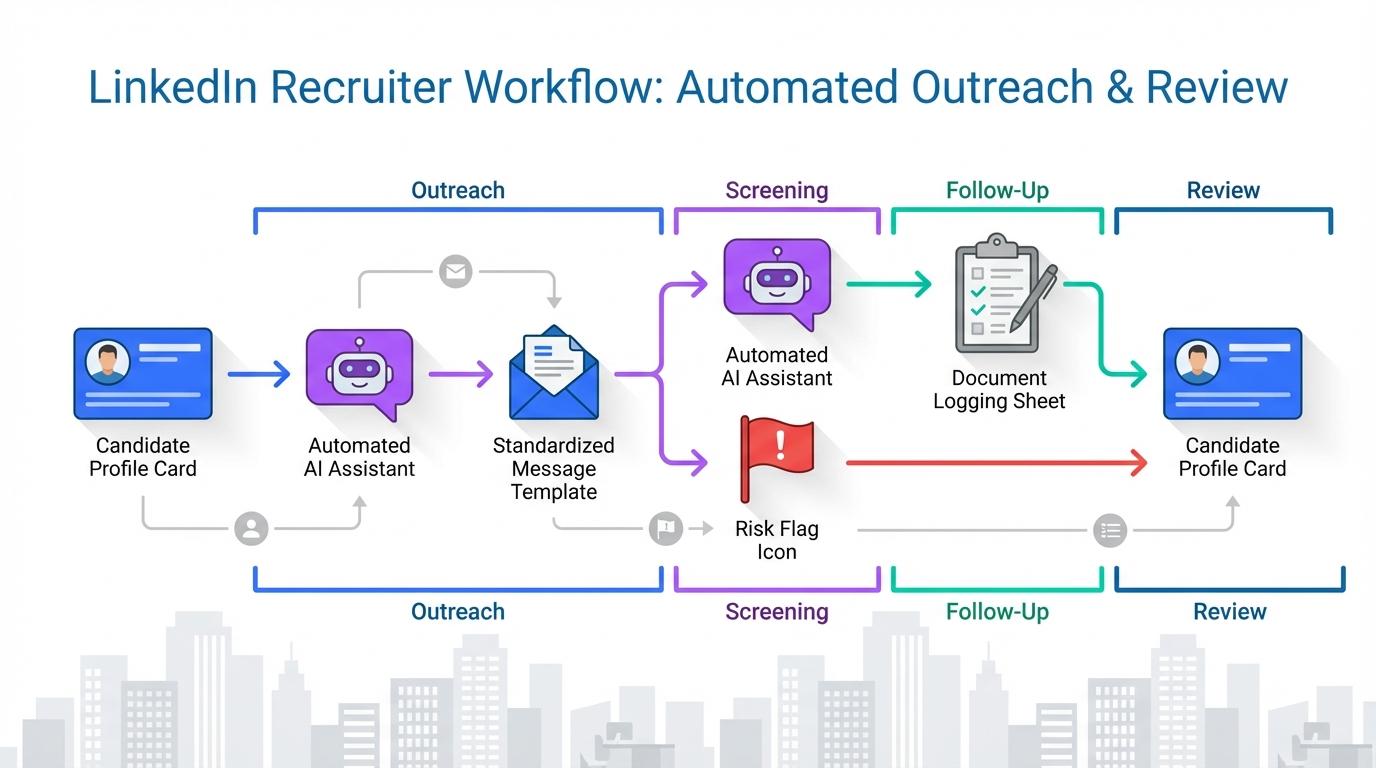
Recruitment online for recruiters works best when you treat every message, post, and workplace “moment” as a brand and compliance risk that can directly impact hiring outcomes. The most reliable approach is to set clear expectations, document incidents, and run consistent outreach and screening workflows so candidates get accurate information and your team avoids avoidable escalation. In this guide, we use real workplace examples to build a recruiter-ready playbook, then show how StrategyBrain AI Recruiter can automate LinkedIn outreach and follow-up with consistent, multilingual communication and structured data capture. This article covers operational practices and tooling patterns, not jurisdiction-specific legal advice.
Key Takeaways
- Online recruiting is public-facing: candidate messages and social posts can become evidence in disputes, so standardize what your team says and how it is logged.
- Risk clusters repeat: pranks, identity-based assumptions, and offensive costumes map to predictable hiring and retention risks that recruiters can mitigate with clear rules and documentation.
- Consistency beats improvisation: scripted outreach and qualification questions reduce misrepresentation risk and improve candidate experience at scale.
- Scale without losing control: StrategyBrain AI Recruiter can handle initial LinkedIn outreach, Q&A, and follow-up 24/7 in any language while capturing résumés and contact details for recruiter review.
- Know the boundary: AI Recruiter can confirm interest and collect information, but final fit assessment remains a recruiter decision after résumé review.
- When you need volume: if you are deciding where to hire a recruiter or whether a remote jobs temp agency model fits, automation can reduce manual workload before you add headcount.
Table of Contents
- Why online recruiting needs risk controls
- Three real-world risk patterns and what recruiters should do
- Method 1: Policy and documentation workflow (Recommended)
- Method 2: Standardize online candidate communication
- Method 3: Scale LinkedIn outreach with StrategyBrain AI Recruiter
- Method 4: When to use an agency or temp model
- Quick Comparison
- FAQ
- Conclusion
Why online recruiting needs risk controls
Online recruiting compresses time and expands reach, but it also amplifies reputational and compliance risk. A single screenshot of a message thread, a social post, or a workplace incident can change how candidates perceive your employer brand and can trigger internal investigations or external claims.
In practice, recruiters need two things to stay safe while moving fast: a repeatable process and a communication system that keeps messaging consistent. That is why “recruitment online for recruiters” is not only about sourcing channels. It is also about governance, documentation, and controlled candidate communication.
Three real-world risk patterns and what recruiters should do
The source material behind this guide describes three workplace Halloween-related incidents that escalated into serious consequences. Even though these are not “recruiting stories,” they are highly relevant to online hiring because they show how quickly poor judgment becomes a brand and legal problem.
1) Reckless pranks that cause harm
One example describes a 2010 incident in Taunton, Massachusetts, where a teacher wearing a mask and holding a chainsaw frightened a student who was then seriously injured. The student’s parents sued the school board for damages. For recruiters, the lesson is straightforward: safety incidents and “jokes” can become litigation, and litigation becomes a hiring and retention problem.
Recruiter action: ensure your intake process includes a risk flag for recent safety incidents, and align with HR on what can be shared with candidates. In online outreach, avoid casual language that minimizes safety concerns.
2) Thoughtless assumptions about identity and belief
Another example describes a 2013 UK case involving a convenience store employee who identified as a Wiccan and later received an award of 15,000 GBP after a discrimination claim. The operational takeaway for recruiters is not the holiday itself. It is that identity-based assumptions can trigger discrimination risk, and online messages can become discoverable records.
Recruiter action: keep candidate communication job-related, document decisions with role-based criteria, and train teams to avoid commentary on religion, politics, or protected characteristics in any channel.
3) Offensive costumes and social media fallout
A third example describes a 2013 Halloween party photo posted online that led to termination after it was seen as racist and in extremely poor taste. For recruiters, this maps to employer brand risk and to candidate trust. Candidates will judge your organization by what they see online and by how your team communicates.
Recruiter action: define a social media escalation path, clarify conduct expectations, and ensure recruiters have approved language for responding to candidate concerns without improvising.
Method 1: Policy and documentation workflow (Recommended)
If you only implement one improvement, make it a simple workflow that turns “online chaos” into consistent records. We use a lightweight framework we have applied in recruiting operations reviews: define, document, decide, and debrief.
Steps
- Define what is unacceptable: write a short conduct and communication standard for recruiters and hiring managers that covers pranks, harassment, discrimination, and social media behavior.
- Document incidents consistently: log date, people involved, what happened, and what actions were taken. Keep it factual and role-relevant.
- Decide who communicates externally: assign one owner for candidate-facing statements so messaging stays consistent across email, LinkedIn, and job boards.
- Debrief and update: after any incident, update your scripts, FAQs, and recruiter training notes so the same mistake does not repeat.
Features
- Lower miscommunication risk because candidates receive consistent answers.
- Faster escalation handling because ownership is clear.
- Better auditability because decisions are documented in a repeatable format.
Limitations
- Not legal advice: you still need jurisdiction-specific review for formal policies.
- Requires adoption: a workflow only works if recruiters and hiring managers actually use it.
Best For
- Teams scaling recruitment online for recruiters across multiple roles and locations.
- Organizations that have had brand or conduct incidents and want a controlled response process.
Method 2: Standardize online candidate communication
Online recruiting fails when every recruiter writes their own version of the role, compensation, and next steps. Standardization is not about sounding robotic. It is about accuracy, fairness, and speed.
Steps
- Create a role brief: include responsibilities, must-have requirements, location or remote policy, compensation range, and interview stages.
- Write an outreach script: keep it short, role-specific, and consistent across channels.
- Prepare a Q&A bank: approved answers for compensation, benefits, work authorization, and timeline.
- Log every touchpoint: store outreach, replies, and outcomes so you can measure conversion and defend decisions.
Features
- Improves candidate experience because expectations are clear.
- Reduces rework because fewer candidates drop due to confusion.
- Supports fair hiring because the same core information is shared consistently.
Limitations
- Needs maintenance: compensation, benefits, and process steps change and scripts must be updated.
- Does not create pipeline by itself: you still need sourcing volume and follow-up discipline.
Best For
- Recruiters managing multiple requisitions who need consistent messaging.
- Teams hiring internationally where language and time zones create friction.
Method 3: Scale LinkedIn outreach with StrategyBrain AI Recruiter
When recruiters ask “where to hire a recruiter,” the hidden issue is often workload, not talent. If your team is spending hours on repetitive LinkedIn tasks like connecting, introducing roles, answering basic questions, and chasing responses, automation can remove the bottleneck before you add headcount.
StrategyBrain AI Recruiter is built for LinkedIn hiring automation. It can automatically connect with candidates that match your search criteria, introduce the job opportunity, learn the candidate’s situation, answer questions about the role, company, and compensation, confirm interview interest, and collect résumés and contact information from interested candidates. It also supports 24/7 multilingual communication and can manage more than 100 LinkedIn accounts for scalable recruiting operations.
Steps
- Provide the LinkedIn account and role details: include company context, compensation, benefits, and candidate search criteria.
- Let AI Recruiter run initial outreach: it connects and starts structured conversations aligned to your role brief.
- Handle candidate Q&A consistently: the system answers common questions using the information you provided.
- Collect résumés and contact details: interested candidates share documents and contact info, which are captured for review.
- Recruiter reviews and qualifies: you make the final fit decision after reviewing the résumé and context.
Features
- Smart LinkedIn recruitment automation: replaces repetitive connecting and initial qualification steps.
- 24/7 global multilingual communication: supports candidate messaging in any global language to reduce misunderstandings.
- AI-powered recruitment teams: supports scaling across more than 100 LinkedIn accounts for high-volume hiring.
- Structured data capture: collects résumés and contact details from interested candidates for recruiter follow-up.
Limitations
- Not a final evaluator: AI Recruiter confirms willingness to proceed but does not decide whether a résumé fully matches requirements.
- Requires accurate inputs: if compensation, benefits, or role scope are unclear, candidate conversations will reflect that ambiguity.
Best For
- Agency recruiters and headhunters who need more outreach capacity without adding staff.
- Corporate recruiting teams hiring across time zones and languages.
- Teams comparing a remote jobs temp agency approach versus building direct pipeline through LinkedIn.
Method 4: When to use an agency or temp model
Sometimes the right answer to “where to hire a recruiter” is not a full-time hire. It can be a contract recruiter, a specialist agency, or a remote jobs temp agency model for short-term volume. The key is to decide based on time-to-fill pressure, role complexity, and internal capacity.
Steps
- Define the hiring spike: number of roles, seniority, and deadline.
- Choose the engagement type: contract recruiter for embedded execution, agency for niche sourcing, temp model for rapid throughput.
- Standardize messaging and handoffs: provide the same role brief, Q&A bank, and documentation rules you use internally.
Features
- Fast capacity increase without long-term headcount commitments.
- Specialization for hard-to-fill roles when internal sourcing is limited.
Limitations
- Consistency risk: external partners can drift from your messaging unless you provide scripts and governance.
- Knowledge loss: pipeline context can disappear when the engagement ends unless documentation is strong.
Best For
- Short-term hiring surges.
- Roles requiring specialized networks.
Quick Comparison
| Method | Speed to implement | Cost profile | Best for |
|---|---|---|---|
| Policy and documentation workflow | 3 to 7 days | Internal time | Reducing brand and compliance risk in online recruiting |
| Standardized candidate communication | 2 to 5 days | Internal time | Consistent outreach and fewer candidate drop-offs |
| StrategyBrain AI Recruiter for LinkedIn | 1 to 14 days | Tooling investment | Scaling outreach, follow-up, and multilingual messaging |
| Agency or temp model | 7 to 21 days | Service fees | Short-term capacity, niche roles, urgent hiring spikes |
FAQ
What does “recruitment online for recruiters” mean in practice?
It means sourcing, outreach, screening, and candidate communication happen primarily through digital channels like LinkedIn, email, and job boards. It also means your messages, response times, and documentation quality directly affect candidate trust and risk exposure.
How do I decide where to hire a recruiter versus using automation?
If the bottleneck is repetitive outreach and follow-up, automation can remove workload before you add headcount. If the bottleneck is deep assessment, stakeholder management, or niche domain expertise, hiring an experienced recruiter or specialist partner is usually the better move.
Can StrategyBrain AI Recruiter replace a recruiter?
No. It automates initial LinkedIn outreach, role introduction, Q&A, interest confirmation, and collection of résumés and contact details. Recruiters still make final qualification decisions after reviewing résumés and context.
How does AI Recruiter handle multilingual candidate communication?
It supports 24/7 messaging in any global language, using the candidate’s native language to reduce misunderstandings and cultural friction. This is especially useful for international hiring across time zones.
How are résumés and contact details collected?
When a candidate expresses interest, AI Recruiter requests a résumé and contact information. It supports email submissions and LinkedIn file uploads, and it captures contact details shared in the conversation for recruiter follow-up.
Is candidate data used to train AI models?
According to the product information provided for StrategyBrain AI Recruiter, customer-provided data is not used to train AI models and is used only to personalize communication for the customer’s AI instance. Data is described as encrypted and isolated per customer.
How does this relate to a remote jobs temp agency model?
A remote jobs temp agency can add short-term recruiting capacity, but it can also introduce inconsistency in messaging and handoffs. If your goal is to scale direct sourcing and keep communication consistent, LinkedIn automation plus strong documentation can reduce reliance on external throughput.
What is the biggest online recruiting mistake recruiters make?
Improvising in candidate messages. Inconsistent statements about compensation, role scope, or process timelines create trust issues and can escalate into disputes. Standard scripts and logged communication reduce that risk.
Conclusion
Recruitment online for recruiters is not only a sourcing problem. It is a consistency and risk-management problem. The incidents described in the source material show how quickly poor judgment can become a public issue, and online recruiting channels make that escalation faster.
Next steps: implement a simple documentation workflow, standardize your candidate messaging, and if LinkedIn outreach is your bottleneck, pilot StrategyBrain AI Recruiter to automate initial conversations, follow-up, and résumé collection while keeping recruiters focused on final qualification and interviews.