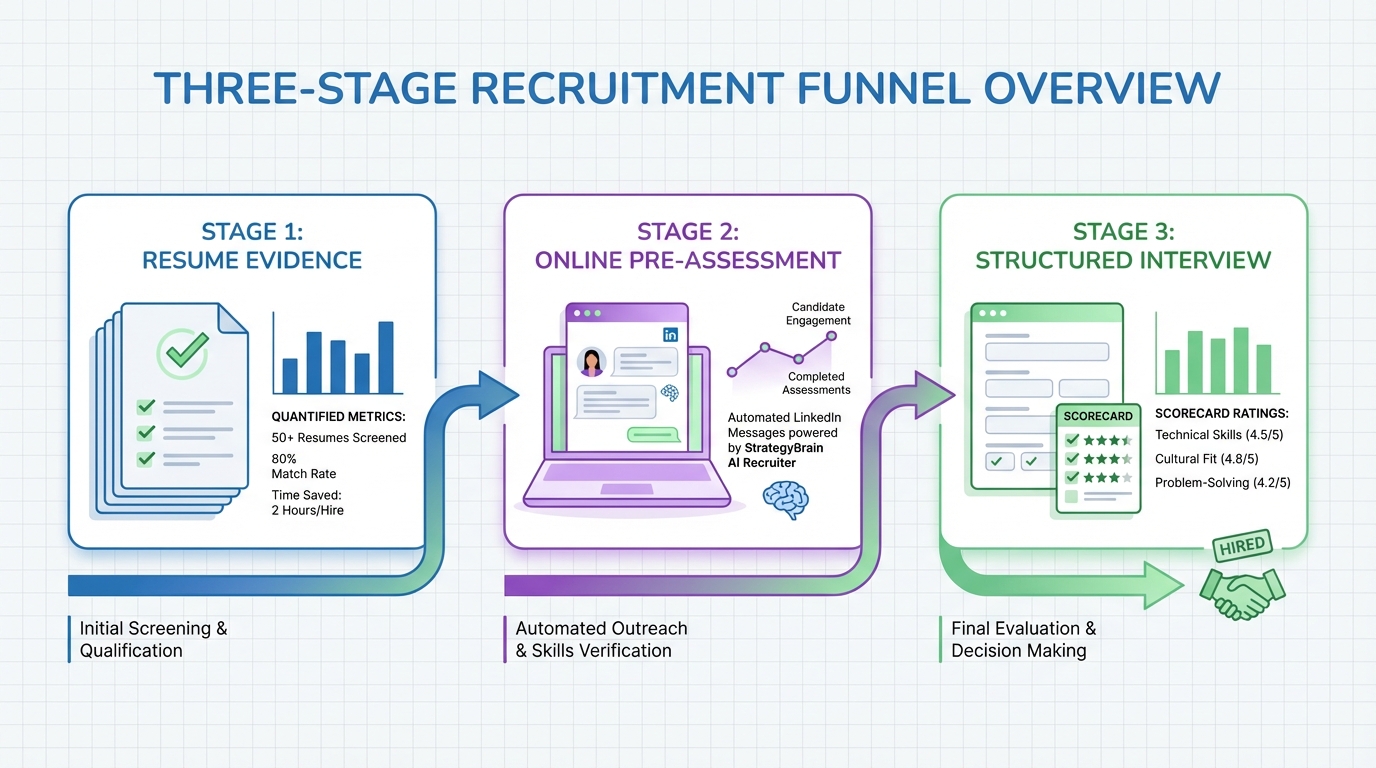
Recruitment online for recruiters is most effective when you use a repeatable system to separate true “A” performers from average applicants across three stages: what their resume proves, what their online footprint confirms before the interview, and what their interview answers quantify. We use a simple scorecard that prioritizes measurable outputs, evidence of innovation, credible benchmarks, and leadership behaviors. Then we validate those signals with targeted online research and a problem solving interview. In our day to day LinkedIn hiring workflow, StrategyBrain AI Recruiter helps us scale the top of funnel by automating initial outreach, answering candidate questions, confirming interview interest, and collecting resumes and contact details so recruiters can spend more time on evaluation and less time on repetitive messaging.
Key Takeaways
- Use a 3 stage filter: resume evidence, online pre assessment, then structured interview proof.
- Prioritize quantified outcomes: dollars, units, percentages, time saved, and delivery against deadlines and budgets.
- Look for innovation signals: new processes, systems, or approaches the candidate personally drove.
- Validate online: confirm work samples, public writing, and professional commentary before you invest interview time.
- Ask for problem solving steps: “walk me through your approach” reveals thinking quality faster than generic questions.
- Scale outreach without lowering standards: StrategyBrain AI Recruiter can automate LinkedIn connecting, messaging, follow up, and resume collection while your scorecard keeps quality consistent.
Method 1: Resume signals that often indicate an “A” performer
Resumes are imperfect, but in recruitment online for recruiters they are still the fastest first pass. The goal is not to “fall in love” with a document. The goal is to spot evidence patterns that correlate with high output and strong judgment, then verify them later.
What to look for (resume evidence)
- Quantified accomplishments: outcomes expressed with numbers and dollars, not only responsibilities.
- Innovation and improvement: the candidate built or redesigned a process, system, or approach.
- Competitive benchmarking: they compare results to industry peers or recognized standards.
- Tools and skills tied to outcomes: they name the tools used and connect them to measurable results.
- Delivery discipline: explicit “on time” and “under budget” language tied to projects.
- Product or service impact: market share, profitability, first to market, or adoption metrics.
- Advanced terminology used correctly: not buzzwords, but accurate language that signals real practice.
- Recognition: promotions, awards, internal recognition, or external validation.
- Team plus individual impact: they show collaboration, not only solo hero stories.
- Leadership in major work: they led a project, a change initiative, or a cross functional effort.
Limitations (what can go wrong)
- Great performers can have average resumes: some people under document their impact.
- Numbers can be context free: a “50% improvement” is meaningless without baseline and scope.
- Over optimized resumes exist: strong writing does not guarantee strong performance.
Best for
- High volume roles where you need a fast, consistent first screen
- Roles with measurable outputs such as sales, operations, engineering delivery, and finance
- Teams that want a shared definition of “top performer”
Method 2: Online pre assessment before the interview
Because “A” performers do not always present as “A” on paper, we add a lightweight online pre assessment step. This is where recruitment online for recruiters becomes a real advantage: you can validate signals quickly using public information and targeted outreach before scheduling a full interview.
Practical pre assessment tactics
- Referral validation: ask your current top performers if they know the candidate and whether they would recommend them.
- Peer check: ask recent hires from the candidate’s current company for a perspective on skill level and reputation.
- Online footprint review: look for articles, comments, or professional opinions that show depth and judgment.
- Work samples: review a portfolio, public projects, or examples of output where applicable.
- Pre interview questionnaire: ask the candidate to define top performer traits in their field and list the top 3 problems and opportunities in the industry.
- Advice request: ask how they would approach a critical problem your team is facing and why.
- Targeted email style prompt: reference a specific idea they shared publicly, then ask for their recommended steps on a real scenario.
Where StrategyBrain AI Recruiter fits (LinkedIn workflow)
In our LinkedIn sourcing process, StrategyBrain AI Recruiter can handle the repetitive parts of pre assessment communication. It can automatically connect with candidates that match your search criteria, introduce the opportunity, answer questions about the role, company, compensation, and benefits, confirm interview interest, and collect resumes and contact details from interested candidates. This keeps the pre assessment step moving even across time zones because it supports 24/7 multilingual messaging.
Limitations and safeguards
- Privacy and compliance: only use candidate data you are authorized to use and follow applicable privacy rules.
- False negatives: not every strong candidate posts publicly or has a visible portfolio.
- Bias risk: online presence can correlate with privilege, not performance. Use it to validate claims, not to replace evaluation.
Best for
- Remote hiring where online signals and async communication matter
- Recruiters building pipelines across regions and languages
- Teams that want faster response times without adding headcount
If you also work with a job agency for remote work or coordinate with top recruitment agencies in USA, this pre assessment layer helps you align on what “A performer evidence” looks like before candidates reach the hiring manager.
Method 3: Interview techniques that surface top performers
Once a candidate passes resume and online pre assessment, the interview should confirm performance through reasoning and proof. We prefer questions that force the candidate to show their thinking steps and quantify outcomes, because that is harder to fake than polished storytelling.
Interview prompts that work well
- Problem solving walkthrough: ask them to explain the steps they would use to solve your toughest problem and why they chose that approach.
- Past problem deconstruction: ask them to walk through how they solved a difficult problem in their current role.
- Two year forecast: ask what issues and opportunities your industry will face in the next 24 months and what signals they watch.
- Quantify outputs: ask for specific metrics, scope, and constraints, including time, budget, and baseline.
- Continuous improvement: ask how they embedded improvement into major projects and what they changed after learning.
- Learning system: ask how they keep up with new issues and solutions and how they test what they learn.
- Talent mapping: ask them to name other top performers they respect in the field and why, then compare to your own target list.
- Define “A vs C”: ask them to describe how they would differentiate top performers from average performers in their function.
Limitations
- Interview skill is not job skill: strong candidates can underperform in interviews, especially across cultures or languages.
- Unstructured interviews drift: without a scorecard, different interviewers reward different traits.
Best for
- Roles where judgment and problem solving matter more than credential signals
- Senior and leadership hiring where impact is multi factor
- Teams that want consistent evaluation across interviewers
Quick Comparison: 3 methods at a glance
| Method | Speed | Cost | Best For |
|---|---|---|---|
| Resume evidence screen | Fast | Low | High volume initial filtering |
| Online pre assessment | Medium | Low to Medium | Validating claims before interviews |
| Structured interview proof | Slower | Medium | Confirming reasoning, impact, and fit |
Copy and use: “A Performer” online scorecard
This is the practical tool we use to keep recruitment online for recruiters consistent across sourcers, recruiters, and hiring managers. Score each item from 0 to 2, where 0 means no evidence, 1 means partial evidence, and 2 means strong evidence with proof.
Resume scorecard
- Quantified outcomes with units such as dollars, percentages, time, or volume
- Innovation or process improvement ownership
- Benchmarks against competitors or recognized standards
- Tools and skills tied to outcomes
- Delivery against deadlines and budgets
- Recognition such as promotions or awards
- Leadership and teamwork evidence
Online pre assessment scorecard
- Work samples or public output that matches claimed skills
- Professional commentary that shows judgment and domain understanding
- Referral or peer validation when available
- Quality of answers to a short questionnaire or advice request
Interview scorecard
- Problem solving steps are clear, logical, and testable
- Impact is quantified with baseline, scope, and constraints
- Learning loop is explicit, including what they changed after feedback
- Forecasting shows signal awareness, not only opinions
Operational tip for scaling
If your bottleneck is outreach and follow up, keep the scorecard human owned but automate the messaging layer. StrategyBrain AI Recruiter can run the initial LinkedIn conversations, answer common questions, and collect resumes and contact details so your team can apply the scorecard to a cleaner, more qualified shortlist.
FAQ
What does “recruitment online for recruiters” mean in practice?
It means your sourcing, outreach, pre screening, and scheduling are designed for digital channels first, including LinkedIn messaging and online validation of candidate claims. The core requirement is a consistent evaluation system so speed does not reduce quality.
Can I identify “A” performers from resumes alone?
No. Resumes are a fast filter, but strong performers can under document their impact and weak performers can over optimize wording. Use resume signals as hypotheses, then validate with online pre assessment and structured interviews.
Which resume signals matter most?
Quantified outcomes, evidence of innovation, credible benchmarks, and leadership indicators are the most consistently useful. Also look for tools and skills tied directly to measurable results.
How do I pre assess candidates online without introducing bias?
Use online information to verify specific claims, not to reward visibility. When a candidate has limited public presence, rely more on structured questionnaires, referrals, and interview proof.
How can StrategyBrain AI Recruiter help with LinkedIn recruiting?
It automates initial LinkedIn outreach and qualification by connecting with candidates, introducing the role, answering questions about the company, compensation, and benefits, confirming interview interest, and collecting resumes and contact details. Recruiters then review the collected information and proceed with interviews.
Does StrategyBrain AI Recruiter replace recruiter judgment?
No. It is designed to replace repetitive messaging and early funnel tasks, not final qualification. Recruiters still evaluate resume fit, run interviews, and make hiring recommendations.
How does this apply to remote hiring and agencies?
Remote hiring increases the value of fast, consistent online workflows. If you partner with a job agency for remote work or coordinate with top recruitment agencies in USA, a shared scorecard and structured process reduces misalignment and improves shortlist quality.
What is the fastest way to improve quality without slowing down hiring?
Standardize your scorecard and automate the top of funnel communication. This combination keeps evaluation consistent while reducing time spent on manual outreach and follow up.
Conclusion
Recruitment online for recruiters becomes reliable when you treat “A performer” identification as a system, not a gut feeling. Start with resume evidence, validate with online pre assessment, and confirm with structured interviews that force candidates to show their thinking and quantify impact. If your team needs more throughput, keep the scorecard and decision making human led, and use StrategyBrain AI Recruiter to scale LinkedIn outreach, candidate Q and A, follow up, and resume collection so recruiters can focus on the work that actually requires expertise.