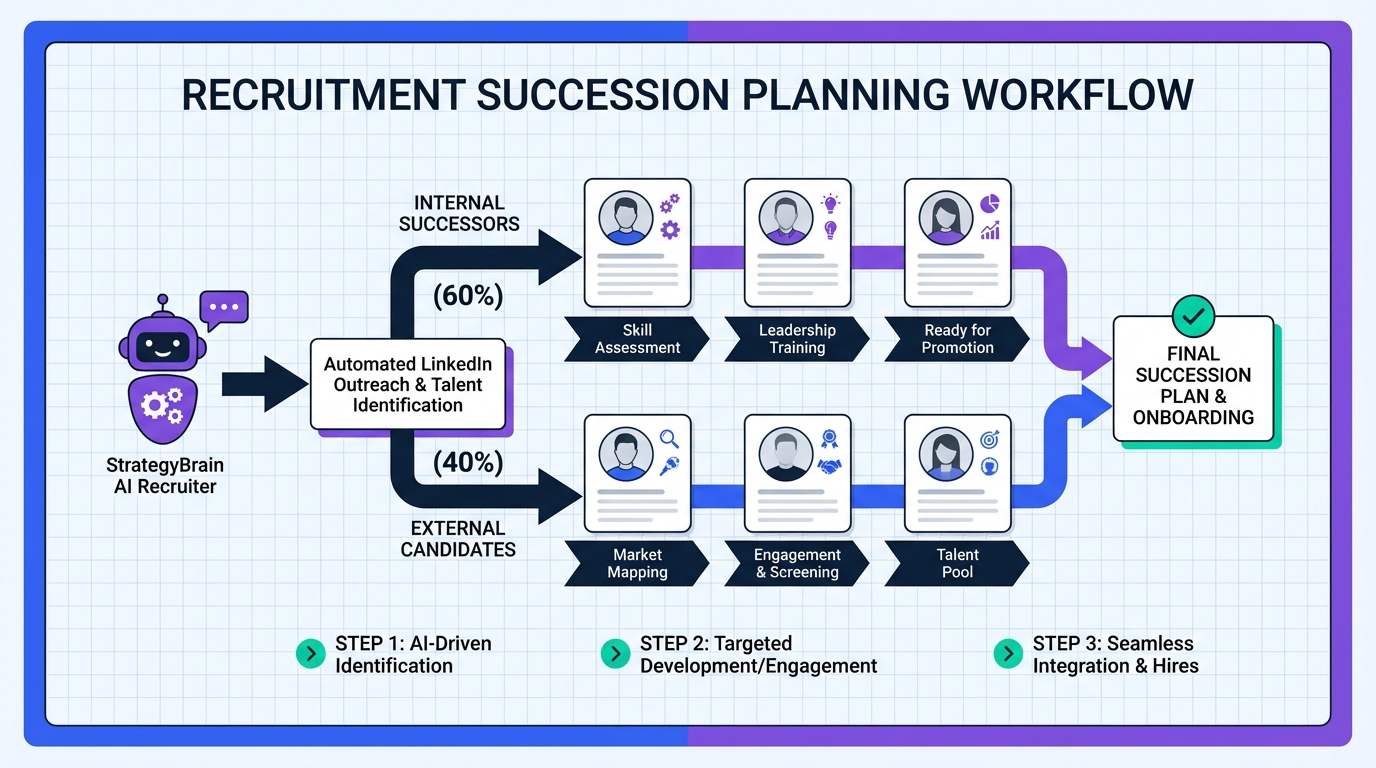
Recruitment online for recruiters works best when you treat succession planning as a repeatable hiring system, not a one time leadership exercise. The practical starting point is to identify the roles that would hurt the business within 30 days if they became vacant, define the outcomes and skills for each role, and then build two pipelines: internal successors and external candidates through recruiting companies and targeted LinkedIn outreach. In our day to day recruiting work, the biggest difference comes from disciplined communication and follow up, because succession candidates often need multiple touchpoints before they commit to a conversation. StrategyBrain AI Recruiter fits naturally into this workflow by automating early LinkedIn connecting, role introduction, Q and A, and résumé and contact collection, so recruiters can spend their time on interviews and final qualification.
The succession planning question recruiters hear most
An owner manager of an Edmonton based company once asked a question I have heard in different forms for years. They had owned and managed the business for 15 years, had a team of 60, and several senior people had been with the organization since the beginning. The question was simple. How urgent is it to develop a succession plan, and what trends are recruiters seeing in the market.
When we see this scenario, we treat it as both a leadership continuity problem and a recruiting capacity problem. If you wait until a senior leader resigns or retires, you are forced into reactive hiring, which usually increases time to fill and compensation pressure. If you plan early, you can build optionality through internal development and external pipelines, including support from top recruitment agencies when you need specialized reach.
Why succession planning is urgent in 2026
Recruiters tend to spot hiring shifts early because we see demand patterns across multiple employers and industries. One long running trend is the retirement wave. As reported by The Globe and Mail, Canada reached a point where there were more people over age 65 than under age 15, and the 50 to 69 age group represented 27 percent of the population compared with 18 percent two decades earlier. The same source noted people over 65 represented 16 percent of the population, which was double their proportion in 1971.
For succession planning, those numbers matter because they translate into higher probability of leadership turnover, more competition for experienced operators, and a greater need to develop internal talent. They also push recruiters toward recruitment online for recruiters workflows that can scale, because manual outreach alone struggles when multiple senior roles move at the same time.
Another important point is productivity. Many economists argue mature economies can offset demographic headwinds by increasing innovation and productivity. In practical recruiting terms, that means companies invest in technology and process improvements, and recruiting teams should do the same. If your succession plan depends on a recruiter manually sending every LinkedIn message and chasing every follow up, it will break under volume.
Key Takeaways
- Succession planning is a recruiting system: Treat it as ongoing pipeline work, not a one time org chart exercise.
- Demographics increase urgency: Canada’s 50 to 69 cohort was 27% of the population and 65+ was 16% (Source: The Globe and Mail, access date listed below).
- Split the pipeline in two: Build internal successors and an external bench through recruiting companies and LinkedIn.
- Standardize role profiles: Clear outcomes and skills reduce misalignment and speed up screening.
- Automate early outreach: StrategyBrain AI Recruiter can handle connecting, initial messaging, Q and A, and résumé collection on LinkedIn.
- Keep humans for final qualification: AI Recruiter confirms interest and gathers information, while recruiters make the final fit decision.
A recruitment online workflow for succession planning
Below is the workflow we use when we need succession planning to translate into real hiring outcomes. It is designed for recruiters who work with owner managed companies, public companies, and government teams, and it scales whether you are a solo recruiter or part of a larger recruiting company.
- Define critical roles: Identify roles where vacancy creates immediate operational risk.
- Write outcome based role profiles: Define what success looks like in 6 months and 12 months.
- Build an internal successor bench: Use a skills matrix and development plan.
- Build an external bench: Maintain warm candidates and passive prospects.
- Operationalize communication: Set follow up rules and response time targets.
- Review quarterly: Update readiness, compensation bands, and market availability.
Method 1: Build a role criticality map
Steps
- List leadership and specialist roles: Include senior management, finance leadership, operations leadership, and any role with unique knowledge.
- Score business impact: Use a 1 to 5 scale for impact if the role is vacant for 30 days.
- Score replacement difficulty: Use a 1 to 5 scale based on scarcity and ramp time.
- Prioritize the top 3 to 5 roles: Start where risk is highest.
Features
- Creates a shared definition of urgency between recruiters and leadership.
- Prevents spreading effort across too many roles at once.
- Improves alignment when working with top recruitment agencies or external recruiting companies.
Limitations
- It can become political if leaders feel their role is being ranked.
- It needs periodic updates when strategy changes.
Best For
- Owner managed companies with long tenured leaders.
- Organizations with multiple senior roles nearing retirement eligibility.
Method 2: Create a successor bench with a skills matrix
Steps
- Define the skill domains: For example, people leadership, financial acumen, operational execution, stakeholder management.
- Rate current capability: Use consistent levels such as developing, proficient, expert.
- Assign readiness: Ready now, ready in 12 months, ready in 24 months.
- Build development actions: Stretch projects, mentoring, and cross functional exposure.
Features
- Turns succession planning into measurable development work.
- Helps recruiters and HR managers explain why an external search is still needed.
- Supports consistent evaluation across departments.
Limitations
- Internal candidates may leave if timelines are unclear.
- Managers may overrate their team members without calibration.
Best For
- Companies that want to reduce external hiring risk for leadership roles.
- Recruiters partnering closely with HR on internal mobility.
Method 3: Run an external pipeline with recruiting companies and LinkedIn
Even with strong internal development, most succession plans need an external bench. This is where recruitment online for recruiters becomes a competitive advantage, because passive candidates respond to relevance and timing, not job postings alone.
Steps
- Build a target list: Identify comparable companies, titles, and functional backgrounds.
- Write a short outreach narrative: Focus on the business problem and why the role matters.
- Set a follow up cadence: For example, day 2, day 7, day 14, then monthly nurture.
- Track responses and objections: Compensation, location, timing, and scope are the most common.
Features
- Creates optionality before a vacancy occurs.
- Supports confidential searches when leadership transitions are sensitive.
- Pairs well with specialized recruitment consultants and top recruitment agencies when you need deeper networks.
Limitations
- Manual LinkedIn outreach does not scale well across multiple roles.
- Response rates drop when messaging is generic or inconsistent.
Best For
- Succession planning for operations, finance, and senior management roles.
- Recruiting companies managing multiple concurrent leadership pipelines.
Method 4: Use StrategyBrain AI Recruiter to automate early outreach and follow up
When we tested AI assisted outreach workflows for succession pipelines, the bottleneck was not sourcing. The bottleneck was consistent, timely conversation management across time zones and languages. StrategyBrain AI Recruiter is designed for LinkedIn hiring and can take over the repetitive front end of the process while keeping recruiters in control of final decisions.
What it does in a succession pipeline
- Automatically connects with candidates who match your search criteria.
- Introduces the opportunity and handles early questions about role, company, and compensation based on the information you provide.
- Confirms interview interest and collects résumés and contact details from interested candidates.
- Responds 24/7 in any language so candidates do not wait for business hours.
Steps
- Prepare the role brief: Company context, compensation, benefits, and candidate criteria.
- Define the LinkedIn search: Titles, industries, locations, and must have skills.
- Set conversation guardrails: What the AI can answer and what should be escalated to a recruiter.
- Review collected résumés: Recruiters complete final qualification and schedule interviews.
Limitations
- AI Recruiter confirms willingness to engage and interview, but it does not decide whether a résumé fully matches job requirements. Recruiters still make the final fit decision.
- Like any LinkedIn based workflow, it depends on having a clear search strategy and compliant account usage.
Best For
- Recruiters who need consistent follow up across many passive candidates.
- Teams hiring globally where multilingual communication reduces friction.
- Organizations that want to scale outreach across many LinkedIn accounts as an AI powered recruiting team.
Quick Comparison
| Method | Speed to start | Cost | Best For |
|---|---|---|---|
| Role criticality map | 1 to 2 days | Internal time | Prioritizing which succession roles matter most |
| Successor bench and skills matrix | 1 to 3 weeks | Internal time | Developing internal leaders and reducing external risk |
| External pipeline with recruiting companies and LinkedIn | 3 to 7 days | Varies by approach | Building a warm bench for confidential or high impact roles |
| StrategyBrain AI Recruiter for LinkedIn automation | Same day once role brief is ready | Varies by plan | Scaling outreach, Q and A, and follow up without adding recruiter headcount |
Copy and use: Succession planning recruiting checklist
- Identify top 3 to 5 critical roles and define vacancy impact within 30 days
- Write outcome based role profiles for 6 month and 12 month success
- Build an internal successor list with readiness categories
- Create an external target list and outreach narrative
- Set a follow up cadence and response time target
- Decide what to automate with StrategyBrain AI Recruiter and what stays human led
- Review the plan quarterly and update compensation and market availability
FAQ
What does recruitment online for recruiters mean in practice?
It means your recruiting workflow is built around digital sourcing, messaging, follow up, and pipeline tracking rather than relying on inbound applicants alone. In succession planning, it usually includes LinkedIn outreach, structured screening, and consistent candidate communication.
How urgent is succession planning for a 60 person company?
It is urgent when a small number of senior leaders hold critical knowledge or decision authority. If one departure would disrupt operations within 30 days, you should treat it as a priority role and build both internal and external successors.
Do I need top recruitment agencies if I already have internal candidates?
Not always, but many teams still keep an external bench for risk management. Top recruitment agencies can be useful when the role is specialized, confidential, or time sensitive.
How does StrategyBrain AI Recruiter help with LinkedIn succession pipelines?
It automates early stage LinkedIn work such as connecting, introducing the role, answering common questions, confirming interest, and collecting résumés and contact details. Recruiters then review the information and complete final qualification and interviews.
Can AI Recruiter decide whether a candidate is qualified?
No. It identifies willingness to engage and interview, but it does not determine whether the résumé fully matches job requirements. Recruiters make the final fit decision after reviewing the résumé.
How does AI Recruiter handle multilingual candidates?
It can communicate in the candidate’s native language and respond 24/7, which reduces delays and misunderstandings across time zones. This is especially helpful when succession planning includes global hiring.
Is candidate data used to train AI models?
According to StrategyBrain product information, customer provided data is not used to train AI models, and data is encrypted and isolated per customer. Recruiters should still align usage with their internal privacy policies and applicable regulations.
What is the biggest mistake recruiters make in succession planning?
They treat it as a document instead of a pipeline. Without ongoing outreach, follow up, and periodic review, the plan becomes outdated before it is needed.
Conclusion
Succession planning becomes effective when it is executed like recruiting. Identify the roles that create immediate risk, define success outcomes, build an internal bench, and keep an external pipeline warm through recruitment online for recruiters practices. If you want to scale that pipeline without adding recruiter headcount, use StrategyBrain AI Recruiter to automate the early LinkedIn conversations, multilingual follow up, and résumé collection, then keep your recruiters focused on interviews and final qualification.
Next step: pick one critical role, build the role profile and target list this week, and set a quarterly review date so the plan stays current.