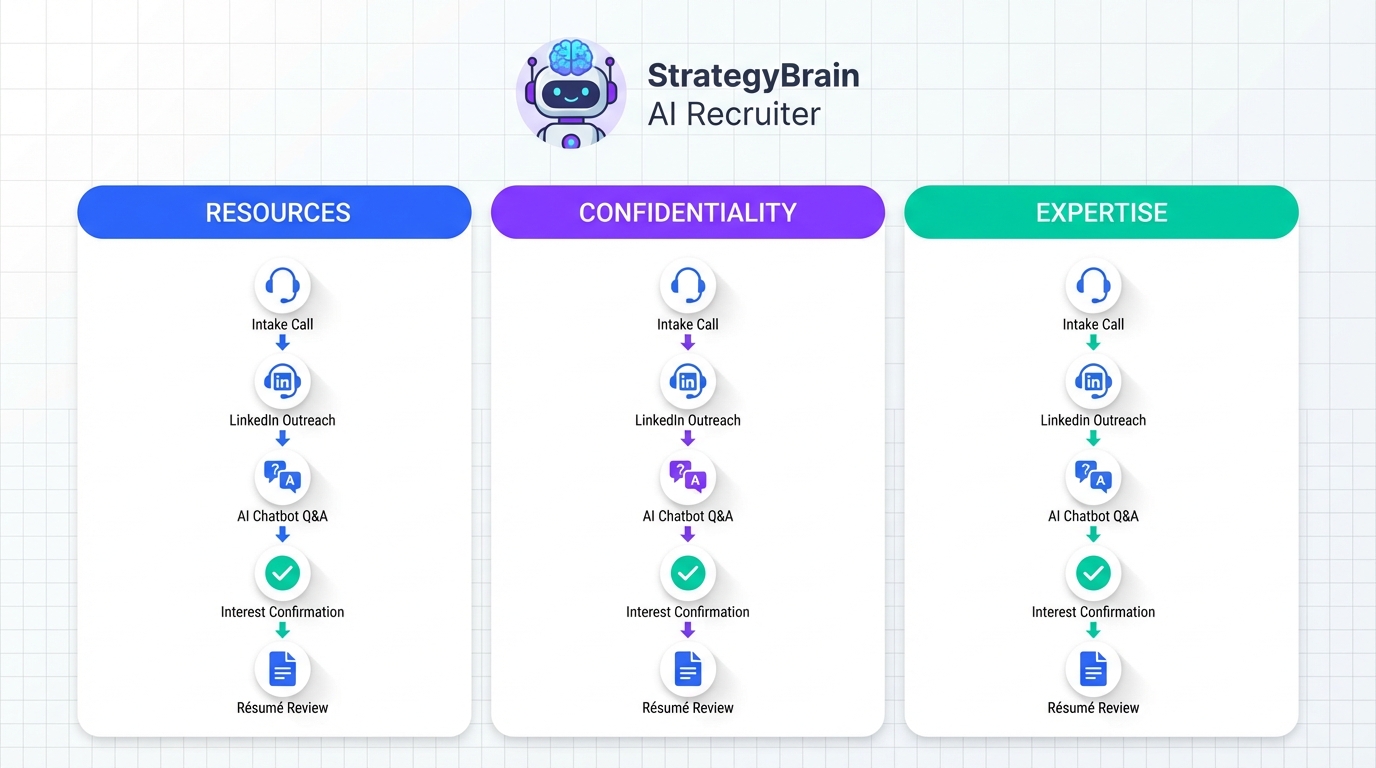
Recruitment online for recruiters works best when you match the hiring situation to the right delivery model: internal HR, external agency support, or LinkedIn-first automation. In our day to day recruiting operations, we see businesses most often turn to recruiters for three reasons: lack of resources, a need for confidentiality, or a need for specialized experience and expertise. This guide turns those scenarios into practical online workflows you can run immediately, including how StrategyBrain AI Recruiter can automate LinkedIn connection, job introduction, candidate questions, interest confirmation, and résumé plus contact capture so you can recruit for staff at higher volume without losing control of quality.
Key Takeaways
- Most “use a recruiter” moments fall into 3 buckets: lack of resources, confidentiality, or experience and expertise.
- Online execution matters: each bucket maps to a different workflow, messaging style, and risk profile.
- LinkedIn can be systematized: StrategyBrain AI Recruiter automates initial outreach, Q&A, interest checks, and résumé plus contact capture.
- Global hiring is an online operations problem: 24/7 multilingual messaging reduces time zone delays and misunderstandings.
- Scaling requires account operations: AI Recruiter supports managing more than 100 LinkedIn accounts for team style throughput.
- Be honest about limits: AI Recruiter confirms interest and collects materials, but final qualification still requires recruiter review.
Why businesses turn to recruiters
When a company says it “needs a recruiter,” it is usually describing a constraint, not a preference. The constraint might be time, internal capability, sensitivity, or uncertainty about whether the current shortlist is truly the best available. Recruitment online for recruiters is about diagnosing that constraint quickly, then choosing the right online channel mix and operating cadence.
Scope note: This article focuses on employer side scenarios and online execution. It does not list specific agencies or claim which provider is the best in any city. If you are searching “best staffing agencies for remote jobs near me,” use the evaluation checklist in this guide to compare options consistently.
Category 1: Lack of resources
Resource gaps are the most common reason businesses outsource recruiting. Online recruiting can solve the gap, but only if you define ownership for sourcing, screening, scheduling, and candidate communication.
Situation: No HR department
Some businesses do not have an internal HR team to run a structured hiring process. In these cases, the recruiter becomes the process owner and the online workflow must include intake, calibration, sourcing, and candidate management.
- Online workflow: intake call, scorecard, sourcing plan, outreach, screening, shortlist, interview scheduling.
- Where AI Recruiter fits: automate LinkedIn outreach and first response handling so the business does not need internal bandwidth for early stage messaging.
Situation: Hiring in a new jurisdiction
When a business expands into a new market or country, it often lacks local compensation context and candidate expectations. Online recruiting helps you reach local talent quickly, but you still need structured discovery to avoid mismatched offers.
- Online workflow: define location specific requirements, confirm compensation and benefits ranges, then run localized sourcing and messaging.
- Execution tip: use candidate conversations to surface “perk expectations” and role clarity early, then feed that back into the job brief.
Situation: Staffing issues in auxiliary markets
Companies with a strong HR function in a head office can still struggle to hire in smaller or remote markets. Online recruiting can bridge the distance, but the process must be consistent across locations.
- Online workflow: centralize the scorecard and interview plan, then run distributed sourcing and screening.
- How to recruit for staff: standardize screening questions and evaluation criteria so hiring managers in different cities compare candidates fairly.
Situation: Replacing the top employee or succession planning
Leadership transitions require careful messaging and controlled access to information. Online recruiting can widen the pool, but you must manage confidentiality and stakeholder alignment.
- Online workflow: confidential intake, stakeholder map, controlled outreach, staged disclosure, structured references.
- Where AI Recruiter fits: handle early LinkedIn engagement at scale while keeping sensitive details gated until later stages.
Category 2: Confidentiality requirements
Confidential searches are not only about secrecy. They are also about minimizing disruption and protecting relationships. Recruitment online for recruiters in this category is about secure communication, careful disclosure, and consistent documentation.
Situation: An employee is underperforming
Replacing an underperforming employee requires discretion. The search and selection process is often run off site to reduce operational disruption.
- Online workflow: anonymized job brief, controlled outreach, private screening, limited internal visibility until finalist stage.
- Risk control: keep candidate communications consistent and avoid sharing identifying company details too early.
Situation: Company structure changes
New divisions, acquisitions, or product lines can trigger hiring before the news is public. Online recruiting can move fast, but speed increases the chance of leaks if you do not control messaging.
- Online workflow: staged disclosure, NDA where appropriate, and a single source of truth for role details.
- Where AI Recruiter fits: automate initial conversations while ensuring the AI uses only the employer provided role and company information you authorize.
Situation: Top grading during market shifts
In a deflated market, companies may revisit their workforce and upgrade talent. Online recruiting helps you benchmark quickly, but you need a fair and documented evaluation process.
- Online workflow: define the new bar, run targeted sourcing, and use structured interviews to reduce bias.
- Execution tip: keep a written scorecard so decisions are defensible and consistent.
Situation: Competitive landscape sensitivity
Some companies avoid recruiting directly from competitors, especially in small markets where relationships matter. A recruiter can act as an intermediary to create distance and reduce reputational risk.
- Online workflow: intermediary outreach, neutral positioning, and careful handling of employer identity until interest is confirmed.
- How AI Recruiter helps: maintain consistent outreach and follow up cadence on LinkedIn while you control when the company name is disclosed.
Category 3: Experience and expertise
Sometimes the company has time and resources, but it wants confidence. In these scenarios, recruitment online for recruiters is about market mapping, validation, and process design.
Situation: Confidence of choice
Organizations may believe they already have a strong candidate, but want to validate that choice against the market. This can be run as a review process with a defined scope.
- Online workflow: market scan, targeted outreach, structured comparison, and decision support.
- Practical note: this can be structured as a fixed scope engagement when the goal is validation rather than full cycle recruiting.
Situation: Previous non success filling a similar role
If a company tried and failed to fill a role, the root cause is often unclear requirements, weak sourcing, or slow candidate experience. Online recruiting can fix these, but only if you diagnose the failure before restarting.
- Online workflow: postmortem, rewrite the scorecard, rebuild the sourcing plan, then relaunch outreach with tighter messaging.
- Where AI Recruiter fits: accelerate the relaunch by automating LinkedIn connection and early stage Q&A so candidates get timely responses.
How to run these scenarios online
Below is the operating playbook we use to translate the scenarios above into a repeatable online system. The goal is to reduce manual work while improving consistency and documentation.
Step by step implementation
- Classify the hiring situation
Pick one primary driver: resources, confidentiality, or expertise. This determines how much you disclose, how fast you move, and what you automate.
- Define the minimum viable intake package
Collect role outcomes, must have skills, compensation, benefits, and candidate search criteria. This is the information StrategyBrain AI Recruiter uses to introduce the role and answer candidate questions accurately.
- Choose your online channel mix
Use LinkedIn for targeted outreach, job boards for inbound volume, and referrals for trust. If the request looks like “best staffing agencies for remote jobs near me,” treat it as a vendor selection problem and compare providers using the checklist below.
- Automate early stage LinkedIn work with StrategyBrain AI Recruiter
We use AI Recruiter to automatically connect with candidates within defined search criteria, introduce the opportunity, learn the candidate’s situation, answer questions about the role, company, and compensation, confirm interview interest, and collect résumés and contact information from interested candidates.
- Keep humans on final qualification
AI Recruiter can confirm willingness to proceed and capture materials, but it does not decide whether a résumé fully matches requirements. A recruiter reviews the résumé and advances qualified candidates to interviews.
- Run a documented shortlist review
Use a scorecard and a consistent debrief format. This is especially important for confidential searches and leadership transitions.
A practical framework we use: the RCE triage
To make recruitment online for recruiters easier to operationalize, we use a simple triage we call RCE:
- R: Resources means the client needs process ownership and speed. Optimize for automation and throughput.
- C: Confidentiality means the client needs controlled disclosure and risk management. Optimize for staged messaging and documentation.
- E: Expertise means the client needs validation and market insight. Optimize for market mapping and structured comparison.
This is not a theory exercise. It tells you whether to lead with volume sourcing, discreet outreach, or a validation style market scan.
Limitations and honest pain points
- Automation can amplify unclear intake: if compensation or role scope is vague, automated messaging spreads that vagueness faster.
- Confidential searches require discipline: even small disclosure mistakes can create internal disruption.
- Global hiring adds operational load: time zones and language differences slow teams down unless you use 24/7 multilingual communication.
Quick Comparison
| Situation | Primary risk | Best online approach | Where StrategyBrain AI Recruiter helps most |
|---|---|---|---|
| No HR department | Process gaps | Recruiter owned workflow plus LinkedIn sourcing | Automates connection, intro, Q&A, interest confirmation, résumé and contact capture |
| New jurisdiction | Misaligned expectations | Localized sourcing plus structured discovery | 24/7 multilingual messaging to reduce time zone delays |
| Auxiliary markets | Inconsistent evaluation | Central scorecard plus distributed sourcing | Consistent outreach and follow up across markets |
| Succession planning | Confidentiality | Staged disclosure and controlled outreach | Scales early engagement while you gate sensitive details |
| Underperformer replacement | Internal disruption | Off site confidential process | Handles early conversations without tying up internal staff |
| Competitive sensitivity | Relationship risk | Intermediary outreach | Maintains cadence and documentation on LinkedIn |
| Confidence of choice | False certainty | Market validation scan | Rapid outreach to benchmark candidate availability |
| Previous non success | Repeating failure | Postmortem then relaunch | Speeds relaunch and improves candidate response time |
FAQ
What does “recruitment online for recruiters” mean in practice?
It means running sourcing, outreach, screening, and candidate communication through digital systems with clear ownership and documentation. The goal is faster cycle time and consistent candidate experience without sacrificing quality.
When should a business use a recruiter instead of hiring directly?
Use a recruiter when the business lacks internal resources, needs confidentiality, or needs specialized experience and expertise to validate choices or access talent. These are the most repeatable triggers we see across industries.
How can I recruit for staff faster without spamming candidates?
Start with a tighter intake and a clear candidate profile, then use structured messaging and follow up rules. StrategyBrain AI Recruiter helps by automating connection and early Q&A while keeping the conversation aligned to the job details you provide.
Can StrategyBrain AI Recruiter qualify candidates end to end?
It confirms willingness to proceed, answers role questions, and collects résumés and contact details from interested candidates. It does not determine whether a résumé fully matches job requirements, so a recruiter still performs final qualification.
How does AI Recruiter handle global candidates and time zones?
It provides 24/7 responses and can communicate in the candidate’s native language. This reduces delays and misunderstandings that often happen when teams only message during one time zone’s business hours.
Is it possible to scale LinkedIn recruiting across multiple accounts?
Yes, if you treat it as an operations system with governance and consistent messaging. AI Recruiter supports managing more than 100 LinkedIn accounts so teams can scale outreach capacity while keeping workflows consistent.
How should I respond to “best staffing agencies for remote jobs near me” requests?
Clarify whether the requester wants local compliance support, remote sourcing reach, or speed. Then compare agencies on process transparency, candidate communication standards, and how they handle remote screening and onboarding.
What is the biggest mistake in confidential online recruiting?
Sharing identifying details too early or inconsistently across channels. Use staged disclosure, keep a single approved job brief, and document what is shared at each stage.
Conclusion
Recruitment online for recruiters is most effective when you start with the real reason the business is seeking help: resources, confidentiality, or expertise. Once you classify the situation, you can choose the right online workflow and decide what to automate. If your bottleneck is LinkedIn outreach and early stage back and forth, StrategyBrain AI Recruiter can take over connection, role introduction, candidate Q&A, interest confirmation, and résumé plus contact capture so you can focus your time on final qualification and closing. Next step: pick one open role, run the RCE triage, and implement the step by step workflow above for 14 days, then review response rates and shortlist quality.