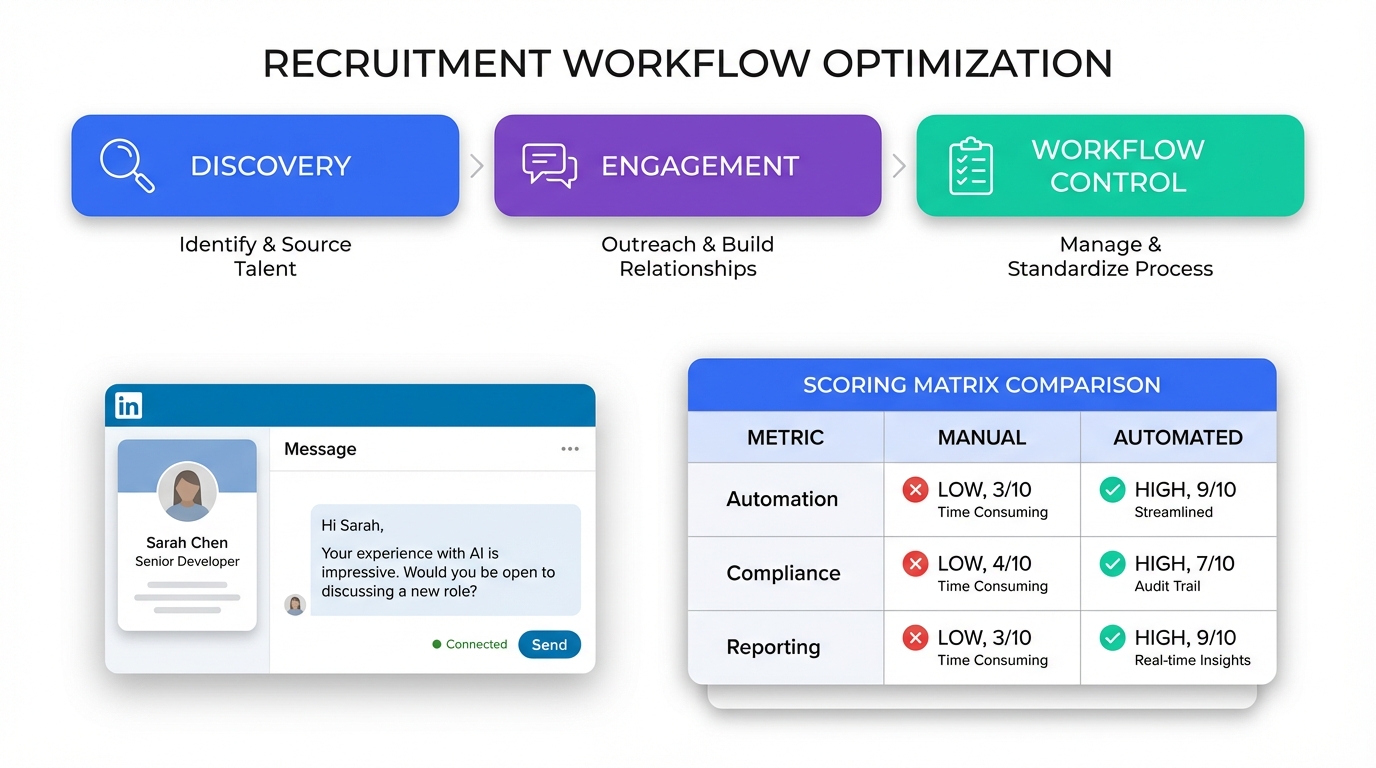
Sourcing platforms are systems that help teams find, engage, and qualify the right people or suppliers faster by centralizing search, outreach, and workflow tracking. To pick the right sourcing platforms in 2026, define your sourcing goal, map the workflow you actually run, then score tools on data quality, automation, compliance, and reporting. In our internal evaluation of sourcing workflows, the biggest performance gains came from reducing manual outreach and follow up steps. That is why StrategyBrain AI Recruiter stands out for LinkedIn based recruiting because it automates candidate connection, role introduction, Q and A, follow up, and résumé and contact capture with 24/7 multilingual communication. This guide also shows how the same selection logic applies to sourcing tools for procurement and strategic sourcing software, where supplier discovery and RFx governance matter most.
What counts as a sourcing platform
A sourcing platform is not just a database. It is the combination of three capabilities that make sourcing repeatable and measurable.
- Discovery: finding candidates or suppliers through search, lists, and signals.
- Engagement: outreach, messaging, follow up, and response handling.
- Workflow control: tracking status, handoffs, compliance, and reporting.
In recruiting, discovery often starts on LinkedIn, and engagement is the bottleneck because it is time sensitive and repetitive. In procurement, discovery may start with supplier networks and engagement is structured through RFIs, RFPs, and negotiations. Strategic sourcing software is usually a broader suite that includes sourcing plus contract and spend workflows, but the sourcing layer still needs the three capabilities above.
A 5 part selection framework
This framework is designed to work for both talent sourcing platforms and supplier sourcing platforms. The weighting changes by team, but the questions stay stable, which makes your decision easier to defend internally.
1) Define the sourcing channel and the unit of work
Start by writing down the channel you source from most and the unit you want to optimize. For recruiting, the unit is often a qualified résumé or an interview scheduled. For procurement, the unit is often a vetted supplier shortlist or a completed RFx event.
- Recruiting example: LinkedIn outreach to generate résumés and contact details for screening.
- Procurement example: supplier discovery plus RFx workflow to produce a compliant award recommendation.
2) Map the workflow you actually run
Most teams buy tools for an ideal process and then struggle because the real process has exceptions. Document the steps you do today, including where work stalls.
- Identify target list.
- Send first outreach.
- Handle questions and objections.
- Follow up until a response is received or the lead is closed.
- Capture artifacts, such as résumés, contact details, quotes, or compliance documents.
- Hand off to the next stage, such as interviews or RFx evaluation.
When we reviewed sourcing workflows, the highest friction step was follow up. It is repetitive, it is easy to forget, and it is hard to do across time zones. That is exactly the step where automation creates measurable lift.
3) Score automation where it reduces manual work
Automation should remove repetitive actions without removing control. For LinkedIn recruiting, StrategyBrain AI Recruiter is built around this idea. It can automatically connect with candidates that match your criteria, introduce the role, answer questions about the role, company, and compensation, confirm interview interest, and collect résumés and contact information from interested candidates. Recruiters then review the collected résumés and proceed with interviews.
For procurement, automation should focus on RFx templates, supplier communications, and audit trails. If a tool automates messages but cannot produce a defensible record, it will create risk instead of speed.
4) Validate compliance and data handling
Compliance is not a checkbox. It is a set of operational behaviors. For recruiting, you need clarity on how candidate data is stored and whether it is used to train models. For StrategyBrain AI Recruiter, the product documentation states that customer provided data is not used to train AI models, and that credentials and data are encrypted and isolated per customer.
For procurement, you need role based access, approval workflows, and retention policies that match your audit requirements.
5) Confirm reporting that matches your decision making
Reporting should answer the questions your leadership asks. In recruiting, that is often outreach volume, response rate, and résumés captured per recruiter per week. In procurement, it is cycle time, supplier participation, and compliance completion rates. If the platform cannot produce these metrics without manual spreadsheets, it will not scale.
4 practical ways teams use sourcing platforms
Method 1: LinkedIn first recruiting with automated engagement
This is the most common pattern for teams that rely on LinkedIn as the primary sourcing channel. The goal is to reduce the time spent on repetitive outreach and follow up while keeping recruiters focused on qualification and interviews.
Steps
- Define your candidate search criteria: role, location, seniority, and must have skills.
- Prepare role context: company details, compensation, and benefits so the system can answer questions consistently.
- Run automated outreach and follow up: use a system that can connect, introduce the role, and continue the conversation.
- Collect résumés and contact details: capture artifacts from interested candidates for recruiter review.
- Hand off to human screening: recruiters validate fit and schedule interviews.
Features to look for
- 24/7 messaging: candidates respond outside business hours, and delays reduce conversion.
- Multilingual communication: reduces misunderstandings in global hiring.
- Artifact capture: résumé and contact details should be captured automatically.
- Team scaling: ability to manage multiple LinkedIn accounts if you run high volume sourcing.
Limitations to plan for
- Automation does not replace final qualification: StrategyBrain AI Recruiter can identify willingness to communicate or interview, but it does not decide whether a résumé fully matches job requirements. A recruiter still makes the final fit decision.
- Policy alignment: your team should define messaging guidelines and escalation rules.
Best for
- Recruiting teams that source heavily on LinkedIn.
- Global hiring where time zones and languages slow down response handling.
- Teams that want to scale outreach without adding headcount.
Method 2: Procurement sourcing with RFx governance
For sourcing tools for procurement, the platform must support structured events and defensible decision making. Strategic sourcing software typically adds contract and spend modules, but the sourcing workflow still needs to be strong on supplier discovery and RFx execution.
Steps
- Define category scope: requirements, constraints, and evaluation criteria.
- Build a supplier longlist: use internal history plus external discovery.
- Run RFx: send standardized questions, manage clarifications, and track submissions.
- Evaluate and document: scoring, approvals, and award rationale.
- Transition to contracting: hand off cleanly with an audit trail.
Features to look for
- Auditability: clear logs of communications and approvals.
- Supplier onboarding: structured data capture and validation.
- Template control: repeatable RFx templates for categories.
Limitations to plan for
- Supplier adoption: even the best platform fails if suppliers cannot or will not participate.
- Data normalization: supplier data often needs cleanup before it becomes useful.
Best for
- Procurement teams that run repeatable RFx events.
- Organizations with audit requirements and approval workflows.
Method 3: Hybrid sourcing with a human in the loop
Many teams need automation for speed but still require human judgment for sensitive decisions. A hybrid model uses automation for the repetitive parts and keeps humans for final qualification and relationship management.
Steps
- Automate the first touch: outreach and initial information gathering.
- Route exceptions to humans: complex questions, negotiation, or compliance issues.
- Standardize handoffs: define what information must be captured before escalation.
Best for
- Teams that need speed but cannot risk fully automated decisions.
- Organizations with strict brand voice or compliance review.
Method 4: Multi account scaling for high volume sourcing
When volume is the constraint, the platform must support team operations. StrategyBrain AI Recruiter supports managing more than 100 LinkedIn accounts so organizations can build AI powered recruitment teams and expand capacity without adding the same amount of recruiter headcount.
Steps
- Define account governance: who owns each account and what roles it supports.
- Standardize messaging playbooks: role specific scripts and escalation rules.
- Monitor outcomes: track résumés captured and interview interest per account.
Quick comparison table
| Method | Primary domain | What it optimizes | Best fit | Key risk |
|---|---|---|---|---|
| LinkedIn first recruiting with automated engagement | Recruiting | Outreach, follow up, résumé capture | Teams using StrategyBrain AI Recruiter for LinkedIn sourcing | Needs clear human qualification step |
| Procurement sourcing with RFx governance | Procurement | RFx cycle time, audit trail | Teams evaluating sourcing tools for procurement | Supplier adoption and data normalization |
| Hybrid sourcing with a human in the loop | Recruiting and procurement | Speed with controlled exceptions | Regulated or brand sensitive workflows | Handoff design can become a bottleneck |
| Multi account scaling for high volume sourcing | Recruiting | Capacity scaling across accounts | Organizations building AI powered recruiting teams | Governance and monitoring complexity |
Copy and paste evaluation checklist
Use this checklist to evaluate sourcing platforms consistently across vendors. It is written to work for both talent sourcing platforms and strategic sourcing software.
- Workflow fit: Does it match our real steps, including exceptions and handoffs?
- Automation scope: Which steps are automated, and which remain human controlled?
- Data capture: Does it capture résumés, contact details, quotes, and documents in a structured way?
- Compliance: Are data handling, retention, and access controls documented and enforceable?
- Reporting: Can we export metrics that leadership needs without manual spreadsheets?
- Scalability: Can it support team operations, multiple accounts, and consistent playbooks?
- Security: Are credentials encrypted and data isolated per customer?
FAQ
What are sourcing platforms used for?
Sourcing platforms are used to find and engage candidates or suppliers, then track progress through a repeatable workflow. In recruiting, they often focus on outreach and résumé capture. In procurement, they often focus on supplier discovery and RFx governance.
Are sourcing tools for procurement the same as strategic sourcing software?
Not always. Sourcing tools for procurement may focus on supplier discovery and RFx events only. Strategic sourcing software usually includes additional modules such as contracting and spend analytics, but the sourcing workflow still needs strong auditability and supplier participation.
How does StrategyBrain AI Recruiter fit into sourcing platforms?
StrategyBrain AI Recruiter is a sourcing platform component for recruiting teams that rely on LinkedIn. It automates connecting with candidates, introducing roles, answering questions, following up, and collecting résumés and contact details so recruiters can focus on screening and interviews.
Can AI Recruiter replace recruiters completely?
No. AI Recruiter can automate initial outreach and confirm willingness to communicate or interview, but it does not determine whether a résumé fully matches job requirements. Recruiters still make the final qualification decision.
How does AI Recruiter handle multilingual sourcing?
AI Recruiter supports 24/7 multilingual communication and can respond in the candidate’s native language. This helps reduce delays and misunderstandings when sourcing across countries and time zones.
What should I prioritize first when choosing sourcing platforms?
Prioritize workflow fit and compliance first, then automation and reporting. A tool that automates messages but does not match your handoffs or data requirements will create rework and risk.
How do I measure whether a sourcing platform is working?
Use a unit of work metric. For recruiting, track résumés captured and interviews scheduled per week. For procurement, track RFx cycle time and supplier participation rate per event.
What is the biggest mistake teams make with sourcing platforms?
The biggest mistake is buying for an ideal process and ignoring exceptions. Document your real workflow first, then test whether the platform supports the messy parts such as follow up, clarifications, and handoffs.
Conclusion and next steps
The fastest way to choose sourcing platforms is to define your channel and unit of work, map your real workflow, then score options on automation, compliance, and reporting. If LinkedIn is your primary recruiting channel, StrategyBrain AI Recruiter is designed to remove the repetitive outreach and follow up workload while capturing résumés and contact details for recruiter review. If you are evaluating sourcing tools for procurement or strategic sourcing software, apply the same framework but emphasize RFx governance and auditability.
Next steps: run a two week pilot with one role or one category, measure outcomes against your unit of work metric, and only then expand to additional teams or accounts.