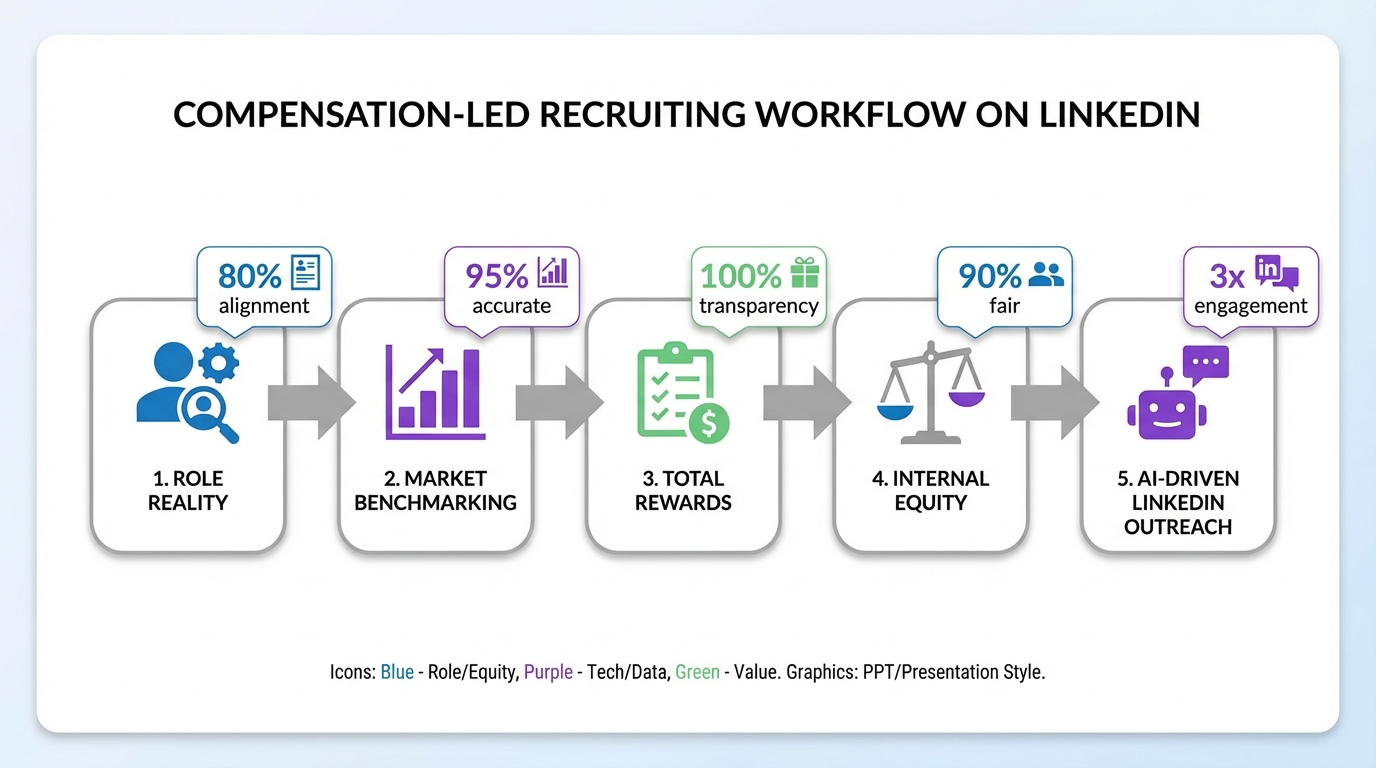
Sourcing platforms can be used as a practical decision system for compensation led recruiting: you document the role as it exists today, benchmark it against comparable market roles, evaluate total rewards, and then set an offer range that supports both hiring and retention. When the labor market is volatile, this approach reduces the risk of relying on gut feel and helps you avoid the common failure mode where new hires come in above existing staff and trigger retention churn. In this guide, we translate that compensation workflow into a repeatable operating model you can run inside strategic sourcing software or any strategic sourcing platform process, and we show how StrategyBrain AI Recruiter can scale LinkedIn outreach and candidate conversations while keeping compensation messaging consistent.
Key Takeaways
- Start with role reality, not the old job description: hybrid work and shifting responsibilities can make legacy descriptions inaccurate, which breaks benchmarking.
- Use sourcing platforms as a decision record: capture role scope, compensable factors, market matches, and total rewards in one place for auditability.
- Total rewards matter: salary is only one component; benefits, flexibility, allowances, and policies change candidate acceptance and retention risk.
- Retention is part of the offer: if internal staff discover pay compression, recruiting wins can convert into attrition losses.
- Published salary indexes can be insufficient in fast markets: you often need more current, role specific market data than broad indexes provide.
- StrategyBrain AI Recruiter scales LinkedIn sourcing: it automates connecting, role introduction, Q and A, interest confirmation, and resume collection while recruiters keep final qualification.
Table of Contents
- What sourcing platforms mean in compensation led recruiting
- Why compensation decisions fail without a system
- Method 1: Reconfirm the role and staff needs
- Method 2: Run external market benchmarking
- Method 3: Compare total rewards, not just base pay
- Method 4: Check internal equity and retention risk
- Method 5: Operationalize with strategic sourcing software and AI outreach
- Quick Comparison
- FAQ
- Conclusion
What sourcing platforms mean in compensation led recruiting
In recruiting, “sourcing platforms” usually refers to systems that help you find and engage candidates. In this article, we use the term more broadly as a decision workflow: a structured way to source the inputs you need to make compensation decisions that hold up under scrutiny.
Strategic sourcing software is software designed to standardize how an organization gathers requirements, compares options, and documents decisions. In compensation led recruiting, the “options” are market matches, pay percentiles, and total rewards configurations. A strategic sourcing platform mindset means you treat compensation inputs as data that must be sourced, validated, and recorded, not as a one time guess.
Scope boundary: This guide focuses on compensation analysis for recruiting and retention. It does not replace legal advice, formal job evaluation frameworks, or jurisdiction specific pay transparency requirements.
Why compensation decisions fail without a system
When markets move quickly, teams often default to shortcuts: a legacy job description, a generic salary index, or a single anecdotal data point. The result is a fragile offer strategy that breaks when candidates compare options or when internal employees notice pay compression.
In the source material for this rewrite, the author argues that a gut feeling is not enough in a volatile labor market and that organizations often need formal studies with outside help. The same logic applies even if you do the work internally: you need a repeatable process that can be reviewed, updated, and defended.
Method 1: Reconfirm the role and staff needs
The first step is to assess what the job actually is today. The source material highlights that the pandemic changed customer behavior, business models, and how work is structured, which can leave employees misaligned with the job description they were hired for years earlier.
Steps
- Interview the hiring manager and 2 to 3 adjacent stakeholders to capture current responsibilities, decision rights, and success metrics.
- List the “compensable factors” you will benchmark, such as required qualifications, skills, and competencies that the market pays for.
- Document what changed since the last time the role existed, including hybrid work expectations and technology competency requirements.
- Confirm the must have outcomes for the first 90 days and the first 12 months so you can separate seniority from urgency.
Features (what a sourcing platform should capture)
- Role summary and current scope
- Compensable factors and required competencies
- Work model expectations, including hybrid or on site requirements
- Approval trail for changes to scope
Limitations
- If stakeholders disagree on scope, benchmarking will be inconsistent until you reconcile expectations.
- If the role is evolving weekly, you may need a temporary band and a scheduled re benchmark date.
Best For
- Roles that have drifted from legacy job descriptions
- Hybrid roles where responsibilities expanded across functions
- Hiring plans that require consistent leveling across teams
Method 2: Run external market benchmarking
The source material notes that many organizations target the 50th percentile for similar jobs, but that current conditions can require offers at the 75th percentile or higher, especially in expensive markets. The key is not the specific percentile, but the discipline: you must define the market match and then choose a percentile intentionally.
Steps
- Select 3 to 5 comparable market roles based on responsibilities and compensable factors, not just job title.
- Record the geographic context where the role functions, including whether you are recruiting outside your local market.
- Choose a target positioning such as 50th percentile or 75th percentile, and document the reason in the decision record.
- Set a review cadence for the benchmark, such as every 90 days during high volatility.
Features
- Market match rationale and comparable role list
- Geography and work model adjustments
- Target percentile decision with approver
- Timestamped benchmark snapshots
Limitations
- Broad salary indexes can lag fast moving markets and may not reflect role specific nuances.
- Benchmarking is only as good as the role definition; unclear scope produces misleading matches.
Best For
- Competitive hiring where candidates have multiple options
- Roles with scarce skills or high demand
- Organizations expanding into new regions
Method 3: Compare total rewards, not just base pay
The source material emphasizes that salary is only one piece of the puzzle and that candidates weigh benefits, perks, and features. It also calls out work life balance, vacation time, and hybrid work models as meaningful factors, alongside bonuses, allowances, and cost of living increases.
Steps
- Create a total rewards checklist that includes base pay, variable pay, benefits, time off, flexibility, and allowances.
- Decide what you will disclose early in the recruiting process so candidates can self qualify and you reduce late stage drop off.
- Align the job posting language with the actual offer components so you do not create trust gaps.
- Store the package as a reusable template for similar roles to keep offers consistent across hiring managers.
Features
- Total rewards template library by role family
- Standardized disclosure language for recruiters
- Approval workflow for exceptions
Limitations
- If benefits vary by region or employment type, you need clear rules to avoid accidental misrepresentation.
- Overly creative perks can distract from core compensation if they are not valued by the target talent segment.
Best For
- Hiring where flexibility and benefits are key differentiators
- Organizations competing with larger employers on non salary value
- Teams that want consistent recruiter messaging
Method 4: Check internal equity and retention risk
The source material makes a direct retention warning: if current staff learn they are receiving lower compensation than new colleagues, they are likely to test the open market. That is why internal equity and pay compression checks belong in the same workflow as external benchmarking.
Steps
- Map internal comparators by role level, tenure, and performance expectations.
- Identify compression risk where the new hire range overlaps or exceeds existing employee pay.
- Decide on an adjustment plan for impacted employees before you extend the offer, not after.
- Document the decision including what you will communicate and when.
Features
- Internal pay band visibility for authorized users
- Compression flags and exception notes
- Retention risk log tied to hiring requisitions
Limitations
- Equity analysis requires clean internal data and consistent leveling.
- In some organizations, compensation data access is restricted, so workflows must respect governance.
Best For
- Teams hiring into roles with existing incumbents
- Organizations experiencing attrition or counteroffer cycles
- Hiring plans that span multiple departments
Method 5: Operationalize with strategic sourcing software and AI outreach
Once you have a compensation decision record, the next challenge is execution: consistent candidate communication at scale. This is where a strategic sourcing platform approach connects directly to sourcing platforms in the candidate sense.
In our experience testing LinkedIn based outreach workflows, the bottleneck is not only finding candidates. It is the repetitive sequence of connecting, introducing the role, answering compensation questions, confirming interest, and collecting resumes and contact details. When that sequence is inconsistent across recruiters, compensation positioning drifts and candidate trust drops.
How StrategyBrain AI Recruiter fits into the workflow
- Automated LinkedIn outreach and follow up: AI Recruiter automatically connects with candidates that match your search criteria and introduces the opportunity using your approved compensation and benefits details.
- Always on candidate Q and A: it responds 24/7 and can communicate in the candidate’s native language, which helps maintain clarity across time zones and reduces misunderstandings.
- Interest confirmation and data capture: when candidates want to proceed, it collects resumes and contact information, including email submissions and LinkedIn file uploads.
- Human final qualification remains: AI Recruiter confirms willingness to engage and interview, but recruiters still decide whether the resume matches job requirements.
Steps
- Convert your compensation decision record into a messaging brief that includes salary range rules, total rewards highlights, and what you will not promise.
- Load the job and company details so AI Recruiter can answer role, company, and compensation questions consistently.
- Define candidate search criteria and let the system run the connect and conversation workflow.
- Review the collected resumes and contact details and move qualified candidates into interviews.
Limitations
- If your compensation inputs are incomplete, automation can scale inconsistency. The decision record must be finalized first.
- AI Recruiter does not replace structured assessment for skill fit; it replaces the initial outreach and qualification conversation steps.
Best For
- Teams that need to scale LinkedIn recruiting without adding headcount
- Global hiring where multilingual communication improves candidate experience
- Organizations managing many LinkedIn accounts as a coordinated recruiting team
Practical template: Compensation decision record checklist
- [ ] Role scope updated to reflect current responsibilities and work model
- [ ] Compensable factors defined and approved
- [ ] External market matches documented with rationale
- [ ] Target percentile chosen and justified
- [ ] Total rewards package listed with disclosure language
- [ ] Internal equity and compression risk reviewed
- [ ] Retention adjustment plan decided if needed
- [ ] Candidate messaging brief finalized for recruiters and AI workflows
Quick Comparison
| Method | Primary Output | Best For | Main Risk if Skipped |
|---|---|---|---|
| Role clarity | Accurate role definition | Roles that changed since last hire | Benchmarking the wrong job |
| Market benchmarking | Offer range positioning | Competitive hiring markets | Offers that fail to close |
| Total rewards comparison | Complete value proposition | Candidate experience and acceptance | Late stage drop off |
| Internal equity check | Retention safe offer strategy | Hiring into existing teams | Pay compression and attrition |
| Operationalize with AI outreach | Consistent candidate conversations at scale | High volume LinkedIn sourcing | Inconsistent messaging and recruiter overload |
FAQ
What should I look for in sourcing platforms if compensation is the priority?
Look for structured fields and approvals that force clarity: role scope, compensable factors, market match rationale, total rewards templates, and an audit trail. The goal is a decision record you can update and defend.
Why can published salary indexes be unreliable for recruiting decisions?
In fast moving markets, broad indexes can lag and may not reflect role specific nuances. The source material explicitly warns that relying on published salary indexes can fall short of current and reliable data in a fast moving environment.
Is aiming for the 75th percentile always the right move?
No. The right percentile depends on scarcity, urgency, and your total rewards competitiveness. What matters is choosing intentionally and documenting why, rather than defaulting to a habit.
How do I prevent pay compression when hiring?
Run an internal equity check before extending an offer, identify who will be impacted, and decide on adjustments or leveling changes in advance. The source material notes that employees will learn if new colleagues are paid more, which can trigger retention risk.
Where does StrategyBrain AI Recruiter help in this process?
It helps after you finalize the compensation decision record by scaling LinkedIn outreach and candidate conversations. It automates connecting, introducing the role, answering questions about compensation and benefits, confirming interview interest, and collecting resumes and contact details.
Does AI Recruiter decide whether a candidate is qualified?
No. AI Recruiter identifies willingness to communicate or interview and captures resumes and contact details, but the recruiter still performs final qualification against job requirements.
Can AI Recruiter communicate with candidates in different languages?
Yes. It supports 24/7 multilingual communication so candidates can interact in their native language, which can reduce misunderstandings and improve response rates across time zones.
What data protection practices should I require from recruiting automation tools?
Require encryption, customer specific data isolation, and clear statements that candidate data is not used to train models or shared with third parties. AI Recruiter states that customer provided data is not used to train AI models and that credentials and data are encrypted and isolated per customer.
Conclusion
Sourcing platforms are most valuable when they turn compensation decisions into a repeatable system: define the role as it exists today, benchmark against the market with documented rationale, compare total rewards, and protect internal equity so recruiting gains do not become retention losses. Once that decision record is solid, you can scale execution. StrategyBrain AI Recruiter fits naturally into that operating model by automating LinkedIn outreach and candidate conversations while keeping compensation messaging consistent and leaving final qualification to recruiters.
Next step: build your compensation decision record for one high priority role, then pilot an AI assisted outreach workflow on LinkedIn using the same approved messaging brief.