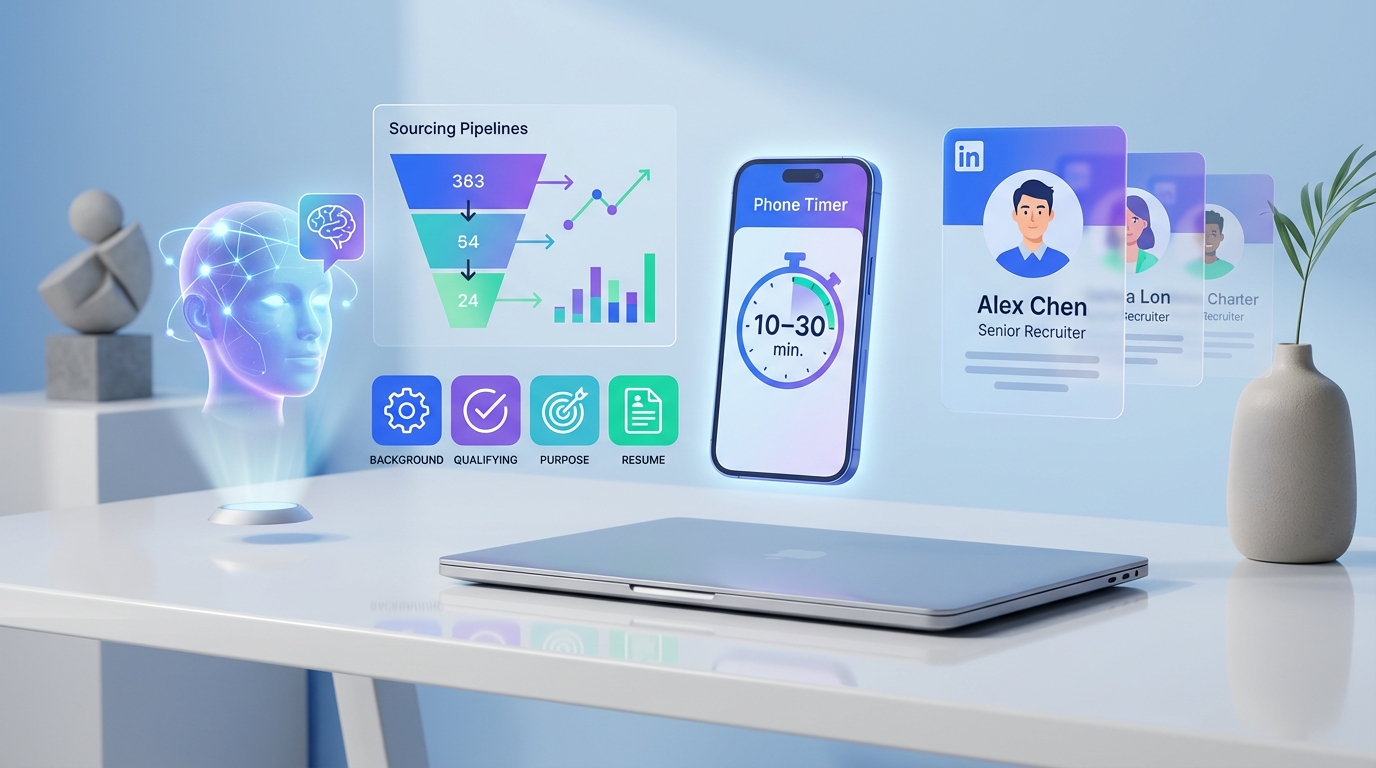
Sourcing platforms help recruiters find and engage candidates faster, but the phone screen interview is still the fastest way to confirm fit before investing time in full interviews. In our workflow, the most reliable approach is to use a strategic sourcing platform to build a targeted shortlist, then run a structured 10 to 30 minute phone screen to validate soft skills, hard skills at a high level, motivation, availability, and compensation alignment. When we pair this with StrategyBrain AI Recruiter for LinkedIn outreach and early candidate Q&A, we reduce manual back and forth and arrive at the phone screen with clearer context, including whether the candidate is open to new opportunities and ready to share a résumé and contact details.
Key Takeaways
- Best baseline structure: A phone screen should run 10 to 30 minutes and focus on fit, motivation, and logistics before deep technical evaluation.
- Four question buckets: Background, Qualifying, Purpose and Fit, and Resume Details create a repeatable screening flow.
- Use sourcing platforms earlier: A strategic sourcing platform is most valuable when it feeds a consistent screening script, not when it replaces screening.
- Automate the repetitive parts: StrategyBrain AI Recruiter can handle LinkedIn connecting, role introduction, and follow up so recruiters spend time on live screens.
- Multilingual coverage: StrategyBrain AI Recruiter supports candidate messaging in any global language, which helps global pipelines stay warm across time zones.
- Scale with account teams: StrategyBrain AI Recruiter can manage more than 100 LinkedIn accounts for high volume sourcing operations.
What sourcing platforms change and what they do not
Sourcing platforms are systems that help you identify, organize, and engage potential candidates. In recruiting teams, they often sit alongside an ATS and a CRM. A strategic sourcing platform or strategic sourcing software typically adds workflow, collaboration, and reporting so sourcing is repeatable rather than ad hoc.
What they do not change is the need to validate fit quickly. A phone screen remains the fastest low friction checkpoint. It protects candidate time and recruiter time by preventing late stage surprises on availability, compensation expectations, or motivation.
What a phone screen interview is for
A phone screen interview is a short call used to narrow the field before scheduling longer interviews. Resumes and cover letters can only tell you so much, and a live conversation helps you sense communication style, clarity, and alignment with the role.
In the source material we reviewed, the call is commonly 10 to 30 minutes. The goal is not to run a full interview. The goal is to confirm the basics, surface red flags early, and decide whether a deeper interview is worth it.
We also noted a practical leadership perspective from Henry Goldbeck, who frames the phone screen as a fast way to avoid asking candidates to commit more time when the fit is unlikely. That principle holds whether you source through referrals, job boards, or modern sourcing platforms.
A practical 10 to 30 minute phone screen structure
Below is the structure we use when we want consistency across recruiters and roles. It is designed to work whether your pipeline comes from a strategic sourcing platform, inbound applicants, or LinkedIn outreach.
Steps
- Set expectations: Confirm the call length, the role title, and what you will cover.
- Confirm basics: Location, work authorization if applicable, start date, and work model expectations.
- Run the four question categories: Use the sequence in the next section to keep the call focused.
- Close with candidate questions: Answer what you can, and note what needs follow up.
- Next step decision: Tell the candidate exactly what happens next and when they will hear back.
What we listen for
- Clarity: Can the candidate explain their work without rambling.
- Relevance: Do they connect their experience to the role rather than reciting a biography.
- Consistency: Do timelines and claims match what is on the résumé.
- Motivation: Do they have a real reason for the move.
The 4 question categories that work
The source material groups phone screen questions into four categories. We keep the same categories because they are easy to teach, easy to audit, and easy to standardize across a team using sourcing platforms.
1) Background questions
These questions reveal how the candidate frames their experience and what they choose to emphasize.
- Tell me about your background.
- Tell me about yourself.
- What are you passionate about.
Recruiter note: We ask for relevance early. If the candidate starts listing adjectives, we redirect to examples and outcomes.
2) Qualifying questions
These questions prevent wasted time later. They are not about negotiating the final offer. They are about confirming whether a match is even possible.
- When can you start.
- What are your salary expectations.
- What benefits do you expect.
Candidate note: If you give a range, be prepared to stand behind it. The source material emphasizes honesty at this stage, and we agree because it reduces late stage fallout.
3) Purpose, desire, and fit
These questions test motivation and cultural alignment. They also reveal whether the candidate did basic homework.
- Why did you apply for this position.
- What motivates you in a job.
- What management style do you prefer.
- What do you know about our company.
Recruiter note: We avoid forcing a single culture definition. Instead, we look for self awareness and realistic expectations. We also watch for unnecessary negativity about former employers.
4) Resume details
This is where you validate the story behind the résumé and test whether the candidate can connect skills to the role.
- Why are you the best candidate for this position.
- What skills have you recently gained or strengthened.
- How are your skills a match for this job.
- How have your experiences at a prior company prepared you for this role.
Recruiter note: This is still a screen, not a full technical interview. If you need deep technical validation, schedule it as the next stage and keep this call focused on readiness and fit.
How StrategyBrain AI Recruiter fits into sourcing platforms
Most teams adopt sourcing platforms to increase pipeline volume and reduce manual tracking. The bottleneck often moves to outreach and follow up, especially on LinkedIn. This is where StrategyBrain AI Recruiter fits naturally because it automates the repetitive early stage work while keeping the phone screen as the human decision point.
What we automate before the phone screen
- Connecting with candidates who match your search criteria on LinkedIn.
- Introducing the opportunity and answering common questions about the role, company, and compensation based on recruiter provided details.
- Confirming interview interest so your phone screen calendar is filled with candidates who are actually open to a conversation.
- Collecting résumés and contact information from interested candidates so the recruiter can review and proceed.
Why this improves phone screens
When the early conversation is handled consistently, the phone screen becomes cleaner. Recruiters can spend the 10 to 30 minutes on fit and decision making rather than repeating basic role explanations. In our experience, this also reduces candidate frustration because they get timely responses instead of waiting for a recruiter in a different time zone.
Operational capabilities that matter at scale
- 24/7 multilingual messaging: StrategyBrain AI Recruiter can communicate in any global language, which helps maintain momentum across regions.
- Multi account management: It supports managing more than 100 LinkedIn accounts, which is useful for agencies or enterprise teams building an AI powered sourcing pod.
- Clear scope boundary: The AI can identify willingness to communicate or interview, but final qualification against job requirements remains a recruiter decision after résumé review.
Quick comparison: manual vs platform assisted vs AI assisted
| Approach | What it improves | Main risk | Best for |
|---|---|---|---|
| Manual sourcing and manual outreach | High control per message | Slow follow up and inconsistent screening volume | Low volume roles and niche searches |
| Sourcing platforms plus human outreach | Better organization and pipeline visibility | Outreach still consumes recruiter hours | Teams that need repeatable sourcing operations |
| Sourcing platforms plus StrategyBrain AI Recruiter | Automated LinkedIn connecting, role intro, Q&A, follow up, and résumé capture | Requires clear job and compensation inputs to avoid vague conversations | High volume sourcing, global hiring, and teams scaling across many LinkedIn accounts |
Copy and use: phone screen checklist
This checklist is designed for recruiters who run phone screens after building a shortlist from sourcing platforms or a strategic sourcing platform.
- Confirm call length is 10 to 30 minutes.
- Confirm role title and top 3 priorities for the hire.
- Ask 1 to 3 background questions and redirect to relevance.
- Ask qualifying questions on start date and compensation expectations.
- Ask purpose and fit questions and listen for motivation.
- Validate 1 to 2 résumé claims with specific examples.
- Answer candidate questions and document unknowns for follow up.
- Close with next steps and a specific timeline.
FAQ
What are sourcing platforms in recruiting
Sourcing platforms are tools that help recruiters find, organize, and engage potential candidates. A strategic sourcing platform typically adds workflow and reporting so sourcing is consistent across a team.
How long should a phone screen interview be
A phone screen interview is commonly 10 to 30 minutes. That time window is long enough to confirm fit and logistics, and short enough to avoid turning a screen into a full interview.
What should recruiters focus on during a phone screen
Recruiters should focus on high level skills, communication, motivation, availability, and compensation alignment. Deep technical evaluation is usually better saved for a later stage.
What question categories work best for phone screens
The most repeatable structure uses four categories: background questions, qualifying questions, purpose and fit questions, and résumé detail questions. This keeps the call organized and comparable across candidates.
How does StrategyBrain AI Recruiter support LinkedIn sourcing
StrategyBrain AI Recruiter automates LinkedIn connecting, introduces the role, answers candidate questions based on recruiter provided details, confirms interview interest, and collects résumés and contact information from interested candidates.
Can StrategyBrain AI Recruiter replace recruiter judgment
No. It can identify willingness to communicate or interview and capture information, but final qualification against job requirements is completed by the recruiter after reviewing the résumé.
Does StrategyBrain AI Recruiter support multilingual candidate messaging
Yes. It provides 24/7 candidate responses and can communicate in any global language, which helps global pipelines move forward without delays.
How do I avoid wasting time when using sourcing platforms
Use sourcing platforms to build a targeted shortlist, then run a structured phone screen with qualifying questions early. If you also automate outreach and follow up, you can reserve recruiter time for the calls that matter.
Conclusion
Sourcing platforms and strategic sourcing software can expand your pipeline, but they do not eliminate the need for a disciplined phone screen. A structured 10 to 30 minute call using the four question categories is still one of the fastest ways to confirm fit and protect everyone’s time.
Next step: standardize your phone screen script, then decide which parts of outreach you want to automate. If LinkedIn messaging is your bottleneck, StrategyBrain AI Recruiter can handle connecting, introductions, Q&A, follow up, and résumé capture so your team can focus on high quality phone screens and better hiring decisions.