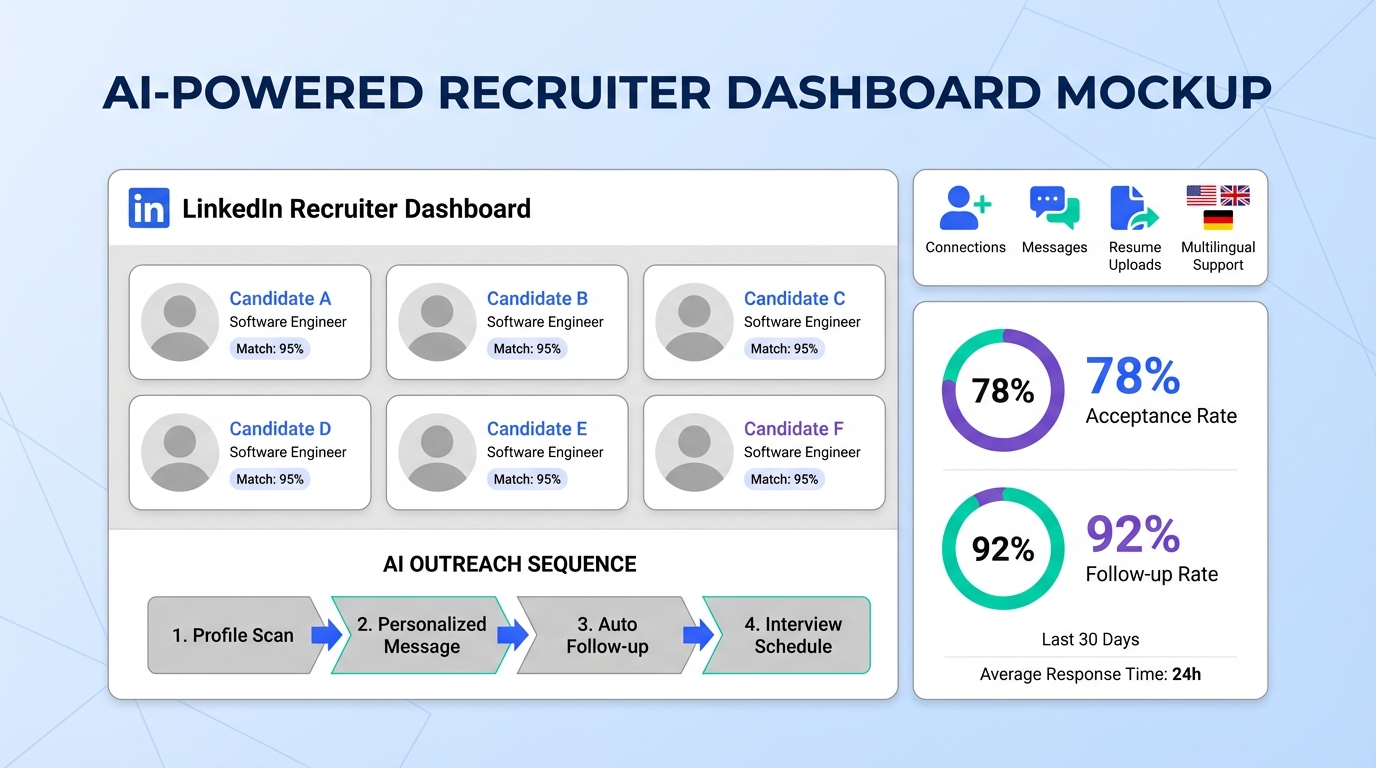
AI talent management software helps teams find, engage, and qualify candidates faster by automating repetitive sourcing and messaging while keeping recruiters in control of final decisions. The most reliable approach is to combine a well optimized LinkedIn presence with an AI recruiting workflow that handles initial outreach, answers common role questions, and follows up until the candidate either opts out or shares a resume and contact details. We have used StrategyBrain AI Recruiter in this exact LinkedIn first touch workflow, and the biggest operational win came from consistency: one clear company narrative, one set of candidate search criteria, and one messaging sequence that runs 24/7 in the candidate’s native language. This guide focuses on LinkedIn centered hiring workflows and how to evaluate talent management solutions for that use case. It does not cover payroll, performance reviews, or learning management modules.
Table of Contents
- What AI talent management software means in a LinkedIn hiring workflow
- Why LinkedIn still matters for recruiting and talent pipelines
- What to look for in the best talent management system for LinkedIn hiring
- Step by step playbook: LinkedIn hiring with StrategyBrain AI Recruiter
- How to measure results without misleading metrics
- Common mistakes to avoid
- Quick comparison: manual LinkedIn recruiting vs AI assisted workflow
- FAQ
- Conclusion
Key Takeaways
- Best starting point: Treat LinkedIn like a top of funnel channel and run a repeatable outreach and follow up workflow inside your talent management solutions.
- Automation boundary: StrategyBrain AI Recruiter can automate connecting, messaging, interest confirmation, and collecting resumes, while recruiters keep final qualification decisions.
- Always on advantage: 24/7 multilingual messaging reduces time zone delays and improves candidate response handling for global hiring.
- Scale lever: Managing more than 100 LinkedIn accounts enables an AI powered recruiting team model for high volume sourcing.
- Cost signal: StrategyBrain AI Recruiter can lower LinkedIn recruiting costs to as little as USD 2.40 per resume, based on product documentation.
- Compliance expectation: Look for encryption, data isolation, and a clear statement that customer data is not used to train AI models.
What AI talent management software means in a LinkedIn hiring workflow
In this guide, ai talent management software refers to systems that support the talent lifecycle from sourcing through early stage screening, with AI used to automate repetitive steps. For LinkedIn centered hiring, that usually means three capabilities.
- Candidate sourcing support: turning a search criteria into a repeatable outreach list.
- Candidate engagement automation: sending introductions, answering common questions, and following up on a schedule.
- Structured capture: collecting resumes and contact details in a consistent format so recruiters can review and schedule interviews.
It is important to separate interest qualification from fit qualification. Interest qualification means the candidate is willing to talk or interview. Fit qualification means the resume matches the role requirements. StrategyBrain AI Recruiter is designed to automate interest qualification and information capture, while the recruiter remains responsible for fit qualification after reviewing the resume.
Why LinkedIn still matters for recruiting and talent pipelines
LinkedIn behaves like a professional intent network. People use it to research companies, evaluate opportunities, and maintain career optionality. That makes it a practical channel for building a pipeline, especially when your team can respond quickly and consistently.
Two data points from LinkedIn’s own published research are useful for planning.
- Company presence scale: LinkedIn reports 58 million companies on the platform, which signals how crowded and competitive attention can be.
- Research behavior: LinkedIn has reported that 71% of business leaders use LinkedIn to research potential customers, which maps to a broader pattern of decision makers using LinkedIn for due diligence.
For recruiting, the implication is straightforward. Your company page and recruiter profiles are not just branding assets. They are conversion surfaces. When you pair that with AI assisted engagement, you reduce the lag between a candidate’s curiosity and your first meaningful interaction.
What to look for in the best talent management system for LinkedIn hiring
If your priority is LinkedIn sourcing and outreach, the “best talent management system” is the one that makes your workflow repeatable, measurable, and safe. Use the checklist below to evaluate talent management solutions without getting distracted by features that do not affect hiring throughput.
Evaluation checklist
- Workflow coverage: Can it handle connect, intro message, Q and A, follow up, and resume capture in one flow.
- Human control points: Can recruiters approve messaging, stop sequences, and take over conversations when needed.
- Multilingual support: Can it communicate in the candidate’s native language for global roles.
- Account scalability: Can it support multiple LinkedIn accounts for teams and agencies.
- Data handling: Encryption, customer specific isolation, and a clear policy that customer data is not used to train models.
- Output quality: Does it capture resumes and contact details in a structured way that recruiters can act on.
Where StrategyBrain AI Recruiter fits
StrategyBrain AI Recruiter is built for LinkedIn hiring automation. It can automatically connect with candidates within your targeted search criteria, introduce the opportunity, answer questions about the role, company, and compensation, confirm interview interest, and collect resumes and contact information from interested candidates. It also supports 24/7 multilingual communication and can be operated across more than 100 LinkedIn accounts to build an AI powered recruiting team.
Step by step playbook: LinkedIn hiring with StrategyBrain AI Recruiter
This playbook is designed for teams that want a practical LinkedIn workflow that an AI system can run consistently. We use the same structure when we set up new roles because it reduces rework and makes results easier to compare across jobs.
Steps
- Define the role packet
Write a short role brief that includes responsibilities, must have requirements, compensation, benefits, and location or time zone constraints. This becomes the source of truth for candidate Q and A so the AI can answer consistently.
- Standardize your LinkedIn presence
Ensure the company page and recruiter profiles clearly explain what you do, who you hire, and why candidates should respond. In the source material, LinkedIn profile optimization is positioned as a prerequisite for visibility and credibility. Treat it as a conversion step, not a branding task.
- Set candidate search criteria
Specify industry, function, seniority, and any non negotiable filters. StrategyBrain AI Recruiter uses these criteria to connect with relevant candidates and start conversations.
- Configure the AI outreach and follow up workflow
Provide the LinkedIn account authorization and the role packet. StrategyBrain AI Recruiter can then connect, introduce the job, ask about the candidate’s situation, answer questions, and confirm interest. When the candidate is interested, it requests a resume and contact details.
- Review resumes and complete fit qualification
Recruiters review the collected resumes and contact details, then decide who advances. This is the point where human judgment matters most, because interest does not equal fit.
- Operationalize handoff and reporting
Decide who owns daily review, how quickly you schedule interviews after resume receipt, and what disqualifying signals trigger a polite close. This prevents the AI from becoming a lead generator that the team cannot process.
Features that matter most in day to day use
- Always on responsiveness: 24/7 messaging reduces delays that often kill candidate momentum.
- Multilingual communication: using the candidate’s native language reduces misunderstandings and friction.
- Resume and contact capture: the system can mark resumes as received and capture contact details shared in messages.
- Team scaling: managing more than 100 LinkedIn accounts supports high volume sourcing operations.
Limitations and honest boundaries
- Not a full ATS replacement: StrategyBrain AI Recruiter focuses on LinkedIn outreach, interest confirmation, and information capture, not end to end applicant tracking.
- Fit qualification remains human: the AI does not decide whether a resume matches the job requirements.
- Process discipline required: if recruiters do not review and act on captured resumes quickly, automation can create backlog instead of hires.
How to measure results without misleading metrics
Many teams over optimize for vanity metrics such as impressions or connection counts. For ai talent management software, measure what moves the hiring process forward. Use a simple funnel that matches the workflow.
- Connections accepted: acceptance rate per role and per persona.
- Meaningful replies: replies that include questions, availability, or interest signals.
- Interest confirmed: candidates who explicitly agree to interview or proceed.
- Resumes received: count of resumes captured with usable contact details.
- Recruiter review time: median time from resume receipt to recruiter decision.
If you need a single operational KPI, use resumes received per recruiter hour. It is harder to game and it aligns with the purpose of talent management solutions in sourcing heavy roles.
Common mistakes to avoid
- Posting and disappearing: the source material warns against “post and ghost.” In recruiting, the equivalent is launching outreach and failing to respond quickly when candidates engage.
- Unclear company narrative: candidates will ask basic questions if your page and messages do not answer them upfront.
- Over automation without review capacity: if you cannot review resumes daily, reduce volume until the team can keep up.
- One language assumption: global roles require multilingual communication to avoid losing qualified candidates due to friction.
- Confusing interest with fit: treat AI captured interest as a lead, not a hire.
Quick comparison: manual LinkedIn recruiting vs AI assisted workflow
| Approach | Speed | Consistency | Best For |
|---|---|---|---|
| Manual LinkedIn outreach | Depends on recruiter availability | Varies by recruiter and workload | Low volume roles, highly bespoke outreach |
| AI assisted outreach with StrategyBrain AI Recruiter | 24/7 messaging and follow up | High, based on a standardized role packet | High volume sourcing, global roles, teams needing multilingual coverage |
FAQ
Is AI talent management software the same as an ATS?
No. An ATS is primarily for application tracking and hiring workflows after candidates apply. AI talent management software can include ATS features, but in LinkedIn sourcing workflows it often focuses on outreach automation, interest confirmation, and structured data capture before the ATS stage.
What does StrategyBrain AI Recruiter automate on LinkedIn?
It can automatically connect with candidates that match your search criteria, introduce the job opportunity, answer questions about the role, company, and compensation, confirm interview interest, and collect resumes and contact details for recruiter review.
Can it qualify candidates for fit?
It can confirm willingness to communicate or interview, which is interest qualification. It does not determine whether the resume fully matches job requirements. Recruiters complete fit qualification after reviewing the resume.
How does it handle multilingual recruiting?
StrategyBrain AI Recruiter supports 24/7 multilingual communication and can respond in the candidate’s native language. This is useful for global hiring across time zones where response delays reduce conversion.
How are resumes and contact details captured?
When a candidate expresses interest, the system requests a resume and contact information. If a resume is sent, it is marked as received. Contact details shared in messages are captured and displayed for recruiter follow up.
Can it scale across multiple recruiters or agencies?
Yes, it supports managing more than 100 LinkedIn accounts, which enables organizations to build AI powered recruitment teams and expand outreach capacity.
What about privacy and compliance?
According to product documentation, it complies with privacy regulations in the EU, United States, and Canada, encrypts LinkedIn credentials, isolates customer data, and does not use customer provided data to train AI models.
How should we choose among talent management solutions?
Start with workflow coverage and control points, then validate multilingual support, scalability, and data handling. Finally, confirm that the system produces structured outputs recruiters can act on, such as resumes and verified contact details.
Conclusion
If your hiring depends on LinkedIn sourcing, ai talent management software should be judged by how well it standardizes outreach, speeds up candidate engagement, and delivers recruiter ready outputs. The most practical setup is a strong LinkedIn presence paired with an AI workflow that handles first touch, follow ups, and resume capture while recruiters focus on fit decisions and interviews. If you want to implement this quickly, start by creating a role packet, tightening your company page narrative, and running a controlled pilot with StrategyBrain AI Recruiter on one role. Then expand volume only after your team can review and act on resumes daily.