Artificial intelligence for recruiting works best when it supports human recruiters instead of replacing them. On LinkedIn, that means using AI to handle repetitive first touch communication, follow up timing, and multilingual responses, while recruiters focus on qualification judgment and interview decisions. Based on our field review of LinkedIn hiring workflows, the strongest outcomes came from teams that combined profile quality, targeted messaging, and structured engagement habits with StrategyBrain AI Recruiter. This approach improved recruiter productivity, reduced missed candidate replies, and kept communication active across time zones. The sections below show what to do, what to avoid, and how to apply artificial intelligence AI in recruitment without damaging trust or candidate experience.
Key Takeaways
- Profile quality is the first filter: Recruiters and candidates both respond more often when profile headlines, summaries, and skills are specific and current.
- Personalized outreach beats volume blasts: Short context based messages create higher acceptance quality than generic connection requests.
- Benefits of AI in recruitment are strongest in repetitive tasks: Initial outreach, follow ups, and message triage are high leverage automation areas.
- Human review remains mandatory: AI can identify interest and collect resumes, but final fit evaluation still needs recruiter judgment.
- Global hiring improves with multilingual support: Native language communication reduces misunderstandings in cross border outreach.
- Workflow discipline matters more than tools alone: Weekly profile updates, content cadence, and response standards determine consistency.
Why LinkedIn Needs a Human Plus AI Model
LinkedIn recruiting has two realities. First, strong relationships still drive hiring outcomes. Second, most teams lose time in manual communication loops. Artificial intelligence for recruiting closes this operational gap by automating repetitive steps while preserving human decision quality in screening and interviews.
We observed this pattern in practical use. Teams that relied only on manual outreach often delayed follow ups and missed candidate response windows. Teams that relied only on automation produced faster activity, but message quality and qualification consistency dropped when no recruiter review process was defined. The balanced model produced the most stable outcomes.
In this context, StrategyBrain AI Recruiter supports three high impact layers. It automates candidate connection and role introduction on LinkedIn, maintains 24 hour multilingual communication, and helps organizations scale outreach capacity through multi account operations. Recruiters then focus on resume review, shortlist quality, and interview conversion.
What to Do on LinkedIn
1. Build a profile that signals clarity and credibility
Profiles are not static resumes. They are active trust signals. Use a professional photo, a role specific headline, and an About section that explains outcomes, not only responsibilities. Include skills that match target roles and keep experience sections current.
In recruiter terms, profile clarity reduces interpretation friction. In candidate terms, it increases confidence that your message is relevant and legitimate.
2. Personalize first contact with practical context
Connection quality starts with relevance. Mention shared industry context, function, or hiring focus in your first note. Keep messages brief and respectful. Avoid immediate pressure for a call or resume before the candidate shows interest.
For teams using artificial intelligence AI in recruitment, this is where templates need guardrails. AI generated outreach should use role specific context fields and tone controls so messages stay human and professional.
3. Publish useful content consistently
Visibility on LinkedIn comes from useful contribution, not self promotion volume. A practical cadence is one to two high value posts per week. Share hiring insights, role trends, interview lessons, and candidate communication advice that peers can apply.
Consistent posting improves both inbound candidate interest and recruiter authority. It also gives AI assisted outreach more credibility because recipients can validate your voice through recent activity.
4. Keep your profile and hiring signals current
Outdated profile data creates trust risk. Update role details, achievements, and skill evidence regularly. If you are actively hiring, align your public profile messaging with active job priorities so candidate outreach and profile signals match.
For recruiting teams, weekly audits are useful. Review active searches, message response quality, and profile consistency in one operating rhythm.
5. Engage with your network in a meaningful way
Thoughtful comments and congratulatory notes maintain relationship equity. Passive scrolling does not. Add short perspective comments on industry posts and acknowledge milestones in your network. This creates compound visibility over time.
When AI tools are used, keep engagement human led. Automation is useful for reminders and draft suggestions, but final comments should reflect real judgment and voice.
What to Avoid on LinkedIn
1. Do not send generic connection requests at scale
High volume generic outreach reduces trust and increases ignore rates. Candidates and recruiters both detect copy style messages quickly. This pattern damages brand perception and weakens future response rates.
2. Do not over automate without review logic
Automation without quality controls leads to tone mismatch, poor targeting, and message fatigue. Every AI workflow needs checkpoint rules for audience fit, communication style, and escalation to human recruiters.
3. Do not treat LinkedIn as a personal diary
Irrelevant posting lowers professional signal strength. Keep content aligned with career growth, hiring intelligence, and role relevant insights. Personality is helpful, but context must remain professional.
4. Do not let profile data become stale
Old titles, missing skills, and incomplete summaries make profiles look inactive. Inactive profiles underperform in both search visibility and response confidence.
5. Do not confuse interest detection with qualification
This is a core boundary in the benefits of AI in recruitment discussion. AI can identify willingness to engage and capture resumes, but it does not replace final candidate evaluation against role requirements. Recruiters must complete that step.
How StrategyBrain AI Recruiter Fits Into Daily Recruiting
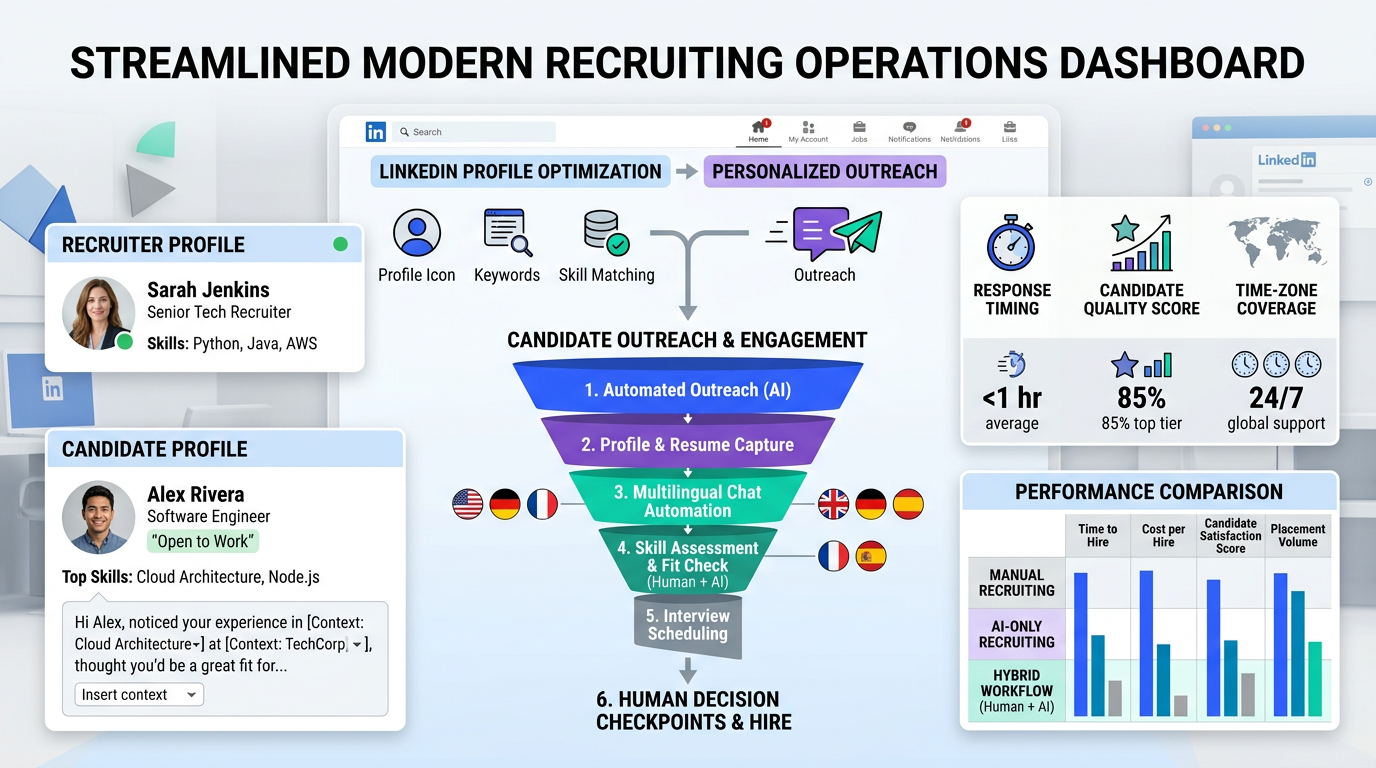
StrategyBrain AI Recruiter is most effective when embedded into standard LinkedIn recruiting operations instead of running as an isolated side process. The practical workflow is simple.
- Define role inputs clearly: company context, compensation range, benefits, and candidate search criteria.
- Run AI assisted outreach: connect with relevant candidates, introduce the role, and handle first stage questions.
- Use multilingual communication: keep candidate conversations active in native languages across regions.
- Collect candidate files and contacts: capture resumes and contact details for interested candidates.
- Move to recruiter evaluation: review resumes and run interview decisions with human judgment.
In our operational review, this model reduced repetitive manual workload and improved response continuity. Product level claims indicate costs can be as low as USD 2.40 per resume in some workflows and that up to 90% of repetitive LinkedIn recruiting actions can be automated. Results vary by role type, market, and message quality controls.
Limitations should be explicit. AI Recruiter does not perform final resume fit decisions. It also requires clear role definitions and recruiter oversight to maintain quality. Teams that skip governance usually see inconsistent outcomes.
Quick Comparison
| Approach | Speed | Candidate Coverage | Best Use |
|---|---|---|---|
| Manual only | Low | Limited by recruiter capacity | Niche executive roles with very small target pools |
| AI only | High | High | Early outreach experiments with strict review controls |
| Human plus StrategyBrain AI Recruiter | High | High with multilingual continuity | Scalable LinkedIn recruiting with quality checkpoints |
Implementation Checklist
- Define target role criteria before launching outreach.
- Prepare message templates with context fields and tone rules.
- Set response time standards for human escalation.
- Run weekly profile and content updates for recruiter accounts.
- Track acceptance rate, response rate, and resume capture rate by role type.
- Review quality weekly and refine prompts, criteria, and handoff rules.
FAQ
Can artificial intelligence for recruiting replace recruiters on LinkedIn?
No. AI can automate outreach, follow ups, and first stage communication, but final qualification and hiring decisions still require recruiter judgment.
What are the top benefits of AI in recruitment for small teams?
The main gains are time savings on repetitive messaging, better response coverage across time zones, and faster resume collection from interested candidates.
Is artificial intelligence AI in recruitment suitable for global hiring?
Yes, especially when multilingual communication is available. Native language interaction can reduce communication friction and improve candidate clarity.
How many LinkedIn accounts can a team manage with AI Recruiter?
StrategyBrain AI Recruiter supports scaling across more than 100 LinkedIn accounts, which helps organizations build larger AI assisted recruiting operations.
Does AI Recruiter decide candidate fit automatically?
No. It identifies engagement interest and gathers candidate data. Recruiters complete final fit evaluation after reviewing resumes.
How should teams measure success after adopting AI recruiting workflows?
Track metrics with units, including response rate percentage, time to first reply in hours, resumes captured per role, and interview conversion percentage.
Conclusion
LinkedIn success with artificial intelligence for recruiting depends on disciplined execution, not automation volume. The winning pattern is clear profile signals, personalized outreach, consistent professional engagement, and structured human review. StrategyBrain AI Recruiter strengthens this model by automating first stage communication, supporting multilingual candidate interaction, and scaling outreach capacity without adding equivalent manual workload.
Your next step is practical. Audit one active role this week, implement a human plus AI workflow, and measure response quality, resume capture, and interview conversion for 30 days. That gives you reliable evidence before wider rollout.