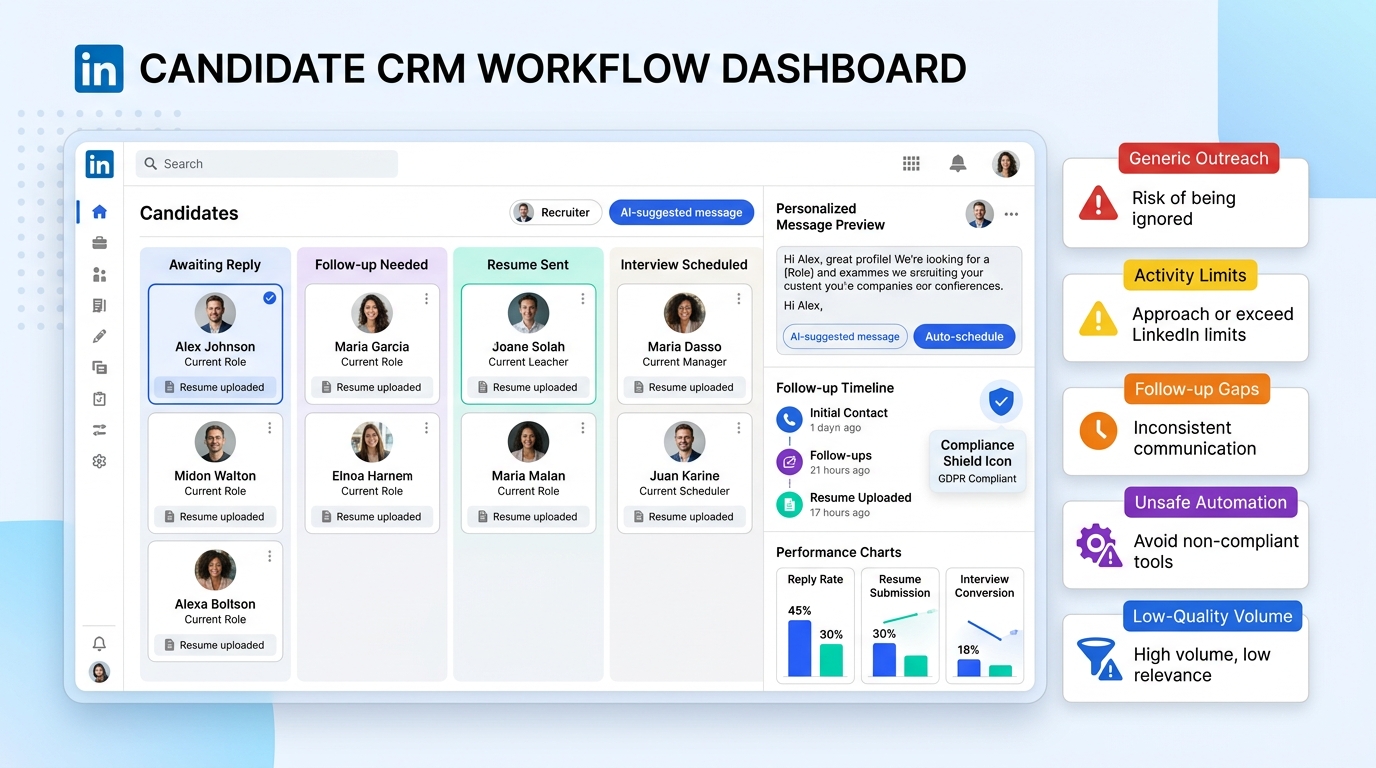
A reliable candidate CRM process on LinkedIn is not just about sending more messages. It is about managing candidate relationships with better timing, better context, and better compliance. The five mistakes that cause the most damage are generic outreach, ignoring platform limits, weak follow up systems, unsafe automation practices, and choosing volume over relevance. In our analysis of LinkedIn recruiting workflows, teams got better outcomes when automation supported candidate management in recruitment instead of replacing recruiter judgment. That is also where tools such as StrategyBrain AI Recruiter can help by automating first contact, multilingual communication, and resume collection while recruiters stay focused on qualification and interviews.
Key Takeaways
- Personalization matters: Generic LinkedIn outreach lowers reply quality and weakens trust with candidates.
- Limits matter: LinkedIn states weekly invitation limits can apply and may vary by account behavior and platform policy.
- Follow up is part of candidate CRM: Candidate relationship management systems work best when every reply, milestone, and resume is tracked.
- Compliance matters: Unsafe automation can create account risk, poor candidate experience, and inconsistent recruiter workflows.
- Quality beats volume: Better candidate management in recruitment comes from relevant conversations, not maximum message output.
- AI can help when used correctly: StrategyBrain AI Recruiter automates outreach, candidate conversations, and resume capture while leaving final qualification to recruiters.
Why Candidate CRM Matters on LinkedIn
LinkedIn recruiting often breaks down when teams treat outreach as a one step task. In practice, recruiting on LinkedIn is a sequence that includes targeting, first contact, response handling, follow up, resume collection, and interview handoff. A candidate CRM helps organize that sequence so recruiters do not lose context between messages and candidate milestones.
This is why many teams now look beyond simple outreach tools and toward broader candidate relationship management systems. The goal is not only to send messages faster. The goal is to build a repeatable process for candidate engagement, especially when multiple recruiters, multiple roles, or multiple LinkedIn accounts are involved.
We have seen that the strongest candidate management in recruitment workflows share three traits. They keep communication relevant, they document every important interaction, and they reduce manual work without removing human review. StrategyBrain AI Recruiter aligns with that model because it can introduce roles, answer candidate questions, collect resumes and contact details, and support multilingual communication around the clock while recruiters retain control over final screening.
1. Sending Generic Outreach
The fastest way to weaken a candidate CRM workflow is to start with messages that feel copied and pasted. Candidates can usually tell when outreach ignores their background, recent activity, or likely motivations. That creates friction at the very first touchpoint.
Generic outreach hurts more than response rate. It also damages data quality inside your recruiting process. If candidates ignore the first message, your pipeline becomes filled with non responsive contacts rather than engaged prospects. That makes your candidate relationship management systems less useful because the underlying interactions are weak from the start.
Why this happens
- Recruiters optimize for message volume instead of relevance.
- Templates are reused without role specific context.
- Outreach ignores signals such as job changes, recent posts, or hiring intent.
What to do instead
- Segment candidates by role, seniority, geography, and likely motivation.
- Reference one specific detail that shows why the candidate was selected.
- Keep the first message short and focused on relevance, not persuasion.
- Track which message angles produce replies, resumes, and interviews.
This is also where AI can be useful if it is applied carefully. StrategyBrain AI Recruiter is designed to automate initial LinkedIn recruitment communication while learning about each candidate’s work situation, answering questions about the role, and confirming interview interest. Used well, that supports personalization at scale instead of replacing it with robotic text.
Best practice
Use automation to prepare and manage outreach, but keep the message logic grounded in candidate context. A candidate CRM should improve relevance, not standardize irrelevance.
2. Ignoring LinkedIn Activity Limits
Many recruiting teams run into trouble when they assume more activity always means more results. LinkedIn monitors behavior patterns, and aggressive outreach can trigger restrictions or reduce account effectiveness. Official guidance from LinkedIn notes that invitation limits exist and can change based on platform policy and account behavior.
For recruiters, this is not just a compliance issue. It is an operational issue. If an account is restricted, candidate outreach slows down, follow up timing breaks, and your candidate CRM data becomes less reliable because activity is interrupted.
Common consequences
- Temporary limits on invitations or messaging.
- Reduced confidence in automation workflows.
- Interrupted recruiter productivity.
- Inconsistent candidate experience.
Safer approach
- Monitor invitation and messaging volume by account.
- Spread activity across realistic time windows.
- Prioritize high fit candidates instead of broad lists.
- Review account health and response patterns weekly.
StrategyBrain AI Recruiter is relevant here because it is built around structured LinkedIn recruiting workflows rather than random mass activity. It helps recruiters automate connection and conversation steps while keeping the process tied to job criteria, candidate interest, and recruiter review. That is a better fit for disciplined candidate management in recruitment than brute force outreach.
3. Losing Control of Follow Up
Weak follow up is one of the most expensive recruiting mistakes because it wastes interest that has already been earned. A candidate may accept a connection request, ask a question, or signal openness to a role, but if no one responds at the right time, momentum disappears.
This is where a true candidate CRM becomes essential. Candidate relationship management systems should not only store names. They should help recruiters track conversation status, reminders, candidate questions, resume receipt, and next actions.
What poor follow up looks like
- No clear owner for candidate replies.
- Resumes arrive through different channels and get lost.
- Interested candidates wait too long for the next step.
- Recruiters repeat questions because prior context is missing.
What strong follow up looks like
- Every candidate interaction is logged.
- Response timing is consistent.
- Resume and contact details are captured in one workflow.
- Recruiters know exactly when to step in for screening.
One practical advantage of StrategyBrain AI Recruiter is that it can request resumes and contact details from interested candidates, support both email submission and LinkedIn file upload, and mark resumes as received. That reduces one of the biggest operational gaps in LinkedIn recruiting, which is the handoff from conversation to candidate record creation.
In our view, this is one of the clearest examples of how AI can strengthen candidate management in recruitment. The AI handles repetitive communication and collection tasks, while the recruiter focuses on evaluating fit.
4. Using Unsafe Automation Workflows
Not all automation is equal. Some workflows create unnecessary risk because they are poorly controlled, poorly monitored, or disconnected from platform rules. Even when a tool promises speed, the real question is whether it supports a trustworthy recruiting process.
Unsafe automation usually shows up in one of two ways. Either the workflow behaves too aggressively, or it removes too much human oversight. Both problems can damage candidate experience and recruiter credibility.
Warning signs
- Recruiters cannot review or understand what is being sent.
- Candidate replies are not routed into a structured process.
- There is no clear data handling or privacy explanation.
- Automation is treated as a replacement for recruiter judgment.
What trustworthy automation should include
- Clear role based workflows.
- Documented handling of candidate data.
- Human review at qualification and interview stages.
- Consistent capture of resumes, contact details, and conversation history.
Trust is especially important in recruiting because candidate data is sensitive. StrategyBrain states that its AI Recruiter complies with privacy regulations in the European Union, United States, and Canada, does not use customer provided data to train AI models, and stores credentials and candidate information with encryption and customer specific isolation. Those trust signals matter when evaluating any candidate CRM related workflow.
Recruiters should still verify internal legal and security requirements before deployment. However, from a process perspective, safer automation is usually the automation that is transparent, limited to clear tasks, and easy to audit.
5. Choosing Speed Over Candidate Quality
Recruiting teams often chase output metrics because they are easy to measure. More messages sent. More profiles contacted. More accounts active. But those numbers can hide a weak pipeline if the conversations are low quality.
A good candidate CRM strategy values progression metrics more than raw activity. The better questions are these. Did the candidate reply. Did the candidate understand the role. Did the candidate share a resume. Did the recruiter get enough context to decide on next steps.
That is why quality should lead automation design. StrategyBrain AI Recruiter is useful in this context because it does not claim to replace final qualification. Instead, it helps determine willingness to communicate or interview, then passes the process to the recruiter for resume review and screening. That boundary is important. It keeps automation focused on efficiency while preserving recruiter expertise where it matters most.
Better metrics to track
- Reply rate by candidate segment.
- Interested candidate rate.
- Resume submission rate.
- Time from first outreach to recruiter handoff.
- Interview conversion rate.
If your current workflow rewards only speed, your candidate relationship management systems may look busy while producing weak hiring outcomes. Stronger candidate management in recruitment comes from relevant outreach, disciplined follow up, and clear handoffs.
Quick Comparison
| Mistake | Main Risk | Impact on Candidate CRM | Better Approach |
|---|---|---|---|
| Generic outreach | Low trust and low reply quality | Weak candidate engagement data | Use segmented and context aware messaging |
| Ignoring limits | Account restrictions | Interrupted outreach workflow | Control volume and monitor account activity |
| Poor follow up | Lost candidate interest | Broken pipeline continuity | Track replies, resumes, and next steps centrally |
| Unsafe automation | Compliance and trust issues | Unreliable process and data risk | Use transparent workflows with human review |
| Speed over quality | Low conversion quality | Busy system with weak outcomes | Measure replies, resumes, and interviews |
How We Evaluated These Workflows
We reviewed the source material on LinkedIn automation risks and compared it against practical recruiting workflow requirements for outreach, follow up, and candidate handoff. We also mapped those issues to the documented capabilities of StrategyBrain AI Recruiter, including automated candidate outreach, multilingual communication, resume capture, and recruiter led final qualification.
Our evaluation criteria focused on four areas.
- Workflow clarity: Can recruiters understand and control each step.
- Candidate experience: Does the process feel relevant and timely.
- Operational continuity: Are replies, resumes, and next steps captured consistently.
- Trust signals: Are privacy, compliance, and role boundaries clearly stated.
One limitation is that not every performance claim in the source material could be independently verified from primary public data. Where that was the case, we used conservative language and avoided extending unsupported claims.
Candidate CRM Safety Checklist
- Use role based candidate segments before launching outreach.
- Personalize the first message with one relevant detail.
- Track invitation and messaging volume by account.
- Log every candidate reply and follow up status.
- Capture resumes and contact details in one workflow.
- Keep recruiter review in the qualification stage.
- Review privacy and data handling requirements before rollout.
- Measure reply rate, interested candidate rate, and interview conversion rate.
FAQ
What is a candidate CRM in recruiting?
A candidate CRM is a system or workflow used to manage relationships with potential candidates over time. It helps recruiters organize outreach, replies, follow up, resumes, and next steps so candidate engagement does not get lost between touchpoints.
How is candidate CRM different from an ATS?
A candidate CRM is usually focused on relationship building before or during active engagement, while an applicant tracking system is often centered on applicants already in a hiring process. In practice, many recruiting teams use both because candidate management in recruitment starts before formal application.
Why does personalization matter in candidate relationship management systems?
Personalization improves relevance and trust. When candidates feel that outreach reflects their background or interests, reply quality tends to improve and the candidate CRM contains stronger engagement signals.
Can LinkedIn automation support candidate management in recruitment safely?
Yes, but only when it is controlled carefully. Safe automation should respect platform rules, support human review, and improve process consistency rather than maximize raw activity.
How does StrategyBrain AI Recruiter fit into a candidate CRM workflow?
StrategyBrain AI Recruiter can automate LinkedIn candidate outreach, answer role related questions, confirm interest, and collect resumes and contact details. Recruiters then review the collected information and handle final qualification and interviews.
Does AI Recruiter replace recruiter judgment?
No. Based on the product information provided, AI Recruiter helps identify willingness to communicate or interview, but final qualification against job requirements is still completed by the recruiter after reviewing the resume.
What metrics should I track in a candidate CRM process?
Track reply rate, interested candidate rate, resume submission rate, time to recruiter handoff, and interview conversion rate. These metrics are more useful than message volume alone.
What is the biggest mistake teams make with LinkedIn recruiting automation?
The biggest mistake is treating automation as a substitute for relationship management. The best results come when automation supports candidate relationship management systems with better timing, better tracking, and better consistency.
Conclusion
The best candidate CRM strategy on LinkedIn is not the fastest one. It is the one that keeps outreach relevant, respects platform limits, tracks follow up carefully, and protects candidate trust. If you avoid generic messaging, control activity volume, centralize follow up, and use automation responsibly, your recruiting process becomes more consistent and more scalable.
For teams that want stronger candidate management in recruitment, the next step is to audit the current workflow from first outreach to resume handoff. Identify where candidates drop off, where recruiters lose context, and where repetitive work slows the team down. That is the point where a structured approach and tools such as StrategyBrain AI Recruiter can add practical value.