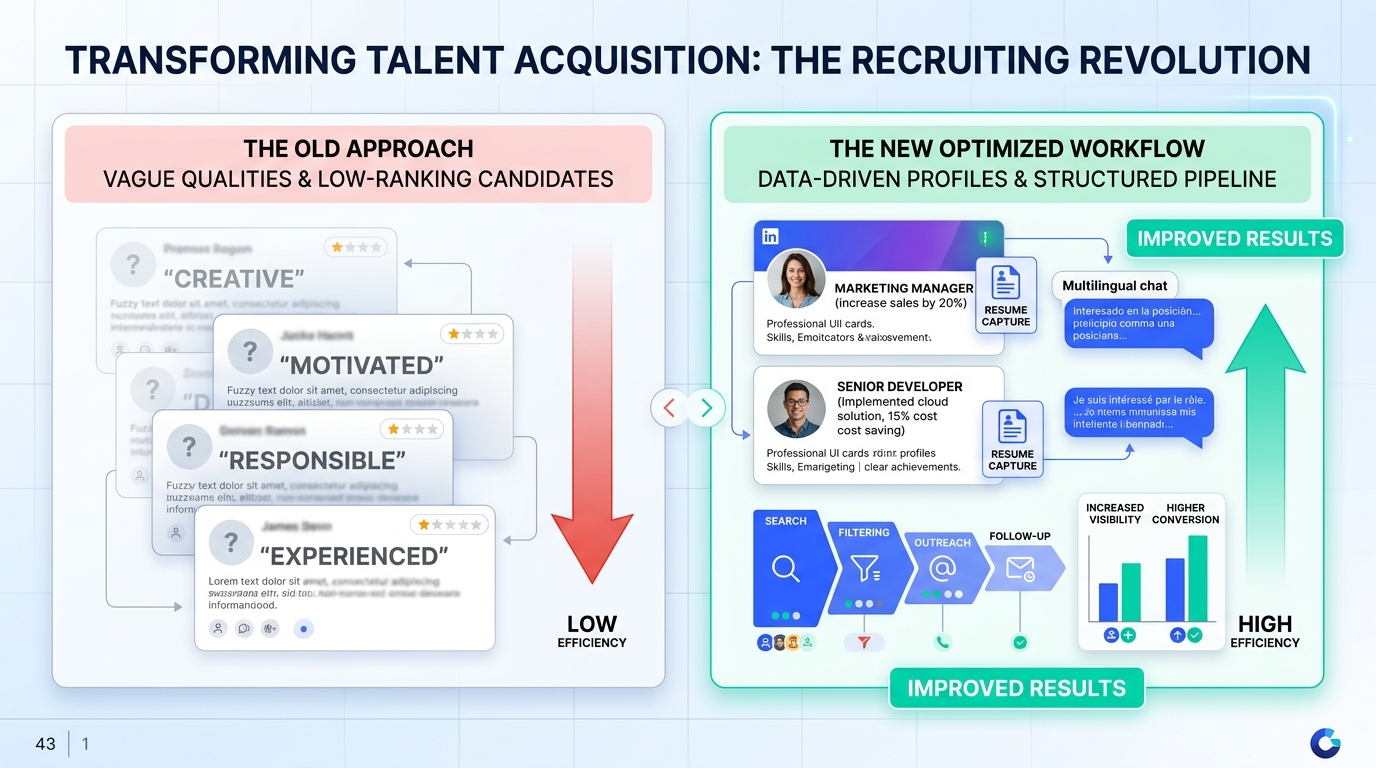
Candidate tracking software delivers better results when recruiters and candidates use precise, evidence based language instead of generic LinkedIn buzzwords. Terms such as creative, motivated, and responsible may sound professional, but they reduce search clarity inside ATS HR workflows and make an automated tracking system less useful for ranking, filtering, and outreach. We reviewed the original LinkedIn buzzword discussion and rebuilt the topic for modern recruiting teams. The practical takeaway is simple. Replace vague claims with measurable outcomes, then connect that cleaner profile data to a workflow that can capture interest, collect resumes, and support follow up at scale through tools such as StrategyBrain AI Recruiter.
Key Takeaways
- Buzzwords reduce search quality: Generic terms make candidate tracking software less effective because they do not describe skills, outcomes, or fit.
- LinkedIn identified repeated profile language: Creative ranked first in the cited historical LinkedIn buzzword list across multiple markets.
- ATS HR systems need structured inputs: Specific achievements such as revenue growth, hiring volume, or project scope are easier to search and compare.
- Recruiters should rewrite outreach too: Candidate messages perform better when they explain role details, compensation context, and next steps clearly.
- Automation improves follow through: StrategyBrain AI Recruiter can automate LinkedIn connection, role introduction, candidate interest checks, and resume collection.
- Multilingual communication matters: Global hiring workflows improve when candidate communication happens in the candidate’s native language.
Why buzzwords still matter in recruiting
Recruiters have complained about empty profile language for years, yet the problem remains relevant because modern hiring stacks depend on structured information. A profile filled with broad adjectives may look polished at first glance, but it gives very little usable data to a recruiter, a sourcer, or a candidate tracking software platform. When every profile says motivated, effective, and innovative, those words stop helping anyone make decisions.
This matters even more now because ATS HR teams increasingly rely on search filters, tags, ranking logic, and automated outreach sequences. If the underlying profile language is vague, the automated tracking system has less signal to work with. That creates a downstream problem. Recruiters spend more time manually reviewing profiles, candidates receive less relevant outreach, and hiring teams lose speed.
We see this in practice whenever sourcing teams try to separate strong candidates from average matches. A measurable statement such as increased online sales revenue by 13 percent is far more useful than saying results driven marketer. The first phrase gives context, scale, and evidence. The second phrase gives almost nothing that a recruiter can verify or compare.
What the LinkedIn data showed
The original source material highlighted LinkedIn’s review of 187 million member profiles and its annual buzzword list. In that review, creative held the top position for the second year in a row. The United States top 10 also included organizational, effective, motivated, extensive experience, track record, innovative, responsible, analytical, and problem solving. The same pattern appeared internationally, with several countries repeating similar language trends.
LinkedIn also noted that some terms stayed near the top while others moved in or out of the ranking. According to the cited summary, responsible and analytical appeared for the first time in that ranking, while dynamic and communication skills dropped out. Motivated also moved above extensive experience compared with the earlier list.
Those details may look like a lighthearted year end observation, but they reveal a serious recruiting issue. When millions of professionals describe themselves with the same words, profile differentiation declines. That hurts both sides of the market. Candidates become harder to evaluate, and recruiters struggle to identify fit quickly.
The original practical advice still holds up well. Remove unnecessary buzzwords, use simple language, show tangible results, avoid inflated headlines, and rely on recommendations or endorsed skills where possible. In today’s environment, I would add one more point. Write profiles and outreach in a way that improves machine readability as well as human credibility.
Why this affects candidate tracking software
Candidate tracking software is only as useful as the data it receives. Most teams think about resumes when they hear that phrase, but the same principle applies to LinkedIn sourcing, recruiter notes, outreach replies, and qualification data. If your system stores weak inputs, it produces weak outputs.
What vague language does to ATS HR workflows
- Search relevance drops: Broad adjectives create noisy search results because too many profiles contain the same terms.
- Ranking becomes less meaningful: An automated tracking system cannot easily distinguish candidates when profiles lack measurable evidence.
- Screening takes longer: Recruiters must manually interpret what a candidate actually did.
- Outreach quality suffers: Generic recruiter messages often mirror generic profiles, which lowers response quality.
- Reporting gets weaker: Teams cannot learn much from data that lacks specificity.
What strong language looks like instead
Strong profile language includes scope, outcomes, tools, industries, and timelines. For example, instead of writing experienced recruiter, a stronger version would say managed full cycle hiring for 45 sales and operations roles across Canada and the United States. Instead of writing strong communication skills, a candidate could say led weekly stakeholder updates for a 12 person cross functional implementation team.
These details help both humans and systems. Recruiters can assess relevance faster. Candidate tracking software can index more useful terms. ATS HR reporting becomes more actionable because the data reflects real work rather than self promotional filler.
How recruiters should rewrite profiles and outreach
If you want better results from candidate tracking software, start by improving the language in three places. Candidate profiles, recruiter outreach, and qualification notes. Each one feeds your broader hiring system.
1. Rewrite profile summaries around evidence
Encourage candidates and internal recruiting teams to replace adjectives with proof. Numbers, project scope, hiring volume, market coverage, and business outcomes all create stronger records. This is especially important for LinkedIn recruiting because profile text often becomes the first layer of sourcing data.
2. Rewrite recruiter outreach around clarity
Many outreach messages still sound like they were written for a mass blast. Candidates respond better when the message explains the role, employer context, compensation range if available, and why the recruiter reached out. Clear outreach also improves the data captured later in the process because candidates answer more directly when the opening message is specific.
3. Rewrite qualification notes around decision signals
Recruiter notes should capture facts that matter for next step decisions. Availability, location preference, compensation expectations, interview interest, language ability, and resume status are all useful fields. Notes such as great profile or seems strong are not useful inside an automated tracking system because they cannot be standardized or audited easily.
4. Use a repeatable profile review framework
We recommend a simple four part review model for LinkedIn and resume language.
- Specificity: Does the profile mention measurable outcomes, role scope, or tools used?
- Relevance: Does the language match the target role and industry?
- Credibility: Are claims supported by examples, recommendations, or consistent career history?
- Searchability: Would a recruiter or ATS HR search query realistically surface this profile?
This framework is easy to apply across recruiting teams and improves consistency in candidate evaluation.
Where StrategyBrain AI Recruiter fits
Once profile language and outreach quality improve, the next challenge is execution at scale. This is where StrategyBrain AI Recruiter becomes relevant to the broader candidate tracking software conversation. It is designed for LinkedIn recruitment automation and helps teams handle the repetitive front end work that often slows sourcing pipelines.
Based on the provided product information, AI Recruiter can automatically connect with candidates who match targeted search criteria, introduce job opportunities, answer questions about the role and company, confirm interview interest, and collect resumes plus contact details from interested candidates. That means the system does not just send messages. It supports the early qualification workflow that many recruiters still manage manually.
For ATS HR teams, this matters because the value of an automated tracking system increases when candidate interactions are captured in a structured way. If a candidate expresses interest, shares a resume, or provides contact details, those are meaningful workflow events. They are much more useful than a vague note that someone seemed promising.
Why this is useful for LinkedIn recruiting
- Better first contact: Candidates receive a clearer introduction to the role instead of a generic pitch.
- Faster response handling: AI Recruiter supports round the clock follow up.
- Multilingual communication: Candidate conversations can happen in the candidate’s native language.
- Resume capture: Interested candidates can share resumes and contact details for recruiter review.
- Scalable operations: Teams can manage more than 100 LinkedIn accounts to expand hiring capacity.
The product information also states that AI Recruiter can reduce LinkedIn recruiting costs to as little as USD 2.40 per resume and replace up to 90 percent of manual LinkedIn recruiting work. Those figures are product claims from the provided source material, so teams should validate fit against their own workflow, role type, and market conditions. Even with that caution, the operational direction is clear. Better candidate data plus better automation creates a stronger recruiting engine.
Important scope boundary
AI Recruiter helps identify willingness to communicate or interview, but it does not make the final judgment on whether a resume fully matches job requirements. Recruiters still review resumes and make the final qualification decision. That boundary is important because it keeps the system aligned with practical recruiting operations rather than overstating automation.
Practical checklist
Use this checklist if you want to improve profile quality and get more value from candidate tracking software.
- Replace generic adjectives with measurable outcomes.
- Remove inflated headlines that do not describe actual work.
- Add role scope, geography, team size, or hiring volume where relevant.
- Standardize recruiter notes around availability, interest, compensation, and resume status.
- Review whether your ATS HR fields capture useful qualification signals.
- Audit LinkedIn outreach templates for clarity and specificity.
- Use automation for connection, follow up, and resume collection where appropriate.
- Keep final fit assessment with human recruiters.
Before and after examples
| Weak wording | Stronger wording |
|---|---|
| Creative recruiter with extensive experience | Led full cycle hiring for 60 operations and sales roles across 3 regions |
| Motivated HR professional | Reduced time to interview scheduling by 28 percent through workflow redesign |
| Strong communication skills | Managed candidate communication across English, French, and Spanish speaking markets |
| Track record of success | Filled 18 hard to hire technical roles in 2 quarters |
These examples show the core principle. Candidate tracking software performs better when the language entering the system is concrete and comparable.
FAQ
What is candidate tracking software?
Candidate tracking software is a system that helps recruiting teams organize applicants, sourcing activity, communication history, and hiring stage data. In many companies, it overlaps with ATS HR workflows and supports search, filtering, reporting, and collaboration.
Why do LinkedIn buzzwords hurt ATS HR performance?
Buzzwords hurt ATS HR performance because they are too generic to support accurate search and ranking. When many profiles use the same vague terms, an automated tracking system has less useful information for matching and prioritization.
Is candidate tracking software the same as an automated tracking system?
In practice, the terms are often used similarly, although teams may define them differently. Candidate tracking software usually refers to the recruiting workflow platform, while automated tracking system may emphasize automation features such as status updates, outreach triggers, and resume capture.
How can recruiters improve candidate data quality?
Recruiters can improve data quality by replacing vague notes with structured facts, using measurable language in outreach and profile reviews, and standardizing what gets recorded after each candidate interaction. Clearer inputs lead to better searchability and reporting.
How does StrategyBrain AI Recruiter support recruiting teams?
Based on the provided product information, StrategyBrain AI Recruiter automates LinkedIn connection requests, role introductions, candidate conversations, interest checks, and resume or contact detail collection. It also supports multilingual communication and scalable account management for larger recruiting operations.
Does AI Recruiter replace recruiter judgment?
No. The provided product information states that AI Recruiter helps identify candidate willingness to engage or interview, but recruiters still review resumes and make final qualification decisions.
Can multilingual communication improve sourcing results?
Yes. Multilingual communication can reduce misunderstandings and improve candidate comfort, especially in cross border hiring. It can also help recruiters maintain response quality across time zones and markets.
What should recruiters remove from LinkedIn profiles first?
Start with repeated adjectives that do not prove anything, such as creative, motivated, or responsible when they appear without context. Replace them with outcomes, scope, tools, and role specific evidence.
Conclusion
Candidate tracking software becomes more valuable when recruiting teams stop relying on buzzwords and start capturing evidence. That was the hidden lesson in the old LinkedIn buzzword list, and it is even more relevant now. Clear profile language improves sourcing. Structured notes improve ATS HR workflows. Better outreach improves candidate response quality. Then automation can do more useful work on top of that stronger foundation.
If your team wants a practical next step, audit your LinkedIn messaging, profile review standards, and qualification notes this week. After that, evaluate whether an automated tracking system and LinkedIn automation layer such as StrategyBrain AI Recruiter can help your team scale candidate engagement, resume capture, and follow up without adding unnecessary manual work.