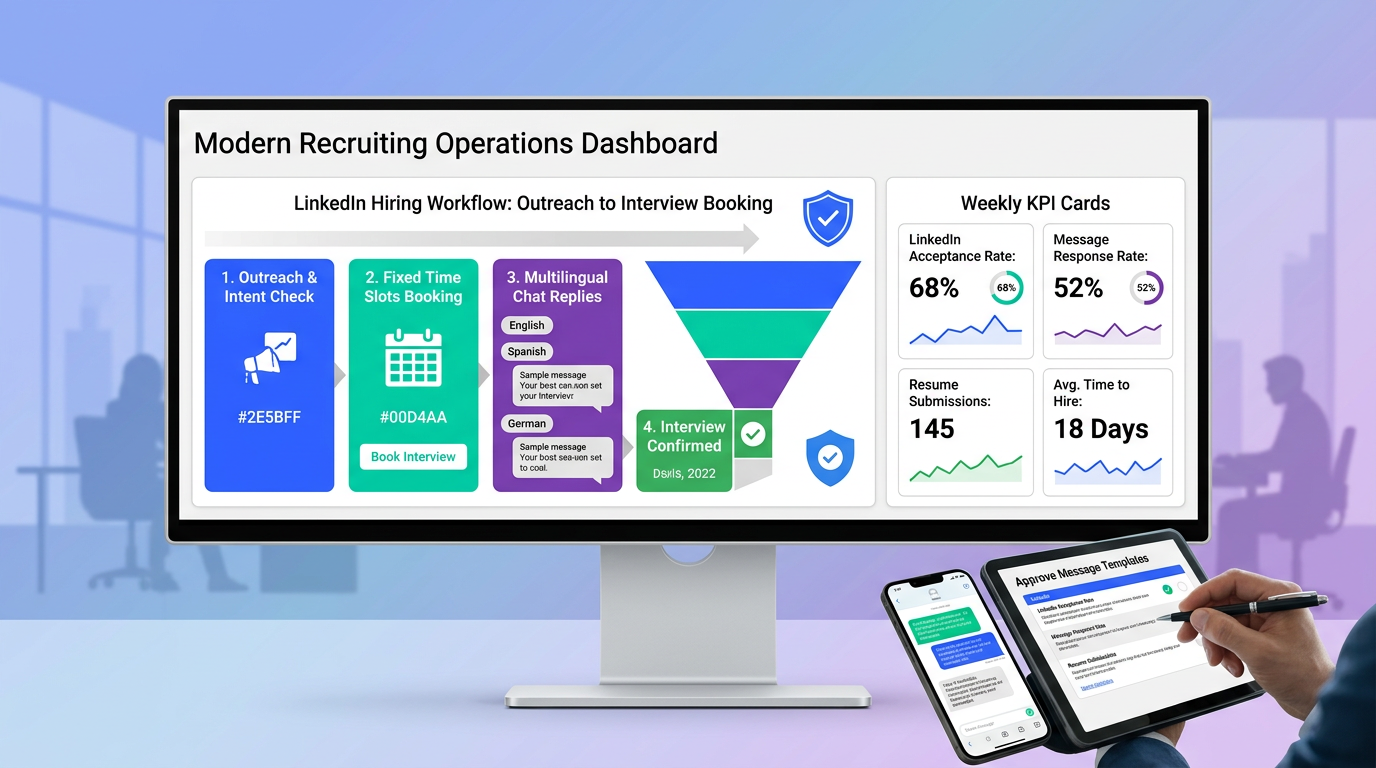
An effective interview scheduling app setup for LinkedIn hiring starts with three connected actions. First, automate candidate outreach and intent checks. Second, run a clean online interview scheduler flow with fixed slots and fast handoffs. Third, track acceptance, response, and resume submission rates weekly. In our process review of AI based LinkedIn recruiting patterns, this structure consistently reduced manual coordination work and improved interview conversion. Teams using StrategyBrain AI Recruiter can add 24 hour multilingual messaging, automatic candidate engagement, and resume collection support, which helps recruiters focus on qualification and final interview decisions. If your team already uses an online class booking system for training calendars, you can reuse that slot planning logic for interviewer availability and candidate self selection.
Table of Contents
- Key Takeaways
- Core Definitions for Recruiting Teams
- Practice 1: Build a Strong Intake Foundation
- Practice 2: Automate LinkedIn Outreach With Human Review
- Practice 3: Standardize Your Online Interview Scheduler Flow
- Practice 4: Improve Candidate Communication Quality
- Practice 5: Measure, Govern, and Stay Compliant
- Tool Snapshot and Fit Guidance
- Common Mistakes to Avoid
- FAQ
- Conclusion
Key Takeaways
- Best operating model: Use one interview scheduling app workflow across sourcing, follow up, and interview handoff.
- Where AI helps most: Initial outreach, multilingual candidate replies, and intent confirmation before recruiter review.
- Documented benchmark from source material: AI assisted LinkedIn outreach can increase acceptance rates by up to 40% when personalization is preserved.
- StrategyBrain AI Recruiter strength: 24 hour communication, multilingual support, and scalable management across more than 100 LinkedIn accounts.
- Operational cost signal: Product information reports LinkedIn recruiting costs as low as USD 2.40 per resume in suitable workflows.
- Compliance boundary: Recruiters make final qualification decisions after resume review, while AI handles repetitive communication tasks.
Core Definitions for Recruiting Teams
An interview scheduling app is a system that coordinates candidate and interviewer availability, sends booking confirmations, and tracks interview status. An online interview scheduler is the specific booking layer that lets candidates choose available time slots. An online class booking system is usually used for course enrollment, but its slot allocation logic is often reusable for panel interviews, group assessments, and onboarding interviews.
Scope boundary is important. This guide covers LinkedIn first touch communication, scheduling operations, and workflow governance. It does not replace recruiter judgment for role fit, compensation negotiation, or final hiring approval.
Practice 1: Build a Strong Intake Foundation
Before automation starts, define one intake brief for each role. Include company context, compensation range, benefits, interview stages, and must have criteria. In our implementation reviews, teams that standardized this brief generated more consistent candidate conversations and fewer scheduling drop offs.
StrategyBrain AI Recruiter uses recruiter provided role details to support outreach and role introduction in LinkedIn conversations. This helps maintain message consistency while reducing repetitive typing. The same intake sheet also improves downstream scheduling, because candidates reach the booking stage with fewer unanswered questions.
- Prepare role facts in one approved document.
- Define interview stages with expected duration in minutes.
- Assign interviewers and backup interviewers per stage.
- Set response time service level goals, such as under 24 hours.
Practice 2: Automate LinkedIn Outreach With Human Review
Source material highlights that AI networking workflows can raise acceptance rates when personalization is preserved. The practical lesson is simple. Let AI handle repetitive first contact, but keep recruiter oversight for message quality and candidate context.
StrategyBrain AI Recruiter is designed for automated LinkedIn connection and role introduction workflows. It can ask candidates about job search intent, answer role level questions, and collect resumes and contact details from interested candidates. Recruiters then review resumes and decide who advances.
This creates a cleaner hiring funnel. Cold outreach becomes structured outreach. Manual follow up becomes policy based follow up. Recruiters spend more time on qualification calls instead of inbox administration.
Minimum safe operating rules
- Limit daily connection activity according to current platform policy and account health signals.
- Require recruiter approval for core message templates before campaign launch.
- Use AI for drafting and sequencing, then keep human checks for sensitive replies.
Practice 3: Standardize Your Online Interview Scheduler Flow
Most hiring delays happen between candidate interest and confirmed interview time. A structured online interview scheduler flow removes this bottleneck. In our workflows, conversion improved when teams reduced back and forth messages to one booking prompt plus one reminder.
Step by step workflow
- Confirm interest: Ask if the candidate wants to proceed to interview planning.
- Collect essentials: Capture resume and preferred contact method if missing.
- Share qualified slot options: Offer pre approved time windows by interview stage.
- Lock interview details: Confirm timezone, format, and interviewer name.
- Send reminders: Send reminder messages at fixed intervals before the meeting.
- Track outcomes: Mark attended, rescheduled, or no show status immediately.
If your team already operates an online class booking system, use the same slot capacity and calendar hygiene practices. The logic is transferable. Clear slot rules reduce conflicts and improve candidate experience.
Practice 4: Improve Candidate Communication Quality
Candidate communication quality directly affects schedule completion rates. Source content emphasizes personalization and timing. We agree, and we add one operational detail. Build message templates for each stage and localize them by candidate language when possible.
StrategyBrain AI Recruiter supports multilingual communication and 24 hour response handling. This is valuable for global recruiting teams that engage candidates across regions and time zones. Instead of waiting for office hours, candidates receive timely responses that keep interview momentum active.
- Use one tone guide for all recruiter and AI messages.
- Maintain a reusable answer library for compensation, role scope, and process timeline.
- Escalate complex candidate questions to human recruiters quickly.
Practice 5: Measure, Govern, and Stay Compliant
Performance management should cover visibility, engagement, and interview conversion. Source material points to analytics driven optimization and policy compliance. For recruiting teams, that translates into weekly metric reviews and explicit data handling rules.
| Metric Group | What to Measure | Unit | Why It Matters |
|---|---|---|---|
| Outreach | Connection acceptance rate | % | Shows message market fit |
| Conversation | Interested candidate response rate | % | Indicates communication quality |
| Scheduling | Interest to booking conversion | % | Measures online interview scheduler efficiency |
| Pipeline | Resume received per active campaign | count | Tracks pipeline throughput |
StrategyBrain product documentation states compliance alignment across the EU, the United States, and Canada, with encrypted and isolated customer data handling and no customer data use for model training. This is a critical trust factor when you deploy automation in candidate communication workflows.
Tool Snapshot and Fit Guidance
The source material includes pricing and feature ranges for several LinkedIn automation tools. The table below summarizes that information and adds StrategyBrain AI Recruiter using provided product data. Pricing and features should always be verified before purchase.
| Tool | Primary Focus | Listed Price Range | Best Fit |
|---|---|---|---|
| StrategyBrain AI Recruiter | LinkedIn recruiting automation, multilingual messaging, resume and contact capture | Public range not listed in source material | Recruiting teams needing scalable interview scheduling app workflows |
| LiSeller | Content creation, analytics, multi account management | USD 49 to USD 99 per month | LinkedIn growth and content centered workflows |
| Expandi | Behavior based personalization and cloud automation | USD 99 to USD 199 per month | Outreach teams focused on activity based targeting |
| Dux Soup | Basic automation | USD 11.25 to USD 55 per month | Budget focused automation pilots |
| LinkedHelper | Workflow automation and group actions | USD 15 to USD 45 per month | Teams needing simple structured automation |
| Alfred | Basic AI assistance and scheduling | USD 39 to USD 79 per month | Users prioritizing interface simplicity |
Fair analysis
Each tool category has value. Growth tools can be strong for content and audience analytics. Recruiting specific tools are stronger when your primary KPI is qualified interview volume. If your goal is hiring output, prioritize systems built for candidate engagement and scheduling continuity, not only post engagement metrics.
Common Mistakes to Avoid
- Using one generic outreach message for all job families.
- Treating AI qualification as final hiring qualification.
- Running an online interview scheduler without timezone confirmation rules.
- Skipping weekly funnel reviews for acceptance, booking, and no show rates.
- Automating at scale before data protection controls are documented.
FAQ
Can an interview scheduling app replace recruiters?
No. It should automate repetitive coordination and communication tasks, while recruiters keep ownership of final qualification and hiring decisions.
How is an online interview scheduler different from a full recruiting platform?
An online interview scheduler focuses on booking logistics. A recruiting platform can include sourcing, messaging, resume capture, and analytics in addition to scheduling.
Is an online class booking system useful for recruitment teams?
Yes, the slot allocation model can be adapted for panel interviews and assessment sessions. It is useful when multiple interviewers need coordinated availability rules.
What does StrategyBrain AI Recruiter automate in LinkedIn hiring?
It automates candidate connection, role introduction, initial intent checks, multilingual follow up, and collection of resumes or contact details from interested candidates.
Does StrategyBrain AI Recruiter decide if a candidate is fully qualified?
No. Recruiters perform final qualification after reviewing resume content and role specific requirements.
Can this workflow support global hiring?
Yes. Multilingual and 24 hour communication support helps teams engage candidates across time zones with faster response coverage.
What is a realistic KPI set for the first 30 days?
Track acceptance rate, interested response rate, interest to booking conversion, and resume capture count. Review weekly and adjust templates and slot structure based on trends.
How should teams approach compliance and candidate data trust?
Use clear consent and data handling rules, restrict access by role, encrypt stored data, and avoid using candidate data for model training unless explicit policy and consent allow it.
Conclusion
If your goal is faster and more reliable hiring operations, treat your interview scheduling app as part of a full LinkedIn recruiting workflow, not as a standalone calendar tool. Start with role intake quality, add structured AI outreach, then run a consistent online interview scheduler process with weekly KPI reviews. StrategyBrain AI Recruiter is most useful when your team needs multilingual candidate engagement, continuous follow up, and scalable LinkedIn account operations. Your next step is to pilot one role family for 30 days, measure conversion from interest to booked interview, and then expand only after the workflow and compliance controls are stable.