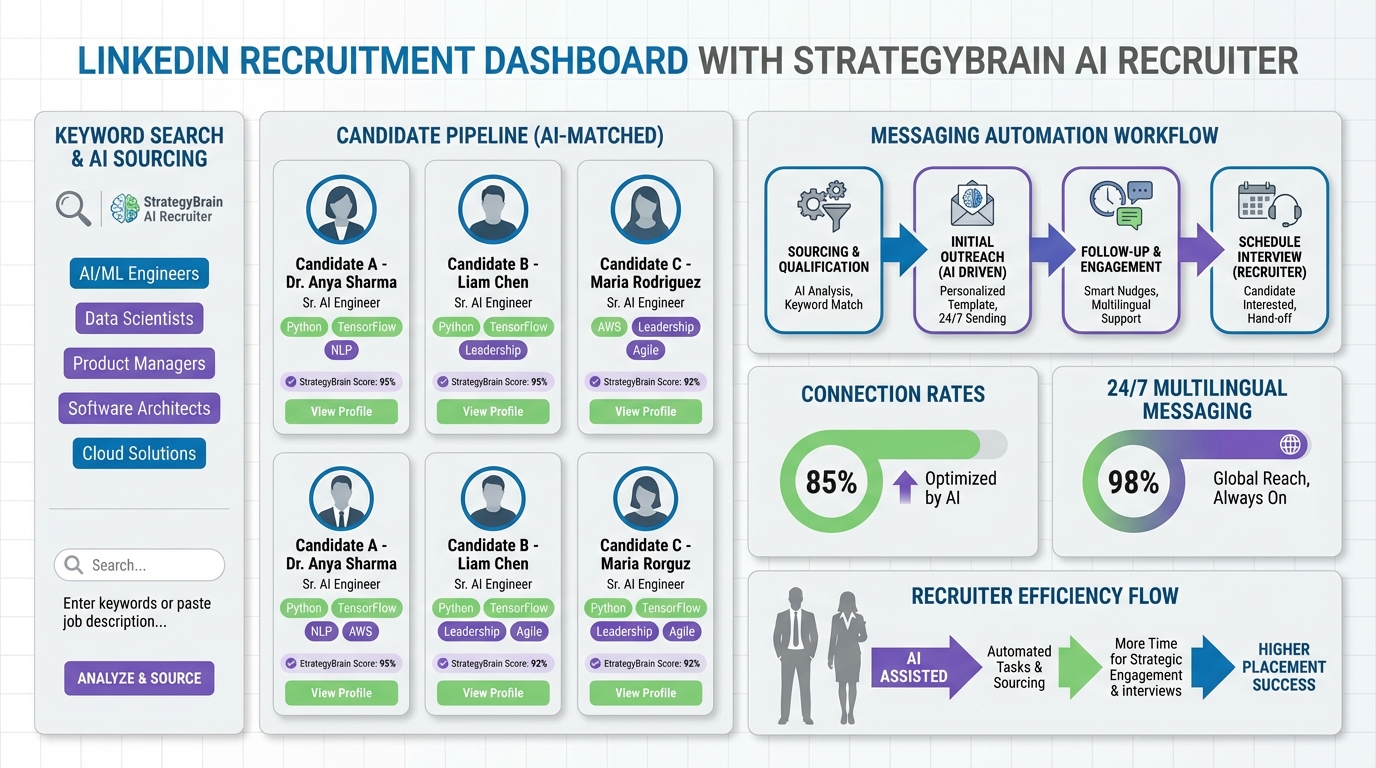
Recruiting software platforms work best when they amplify where candidates already spend time, and LinkedIn is still one of the most practical places to start. For employers, LinkedIn supports keyword based candidate search, job posting visibility, groups for niche communities, and a company profile that builds credibility. For job seekers, it improves discoverability through profile keywords, strengthens trust via recommendations, and makes it easier to maintain a professional network. If you want to turn LinkedIn activity into a repeatable workflow, hiring software for small business can add structure, while StrategyBrain AI Recruiter can automate the first touch, follow up, and multilingual conversations so recruiters spend more time interviewing and less time messaging.
Key Takeaways
- LinkedIn is a high leverage channel for recruiting technology because it combines search, messaging, and credibility signals in one place.
- Employers get six practical benefits on LinkedIn: network growth, keyword search, job posts, groups, company profile credibility, and business opportunities.
- Job seekers get six practical benefits on LinkedIn: credibility, discoverability, a personal address book, easier connection building, groups, and simple applications.
- Recruiting software platforms add consistency by turning ad hoc sourcing into a trackable workflow with defined steps and handoffs.
- StrategyBrain AI Recruiter can automate early stage LinkedIn work including connecting, introducing roles, answering questions, confirming interest, and collecting resumes and contact details.
- Always on communication matters because StrategyBrain AI Recruiter supports 24/7 multilingual messaging to reduce delays across time zones.
Why LinkedIn still matters for recruiting software platforms
LinkedIn is not just a place to post roles. It is a professional identity layer where profiles, recommendations, and shared connections create trust signals that are hard to replicate elsewhere. That is why many recruiting software platforms either integrate with LinkedIn workflows or are judged by how well they support LinkedIn sourcing and outreach.
In practice, the value comes from two things. First, LinkedIn makes it easier to find people using keywords that match skills, titles, and industries. Second, it gives both sides a way to validate credibility through profiles, endorsements, and mutual connections.
Scope note: This guide focuses on LinkedIn as a sourcing and networking channel and how recruiting technology can operationalize it. It does not cover paid advertising strategy, employer branding campaigns, or detailed ATS implementation.
Benefits of LinkedIn to employers
When I evaluate hiring software for small business, I look for tools that support the basics: sourcing, outreach, follow up, and a clean handoff to interviews. LinkedIn already covers a large part of the sourcing and credibility side, so the employer benefits are straightforward and practical.
1) Develop and expand your network
By building and maintaining a complete company presence and personal recruiter profiles, you increase credibility. Over time, that credibility turns into referrals and warm introductions, which are typically faster than cold outreach.
2) Search for potential candidates using keywords
Keyword search is one of LinkedIn’s most direct recruiting advantages. You can search for the exact terms you want in an employee, then refine and prioritize outreach based on relevance.
3) Post jobs
Job posting on LinkedIn can increase submissions because candidates are already browsing roles and can apply with their profile. For small teams, this can be a simple way to widen the top of funnel without building a complex distribution plan.
4) Groups
Groups can help you become known as a specialist in a niche. They also provide a place to learn what professionals in that niche care about, which improves how you write outreach messages and job descriptions.
5) Company profile
A company profile is a credibility asset. It helps candidates validate that the role is real and that the organization has a consistent story, which can reduce friction during early conversations.
6) Business opportunities
LinkedIn networking can open doors beyond hiring, including partnerships and customer relationships. That matters because recruiting is often easier when the company is visible and trusted in its market.
Benefits of LinkedIn to job seekers
From the candidate side, LinkedIn is a discoverability engine. The same keyword logic that helps recruiters search also helps job seekers get found. The platform also makes it easier to keep relationships alive with minimal effort.
1) Build credibility
Recommendations and endorsements create social proof. They are not perfect, but they can help a recruiter quickly understand how others describe your work.
2) Get discovered
Recruiters often search by role keywords, tools, and industries. When job seekers use specific keywords in their profiles, they increase the chance of appearing in relevant searches.
3) Create your own personal address book
For people who attend networking events, LinkedIn makes it easier to reconnect later. It becomes a lightweight system for maintaining professional relationships over years.
4) Build connections more easily
Connecting with one person can expand access to their network. That can lead to introductions that would be difficult to request through email alone.
5) Join groups
Groups can provide insights, peer support, and job search context. They also help candidates learn the language of a niche, which improves how they present their experience.
6) Apply for positions
Applying with a LinkedIn profile can be faster than filling out long forms. It also gives employers a more interactive view of experience than a resume alone.
How to turn LinkedIn activity into a repeatable workflow
LinkedIn works, but it can become messy fast. The difference between casual sourcing and a reliable pipeline is process. This is where recruiting software platforms and hiring software for small business earn their keep by enforcing consistency.
Step by step workflow (practical and lightweight)
- Define your search criteria
Write down the must have keywords, nice to have keywords, target titles, and locations. Keep it to 10 to 20 keywords so your search stays focused. - Build a short outreach script
Create a 3 message sequence: initial intro, follow up, and a final check in. Keep each message under 80 words and include one clear question. - Track outcomes in a simple funnel
Use stages such as Connected, Replied, Interested, Resume received, Interview scheduled. This is the minimum structure most recruiting technology needs to be useful. - Set a follow up cadence
Pick fixed follow up days, for example day 2 and day 5 after the first message. Consistency matters more than volume. - Standardize the handoff to interviews
Once a candidate is interested, collect resume and contact details, then move the conversation to scheduling and screening with a human recruiter.
Common pain points we see in real teams
- Follow up gaps where interested candidates go cold because nobody replies quickly enough.
- Inconsistent messaging where different recruiters describe the same role differently.
- Manual admin overload where time is spent copying details into spreadsheets instead of interviewing.
Where StrategyBrain AI Recruiter fits in a LinkedIn workflow
StrategyBrain AI Recruiter is designed specifically for LinkedIn hiring. In our internal walkthroughs of the product flow, the clearest value is that it replaces the repetitive first phase of LinkedIn recruiting: connecting, introducing the opportunity, handling common questions, confirming interest, and collecting resumes and contact information for candidates who want to proceed.
What it automates on LinkedIn
- Smart LinkedIn recruitment automation that connects with candidates who match your targeted search criteria and starts the initial conversation.
- Role introduction and Q&A so candidates can ask about the role, company, and compensation and get timely responses.
- Interest confirmation to identify who wants to move forward to an interview.
- Resume and contact capture by requesting resumes and collecting contact details from interested candidates.
Why 24/7 multilingual messaging changes the funnel
One of the most underestimated bottlenecks in LinkedIn recruiting is response time. StrategyBrain AI Recruiter provides 24/7 multilingual communication, which helps teams keep momentum with candidates across time zones and reduces misunderstandings by using the candidate’s native language.
Scaling beyond one recruiter
For teams that need volume, StrategyBrain AI Recruiter supports managing more than 100 LinkedIn accounts so organizations can build AI powered recruitment teams. This is a different approach than simply adding more recruiters, because it scales the outreach and follow up layer without expanding headcount at the same rate.
Limitations and what still needs a human
StrategyBrain AI Recruiter can identify willingness to communicate or interview, but it does not decide whether a resume fully matches job requirements. A recruiter still needs to review resumes and run the final qualification and interview process.
Data protection and security notes
According to StrategyBrain product documentation provided for this article, customer provided data is not used to train AI models. LinkedIn account credentials are encrypted and stored independently per user with explicit authorization. Candidate information such as resumes, contact details, and conversation history is encrypted and not shared with third parties.
Quick comparison: manual LinkedIn vs structured workflow vs AI automation
| Approach | Speed to first response | Consistency | Best for |
|---|---|---|---|
| Manual LinkedIn recruiting | Depends on recruiter availability | Varies by person | Low volume roles and highly personalized outreach |
| Workflow driven recruiting technology | Improves with defined follow up cadence | Higher with templates and stages | Teams that need repeatability and reporting |
| StrategyBrain AI Recruiter on LinkedIn | 24/7 messaging support | High for early stage outreach and follow up | Teams scaling sourcing and initial qualification across time zones |
FAQ
What are recruiting software platforms in plain terms?
Recruiting software platforms are systems that help teams source candidates, manage outreach, track pipeline stages, and coordinate interviews. Some focus on applicant tracking, while others focus on sourcing and messaging.
Is LinkedIn enough, or do I still need hiring software for small business?
LinkedIn can be enough for early stage hiring if volume is low and follow up is disciplined. Hiring software for small business becomes important when you need consistent stages, templates, and visibility into what is happening across roles.
How do keywords actually help on LinkedIn?
Keywords help recruiters find candidates and help candidates get discovered. The practical rule is to use specific skill and role terms that match how your target market describes the work.
What does StrategyBrain AI Recruiter automate on LinkedIn?
It automates connecting with candidates, introducing job opportunities, answering common questions about the role and company, confirming interview interest, and collecting resumes and contact details from interested candidates.
Does StrategyBrain AI Recruiter replace recruiters?
No. It replaces repetitive early stage LinkedIn tasks, but recruiters still review resumes, assess fit, and run interviews. Think of it as automation for outreach and initial qualification, not final hiring decisions.
Can it communicate with candidates in different languages?
Yes. StrategyBrain AI Recruiter supports multilingual communication and can respond 24/7, which helps when candidates are in different countries and time zones.
How does it handle resumes and contact details?
When a candidate is interested, it requests a resume and captures contact details shared in the conversation. It supports both email submissions and LinkedIn file uploads, based on the product information provided for this article.
What should I do first if I want better results on LinkedIn this week?
Start by tightening your keyword list and writing a 3 message outreach sequence. Then set a fixed follow up cadence and track outcomes in simple stages so you can see where candidates drop off.
Conclusion
LinkedIn remains valuable because it combines search, messaging, and credibility in one place, which is exactly what recruiting software platforms try to operationalize. Employers benefit from network growth, keyword search, job posts, groups, and company credibility, while job seekers benefit from discoverability and trust signals like recommendations.
Next, turn LinkedIn from a habit into a workflow: define criteria, standardize outreach, track stages, and follow up on a schedule. If your bottleneck is time spent on repetitive messaging, StrategyBrain AI Recruiter can automate the early stage LinkedIn outreach, follow up, and multilingual conversations so your team can focus on interviews and final qualification.