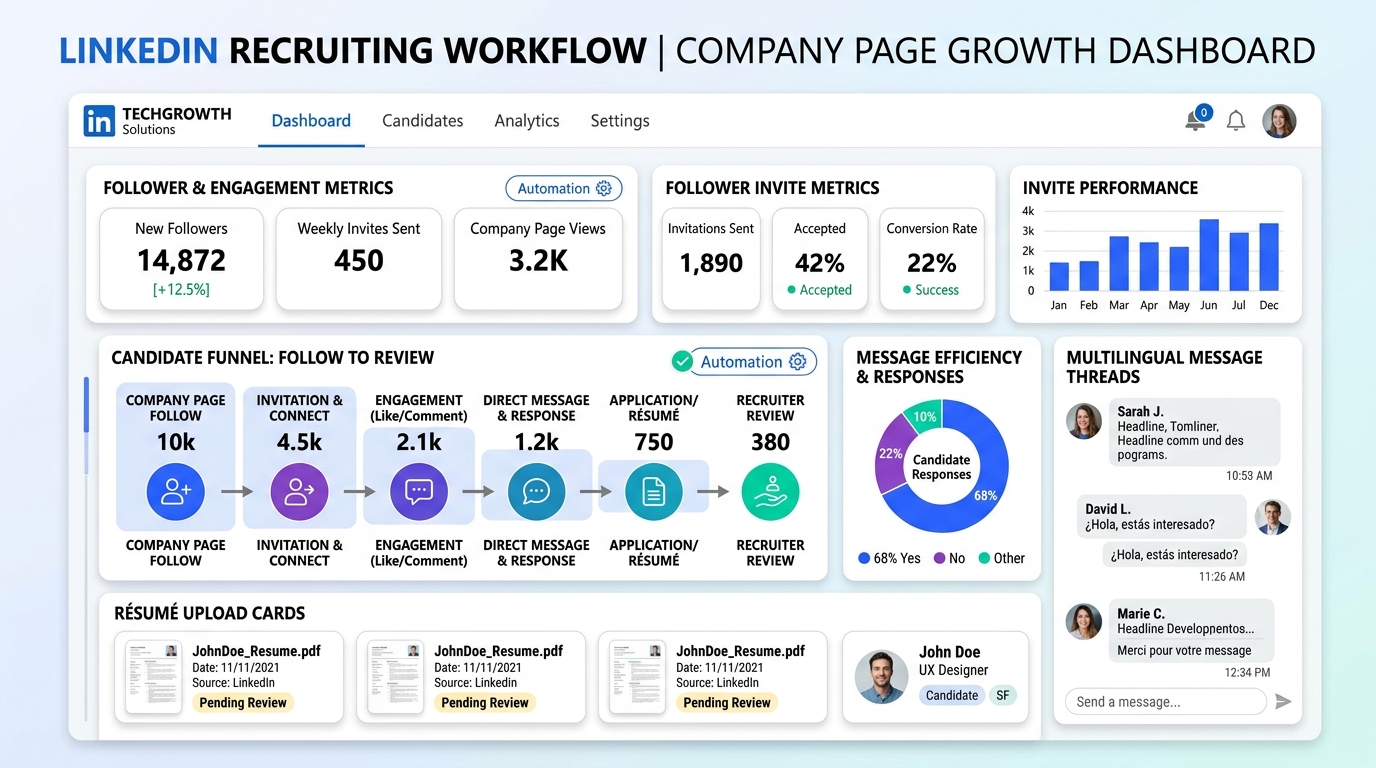
A recruitment app can help teams do more than send messages or manage candidate pipelines. It can also support LinkedIn company page growth by helping recruiters reach the right professionals, increase brand visibility, and create a more engaged audience around hiring activity. Based on the source material and our review of LinkedIn recruiting workflows, the strongest results come from combining targeted company follow invites with automated candidate outreach, clear employer messaging, and consistent follow up. For teams that hire at scale, StrategyBrain AI Recruiter adds practical value because it supports LinkedIn recruitment automation, multilingual communication, and résumé collection while keeping recruiters focused on final screening and interviews.
Key Takeaways
- Company follow invites can support recruiting: A larger LinkedIn follower base improves employer brand reach among relevant professionals.
- Targeting matters more than volume: Inviting first degree connections and relevant professionals creates a more useful audience than broad untargeted growth.
- A recruitment app should support both branding and hiring: The best recruiting apps help teams attract attention and move interested candidates into active conversations.
- StrategyBrain AI Recruiter fits this workflow well: It automates LinkedIn outreach, answers candidate questions, and collects résumés and contact details for recruiter review.
- Multilingual communication expands reach: Global hiring teams benefit when candidate communication happens in the candidate’s native language.
- Recruiters still own final qualification: Automation can identify interest and gather information, but résumé review and hiring decisions remain human tasks.
Why this matters for recruiting teams
LinkedIn company page growth is often treated as a marketing objective, but it also has direct recruiting value. When more relevant professionals follow a company page, job announcements, culture content, and hiring updates reach a warmer audience. That creates more familiarity before a recruiter ever starts a one to one conversation.
The source material emphasizes that company follow invites are useful because they help organizations grow visibility among professionals who are already connected to the business in some way. That matters in recruiting because employer trust often starts before the first outreach message. A company page with a credible follower base can reinforce legitimacy, industry presence, and social proof.
We also see a practical overlap between recruiting apps and audience building. Many recruiting apps focus only on outreach or pipeline management. However, teams that hire repeatedly on LinkedIn often need a broader system that supports awareness, consideration, and candidate engagement. That is where a recruitment app can become part of a larger hiring growth engine.
What the source material shows
The original article describes a campaign type designed to invite LinkedIn users to follow a company page. Its core idea is simple. Instead of treating follower growth as passive, teams can actively invite relevant professionals to follow the page and expand brand reach.
Several benefits stand out from the source material. First, follower growth increases visibility. Second, targeted invites improve relevance because the audience is more likely to care about the company’s content. Third, a larger follower base can improve engagement and strengthen perceived credibility. The article also highlights flexibility, noting that this type of campaign can be used on its own or as part of a broader workflow.
The source material gives four practical scenarios. These include launching a new product, building a revenue machine, supporting recruitment campaigns, and promoting events. For recruiting teams, the most relevant point is that inviting professionals to follow a company page can increase visibility among potential candidates and showcase company culture and values.
That logic remains useful even when we rewrite the structure and apply it to a recruitment app context. The central lesson is that LinkedIn audience growth is not only a brand metric. It can also become a recruiting asset when paired with the right outreach and follow up process.
How a recruitment app supports company growth
A recruitment app supports company page growth when it helps teams identify the right audience, engage them with relevant messaging, and move interested people into a more active relationship with the employer brand. This is especially important on LinkedIn, where recruiting and brand visibility often influence each other.
1. Better audience relevance
Not every follower is equally valuable. For recruiting, the goal is not simply to increase follower count. The goal is to attract professionals who match hiring needs, industry focus, or talent communities the company wants to build over time. Recruiting apps that support targeted search criteria make this process more strategic.
StrategyBrain AI Recruiter is relevant here because recruiters can define candidate search criteria and let the system connect with professionals who fit those parameters. While its primary role is candidate outreach and qualification, the same targeting discipline also supports stronger employer brand distribution on LinkedIn.
2. More consistent employer messaging
When recruiters manually message candidates, consistency often varies across team members, time zones, and hiring campaigns. A recruitment app can improve this by standardizing how roles, company information, compensation context, and benefits are introduced. That consistency helps candidates understand the opportunity and the employer more clearly.
In our review of the provided product information, StrategyBrain AI Recruiter is designed to introduce job opportunities, answer questions about the role and employer, and continue follow up automatically. That makes it useful not only for efficiency, but also for maintaining a more coherent employer narrative across many conversations.
3. Stronger follow up at scale
One of the biggest gaps in LinkedIn recruiting is follow up discipline. Recruiters are busy, response windows are short, and promising conversations can stall. Recruiting apps help close that gap by maintaining timely communication. This matters for company page growth too, because professionals who repeatedly see relevant outreach and useful content are more likely to trust the brand behind the message.
StrategyBrain AI Recruiter supports 24 hour multilingual communication, which is especially useful for global hiring teams. If a candidate replies outside local business hours, the system can continue the conversation and reduce delays that often weaken engagement.
4. Cleaner handoff from awareness to application
A recruitment app becomes more valuable when it does not stop at first contact. It should help move interested professionals toward the next step. According to the product information provided, StrategyBrain AI Recruiter can collect résumés and contact details from candidates who express interest. It supports both email submissions and LinkedIn file uploads, and it marks résumé receipt automatically.
That matters because employer branding alone does not create hires. The real value comes from connecting visibility with action. A company page follower who later receives a relevant outreach message is already warmer than a cold prospect. If the recruitment app can then answer questions and collect application materials, the workflow becomes much more efficient.
Practical use cases
Launching a hiring push
The source material originally framed one use case around launching a new product. In a recruiting context, the same logic applies to a hiring push. If a company is opening a new department, entering a new market, or scaling a specific function, growing the LinkedIn follower base among relevant professionals can improve visibility before direct outreach begins.
A recruitment app helps by identifying the right audience and starting conversations with people who fit the role criteria. StrategyBrain AI Recruiter is particularly useful in this scenario because it can introduce the opportunity, answer common questions, and determine whether the candidate wants to continue.
Building a long term talent audience
The source material also described a broader machine that moves people from awareness to consideration and then to deeper engagement. That same framework works for recruiting. A company page follower may not be ready to apply today, but they may become a candidate later if they continue seeing relevant content and receive timely outreach.
This is where recruiting apps and company page growth reinforce each other. The page builds familiarity. The outreach creates direct engagement. The follow up keeps the conversation moving. Over time, that can create a more durable talent pipeline than one off cold outreach alone.
Recruitment campaigns
This was one of the clearest use cases in the source material, and it remains highly relevant. Inviting professionals to follow a company page can increase visibility among potential candidates and help communicate company culture and values. For many hiring teams, that is a meaningful advantage because candidates often evaluate the employer before replying.
StrategyBrain AI Recruiter complements this well. Once awareness exists, the system can handle repetitive LinkedIn tasks such as connecting with candidates, introducing roles, assessing interest, and collecting résumés. Based on the provided product information, it can replace up to 90% of manual LinkedIn recruiting work and lower recruiting costs to as little as USD 2.40 per résumé. Those figures come from the product information supplied for this rewrite and should be evaluated in the context of each team’s workflow.
Event and employer brand promotion
The source material also mentioned event promotion. For recruiting teams, this can include hiring webinars, virtual open houses, campus sessions, or employer brand events. A larger and more relevant follower base improves the reach of those announcements. A recruitment app then helps convert interested attendees into active candidates through direct conversation and follow up.
How we apply this to LinkedIn recruiting
We would structure this workflow in three layers. First comes audience growth. Second comes candidate engagement. Third comes recruiter review. This keeps the process efficient without pretending that automation should replace hiring judgment.
Layer 1: Grow the right audience
- Invite relevant professionals to follow the company page.
- Focus on first degree connections and role relevant talent pools.
- Use company content to reinforce employer brand credibility.
Layer 2: Start and maintain candidate conversations
- Use a recruitment app to connect with candidates who match search criteria.
- Introduce the role clearly with company, compensation, and benefits context.
- Answer candidate questions quickly and continue follow up consistently.
Layer 3: Collect information and hand off to recruiters
- Capture résumés and contact details from interested candidates.
- Mark interested prospects clearly for recruiter review.
- Keep final qualification and interview decisions with the human team.
This is one reason StrategyBrain AI Recruiter stands out in this workflow. It is not positioned as a full replacement for recruiters. Instead, it automates the repetitive front end of LinkedIn recruiting while leaving final résumé evaluation and hiring decisions to people. That boundary is important for both trust and practical execution.
Quick framework for execution
- Define the talent audience
List the roles, industries, geographies, and seniority levels you want your LinkedIn presence to reach. - Strengthen the company page
Make sure the page communicates culture, hiring priorities, and employer value clearly before you invite more professionals to follow it. - Use targeted follow invites
Prioritize relevance over raw volume so the follower base becomes useful for future recruiting. - Activate outreach with a recruitment app
Use recruiting apps to connect with matching candidates and start structured conversations at scale. - Automate early stage engagement
Let the system answer common questions, confirm interest, and request résumés or contact details. - Review and qualify manually
Have recruiters review incoming résumés and move the best candidates into interviews.
Common mistakes to avoid
- Chasing follower count without relevance: A larger audience is only useful if it includes professionals connected to your hiring goals.
- Separating employer branding from recruiting operations: Company page growth and candidate outreach work better when they support each other.
- Relying on manual follow up alone: Delayed responses reduce candidate engagement and waste warm interest.
- Expecting automation to replace recruiter judgment: A recruitment app should accelerate outreach and information gathering, not make final hiring decisions.
- Ignoring global communication needs: International hiring becomes harder when teams cannot respond across time zones or languages.
FAQ
Can a recruitment app help grow a LinkedIn company page?
Yes. A recruitment app can support company page growth indirectly by helping teams target the right professionals, improve employer brand visibility, and maintain more consistent engagement on LinkedIn. The strongest results usually come when page growth and candidate outreach are managed as part of one recruiting strategy.
Are recruiting apps only useful for outreach?
No. The best recruiting apps support more than first contact. They can help with candidate communication, follow up, information capture, and workflow consistency. In the case of StrategyBrain AI Recruiter, the system also collects résumés and contact details from interested candidates.
What makes a recruitment app useful for LinkedIn hiring?
A useful recruitment app should support targeted candidate search, clear role introduction, timely follow up, and efficient handoff to recruiters. For global teams, multilingual communication is also important because it reduces delays and misunderstandings.
Does StrategyBrain AI Recruiter replace recruiters?
No. Based on the provided product information, StrategyBrain AI Recruiter automates the initial outreach and interest qualification process on LinkedIn. Recruiters still review résumés, assess fit against job requirements, and make interview decisions.
How does AI Recruiter collect candidate information?
According to the supplied product details, AI Recruiter requests résumés and contact information from candidates who express interest. It supports email submissions and LinkedIn file uploads, and it captures contact details shared in LinkedIn conversations.
Is multilingual communication important in job recruiting apps?
Yes. For companies hiring across regions, multilingual communication improves response quality and reduces friction. It also helps candidates engage in their native language, which can improve clarity and trust early in the process.
What should teams measure when using recruiting apps?
Teams should track follower relevance, candidate response rates, résumé collection volume, recruiter time saved, and interview conversion from interested candidates. These metrics show whether the recruitment app is improving both visibility and hiring efficiency.
Conclusion
A recruitment app is most valuable when it supports the full front end of LinkedIn hiring rather than acting as a narrow automation tool. The source material shows that targeted company follow invites can expand visibility and strengthen brand credibility. When that approach is combined with structured candidate outreach, timely follow up, and résumé collection, the result is a more efficient recruiting system.
For teams hiring on LinkedIn, StrategyBrain AI Recruiter fits naturally into this model. It helps automate connection requests, role introductions, candidate conversations, and information capture while leaving final qualification to recruiters. If your goal is to turn LinkedIn visibility into real recruiting momentum, start by aligning company page growth with a recruitment app workflow that can scale without losing relevance.