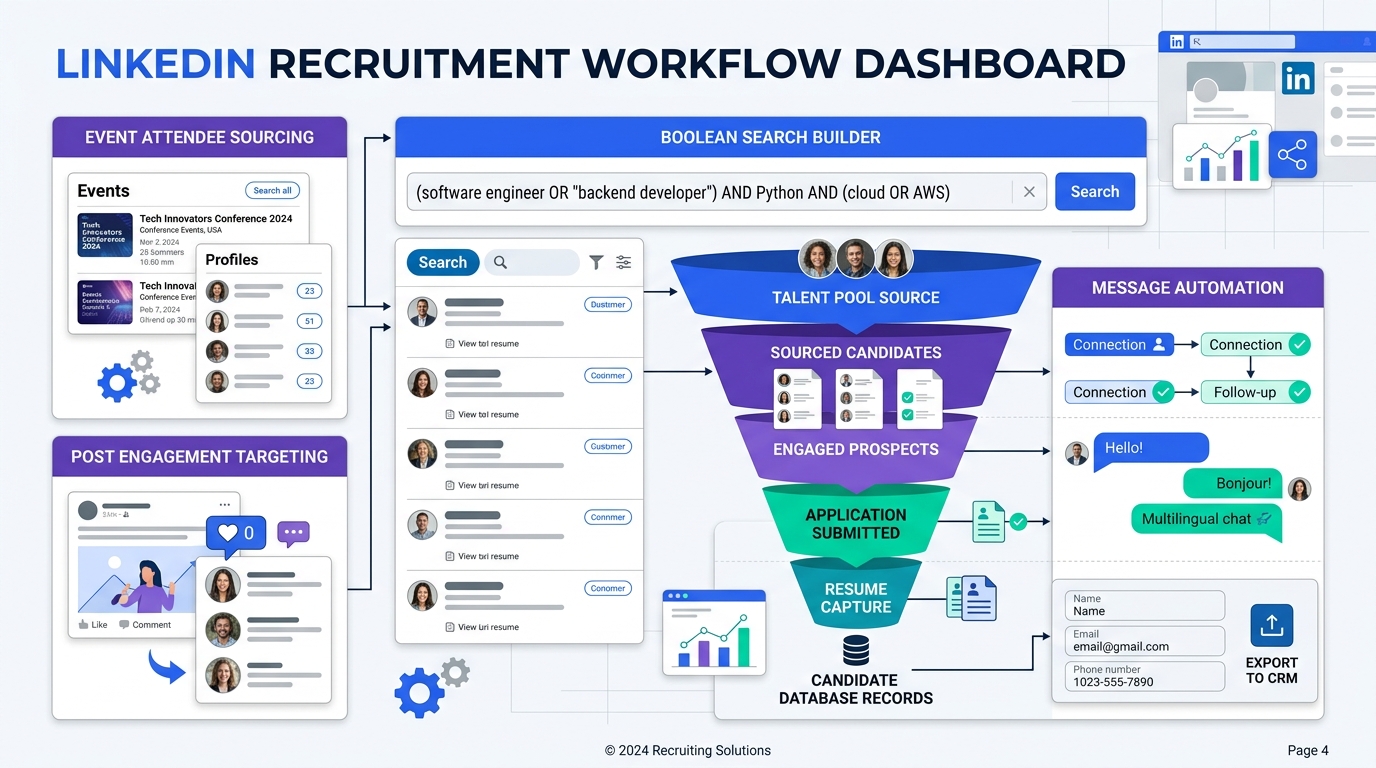
If you want to build a high quality recruitment database, the most effective approach is to combine precise LinkedIn search, event attendee sourcing, and engagement based targeting into one repeatable workflow. For teams building a US recruitment database or a broader united states recruitment database, this means identifying the right candidate pools first, then using structured outreach and follow up to capture resumes, contact details, and interest signals. In our review of common LinkedIn sourcing workflows, the biggest improvement came when recruiters paired manual targeting logic with automation that could handle first contact, follow up, and multilingual communication at scale.
Key Takeaways
- Boolean search improves targeting: It helps recruiters narrow candidate lists before adding profiles to a recruitment database.
- Event attendee lists reveal intent: Public LinkedIn events can surface candidates already interested in a topic, employer category, or technology area.
- Post likes can signal market interest: People engaging with relevant posts often provide useful sourcing signals for a united states recruitment database.
- Manual review still matters: We found that cleansing lists before outreach improves database quality and reduces wasted messaging.
- Automation works best after targeting: StrategyBrain AI Recruiter is most useful once search criteria, role details, and outreach logic are clearly defined.
- Multilingual follow up expands reach: For US based and global hiring teams, native language communication can reduce friction in early candidate conversations.
Why recruitment database quality matters
A recruitment database is only valuable if the records inside it are relevant, current, and actionable. Many teams focus on volume first, but a large list with weak fit signals usually creates more manual work later. Recruiters then spend time sorting through low intent profiles, incomplete contact records, or candidates who were never a realistic match.
For a US recruitment database, quality often depends on three factors. First, the search logic must reflect the actual role requirements. Second, the sourcing source should indicate some level of relevance or intent. Third, the outreach process should capture useful next step data such as resume availability, contact details, and interview interest.
We see this most clearly in LinkedIn based workflows. Recruiters can find candidates quickly, but without a structured process, those profiles remain scattered across searches, saved lists, spreadsheets, and inboxes. A better system turns those profiles into a usable recruitment database rather than a temporary sourcing list.
Free vs paid LinkedIn for database building
Both free LinkedIn and paid LinkedIn plans can support recruitment database building, but they do not offer the same level of targeting or workflow control. Free search can still be useful for early list building, especially when recruiters know how to use Boolean operators well. Paid plans, including Sales Navigator and recruiter focused workflows, usually make it easier to refine searches, save lead groups, and work through larger candidate pools.
The practical difference is not just access. It is efficiency. A recruiter using free search may still build a solid recruitment database, but the process often requires more manual filtering and more repeated searching. Paid tools reduce some of that friction, especially when teams need to build a united states recruitment database across multiple regions, functions, or seniority levels.
That said, the plan itself does not create quality. Search logic, list hygiene, and follow up discipline still matter more than the subscription tier. This is also where StrategyBrain AI Recruiter becomes relevant. Once a recruiter has defined the target criteria and role information, the system can automate connection requests, role introductions, candidate Q and A, interest confirmation, and resume collection, which helps convert sourcing activity into a more complete recruitment database.
Tactic 1: Use Boolean search to tighten your recruitment database
Boolean search is one of the most practical ways to improve recruitment database quality before outreach begins. It uses operators such as AND, OR, and NOT to control how LinkedIn search results are filtered. This matters because broad searches usually create noisy lists, while structured searches produce candidate pools that are easier to review and more relevant to the role.
How Boolean search works
- AND narrows results by requiring multiple terms.
- OR broadens results by allowing alternative titles or skills.
- NOT removes unwanted terms or adjacent functions.
For example, a recruiter building a US recruitment database for commercial leadership roles might search for a combination of function and seniority rather than a single title. That approach usually captures more realistic title variation while still keeping the list focused.
Why this tactic matters
We found that recruiters often lose time after the search stage, not during it. If the initial list is too broad, every later step becomes slower. Outreach personalization becomes weaker, follow up becomes less relevant, and the final recruitment database contains more records that never move forward.
By contrast, a tighter search creates a better starting point for automation. StrategyBrain AI Recruiter works best when the candidate pool already reflects clear search criteria. Once that is in place, the system can handle first touch communication, answer common role questions, and collect resumes from interested candidates, while the recruiter focuses on final qualification.
Best use cases
- Building role specific candidate pools
- Creating a united states recruitment database by region or function
- Improving personalization before automated outreach
- Reducing manual cleanup later in the workflow
Tactic 2: Use LinkedIn events to find active talent pools
LinkedIn events can be a strong sourcing channel because they reveal topic level interest. People who register for or attend public events are often easier to segment than people found through a broad keyword search alone. For recruiters, that means event participation can become a useful signal when building a recruitment database around a niche skill, industry, or employer category.
A simple event based workflow
- Search for a relevant event by topic, technology, or hiring theme.
- Review the attendee list to identify profiles connected to your target role or market.
- Apply additional filters such as geography, seniority, or function.
- Create outreach messaging that references the shared event context.
- Capture responses and resumes into your recruitment database.
This tactic works because the outreach context is more specific. Instead of sending a generic message, the recruiter can reference a shared event topic. That usually makes the first message feel more relevant and less random.
For teams managing a US recruitment database, event sourcing is especially useful when hiring for specialized roles in software, operations, healthcare, manufacturing, or enterprise technology. It can also help recruiters identify candidates who are already paying attention to a market trend or professional topic.
StrategyBrain AI Recruiter can strengthen this workflow after the list is defined. Recruiters can provide the role details, compensation context, benefits, and candidate criteria, then let the system handle initial outreach, candidate questions, and interest checks. If a candidate wants to proceed, the system can request a resume and capture contact details, which makes the recruitment database more complete without requiring the recruiter to manage every early conversation manually.
Limitations to keep in mind
- Event attendance does not guarantee job seeking intent.
- Some attendee lists may include vendors, peers, or competitors.
- Manual review is still needed before large scale outreach.
Tactic 3: Use post engagement to identify in market candidates
Another useful sourcing method is reviewing people who liked or engaged with relevant LinkedIn posts. This can include posts about a technology category, a compliance topic, a hiring trend, or a competitor discussion. Engagement does not prove fit, but it can reveal awareness and interest, which makes it a practical signal for recruitment database building.
How to use engagement data well
The key is not to message everyone immediately. First, review the list and remove profiles that are clearly outside your target audience. In our experience, this cleansing step is where much of the value is created. A raw engagement list may be large, but a reviewed list is far more useful.
After cleansing, recruiters can build a more relevant outreach sequence. The message can reference the topic the candidate engaged with, ask a contextual question, and open a conversation naturally. This is more effective than treating every profile as a cold contact with no shared context.
For a recruitment database, this tactic is valuable because it adds behavioral signals. A profile is no longer just a title and company. It also includes evidence that the person interacted with a topic related to your role, market, or hiring theme.
Where AI Recruiter adds value
Once the reviewed list is ready, StrategyBrain AI Recruiter can take over the repetitive parts of the process. It can connect with candidates, introduce the opportunity, answer common questions about the role and employer, and confirm whether the person is open to an interview. If the candidate is interested, the system can collect resumes and contact details through supported channels. This helps transform a manually reviewed engagement list into a more actionable recruitment database.
Common mistakes to avoid
- Using unfiltered engagement lists without review
- Assuming every person who liked a post is a qualified candidate
- Sending generic outreach that ignores the engagement context
- Failing to capture response data back into the database
Bonus tactic: Use Google X Ray search for profile discovery
Google X Ray search is a practical supplement when LinkedIn search results feel too narrow or when recruiters want another way to discover profiles. The basic idea is to search Google for public LinkedIn profile pages using site based search logic plus role and industry keywords.
This method can help uncover profiles that may not appear in the same way through standard LinkedIn search workflows. It is especially useful when building a united states recruitment database for niche titles or when recruiters want to test alternative keyword combinations quickly.
However, this tactic should be treated as a discovery layer, not a complete workflow. The profiles still need to be reviewed, segmented, and added into a structured outreach process. Without that next step, the search results remain just another list.
That is why the strongest workflow is usually a combination of discovery plus automation. Search identifies the right people. Review improves list quality. StrategyBrain AI Recruiter then handles the repetitive communication layer so recruiters can focus on resume review and final qualification.
How StrategyBrain AI Recruiter fits into the workflow
Most recruiters do not struggle to find profiles. They struggle to move those profiles through the early stages consistently. That is the gap between a sourcing list and a real recruitment database. StrategyBrain AI Recruiter is designed to help close that gap.
Based on the product information reviewed, the system supports smart LinkedIn recruitment automation by connecting with candidates who match defined search criteria, introducing job opportunities, learning about each candidate’s work situation, answering questions about the role, company, and compensation, and confirming interview interest. For interested candidates, it can collect resumes and contact information so recruiters can review qualified responses instead of managing every first touch manually.
This is particularly relevant for teams building a US recruitment database at scale. The platform also supports 24 hour multilingual communication, which can help recruiters engage candidates in their native language and maintain follow up across time zones. In addition, organizations can manage more than 100 LinkedIn accounts, which creates a path for building AI powered recruitment teams for larger hiring operations.
There are also important boundaries. AI Recruiter does not make the final resume fit decision. According to the product details, it identifies willingness to communicate or interview, while the recruiter still reviews the resume and decides whether the candidate matches the job requirements. That limitation is important because it keeps the workflow realistic and aligned with how recruiting decisions are actually made.
From a database perspective, the value is clear. Instead of storing only profile links and notes, recruiters can capture conversation history, interest signals, resumes received, and contact details in a more structured way. That makes the recruitment database more useful for prioritization and follow up.
Quick comparison
| Method | Primary value | Best for | Main limitation |
|---|---|---|---|
| Boolean search | Tighter targeting before outreach | Role specific list building | Requires careful keyword logic |
| LinkedIn events | Topic based audience discovery | Finding relevant talent communities | Attendance does not equal job seeking intent |
| Post engagement | Behavior based sourcing signals | Contextual outreach and personalization | Needs manual cleansing |
| Google X Ray search | Additional profile discovery | Niche searches and alternative sourcing | Not a full workflow by itself |
| StrategyBrain AI Recruiter | Automated outreach, follow up, and resume capture | Scaling candidate engagement after targeting | Final qualification still requires recruiter review |
Practical checklist
- Define the role, geography, and seniority before searching.
- Use Boolean logic to reduce irrelevant profiles.
- Test event attendee lists for topic based sourcing.
- Review post engagement lists before outreach.
- Store only reviewed profiles in your recruitment database.
- Use contextual messaging tied to search or engagement source.
- Capture resumes, contact details, and interest signals consistently.
- Use automation for repetitive outreach, not for final hiring decisions.
FAQ
What is a recruitment database?
A recruitment database is a structured collection of candidate records used for sourcing, outreach, screening, and follow up. A strong database includes more than profile links. It should also contain fit signals, communication history, and next step information.
How do I build a US recruitment database on LinkedIn?
Start with targeted search logic, then use sources such as Boolean search, event attendee lists, and post engagement to identify relevant profiles. After review, move candidates into a structured outreach process and capture resumes, contact details, and interest status.
Is free LinkedIn enough for building a united states recruitment database?
Free LinkedIn can support early stage sourcing, especially if you use Boolean search well. However, paid tools usually improve efficiency, filtering, and list management for larger or more specialized hiring projects.
Why are LinkedIn events useful for recruiters?
Events reveal topic level interest and can surface candidates connected to a specific skill area, industry issue, or employer category. That shared context can make outreach more relevant and improve the quality of records added to a recruitment database.
Can post likes really help with candidate sourcing?
Yes, if used carefully. Post engagement can indicate awareness or interest in a topic, but it should not be treated as proof of fit. Manual review is still necessary before adding those profiles to your recruitment database or starting outreach.
How does StrategyBrain AI Recruiter help with recruitment database building?
It helps by automating early stage LinkedIn recruiting tasks such as connecting with candidates, introducing roles, answering common questions, confirming interest, and collecting resumes and contact details. This turns sourcing activity into more complete candidate records.
Does AI Recruiter replace recruiter judgment?
No. Based on the reviewed product information, the system helps identify candidate willingness to engage or interview, but recruiters still review resumes and make the final qualification decision.
Is multilingual outreach important for a recruitment database?
Yes, especially for teams hiring across regions or engaging international talent. Native language communication can reduce misunderstandings and improve response quality in early candidate conversations.
Conclusion
The fastest way to improve a recruitment database is not to collect more profiles. It is to collect better profiles and move them through a more disciplined workflow. Boolean search helps tighten targeting, LinkedIn events add topic based relevance, and post engagement adds behavioral context. When those tactics are combined with structured follow up, the result is a more useful US recruitment database rather than a loose set of sourcing lists.
For teams that want to scale this process, StrategyBrain AI Recruiter adds practical value in the middle of the workflow by automating outreach, candidate conversations, and resume capture while leaving final qualification to the recruiter. The next step is simple. Review your current sourcing process, choose one of these tactics, and build a repeatable system that turns LinkedIn activity into a stronger recruitment database.