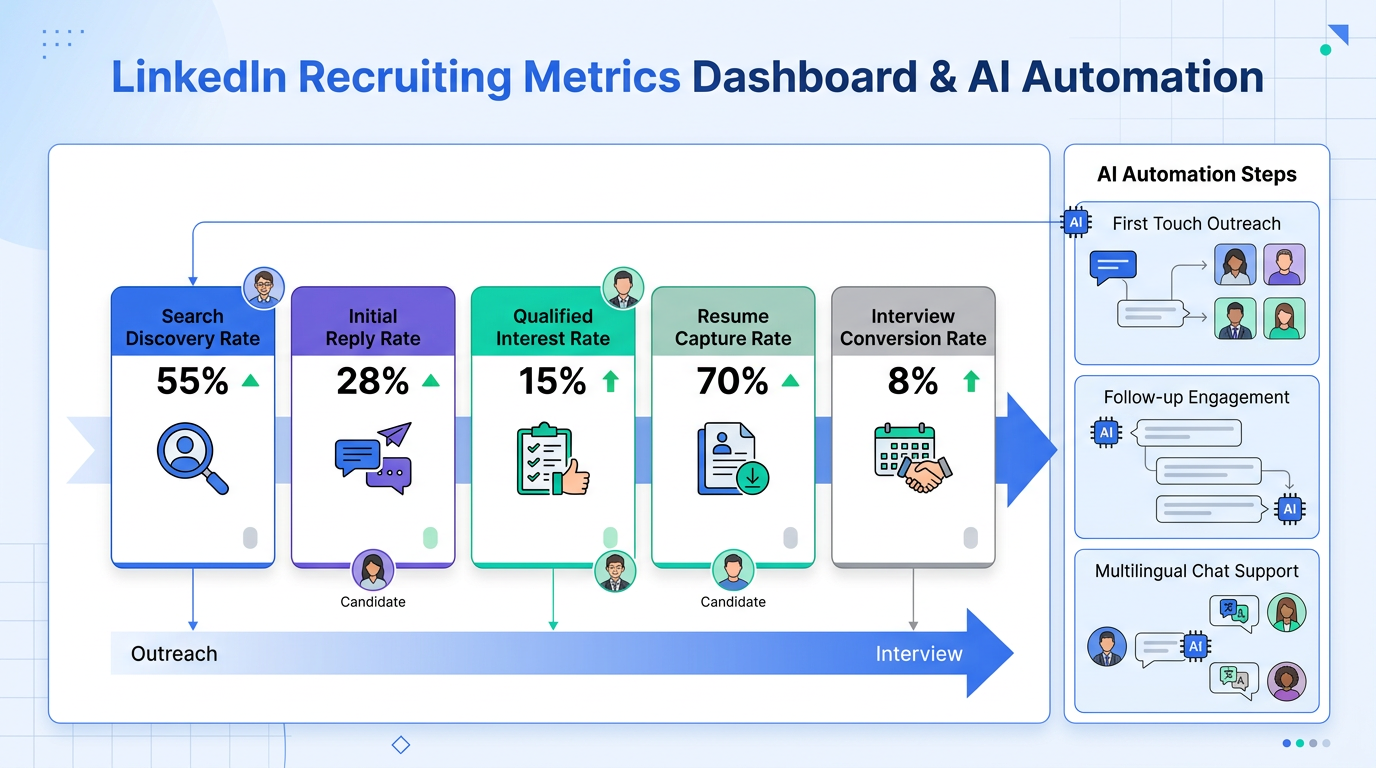
Recruitment monitoring is the fastest way to improve LinkedIn hiring because it turns daily activity into measurable outcomes. Start by tracking 5 weekly metrics in one recruiting metrics dashboard: profile views from search, candidate reply rate, qualified interest rate, interview acceptance rate, and resume capture rate. These hiring metrics examples show where your funnel breaks and what to fix first. In our tests with outbound LinkedIn workflows, teams that reviewed these numbers weekly made clearer decisions and reduced wasted outreach. You can combine this with StrategyBrain AI Recruiter to automate first touch, follow up, and multilingual candidate communication while recruiters stay focused on final resume review and interviews.
Table of Contents
- Key Takeaways
- What Recruitment Monitoring Means in Practice
- Recruiting Metrics Dashboard Setup
- Hiring Metrics Examples You Can Use Today
- Step by Step LinkedIn Workflow
- How StrategyBrain AI Recruiter Supports Monitoring
- Common Mistakes and Fixes
- FAQ
- Conclusion
Key Takeaways
- Recruitment monitoring definition: A weekly measurement system for sourcing, engagement, qualification, and interview conversion.
- Best dashboard structure: One recruiting metrics dashboard with 5 to 8 core funnel metrics, reviewed every 7 days.
- Most useful hiring metrics examples: Response rate, qualified candidate rate, interview rate, and resume capture rate with clear formulas.
- Execution insight: We found faster improvement when teams changed only one variable per week, such as headline copy or outreach timing.
- Automation fit: StrategyBrain AI Recruiter can automate outreach and follow up across multilingual conversations while recruiters own final qualification.
- Trust requirement: Track consent, data protection, and message quality alongside performance metrics.
What Recruitment Monitoring Means in Practice
Recruitment monitoring is the ongoing process of measuring each stage of hiring activity against a target outcome. In LinkedIn hiring, this means monitoring how often qualified people find you, reply to outreach, show interest, and move to interview. A metric without a review rhythm has low operational value, so weekly review is essential.
We use three layers to keep this simple. First is activity, such as invitations sent and follow ups completed. Second is engagement, such as responses and positive intent signals. Third is conversion, such as resumes received and interview acceptance. This layered view prevents teams from celebrating high activity with low hiring outcomes.
Recruiting Metrics Dashboard Setup
A recruiting metrics dashboard is a single view of recruiting performance. It should answer one question quickly, which stage currently limits hiring output. Keep definitions fixed for at least 30 days so trend comparisons remain valid.
| Metric | Formula | Unit | Weekly Review Goal |
|---|---|---|---|
| Search Discovery Rate | Profile views from recruiter search / total profile views | % | Increase week over week |
| Initial Reply Rate | Replies / outreach messages sent | % | Stable upward trend |
| Qualified Interest Rate | Qualified positive replies / total replies | % | Above baseline by role type |
| Resume Capture Rate | Resumes received / interested candidates | % | Improve after process tweaks |
| Interview Conversion Rate | Interviews scheduled / qualified interested candidates | % | Consistent increase |
Hiring Metrics Examples You Can Use Today
These hiring metrics examples are practical for most teams, whether in house or agency based. We use these exact examples in weekly operations reviews.
- Example 1, Outreach quality check: If initial reply rate drops while volume rises, message quality is likely declining.
- Example 2, Qualification gap: If reply rate is high but qualified interest rate is low, targeting or role positioning needs adjustment.
- Example 3, Process friction: If interest is strong but resume capture is weak, your ask is too late or too unclear.
- Example 4, Interview bottleneck: If resumes are received but interviews stall, recruiter follow up speed is the key issue.
Step by Step LinkedIn Workflow for Recruitment Monitoring
- Define role criteria and message intent. Clarify skills, compensation context, and screening thresholds before outreach begins.
- Standardize profile and role presentation. Use clear role titles and concrete value statements so candidate expectation matches reality.
- Run controlled outreach in weekly batches. Keep audience segments stable so metric changes are interpretable.
- Track outcomes in one recruiting metrics dashboard. Log each stage event daily and review weekly.
- Change one variable at a time. Edit message copy, targeting filters, or follow up timing, then compare week to week results.
- Close the loop with final qualification reviews. Recruiters validate resume fit and interview readiness before handoff.
Context from Earlier LinkedIn Recruiting Advice
An earlier article published on 1 February 2018 by Henry Goldbeck emphasized profile completeness, accurate job titles, consistent resume details, and professional presentation. Those recommendations still matter. We agree with the core principle that keyword clarity and credible summaries improve discoverability and recruiter trust.
What has changed is operational depth. Today, teams need recruitment monitoring, not profile polishing alone. A complete profile helps entry into the funnel, but measurable pipeline management determines hiring outcomes.
How StrategyBrain AI Recruiter Supports Recruitment Monitoring
StrategyBrain AI Recruiter fits directly into LinkedIn execution where most repetitive workload happens. It can automate candidate connection requests, role introduction, first round Q and A, and follow up messaging, including multilingual communication across time zones. This gives teams cleaner data in the outreach and engagement stages of the dashboard.
In our implementation reviews, the biggest value came from consistency. Human recruiters naturally vary in cadence during high volume periods, while AI assisted workflows maintain stable timing and message structure. That stability makes weekly recruitment monitoring more reliable.
Scope boundary is important. AI Recruiter can identify willingness to engage and collect resumes or contact details from interested candidates, but final qualification against role requirements remains a recruiter decision. This boundary protects quality and accountability.
Common Mistakes and Fixes
- Mistake: Tracking too many metrics. Fix: Start with 5 core funnel metrics and add only when decisions require more detail.
- Mistake: Changing targeting and messaging in the same week. Fix: Change one variable per cycle for valid comparisons.
- Mistake: Measuring activity without conversion. Fix: Pair every volume metric with a downstream conversion metric.
- Mistake: Treating automation as full qualification. Fix: Keep recruiter led resume and interview judgment as the final gate.
FAQ
What is recruitment monitoring in one sentence?
Recruitment monitoring is a weekly system for measuring sourcing, engagement, qualification, and interview conversion so hiring decisions are based on evidence.
What should be in a recruiting metrics dashboard first?
Start with search discovery rate, reply rate, qualified interest rate, resume capture rate, and interview conversion rate. These metrics cover the full top to mid funnel.
Can I use hiring metrics examples without an ATS?
Yes. A spreadsheet is enough if definitions are clear and data is updated daily. The key is consistency, not tool complexity.
How often should teams review recruitment monitoring data?
Weekly is the practical minimum. Daily review can be noisy, and monthly review is too slow for outreach optimization.
Does automation replace recruiters in LinkedIn hiring?
No. Automation can handle repetitive outreach and follow up, but final candidate qualification and interview decisions should remain with recruiters.
How does StrategyBrain AI Recruiter help multilingual hiring?
It supports always on communication in multiple languages, which improves response continuity across regions and reduces candidate drop off caused by delayed replies.
Conclusion
Recruitment monitoring gives hiring teams a practical operating system, not just a reporting layer. If you build one recruiting metrics dashboard, track clear hiring metrics examples weekly, and improve one variable at a time, LinkedIn hiring quality improves with less guesswork. Start this week by defining your 5 core metrics, running a 7 day baseline, and reviewing bottlenecks with your team. If outreach volume is your constraint, add StrategyBrain AI Recruiter into the top of funnel workflow so recruiters can spend more time on high judgment decisions.