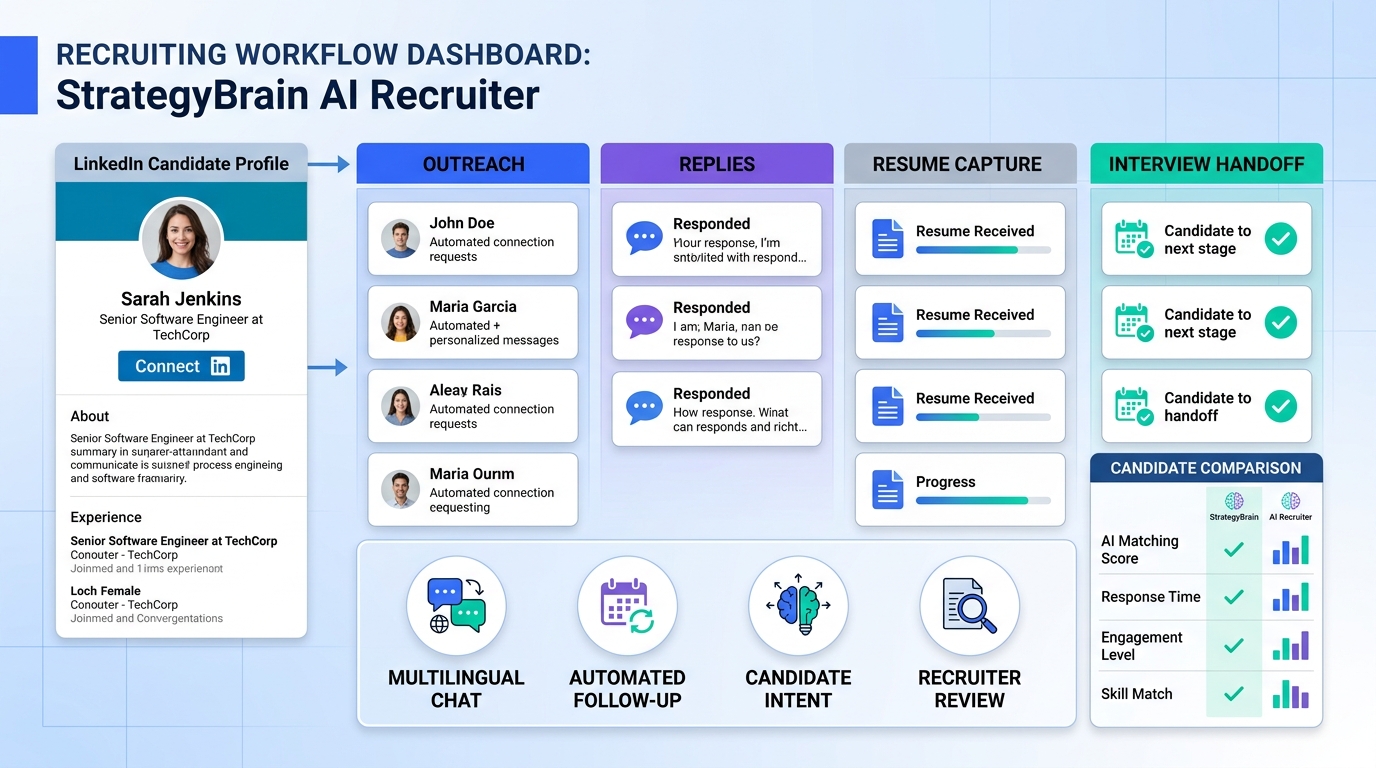
A talent acquisition CRM gives recruiters a structured way to manage candidate relationships from first contact to interview handoff. If your team relies on LinkedIn, the most practical approach is to combine a strong profile and featured proof with a candidate engagement platform that keeps outreach, replies, and resume collection organized. In our review of the source material and current LinkedIn recruiting workflows, we found that the biggest gap is not visibility alone. It is follow through. That is where a system such as StrategyBrain AI Recruiter can support a talent acquisition website strategy by automating initial outreach, answering candidate questions in multiple languages, and capturing resumes and contact details for recruiter review.
Key Takeaways
- Talent acquisition CRM means relationship tracking: It centralizes outreach, replies, resumes, and interview intent in one workflow.
- LinkedIn is only the starting point: A polished profile helps, but consistent follow up is what improves conversion.
- A talent acquisition website should reinforce trust: Clear role details, proof of work, and contact paths reduce candidate hesitation.
- Candidate engagement platform features matter: Multilingual messaging, response handling, and resume capture save recruiter time.
- We found the biggest bottleneck is manual follow up: Teams often source well but lose momentum after first contact.
- StrategyBrain AI Recruiter is strongest in early stage engagement: It automates LinkedIn outreach, answers role questions, and collects resumes for recruiter review.
What a talent acquisition CRM actually does
A talent acquisition CRM is a candidate relationship management system designed for hiring teams rather than sales teams. Instead of tracking deals, it tracks people, conversations, interest signals, and movement through the recruiting funnel. In practice, that means recruiters can see who was contacted, who replied, who asked questions, who shared a resume, and who is ready for interview scheduling.
This matters because recruiting is rarely a one message process. Candidates often need context about the role, compensation, benefits, location, and timing before they decide whether to continue. A good talent acquisition CRM keeps those interactions visible and organized so recruiters do not lose warm candidates in scattered inboxes or disconnected spreadsheets.
It is also useful to define scope clearly. This guide focuses on LinkedIn centered sourcing and engagement. It does not cover full applicant tracking system implementation, payroll, or onboarding software selection.
Why LinkedIn still matters in candidate engagement
LinkedIn remains one of the most important channels for proactive recruiting because it combines professional identity, work history, and direct messaging in one place. For many teams, it functions as the top of funnel source while the talent acquisition CRM becomes the system that keeps the relationship moving.
The source material we reviewed focused on how people showcase proof, projects, and credibility on LinkedIn. That same principle applies to recruiting teams and employers. Candidates evaluate recruiters and employers the same way buyers evaluate brands. They look for clarity, legitimacy, and evidence that the opportunity is real.
In other words, your LinkedIn presence and your talent acquisition website work together. LinkedIn creates the first impression. Your website and CRM workflow determine whether that interest turns into a conversation.
What to showcase on your recruiting presence
If you want a talent acquisition CRM to perform well, the front end experience must support it. Candidates are more likely to respond when your recruiting presence answers obvious questions quickly and looks credible.
Core elements to include
- Clear employer story: Explain what the company does, who it hires, and why the role matters.
- Role context: Share practical information about responsibilities, team environment, compensation approach, and benefits when appropriate.
- Proof of work: Use featured content, hiring updates, team wins, case studies, or project snapshots that show real activity.
- Candidate friendly assets: Add presentations, PDFs, screenshots, or short videos that explain the company or role.
- Trust signals: Include testimonials, recruiter identity, and a straightforward way for candidates to continue the conversation.
The original source emphasized using visual and featured content to make a profile more compelling. We agree with that principle. In recruiting, visuals and proof reduce uncertainty. They help candidates understand whether the opportunity is worth their time before they reply.
How to structure a stronger candidate journey
A strong candidate journey is not just about posting jobs. It is about sequencing information in a way that matches candidate intent. First comes attention. Then trust. Then qualification. Then handoff.
Here is a practical structure for a LinkedIn led recruiting flow supported by a talent acquisition CRM:
- Attract attention: Use a credible LinkedIn profile, company page, or recruiter presence with relevant featured content.
- Start the conversation: Reach out with a concise message that explains the opportunity and why the candidate may be relevant.
- Answer early questions: Be ready to respond on role scope, compensation, benefits, location, and process.
- Capture intent: Identify whether the candidate is open to learning more, actively looking, or not interested right now.
- Collect details: Request a resume and contact information from interested candidates.
- Move to recruiter review: Let the recruiter assess fit and decide on interview next steps.
This is where many teams struggle. Manual outreach can start the process, but manual follow up often breaks it. Delayed replies, inconsistent messaging, and missed resume collection create friction. A candidate engagement platform is valuable because it reduces that friction at scale.
Step by step setup for a better workflow
1. Audit your current candidate touchpoints
Review your LinkedIn recruiter profile, company page, and talent acquisition website. Check whether a candidate can quickly understand the company, the role type, and how to respond. If the answer is unclear, your CRM will not fix the conversion problem by itself.
2. Build a proof based featured section
Add content that demonstrates legitimacy and relevance. This can include hiring updates, team introductions, project snapshots, role explainers, or candidate success stories. Keep the content concise and easy to scan.
3. Standardize your first outreach message
Create a message framework that includes the role, why the candidate was selected, and what happens next. Avoid vague outreach. Specificity improves reply quality and reduces confusion.
4. Prepare answers to common candidate questions
Candidates often ask about compensation, benefits, remote expectations, visa support, and interview timing. Document approved answers so your team responds consistently.
5. Connect outreach to a talent acquisition CRM
Track every candidate interaction in one place. At minimum, record outreach date, response status, interest level, resume received status, and next action owner.
6. Add automation where manual work slows the team
We recommend automating the repetitive parts of top of funnel engagement first. That includes initial LinkedIn connection requests, role introductions, follow up messages, and resume requests. Recruiters should spend more time reviewing qualified interest and less time repeating the same introductory steps.
Where StrategyBrain AI Recruiter fits
StrategyBrain AI Recruiter is most relevant when a team already knows LinkedIn is a core sourcing channel and wants a more scalable candidate engagement platform. Based on the product information provided, it automates LinkedIn candidate connection, introduces job opportunities, answers candidate questions, confirms interview interest, and collects resumes and contact details from interested candidates.
That makes it a practical extension of a talent acquisition CRM workflow rather than a replacement for recruiter judgment. The system can handle the repetitive front end communication, while recruiters review resumes and make the final qualification decision. This boundary is important because it keeps the process efficient without overstating automation.
What stands out in this workflow
- LinkedIn specific automation: It is built around LinkedIn recruiting activity rather than generic outreach.
- 24/7 multilingual communication: Candidates can receive responses in their native language, which can reduce misunderstandings across regions.
- Resume and contact capture: Interested candidates can share resumes and contact details for recruiter follow up.
- Scalable account management: The platform supports managing more than 100 LinkedIn accounts for larger recruiting operations.
We also note the stated limitations. StrategyBrain AI Recruiter helps identify willingness to engage or interview, but it does not replace recruiter review of whether a resume fully matches job requirements. That is a credible and useful distinction because it sets realistic expectations.
For teams building a talent acquisition website strategy, this matters in a practical way. Your website and LinkedIn presence create trust. Your candidate engagement platform keeps the conversation active. Your talent acquisition CRM records the relationship and next steps. StrategyBrain AI Recruiter fits in the middle of that chain.
Best practices for a talent acquisition website and CRM flow
Keep the candidate experience concise
The source material repeatedly emphasized clarity and brevity when showcasing work on LinkedIn. The same rule applies to recruiting. Candidates should not have to dig through long pages to understand the opportunity. Use short sections, visible proof, and direct next steps.
Use multimedia with purpose
Images, PDFs, presentations, and short videos can improve understanding when they explain the role or company clearly. Do not add media just to fill space. Every asset should answer a candidate question or strengthen trust.
Balance quantity and quality
There may be no strict limit to how much content you can publish, but too much content creates noise. A better approach is to highlight your strongest proof points and keep the path to response simple.
Design for recruiter efficiency
A talent acquisition CRM should reduce admin work, not create more of it. Use consistent stages, clear ownership, and simple status labels. If your team cannot tell who needs follow up in less than 30 seconds, the workflow is too complex.
Support global hiring thoughtfully
If you recruit across time zones or languages, multilingual communication is not a nice to have. It is operationally important. StrategyBrain AI Recruiter’s multilingual messaging capability is especially relevant here because it can keep conversations moving outside recruiter working hours.
Common mistakes to avoid
- Treating LinkedIn visibility as the whole strategy: A polished profile helps, but candidate engagement depends on follow up quality.
- Overloading candidates with too much content: More assets do not always mean more trust. Curated proof works better.
- Using inconsistent outreach messages: Mixed messaging creates confusion and lowers response rates.
- Failing to capture candidate intent: If you do not record whether someone is interested, passive, or unavailable, follow up becomes guesswork.
- Expecting automation to replace recruiter judgment: Automation should handle repetitive communication, while recruiters assess fit and make hiring decisions.
Quick Comparison
| Workflow Element | Primary Role | Best For | Key Limitation |
|---|---|---|---|
| LinkedIn profile and featured content | Creates first impression and trust | Attracting candidate attention | Does not manage follow up by itself |
| Talent acquisition website | Provides deeper employer and role context | Supporting candidate evaluation | Needs clear structure to convert interest |
| Talent acquisition CRM | Tracks relationships and pipeline status | Managing candidate conversations | Depends on disciplined data entry and process design |
| Candidate engagement platform | Automates communication and follow up | Scaling top of funnel outreach | Should not replace recruiter fit assessment |
| StrategyBrain AI Recruiter | Automates LinkedIn outreach, Q and A, and resume capture | LinkedIn centered recruiting teams needing scale | Final qualification still requires recruiter review |
FAQ
Is a talent acquisition CRM the same as an ATS?
No. A talent acquisition CRM focuses on building and tracking candidate relationships, especially before formal application or interview stages. An ATS, or applicant tracking system, is usually more focused on application processing, workflow management, and hiring records.
How does a talent acquisition website support recruiting?
A talent acquisition website gives candidates a place to verify the employer story, review role information, and understand the company before replying. It supports trust and improves conversion from outreach to conversation.
What makes a good candidate engagement platform?
A good candidate engagement platform helps teams send timely messages, track replies, answer common questions, and capture candidate details without losing context. The best fit depends on your sourcing channel and team workflow.
Can LinkedIn outreach work without automation?
Yes, but manual outreach becomes difficult to scale. In our assessment, the main issue is not sending the first message. It is maintaining consistent follow up and collecting candidate information efficiently.
What does StrategyBrain AI Recruiter automate?
Based on the provided product information, it automates LinkedIn candidate connection, job introductions, candidate Q and A, interest confirmation, and resume or contact detail collection. Recruiters still review resumes and decide who moves forward.
Does StrategyBrain AI Recruiter support multilingual recruiting?
Yes. The product information states that it supports global multilingual communication and can respond to candidates in their native language. That is useful for international hiring and cross border recruiting teams.
Can a talent acquisition CRM improve recruiter productivity?
Yes, if it is paired with a clear process. The CRM provides visibility, while automation and standardized messaging reduce repetitive work. Productivity gains come from workflow design, not software alone.
What should recruiters showcase on LinkedIn to improve response rates?
Recruiters should showcase clear role context, employer credibility, team or project proof, and relevant featured content. Candidates respond more often when they can quickly understand who is contacting them and why the opportunity is worth considering.
Conclusion
A talent acquisition CRM works best when it is part of a complete candidate journey rather than a standalone tool. LinkedIn helps you get noticed. A talent acquisition website helps candidates verify trust. A candidate engagement platform keeps conversations moving. StrategyBrain AI Recruiter is especially useful for teams that want to automate LinkedIn outreach, maintain multilingual communication, and collect resumes without losing recruiter control over final qualification.
If your current process depends on manual follow up and scattered candidate notes, start by tightening the front end experience and then connect it to a CRM driven workflow. That combination is usually what turns sourcing activity into real hiring momentum.