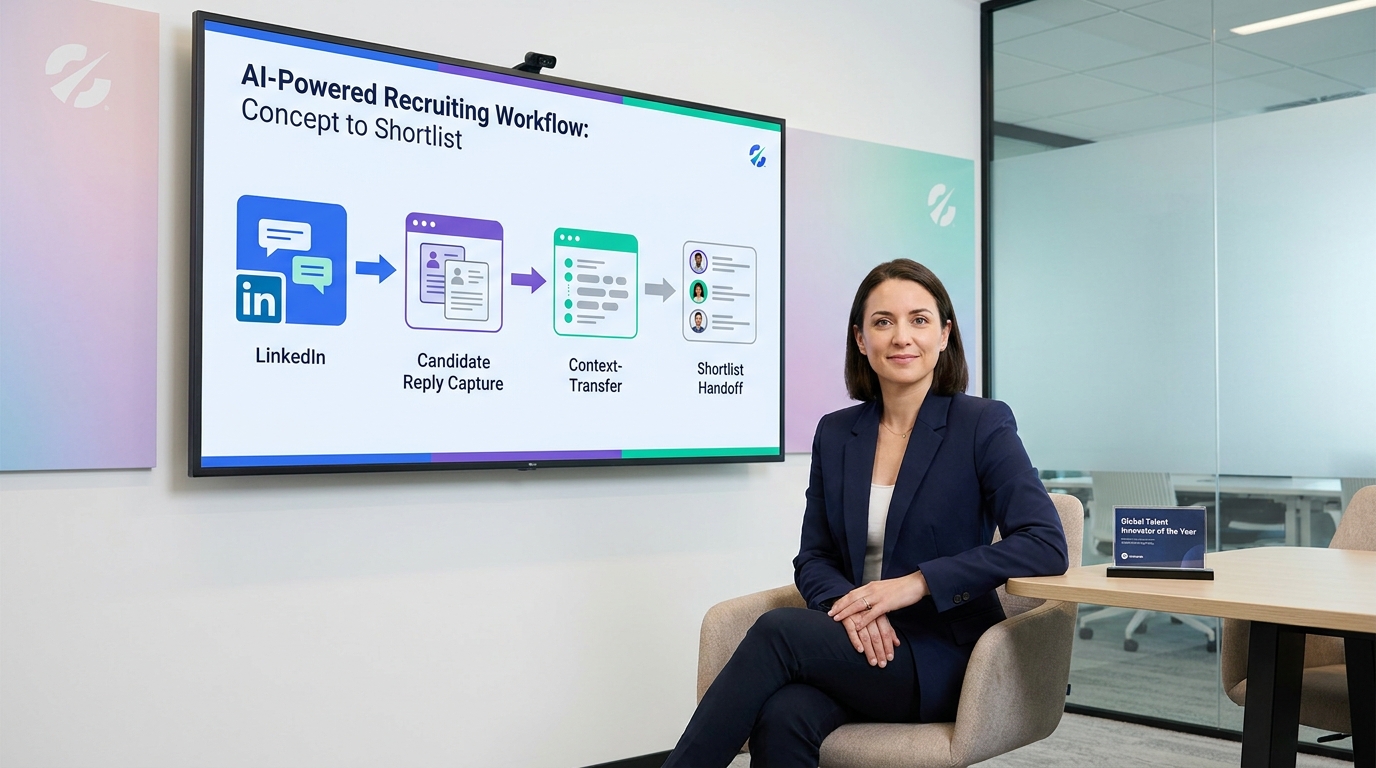
Execution gaps—not AI claims—decide outcomes, and this article helps headhunters judge which ai recruiting tool prevents missed replies, context loss, and weak handoffs.
That matters because most recruiting teams do not lose momentum on strategy alone. They lose it in the middle of real work: when outbound messages sit unanswered after hours, when candidate interest is captured in scattered inboxes, when recruiters manually chase resumes, and when hiring managers receive a shortlist without the context that explains why those people surfaced in the first place. For agency owners, that means lower consultant productivity and weaker client confidence. For in-house teams, it means slower response times, messy pipeline visibility, and missed candidates who were interested but never properly moved forward.
In my own workflow, one practical way to reduce that friction has been using StrategyBrain AI Recruiter for the narrow part of the process that is most repetitive: first-touch LinkedIn outreach, candidate replies, and resume collection across time zones. What I find useful is not the fantasy of full automation, but the ability to keep conversations moving 24/7, communicate in the candidate's language where needed, and capture contact details cleanly so the recruiter can still make the final call on fit, shortlist quality, and next-step judgment. If you want to see how that workflow is framed, their setup overview and conversation examples are useful reference points.
A useful way to think about this comes from outside recruiting software itself. In a founder interview, the central lesson was not technology but operating style: radical curiosity, strong storytelling, and relentless execution. The speaker described moving from advisory work into a startup opportunity after long conversations, weighing a conventional career path against a much riskier decision, and then discovering that vision alone was never enough. The hard part was execution under pressure: answering every message, negotiating details, keeping momentum, and making sure small failures became learning loops instead of dead ends.
That same pattern shows up in hiring. Recruiters also sell a story, move people through uncertainty, and live or die by execution in the details. The opening case above exposes the real selection question behind ai recruiting software: not whether AI can sound impressive, but whether an ai recruiting tool helps your team sustain candidate communication, preserve context, and deliver consistent follow-through. That is the frame for evaluating modern ai recruitment solutions and comparing different ai recruiting companies.
Table of Contents
- Why execution matters more than AI claims
- What AI recruiting software actually does
- How AI recruiting software fits with an ATS
- Feature-to-outcome map for an AI recruiting tool
- Best use cases by hiring model
- Three software paths recruiters compare
- What to compare when evaluating vendors
- Bias, privacy, compliance, and auditability
- How to think about ROI without hype
- How to choose the right platform
- FAQ
Why execution matters more than AI claims
One of the most useful ideas I took from that founder conversation is that storytelling opens the door, but execution keeps the business alive. Recruiting is similar. A recruiter can write a strong search brief, promise a fast shortlist, and speak confidently about market reach. None of that matters if outreach is inconsistent, candidate replies are missed, records are incomplete, or handoffs to hiring managers arrive without enough evidence to support prioritization.
That is why experienced teams should evaluate an ai recruiting tool as an execution system first. The software should help recruiters act on curiosity, not replace it. It should make it easier to test a market, follow up at scale, keep every response visible, and learn from failed outreach patterns without forcing the team into disconnected side processes.
Practical takeaway: the best AI recruiting software usually wins on reliability in day-to-day execution, not on the broadest narrative about transformation.
What AI Recruiting Software Actually Does
An ai recruiting tool uses automation, matching logic, and workflow intelligence to help teams move faster from open role to qualified shortlist. The most useful systems are built around actual recruiter tasks: finding talent, parsing applications, ranking fit, managing outreach, coordinating interviews, and resurfacing overlooked candidates already in your database.
That distinction matters because many buyers still confuse AI recruiting software with a sourcing extension, a chatbot, or a resume parser. In practice, stronger ai recruitment solutions are judged by how well they support the hiring funnel end to end, or by how effectively they strengthen a current recruiting stack without forcing a full replacement.
In the opening case, the real challenge was not a lack of ideas. It was the pressure to keep every conversation moving while protecting decision quality. The same standard applies here. If your workflow breaks at outreach, you need one kind of software. If your issue is screening discipline, interview scheduling, or talent rediscovery, you need another.
How AI Recruiting Software Fits With an ATS
Most buying decisions come down to one question: do you need a new system of record, or do you need an AI layer that improves your current tools? Many ai recruiting companies now position themselves in one of two ways. Some offer a broader platform with ATS capabilities. Others act as an intelligence and automation layer on top of the ATS and CRM you already trust.
A traditional ATS still matters because it centralizes requisitions, stages, candidate records, and compliance history. The point of AI is not to erase that discipline. It is to make the system more usable by reducing manual triage, improving search, and keeping recruiter activity connected to candidate data.
When an AI layer on top of your ATS makes sense
- You already have strong process discipline. The team does not want to replace core systems but needs faster sourcing, better outreach follow-up, or stronger matching.
- You want lower change-management risk. Recruiters can keep familiar workflows while gaining automation.
- You need to protect integrations. ATS, CRM, HRIS, and communication tools are already embedded in your operation.
When a platform replacement may make sense
- Your current ATS creates drag. Weak search, poor reporting, or too many manual steps are limiting execution.
- You need one operating model across teams. Fragmented systems produce duplicate work and inconsistent standards.
- You want native AI across the process. Sourcing, scheduling, ranking, and reporting work better in a single environment.
For operations leaders, test integration depth rather than just integration logos. Ask which fields sync, how often updates happen, whether recruiter actions trigger automation, and whether hiring managers can trust the records they receive.
Feature-to-Outcome Map for an AI Recruiting Tool
The easiest way to compare ai recruitment solutions is to map each feature to a recruiting outcome. That keeps evaluation grounded in execution rather than category jargon.
| Feature | What It Does | Operational Outcome | Advice for Recruiters |
|---|---|---|---|
| AI sourcing | Finds potential candidates across channels and databases | Broader pipeline and faster search starts | Use it to widen coverage, then review for role nuance and market context |
| Resume parsing | Extracts and structures candidate information | Less manual data entry and faster triage | Test on nonstandard resumes and global CV formats |
| Candidate matching score | Ranks applicants or prospects against job criteria | Faster shortlist creation and more consistent review | Check whether the logic is transparent and adjustable |
| Outbound automation | Supports email or multistep outreach | Higher recruiter productivity | Keep human control over messaging tone and escalation points |
| Interview scheduling | Coordinates calendars and candidate availability | Reduced back-and-forth and fewer delays | Confirm the scheduler handles panels, time zones, and reschedules well |
| Interview intelligence | Captures and organizes interview insights | Better debrief quality and stronger records | Decide in advance what should be stored and reviewed |
| Talent rediscovery | Finds previous candidates in your ATS or CRM | Better use of existing talent pools | Especially valuable if your database is large but underused |
| Inbound evaluation | Helps prioritize applicants from career sites | Faster response to strong applicants | Test for false positives and false negatives across role types |
In my own experience, LinkedIn-heavy roles benefit most when this map includes conversational continuity. Using AI Recruiter, I found the gain was not magical matching. It was the simple operational lift of having candidate replies answered after hours, multilingual conversations handled cleanly, and resumes collected without constant manual chasing. The recruiter still needs to judge relevance, but the workflow becomes much easier to manage.
Best Use Cases by Hiring Model
Not every recruiting team should evaluate AI the same way. The right fit depends on hiring volume, role complexity, geography, and how much of the funnel is outbound-driven.
High-volume hiring
For repeated roles, AI is often most useful in applicant prioritization, screening support, scheduling, and workflow standardization. The goal is not just speed. It is consistency. Teams that hire at scale need software that helps them execute repetitive tasks accurately without breaking audit trails.
Technical recruiting
For technical roles, AI can help with sourcing, profile comparison, and market mapping, but ranking alone is not enough. Nonlinear backgrounds and adjacent skills often require recruiter interpretation and hiring manager calibration.
Passive sourcing
When recruiters spend most of their day finding and contacting passive talent, outreach automation becomes more valuable. This is where many ai recruiting companies focus their pitch. The real differentiator is whether the tool can keep conversations moving, segment responses intelligently, and pass candidate data back into the ATS or CRM without creating cleanup work later.
Global hiring
Global teams should pay close attention to language handling, scheduling across time zones, privacy controls, and deployment flexibility. In cross-border work, communication delays are often as damaging as poor matching.
Three software paths recruiters compare
When teams shop for AI recruiting software, they usually end up comparing three software paths rather than one identical category. The choice depends on workflow shape, budget tolerance, and where the current process fails.
1. Full-suite enterprise hiring platforms
Strengths: broad workflow coverage, mature reporting, structured approvals, and stronger governance for large organizations.
Trade-offs: higher implementation effort, more formal rollout, and sometimes slower innovation in recruiter-facing sourcing workflows.
Best fit: enterprise teams with complex compliance needs, multiple business units, and established HRIS ecosystems.
How they work with StrategyBrain AI Recruiter: if your enterprise stack is strong but LinkedIn outreach is still manual, a specialized layer such as AI Recruiter can support first-touch communication and resume capture before the recruiter moves qualified interest back into the core system.
2. Point solutions for sourcing and outreach
Strengths: easier deployment, faster recruiter adoption, and clearer value when the problem is top-of-funnel activity.
Trade-offs: narrower workflow coverage, more dependence on integration quality, and potential fragmentation if teams add too many tools.
Best fit: agencies, founder-led hiring teams, and internal recruiters who need better outbound performance without replacing core systems.
How they work with StrategyBrain AI Recruiter: this is the closest overlap. The advantage of StrategyBrain's model is its focus on automating repetitive LinkedIn communication, keeping replies active around the clock, and supporting multilingual candidate interaction while leaving final qualification to the recruiter.
3. ATS-native AI layers
Strengths: cleaner data flow, less context switching, and easier governance because automation sits closer to the system of record.
Trade-offs: capabilities may be good enough rather than best-in-class, especially for niche outbound motions.
Best fit: organizations that value process control and want incremental AI gains without adding a separate operating environment.
How they work with StrategyBrain AI Recruiter: some teams use ATS-native AI internally for screening and pipeline management, while adding StrategyBrain for the specific LinkedIn sourcing and response bottleneck that their native tools do not handle well.
The practical point is that software comparison should not begin with abstract brand debates. It should begin with which layer of work is actually failing: sourcing, response management, qualification handoff, or system visibility.
What to Compare When Evaluating Vendors
If you are reviewing multiple ai recruitment solutions, use a structured comparison instead of broad transformation claims.
| Evaluation Area | What Good Looks Like | Why It Matters |
|---|---|---|
| Workflow coverage | Supports sourcing, screening, outreach, scheduling, ranking, and rediscovery where needed | Prevents solving a process-wide problem with a point tool that is too narrow |
| ATS and CRM sync | Reliable two-way data flow with clear field mapping | Protects data quality and recruiter trust |
| Matching transparency | Explains why candidates are ranked or recommended | Helps recruiters audit and defend decisions |
| Customization | Role-specific logic and configurable workflow rules | Different teams hire differently |
| Search and rediscovery | Surfaces prior applicants and silver medalists quickly | Improves value from the talent you already know |
| Privacy and security | Encrypted data, access controls, and clear retention options | Candidate trust and internal governance depend on it |
| Compliance support | Auditability, documentation, and policy alignment | Important in regulated or enterprise settings |
| Deployment model | Cloud or privacy-first options that match IT requirements | Critical for sensitive hiring environments |
| Communication continuity | Can respond promptly across time zones and languages | Directly affects passive candidate conversion |
The founder lesson about execution is relevant again here. Good recruiting software should help the team do the small things well and repeatedly. If the vendor cannot show that in a live workflow, the pitch is probably stronger than the product.
Bias, Privacy, Compliance, and Auditability
Any ai recruiting tool that influences sourcing, screening, matching, or candidate communication should be reviewed for bias controls, privacy design, and auditability. These are not side issues. They affect adoption, candidate trust, and internal defensibility.
Bias control should mean structured review, not marketing language
No system removes the need for human judgment. What good software can do is standardize criteria, preserve records, and make outcomes easier to review when something looks off.
Privacy questions should be concrete
- What candidate data is required to make the system useful?
- How is that data encrypted and who can access it?
- Can your organization control retention and deletion?
- Is customer data used to train models or kept isolated?
On that last point, one reason some teams explore StrategyBrain is its stated position that customer data is not used to train shared AI models and that candidate information is isolated per customer environment. That does not remove the need for legal review, but it is the kind of operational question buyers should ask every vendor.
Auditability matters for recruiter confidence
If recruiters cannot explain why the system recommended someone or why a conversation progressed in a certain way, adoption will drop fast. Auditability is practical. It helps teams see whether automation improved execution or simply hid weak decisions inside a black box.
How to Think About ROI Without Hype
Most vendors lead with speed claims. A better ROI model starts with operations.
- Recruiter time saved: less manual outreach, reply handling, and scheduling.
- Pipeline quality: better prioritization and more consistent follow-through.
- Process consistency: stronger handoffs from recruiter to hiring manager.
- System leverage: better use of your ATS, CRM, and existing candidate database.
For LinkedIn-driven teams, the easiest ROI to see is usually in response continuity. In my own testing of outreach-heavy workflows, the useful part of an AI assistant was not that it decided who to hire. It was that it continued conversations while I was off the platform, captured resumes and contact details, and reduced the amount of admin work needed to keep a passive search alive. That is a more believable gain than inflated claims about fully automated qualification.
Practical advice: run a pilot around one motion only, such as passive sourcing for hard-to-fill roles, and define success in terms of recruiter time, response handling, and shortlist confidence.
How to Choose the Right AI Recruiting Tool for Your Team
If I were helping a hiring team shortlist vendors, I would use a simple sequence.
- Identify the broken workflow. Is the issue sourcing, response speed, screening, scheduling, rediscovery, or end-to-end orchestration?
- Map required integrations. Confirm ATS, CRM, HRIS, and channel requirements before serious demos.
- Decide on augmentation versus replacement. Know whether you are upgrading a stack or replacing a system of record.
- Stress-test trust controls. Review privacy, bias handling, compliance support, and auditability.
- Use real scenarios in demos. Ask vendors to show your actual workflow, not a polished sample.
- Include recruiters and hiring managers. Execution and decision quality both matter.
Teams comparing ai recruiting companies should avoid buying the broadest narrative. In practice, the best choice is often the software that solves a defined execution problem well, integrates cleanly, and helps recruiters keep context intact from first contact through shortlist delivery.
Ultimately, strong ai recruitment solutions do not replace recruiters. They make follow-through more reliable, reduce friction around repetitive work, and help teams defend their decisions with better records. That is what separates a promising demo from an ai recruiting tool that actually improves hiring.
FAQ
What does AI recruiting software do?
AI recruiting software helps automate and improve sourcing, screening, outreach, scheduling, candidate matching, and talent rediscovery. The best systems increase recruiter productivity while keeping humans responsible for hiring decisions.
Does an AI recruiting tool replace recruiters?
No. It should remove repetitive administrative work and improve prioritization, not replace recruiter judgment. Recruiters still handle calibration, relationship building, and final evaluation.
How does AI recruiting software work with an ATS?
It usually works either as part of a platform with ATS functionality or as an AI layer connected to your existing ATS and CRM. Integration quality matters because data sync affects workflow trust.
What are good use cases for AI recruitment solutions?
Common use cases include passive sourcing, high-volume applicant triage, interview scheduling, candidate rediscovery, and multilingual outreach across regions.
Why do teams compare different AI recruiting companies so carefully?
Because tools vary widely in workflow depth, transparency, integration quality, and privacy design. Two products may both claim automation but solve very different problems.
Where can a LinkedIn-focused AI assistant help most?
It can help most with repetitive first-touch outreach, after-hours response handling, multilingual communication, and resume capture from interested prospects before the recruiter steps in for final review.