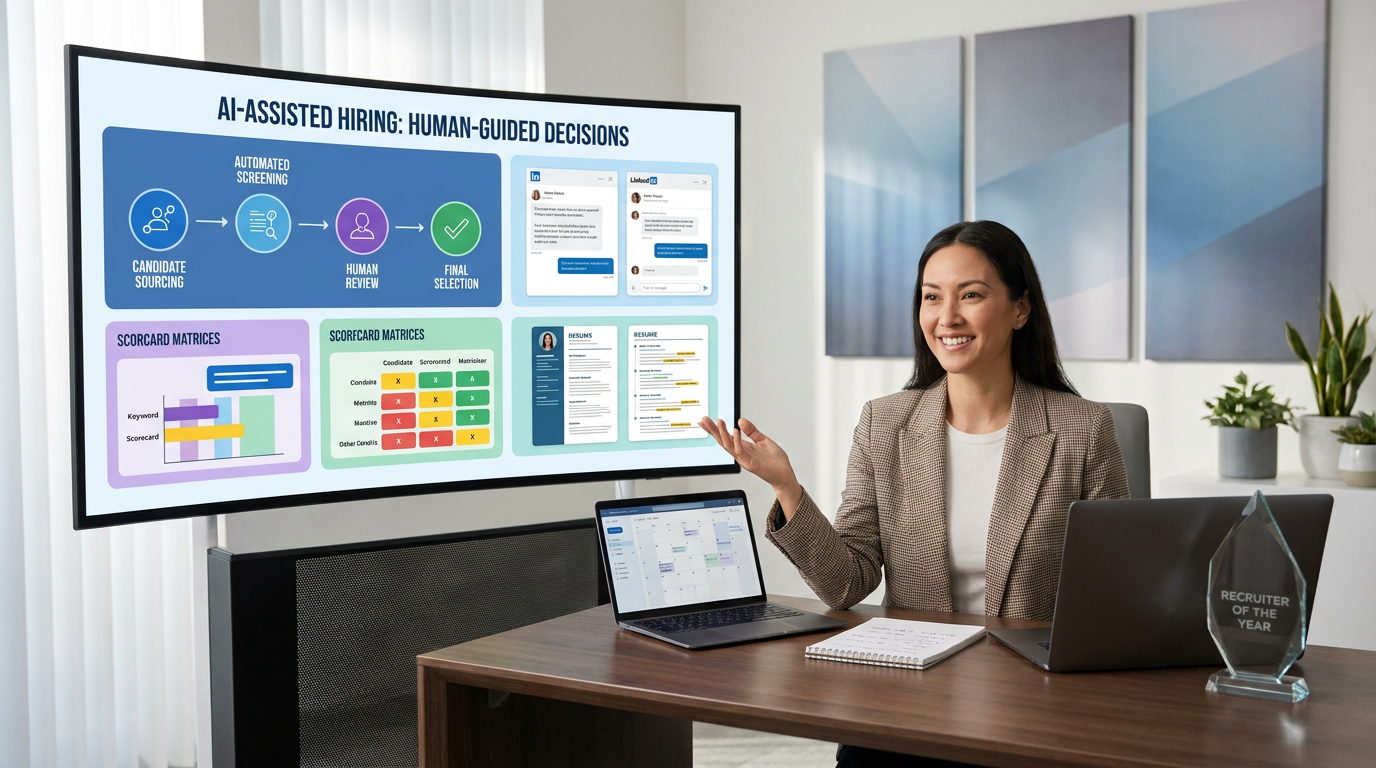
When hiring volume creates too many parallel decisions, this article helps recruiters judge where gpt recruiter workflows truly scale and where they create rework.
That matters because most recruiting teams do not break under lack of effort; they break when growth creates too many parallel decisions at once. One desk is rewriting job descriptions, another is juggling LinkedIn replies after hours, a hiring manager wants a better scorecard, and nobody is fully sure which search should get more attention this week. For a solo headhunter, that means missed responses and slower placements. For a small agency owner, it means margin pressure and inconsistent delivery. For an in-house recruiter, it means more manual work, weaker candidate experience, and less time for actual assessment.
In that gap, AI support can be useful if it is attached to a real workflow rather than treated like a magic answer. I have found that StrategyBrain AI Recruiter is most relevant when the bottleneck is repetitive LinkedIn outreach, after-hours candidate messaging, and collecting resumes from interested prospects at scale. Its automated LinkedIn conversations, multilingual follow-up, and always-on response coverage can reduce the back-and-forth that drains recruiter capacity, while the recruiter still owns shortlist review, resume evaluation, and next-step decisions.
You can see the logic more clearly if you borrow a lesson from high-growth finance leadership. In one scale-up story, the first finance hire eventually became CFO and had to operate far beyond classic finance boundaries. In the early stage, she was not only watching budgets. She was helping leadership cover blind spots, tracking product performance daily, weekly, and monthly, and deciding where the company should invest aggressively versus where it should pull back. The work was not just technical. It was operational prioritization under uncertainty.
The recruiting parallel is direct. A recruiter using recruiting gpt or chatgpt for recruiting is not simply looking for faster writing. The real question is how to manage limited team capacity, choose where automation adds value, share decision context across stakeholders, and avoid being cheap about the workflows, people, and systems that actually support growth. That is why this article treats GPT less like a novelty tool and more like an operating layer for hiring teams that need to scale with discipline.
- What GPT for recruiting really means
- What high-growth leadership teaches recruiters about GPT
- Best use cases for a gpt recruiter workflow
- ChatGPT vs recruiting software and ATS workflows
- How to prompt recruiting GPT with better judgment
- Risks, privacy, bias, and human review
- How to implement GPT responsibly in recruiting
- FAQ
What GPT for Recruiting Really Means
GPT for recruiting is most useful when you treat it as a workflow assistant for repetitive, text-heavy hiring tasks rather than as a replacement for recruiter judgment. In practice, that includes job description drafting, Boolean search creation, outreach variations, interview kit preparation, note summarization, and documentation cleanup.
A useful working definition is this: recruiting gpt is a copilot for communication, prioritization, and process consistency. It helps recruiters move faster on first drafts and repeated language tasks, but it does not understand business tradeoffs, team chemistry, compensation nuance, or hiring risk the way an experienced recruiter does.
That distinction matters because many teams asking about chatgpt for recruiting are really trying to solve a broader operating problem. They want more output without adding headcount, better responsiveness without working around the clock, and cleaner handoffs between sourcers, recruiters, hiring managers, and coordinators. GPT can help with that, but only when the team already knows what good hiring looks like.
What High-Growth Leadership Teaches Recruiters About GPT
The most valuable lesson from the finance-leadership reference story is not about finance itself. It is about what leaders do when a company is scaling faster than its systems. In that example, the finance leader had to act more like an operator: covering gaps, helping founders stay focused, tracking what was actually working, and reallocating resources based on evidence instead of instinct alone.
Recruiters in growing companies face the same pattern. They are expected to support hiring managers, advise leadership, keep searches moving, protect candidate experience, and make fast adjustments when role priorities change. If they are buried in manual writing and repetitive messaging, they cannot do the higher-value work. That is where a gpt recruiter workflow starts to make sense.
1. Cover operational gaps, not just writing tasks
Early-stage and high-growth teams often ask recruiters to do more than fill roles. They may need intake structure, clearer scorecards, better search logic, and alignment across stakeholders who are moving at different speeds. GPT is useful when it helps you close those operational gaps with better documentation and communication.
2. Invest aggressively where there is proven value
In the reference story, investment decisions were guided by hypotheses and then adjusted with frequent data review. Recruiters should take the same approach. Do not try to automate everything at once. Pick one or two workflows where output is high-volume, easy to review, and clearly connected to delivery speed, such as outbound messaging or screening-note summaries.
3. Bring expertise beyond your narrow function
That finance leader also stepped into people-related leadership and emphasized shared KPIs across departments. Recruiters can borrow that discipline by using GPT to standardize job requirements, interview rubrics, and intake language so the entire hiring team works from the same operating context.
4. Do not be cheap when building the team layer
One of the clearest lessons in the reference material was that high-growth companies should invest in strong teams and leadership development instead of trying to save money in the wrong places. In recruiting, that means being careful with shallow automation. Cheap, generic AI output creates rework. Well-governed workflows, recruiter training, and stronger systems usually outperform “fast but sloppy” adoption.
5. Culture and candidate experience still matter
The reference story argued that leaders should care about culture as much as operational metrics. That applies directly to hiring. If GPT makes candidate communication feel robotic or interview teams less thoughtful, the process gets worse even if the team sends more messages. Speed without trust is not scale. It is just noise.
Best Use Cases for a GPT Recruiter Workflow
The strongest GPT use cases in recruiting are high-volume, text-based, and easy for a person to review. If you are building a practical workflow, start with visible outputs and keep decision authority with the recruiter.
Job description drafting and rewriting
GPT can turn intake notes into cleaner job descriptions, simplify jargon, separate must-haves from nice-to-haves, and tailor language by seniority or audience. This is one of the most practical uses of chatgpt for recruiting because recruiters can compare the output against approved hiring criteria and quickly spot invented requirements.
Boolean search string creation
Sourcing teams often use recruiting gpt to generate broad, balanced, and narrow search strings for the same role. It can suggest title variants, synonyms, adjacent skills, and exclusion logic. This saves time, especially on new searches where the team is still pressure-testing the target profile.
Candidate outreach personalization
GPT is helpful for drafting first-touch outreach, referral follow-ups, re-engagement campaigns, and variations by persona or function. The recruiter should still supply the real context and remove anything the model guesses incorrectly.
For LinkedIn-heavy teams, this is also where I have seen AI Recruiter fit best alongside GPT. In my own testing mindset, the useful division is simple: use GPT for message drafting and positioning logic, then use StrategyBrain AI Recruiter when you need candidate conversations to continue after hours, in multiple languages, and across higher outreach volume without forcing recruiters to babysit every inbox. The strongest benefit is not replacing the recruiter. It is keeping warm prospects from going cold before a human can step in.
Interview kits and scorecards
Many recruiters use GPT to draft competency-based interview questions, follow-ups, and scorecard templates. This can improve interviewer consistency when the recruiter gives the model clear business context and approved evaluation criteria.
Screening summaries and intake notes
GPT can convert rough notes into structured summaries with strengths, concerns, compensation expectations, location constraints, and next-step recommendations. That improves handoffs and makes stakeholder updates easier, especially when several recruiters are covering related roles.
Where GPT helps most vs least
| Task | GPT value | Human review needed |
|---|---|---|
| Job description first draft | High | Yes |
| Boolean string generation | High | Yes |
| Outreach drafting | High | Yes |
| Interview kit creation | Medium to high | Yes |
| Screening summaries | Medium to high | Yes |
| Candidate ranking by fit | Low to medium | Always |
| Final hiring recommendation | Low | Always |
ChatGPT vs Recruiting Software and ATS Workflows
A common mistake is comparing a general chatbot directly to a full recruiting platform. They solve different problems. ChatGPT for recruiting is usually strongest as a flexible drafting and ideation layer, while recruiting software is stronger at workflow management, approvals, candidate stages, collaboration, and recordkeeping.
General GPT tools are broad. They can help you write, summarize, and restructure information. But they usually do not provide recruiting-specific governance on their own. If your team handles large candidate volumes, hiring-manager approvals, or sensitive data, that matters.
This is the same structural lesson from the opening case. High-growth teams need more than technical talent. They need operating discipline. In recruiting, that means deciding what belongs in a drafting layer, what belongs in your ATS, and what belongs in outreach automation or candidate engagement workflows.
Quick comparison
| Category | General GPT tool | Recruiting software / ATS workflow |
|---|---|---|
| Drafting text | Excellent | Good to excellent |
| Workflow structure | Limited | Strong |
| Candidate record management | Limited | Strong |
| Hiring team collaboration | Manual | Built in |
| Governance and controls | Varies | Usually stronger |
| ATS integration | Not native by default | Native by design |
For teams that rely heavily on LinkedIn sourcing, there is also a separate category worth acknowledging: AI-supported communication tools that help with repetitive outreach and follow-up. Used carefully, these tools can sit beside GPT and an ATS rather than replace either one. The key is preserving recruiter review at the point of resume assessment, shortlist decisions, and interview progression.
How to Prompt Recruiting GPT With Better Judgment
Prompt quality is the biggest success factor in recruiting GPT usage. Generic prompts produce generic output, and generic output creates rework. Strong prompts read more like operational briefs.
A simple prompt framework recruiters can reuse
- Assign a role: Tell the model whether it should act like a technical recruiter, sourcer, coordinator, or TA operations partner.
- Give business context: Include role level, function, reporting line, target market, and approved hiring criteria.
- Specify format: Ask for bullets, a table, an outreach sequence, or a scorecard.
- Add constraints: State what the model should not assume, invent, rank, or mention.
- Require reasoning where useful: Ask it to separate hypotheses from confirmed inputs.
Example: job description prompt
Act as a recruiter supporting a hiring manager for a mid-level operations role. Create a concise job description using only these approved inputs: responsibilities, required skills, preferred skills, reporting line, and work model. Separate must-haves from nice-to-haves, avoid adding new requirements, and output sections for role summary, responsibilities, must-haves, nice-to-haves, and interview focus areas.
Example: Boolean search prompt
Act as a sourcer. Build three Boolean strings for this search: broad, balanced, and narrow. Include title variations, core skills, and exclusions. Explain when each version is most useful. Do not include terms outside the approved target profile.
Example: outreach prompt
Act as a recruiter writing first-touch outreach to passive candidates. Use this approved role context and employer value proposition. Write three versions: concise, conversational, and highly personalized. Keep each under 120 words. Do not invent facts about the candidate or oversell the role.
In practice, the best prompt results come when recruiters already understand the bigger business goal behind the role. That is another place where the reference story is useful. Leaders in growth environments do better when they are not only reacting to tasks; they understand what the company is trying to build, what tradeoffs matter, and where resources should go first.
Risks, Privacy, Bias, and Human Review
The value of GPT in recruiting is real, but so are the risks. The biggest issues are hallucinations, bias, weak data handling, and over-automation. Recruiters should assume every AI-generated output needs review.
Privacy and candidate data
Candidate information can include personally identifiable information, compensation details, work authorization context, and sensitive career history. Teams should be cautious about putting raw applicant records into general AI tools without policy review, legal alignment, and security controls.
If AI-supported messaging is part of your workflow, data handling rules matter just as much there. According to the published material for StrategyBrain, candidate resumes, contact details, and conversation data are not used to train models, and customer data is isolated and encrypted. That kind of safeguard should be part of any serious evaluation, especially for firms using LinkedIn outreach at scale.
Bias and evaluation risk
GPT can produce narrow or biased language in job ads, screening summaries, and candidate comparisons. Recruiters should keep evaluation tied to job-relevant criteria, review for exclusionary wording, and avoid asking AI to rank people based on vague “fit.”
Over-automation and candidate experience
When teams automate too aggressively, communication becomes generic and trust drops. That is especially risky in executive search, niche hiring, and late-stage candidate management. The better model is selective automation in early, repeatable interactions and human ownership in evaluation and relationship-heavy moments.
How to Implement GPT Responsibly in Recruiting
The best rollout is narrow, measurable, and tied to a real bottleneck. Do not begin with “we need AI in recruiting.” Begin with one workflow where the team is losing too much time or consistency.
Step 1: Choose one repeatable use case
Start with job descriptions, Boolean strings, outreach drafting, or note summaries. Each is frequent, reviewable, and easy to test without handing over final judgment.
Step 2: Build approved inputs first
Create intake templates, scorecard standards, role-context briefs, and message guardrails. GPT works better when the team has a stable definition of what good output looks like.
Step 3: Decide where automation belongs
Use GPT for drafting and summarization. Use your ATS for structure and auditability. If LinkedIn follow-up volume is part of the problem, add an automation layer carefully. In that setup, tools like AI Recruiter can support recruiter capacity by handling repetitive candidate messaging and interest collection, while the recruiter remains responsible for matching resumes to role requirements and moving qualified people into interviews.
Step 4: Set explicit human review rules
Document which outputs require approval before use. For example, a recruiter may approve every job ad, every interview kit, and every shortlisted candidate summary, even if GPT helped create the draft.
Step 5: Measure quality as well as speed
Look at rework, response coverage, consistency, stakeholder satisfaction, and candidate experience. Faster output is not enough if job ads become vaguer or outreach quality declines.
My own practical takeaway is that the best results come from combining three layers: a clear recruiting process, selective GPT use for language-heavy tasks, and focused automation for repetitive communication where human delay is the real bottleneck. That is usually more durable than expecting a single tool to solve the entire hiring motion.
FAQ
Can ChatGPT screen candidates?
It can help summarize screening notes or structure questions, but it should not make independent candidate decisions. Screening still requires job-relevant judgment, fairness controls, and accountability from a recruiter or hiring manager.
Can GPT write job descriptions for recruiters?
Yes. It is one of the most practical recruiting use cases. GPT can draft, simplify, and tailor job descriptions quickly, but recruiters should verify accuracy and remove any invented requirements before posting.
Can chatgpt for recruiting personalize candidate outreach?
Yes, if the recruiter provides approved context and reviews the final message. It is useful for message variants and tone adjustment, but it should not invent facts about a candidate.
Can recruiting gpt build Boolean searches?
Yes. GPT can generate Boolean strings with title variations, skill combinations, and exclusions. It is especially useful for creating broad, balanced, and narrow versions for testing.
Can GPT replace recruiters?
No. GPT can speed up drafting, summarization, and process support, but recruiting still depends on stakeholder management, market judgment, candidate assessment, negotiation, and trust.
Where does StrategyBrain AI Recruiter fit if I already use GPT?
If GPT helps you write better outreach and summaries, StrategyBrain AI Recruiter is more relevant for executing repetitive LinkedIn communication at scale, including follow-up, multilingual messaging, and collecting resumes from interested candidates. The recruiter should still decide who is qualified and what happens next.
Is it safe to use GPT with candidate data?
It depends on the workflow and the controls in place. Recruiters should be cautious with personally identifiable information and sensitive applicant data, especially in general consumer AI tools.
Conclusion
GPT for recruiting works best as a focused operating assistant, not an autonomous hiring decision-maker. A strong gpt recruiter workflow can improve speed and consistency in drafting, sourcing support, outreach, and summaries, but it only scales well when human judgment stays in control.
The deeper lesson from the opening case is that growth stresses coordination before it stresses intent. The teams that handle it best do not just add tools. They decide where to invest, what to standardize, and which responsibilities must remain human. That is the most credible way to use recruiting gpt and chatgpt for recruiting without weakening hiring quality.