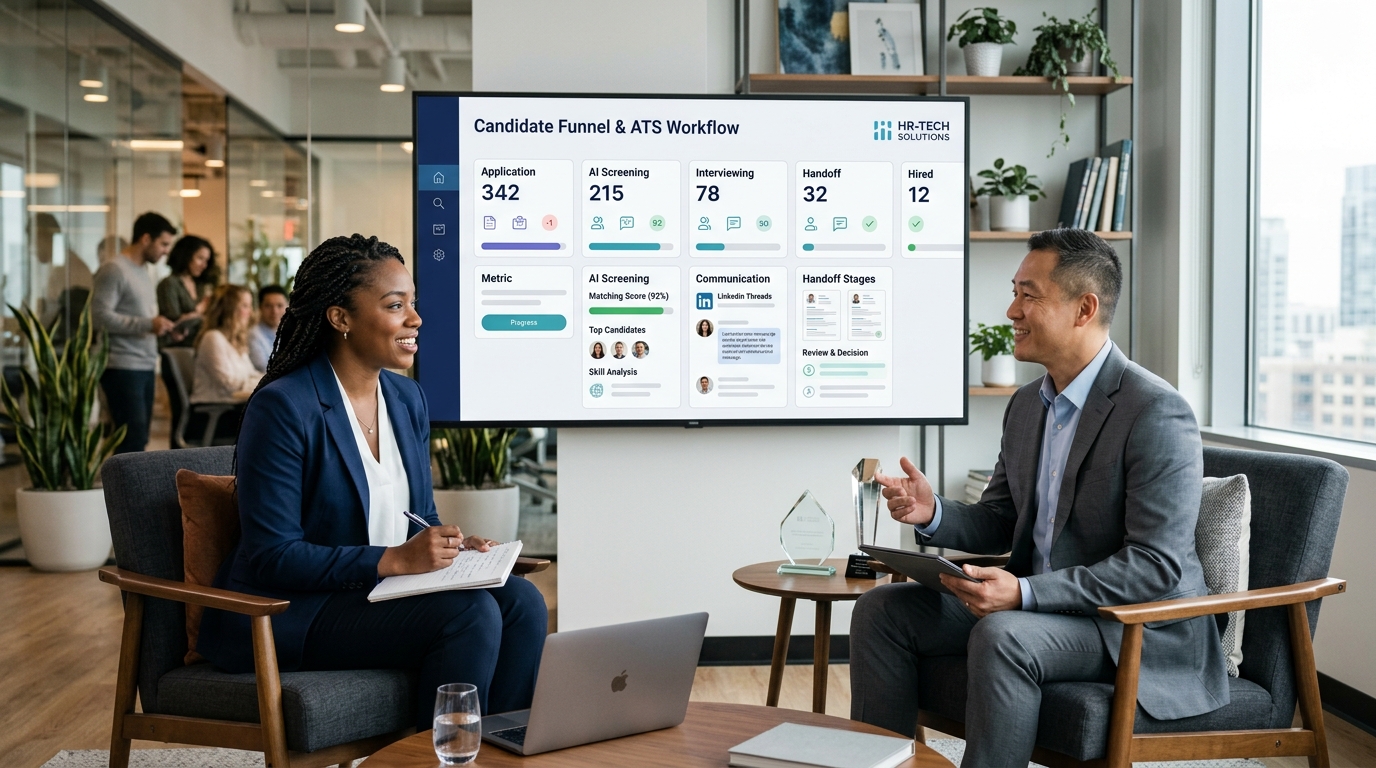
ATS recruitment software works best when it does more than store résumés. It should help hiring teams move candidates through a clear funnel, reduce manual admin, and support better decisions at each stage. A useful takeaway from the conversation with Joe Diubaldo and Abe Alappat is that AI becomes valuable when it improves prioritization, screening, and communication rather than replacing judgment. For teams that source talent on LinkedIn, that same logic extends naturally to StrategyBrain AI Recruiter, which can automate candidate outreach, answer role questions, collect résumés, and hand interested candidates into the broader hiring workflow.
Table of Contents
- Why this conversation matters for ATS recruitment software
- What Abe Alappat highlighted about AI and decision making
- How this connects to the modern ATS workflow
- Where StrategyBrain AI Recruiter fits in
- A practical framework for hiring teams
- What this means for ATS for small business buyers
- Limits and risks to keep in mind
- FAQ
- Conclusion
Key Takeaways
- ATS recruitment software is strongest when paired with workflow discipline: candidate tracking alone does not fix a weak hiring process.
- Abe Alappat’s funnel view is highly relevant: AI can help narrow large candidate pools into smaller, higher intent groups.
- LinkedIn sourcing and ATS management solve different problems: one drives conversations, the other manages pipeline visibility and records.
- StrategyBrain AI Recruiter adds value before ATS handoff: it automates outreach, multilingual follow up, and résumé collection on LinkedIn.
- ATS for small business buyers should focus on simplicity: ease of use, workflow clarity, and recruiter time savings matter more than feature overload.
- The best ATS decision is contextual: the best ats for one team may not be the best fit for another team’s hiring volume or sourcing model.
Why this conversation matters for ATS recruitment software
The original discussion centered on AI across venture capital, recruitment, design, and enterprise software. Even though the conversation was not framed as a software buying guide, it offers a useful lens for evaluating ATS recruitment software. Abe Alappat described how AI can improve funnel optimization by filtering large volumes of information and helping teams focus on the most promising opportunities. In recruiting, that same principle applies to candidate discovery, outreach, screening, and progression.
That matters because many hiring teams still expect an applicant tracking system to solve every recruiting problem. In practice, an ATS is only one layer of the stack. It is designed to centralize candidate records, track stages, support collaboration, and maintain process consistency. It is not always the system that creates candidate engagement at the top of the funnel, especially for passive talent on LinkedIn.
We see this distinction often in recruiting operations. Teams may have a capable ATS but still struggle with response rates, recruiter workload, and slow early stage screening. That gap is where AI enabled sourcing and communication tools become relevant. Instead of replacing ATS recruitment software, they extend it.
What Abe Alappat highlighted about AI and decision making
In the conversation published on October 31, 2024, Joe Diubaldo spoke with Abe Alappat, Senior Technical Product Manager at Odaia, about how AI can reshape decision making in multiple domains. Abe’s background moved from investment banking into venture capital and product management, and one of the clearest themes in his story was system design. At Georgian, he helped build an internal quantitative investment engine that used data and machine learning to prioritize startups from a much larger universe of possibilities.
That idea translates well to recruiting. Hiring teams also face a filtering problem. They need to identify which candidates deserve attention, which conversations should continue, and where recruiter time will create the highest return. Abe discussed generative AI and retrieval augmented generation agents as tools that can ask more context aware questions and support more nuanced screening than simple keyword matching.
For anyone evaluating the best ats, this is an important distinction. Traditional applicant tracking systems are often strong at record keeping and workflow management. They are not always designed to conduct dynamic candidate conversations or maintain around the clock engagement. AI systems can help fill that gap when used carefully and with human oversight.
Abe also emphasized limitations. He noted that AI performs better in environments where some iteration is acceptable and where trust can be built over time. That is a healthy reminder for recruiting leaders. AI can accelerate communication and surface useful signals, but final hiring judgment still belongs to people.
How this connects to the modern ATS workflow
A modern hiring workflow usually has four operational layers. First, teams need candidate generation. Second, they need candidate engagement. Third, they need structured evaluation. Fourth, they need pipeline management and reporting. ATS recruitment software is strongest in the third and fourth layers. It keeps hiring organized, documents movement through stages, and gives stakeholders a shared system of record.
However, many recruiting bottlenecks happen earlier. Recruiters spend hours identifying prospects, sending first messages, answering repetitive questions, and chasing follow ups. If those tasks remain manual, even the best ats will only organize a slow process rather than improve it.
This is why the market has shifted toward connected recruiting stacks. An ATS handles applicant records and workflow governance. Sourcing tools help identify talent. AI communication tools help initiate and sustain candidate conversations. Assessment tools support deeper evaluation. The strongest systems are not necessarily the ones with the longest feature list. They are the ones that reduce friction between these layers.
For teams comparing ATS recruitment software, a practical question is this: where does your current process break down? If the issue is disorganized pipeline management, the ATS should be the priority. If the issue is top of funnel outreach and candidate responsiveness, then AI enabled sourcing support may create faster gains.
Where StrategyBrain AI Recruiter fits in
StrategyBrain AI Recruiter is most relevant before candidates are fully processed inside the ATS. It is built for LinkedIn recruitment automation and helps recruiters handle the repetitive front end of hiring. Based on the product information provided, it can automatically connect with candidates who match target criteria, introduce job opportunities, answer questions about the role and company, confirm interview interest, and collect résumés and contact details from interested candidates.
That makes it complementary to ATS recruitment software rather than a replacement for it. Once a candidate has shown interest and shared the right information, the recruiter can move that person into the applicant tracking system for structured review, team collaboration, and interview progression.
There are three practical advantages here.
- Time savings: repetitive LinkedIn outreach and follow up can be handled automatically, which reduces recruiter admin load.
- Global communication: multilingual messaging supports candidate engagement across regions and time zones.
- Scalability: the platform supports management of more than 100 LinkedIn accounts, which can help organizations build larger AI assisted recruiting operations.
For teams that rely heavily on outbound recruiting, this matters. Many ATS platforms are not designed to run continuous candidate conversations on LinkedIn. StrategyBrain AI Recruiter addresses that operational gap and then feeds the hiring process with warmer, more responsive prospects.
We also find the product positioning notable for ATS for small business use cases. Smaller teams often do not need a highly complex enterprise stack. They need a simple system that keeps hiring organized and another layer that reduces manual sourcing work. In that context, pairing a lightweight ATS with AI driven outreach can be more practical than buying a large all in one platform.
A practical framework for hiring teams
If you are reviewing ATS recruitment software or trying to decide whether your team needs more automation, this framework can help.
1. Map the hiring funnel clearly
Start by separating sourcing, outreach, screening, interview coordination, and final selection. This sounds basic, but many teams blur these stages and then blame the ATS when hiring slows down. A clear funnel makes it easier to see where software should help.
2. Decide what belongs inside the ATS
Your applicant tracking system should own candidate records, stage progression, collaboration notes, and reporting. It should be the source of truth once a candidate enters the formal process.
3. Identify what should happen before ATS entry
Passive candidate outreach, first contact, role explanation, and early interest checks often happen before a candidate is ready for ATS entry. This is where tools like StrategyBrain AI Recruiter can reduce manual effort and improve responsiveness.
4. Use AI for speed, not final judgment
Abe Alappat’s perspective is useful here. AI can narrow options, ask context aware questions, and improve throughput. It should not be treated as the final decision maker for candidate quality or hiring fit.
5. Measure operational outcomes
Track recruiter hours saved, response rates, number of interested candidates, résumé collection volume, and time to move candidates into formal review. These metrics often reveal more than generic software feature comparisons.
6. Keep the candidate experience in view
Automation should make communication faster and clearer. It should not make the process feel robotic or confusing. Multilingual support and timely follow up can improve candidate trust when implemented well.
What this means for ATS for small business buyers
Teams searching for ats for small business often assume they need the same stack as a large enterprise. Usually they do not. Smaller teams benefit most from software that is easy to adopt, quick to configure, and aligned with a focused hiring workflow.
In our experience, small teams should prioritize five buying criteria.
- Ease of setup: recruiters should be able to launch workflows without a long implementation cycle.
- Pipeline clarity: hiring managers need immediate visibility into candidate stages.
- Collaboration support: notes, feedback, and interview status should be easy to share.
- Top of funnel efficiency: if sourcing is manual, recruiter capacity will remain constrained.
- Scalable communication: candidate follow up should not depend entirely on recruiter availability.
This is where the best ats decision becomes situational. A small business that receives many inbound applicants may need a straightforward ATS first. A small business that depends on outbound LinkedIn recruiting may get more value by combining a lean ATS with StrategyBrain AI Recruiter to automate outreach and candidate engagement.
That combination can be especially useful when the team is trying to expand hiring output without adding headcount. According to the product information provided, AI Recruiter can replace up to 90% of manual LinkedIn recruiting work and lower LinkedIn recruiting costs to as little as USD 2.40 per résumé. Those figures should still be evaluated in the context of each team’s workflow, but they point to a clear operational use case.
Limits and risks to keep in mind
Any discussion of ATS recruitment software and AI hiring tools should include boundaries. Abe Alappat made this point well when discussing trust and error tolerance in AI systems. Recruiting is a human decision process with legal, ethical, and reputational implications. Automation can improve speed and consistency, but it should not remove accountability.
There are several practical limits to keep in mind.
- Qualification still needs human review: StrategyBrain AI Recruiter can identify willingness to engage and collect résumés, but final fit assessment still belongs to the recruiter.
- ATS data quality matters: even strong software becomes unreliable when stages, notes, and ownership are inconsistent.
- Candidate communication must stay accurate: automated messaging should reflect real role details, compensation context, and employer information.
- Compliance and security require scrutiny: teams should verify privacy, storage, and data handling practices before deployment.
On that last point, the product information states that AI Recruiter complies with privacy regulations in the European Union, United States, and Canada, does not use customer provided data to train AI models, and stores credentials and candidate information in encrypted, isolated environments. Those are meaningful trust signals for teams evaluating AI recruiting software.
FAQ
What is ATS recruitment software?
ATS recruitment software is an applicant tracking system that helps employers organize candidate records, manage hiring stages, coordinate feedback, and maintain visibility across the recruitment process. It is usually the operational system of record for active candidates.
Is ATS recruitment software enough on its own?
Not always. An ATS is excellent for tracking and workflow management, but it may not solve top of funnel sourcing or candidate engagement challenges. Teams that rely on outbound recruiting often need additional tools for outreach and follow up.
How does StrategyBrain AI Recruiter work with an ATS?
StrategyBrain AI Recruiter supports the front end of recruiting on LinkedIn. It can connect with candidates, introduce roles, answer questions, confirm interest, and collect résumés and contact details. Recruiters can then move interested candidates into their ATS for formal review and progression.
Is this useful for ats for small business teams?
Yes, especially when a small team depends on outbound recruiting and has limited recruiter capacity. A lightweight ATS plus AI driven outreach can be more practical than a large enterprise platform with features the team will not use.
What should I look for in the best ats?
The best ats for your team should match your hiring volume, workflow complexity, collaboration needs, and sourcing model. Look for clear pipeline management, ease of use, reporting, and compatibility with the tools you use for sourcing and communication.
Can AI replace recruiters in the hiring process?
No. AI can automate repetitive tasks, improve response speed, and support early screening, but final hiring decisions still require human judgment. The most effective use of AI is to reduce manual work and improve focus, not remove recruiter oversight.
Does AI Recruiter qualify candidates automatically?
It helps identify candidate willingness to communicate or interview, but it does not make the final determination about whether a résumé fully matches the role. Recruiters still review candidate materials and make the qualification decision.
Why is LinkedIn automation relevant when I already have an ATS?
Because the ATS usually manages candidates after they enter the process, while LinkedIn automation helps create and sustain conversations before that point. The two systems address different parts of the hiring funnel.
Conclusion
ATS recruitment software remains essential because hiring teams need structure, visibility, and a reliable system of record. The larger lesson from the Joe Diubaldo and Abe Alappat conversation is that better outcomes come from better funnel design, smarter prioritization, and careful use of AI where it can genuinely reduce friction. For recruiting teams that depend on LinkedIn sourcing, StrategyBrain AI Recruiter fits naturally into that model by automating outreach, multilingual communication, and résumé collection before candidates move into the ATS. If your process feels slow, the next step is not just to ask which platform is the best ats. It is to identify where your funnel breaks, then choose the right mix of ATS discipline and AI support to fix it.