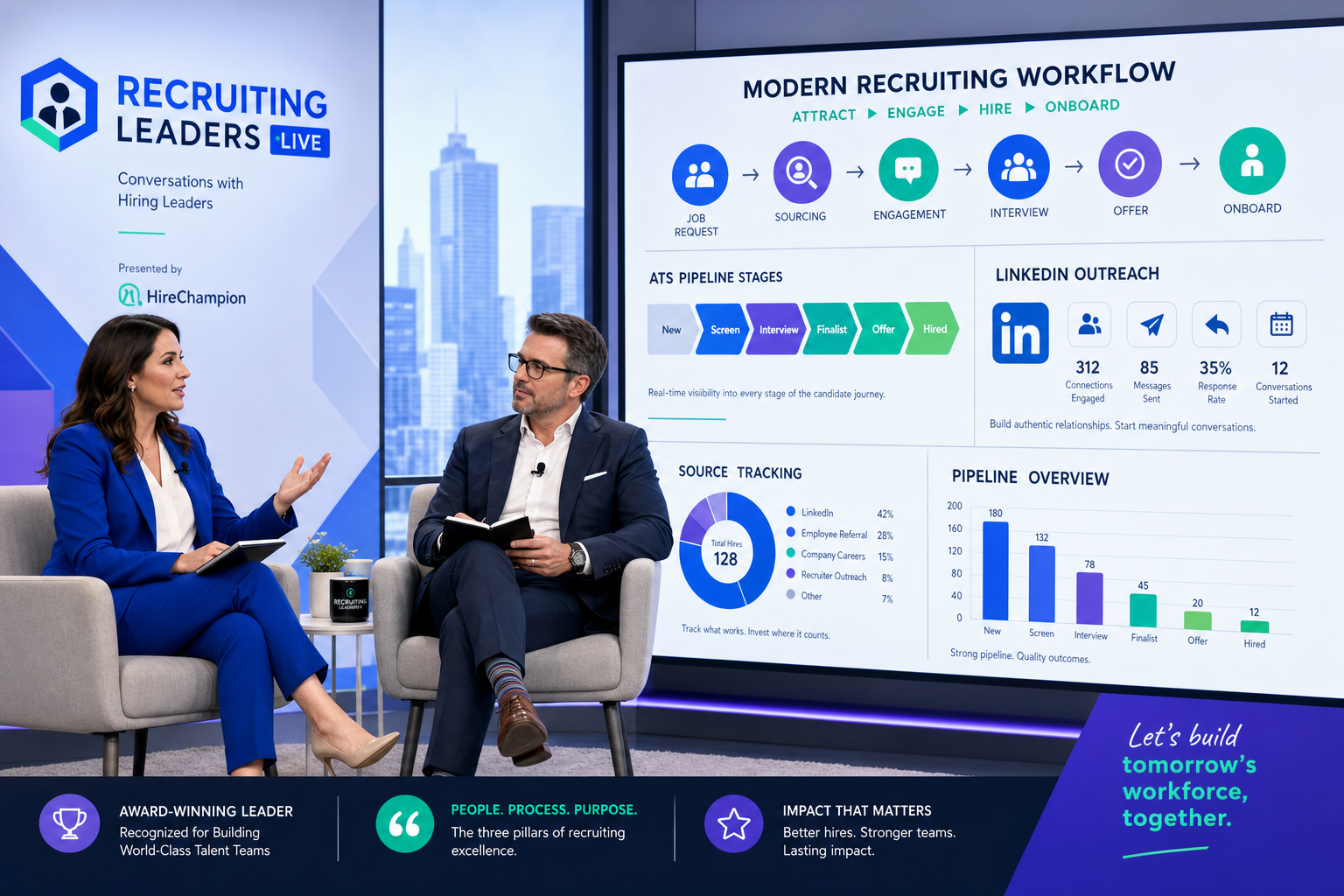
When desk pressure exposes gaps in recruitment online for recruiters, this article helps agency leaders judge the right stack and avoid workflow drag.
That gap matters more than most teams admit. A solo headhunter loses hours chasing LinkedIn replies after work, a small agency owner loses margin when consultants retype the same notes across tools, and an in-house recruiter loses credibility when hiring managers cannot see where candidates stalled. When the workflow breaks, the damage is not abstract: slower response times, weaker candidate engagement, duplicated outreach, missed follow-up, and poor source visibility across job recruiting sites.
In that kind of environment, I have found it useful to pair a core recruiting stack with targeted workflow automation instead of expecting one platform to do everything perfectly. For LinkedIn-heavy sourcing, StrategyBrain AI Recruiter can relieve some of the manual load by handling first-touch messaging, after-hours follow-up, and multilingual candidate communication while the recruiter still owns the final résumé review, qualification judgment, and next-step decision. If your bottleneck is active sourcing rather than ATS administration, that distinction matters.
A useful way to frame the problem comes from a finance team-building conversation with a fast-growth leader who was assembling a construction finance function from the ground up during a period of heavy capital deployment. The challenge was not only to hire one strong analyst. It was to put people, processes, and tools in place that could keep improving as growth accelerated. In practical recruiting terms, that means opening a requisition, sorting incoming profiles, logging outreach, and keeping stakeholder expectations aligned before the team starts outrunning its own process.
That same leader also pointed to a second layer of difficulty that every experienced recruiter recognizes immediately: hard skills were already difficult to find, and culture fit made the search even narrower. Add in a need for leaders who stay humble, learn quickly, challenge the status quo, and improve systems over time, and the hiring brief becomes far more demanding than a simple keyword search. That is exactly where the best recruiting software matters. It should help recruiters manage precision hiring, coordinate with hiring managers, and decide when software, job recruiting sites, or even top rated employment agencies are the right answer for the workload in front of them.
Table of Contents
- Why hiring context matters before software selection
- What recruiting software actually covers today
- Which features matter most in real recruiter workflows
- Best recruiting software by hiring model
- How to compare platforms without getting lost
- Where AI Recruiter fits in a modern sourcing workflow
- What recruiters gain from a strong ATS
- Software vs job recruiting sites vs employment agencies
- How to choose the right stack
- Common buying mistakes
- FAQ
Why hiring context matters before software selection
If you have ever helped a fast-growing business build a team from scratch, you already know that recruiting software decisions are rarely about software alone. They are really about whether your process can hold up when hiring volume, stakeholder pressure, and role complexity all rise at the same time.
That is the most useful lesson from the finance-team example above. The real assignment was not merely to fill seats. It was to build a function that could scale, improve its processes, and support larger business goals. Recruiting teams face the same challenge. A platform that works for occasional hiring often fails once you need better sourcing discipline, tighter coordination, and cleaner data across multiple recruiters and managers.
That is why experienced buyers start with business context first. Are you hiring for repeatable volume, specialized search, executive-level fit, or multi-region growth? Are you trying to improve response speed on LinkedIn, capture better source data from job recruiting sites, or reduce dependence on top rated employment agencies? The answers shape what the best recruiting software actually means for your team.
The strongest recruiting systems do more than process applicants. They help recruiters preserve context as hiring becomes more specialized, more collaborative, and more time-sensitive.
What recruiting software actually covers today
Recruiting software is the operating system for hiring workflow, not just a place to store résumés. In current recruitment online for recruiters, the category usually includes applicant tracking, job distribution, sourcing support, candidate relationship management, interview coordination, analytics, and integrations with adjacent HR tools.
That broader definition matters because most teams no longer recruit in one channel. They post jobs publicly, source privately, manage referrals, coordinate with hiring managers, and revisit silver-medalist candidates from previous searches. Spreadsheets and inbox folders can hold pieces of that work, but they do not create a durable process.
When recruiters say they want the best recruiting software, they often mean they need one of three things:
- Better process control: clean requisition management, stage visibility, and shared feedback.
- Better sourcing throughput: stronger outreach, candidate tracking, and rediscovery.
- Better decision support: reporting, source quality analysis, and workflow consistency.
Some platforms try to cover all three. Others are strongest in one area. Knowing which problem you are really solving saves a lot of wasted demos.
Which features matter most in real recruiter workflows
The best recruiting software supports the way recruiters actually work under pressure. That means less emphasis on impressive feature lists and more attention to whether the system helps your team move from search to shortlist to hire with fewer dropped steps.
1. Applicant tracking and stage control
This is still the foundation. A solid ATS should make it easy to create workflows, move candidates through stages, collect manager feedback, and maintain a complete candidate record. If stage updates are awkward or search is weak, the team will quickly work around the platform instead of inside it.
One of the most practical applicant tracking system benefits is simple visibility. Recruiters stop chasing status updates across email threads, and hiring managers can see where decisions are waiting.
2. Job posting and source tracking
Recruiters still need efficient distribution across career pages and external channels. This is where software intersects directly with job recruiting sites. A useful system helps publish jobs quickly, keeps listings consistent, and shows which channels bring qualified applicants instead of just traffic.
For teams that hire across many roles, source tracking is not optional. Without it, you cannot tell whether your spend and effort are producing the right pipeline.
3. Candidate relationship management
Good recruiters know that not every strong candidate applies at the right time. CRM-style functionality helps teams tag prospects, maintain talent pools, revisit previous finalists, and build a repeatable follow-up rhythm. This becomes critical when hard-skill requirements are narrow and culture fit matters, as in the finance-team example.
When hiring criteria are demanding, the search is often more about long-term relationship management than one-time applicant handling.
4. Interview coordination and collaboration
Scheduling and feedback collection are where many hiring processes lose momentum. A strong system reduces calendar friction, prompts timely feedback, and keeps recruiters from becoming the only people who know what is happening.
This is also where the best recruiting software protects recruiter reputation internally. Hiring managers usually judge the recruiting function by responsiveness and clarity, not by how many features the ATS has.
5. Automation that supports recruiter judgment
Automation has real value when it removes repetitive activity without obscuring decisions. Resume parsing, reminders, communication triggers, and sourcing assistance can all be useful. But the recruiter still needs to understand why a candidate is moving forward and what evidence supports that choice.
That distinction is especially important in outbound recruiting. Automated communication can create consistency and speed, but final qualification still belongs with the recruiter.
6. Reporting, integrations, and compliance support
Recruiting software becomes strategic when it helps answer operational questions clearly. Which source delivers candidates who actually reach final stage? Where do approvals slow down? Which managers sit on feedback? Which recruiters need support on conversion rates?
Integration depth matters too. If candidate information still has to be re-entered into calendars, HR systems, onboarding tools, or payroll workflows, the process remains more manual than it looks on a sales slide.
Best recruiting software by hiring model
The best recruiting software depends on how your team hires, not on generic rankings. A staffing desk, an in-house TA function, and a scaling business all use the same category differently.
Best for staffing firms and contingency recruiters
Agency environments usually need a blend of ATS and CRM. Recruiters want fast search, reusable pipelines, candidate tagging, outreach history, and strong source attribution. Client-submission flow also matters because the workflow does not end at internal stage changes.
For agency recruiters who rely heavily on LinkedIn outreach, I have seen the best results come from combining a core ATS with a specialized sourcing layer. That is where AI Recruiter can fit: it keeps candidate conversations moving after hours, handles multilingual messaging when needed, and captures résumés or contact details from interested prospects while the recruiter focuses on shortlist quality and client alignment.
Best for in-house talent acquisition teams
Internal TA teams usually care more about hiring manager collaboration, approvals, employer branding, career site consistency, and reporting discipline. Ease of review for managers matters almost as much as recruiter usability.
One of the biggest advantages of applicant tracking system adoption in-house is process consistency across departments. If every manager reviews differently and every recruiter tracks notes in a separate place, scaling becomes difficult fast.
Best for SMB hiring
Small and midsize businesses usually need an ATS that is easy to implement and hard to misuse. A simple workflow with clear source tracking and basic automation often beats a larger, more configurable system that the team never fully adopts.
In practice, the main applicant tracking system benefits here are administrative control, time savings, and a cleaner candidate experience.
Best for enterprise hiring environments
Large organizations need permissions, compliance controls, reporting depth, integrations, and support for multiple business units or geographies. But they still need recruiter adoption. Enterprise software that satisfies governance while frustrating recruiters at the desk level usually underperforms.
Best for sourcing-heavy teams
If your main bottleneck is outbound recruiting rather than inbound applicant handling, your best setup may be an ATS plus dedicated sourcing automation. This is common in hard-to-fill roles where recruiters must identify people with the right hard skills and then narrow further based on team fit, communication style, and long-term growth potential.
How to compare platforms without getting lost
Use a comparison framework built around recruiter actions, not software marketing language. Before every demo, I recommend mapping one live hiring scenario from intake to shortlist. That reveals far more than a vendor-led walkthrough.
| Evaluation Area | What to Check | Why It Matters |
|---|---|---|
| ATS workflow | Stage changes, search, notes, feedback capture | Shows whether recruiters can actually run the desk efficiently |
| Job distribution | Career site publishing, multiposting, source tracking | Connects software value to job recruiting sites |
| CRM capability | Talent pools, tags, follow-up structure, rediscovery | Important for specialized or repeat hiring |
| Outreach support | Messaging workflow, candidate response handling, contact capture | Critical for proactive sourcing teams |
| Collaboration | Manager access, scheduling, approvals, reminders | Prevents internal bottlenecks |
| Automation | Parsing, reminders, matching, communication triggers | Reduces repetitive work if it stays transparent |
| Analytics | Source quality, stage conversion, time-to-move metrics | Supports process improvement and budget decisions |
| Integration depth | Calendars, HRIS, onboarding, background checks | Avoids hidden manual work |
| Ease of use | Learning curve, recruiter clicks, admin burden | Adoption usually beats feature breadth |
| Support and rollout | Implementation help, training, responsiveness | Important when processes change under growth pressure |
The finance-team case offers a helpful reminder here: when a business is building a function from the ground up, tools need to support continuous improvement, not just today’s vacancy list. Software should be judged partly by whether it can mature with the team.
Where AI Recruiter fits in a modern sourcing workflow
Because a lot of readers searching for the best recruiting software are really struggling with outbound prospecting, it is worth separating ATS value from sourcing value. They overlap, but they are not identical.
In my own testing mindset, the best use of StrategyBrain AI Recruiter is not as a replacement for recruiter judgment. It is as a workflow assistant for repetitive LinkedIn activity that normally consumes the edges of the day. It can connect with targeted candidates, explain role basics, respond across time zones, and collect contact information or résumés from people who want to continue. The recruiter still reviews the profile, decides whether the résumé matches the brief, and takes over for deeper qualification.
That matters in exactly the kind of search described earlier: hard skills are scarce, fit is narrower still, and the role may support a larger team-building effort rather than a one-off hire. In those searches, speed and continuity in outreach are useful, but only if they hand off cleanly to a human recruiter.
If you want to see the broader workflow logic, the company’s LinkedIn sourcing tutorial is worth reviewing alongside your ATS evaluation. I would treat it as a sourcing layer discussion, not as a complete substitute for recruitment system design.
For agency and headhunting teams, the practical benefit is straightforward: fewer missed replies, better coverage outside standard hours, and less manual switching between outreach, follow-up, and record capture. For in-house teams hiring globally, multilingual communication can help reduce delay and confusion in first-touch engagement. But again, the final hiring call remains firmly with the recruiter and hiring team.
What recruiters gain from a strong ATS
The clearest applicant tracking system benefits are control, consistency, and visibility. Those gains may sound basic, but they have major effects on recruiter performance.
- Centralized records: every applicant, note, and stage change sits in one system.
- Stronger coordination: hiring managers can review candidates without fragmented email chains.
- Faster movement: stage changes, scheduling, and follow-up happen with less admin friction.
- Better source analysis: recruiters can compare referrals, direct sourcing, and job recruiting sites.
- More repeatable hiring: teams can preserve standards across recruiters, departments, and locations.
These are the advantages of applicant tracking system adoption that matter most when a business is trying to build a capability, not just close a role. The stronger the growth pressure, the more valuable workflow discipline becomes.
Software vs job recruiting sites vs employment agencies
Recruiting software, job recruiting sites, and top rated employment agencies solve different parts of the hiring problem. Many buyers compare them during the same search, which causes confusion.
Recruiting software
This is your internal operating system. It manages jobs, pipelines, outreach history, interviews, reporting, and recruiter collaboration. It is the backbone of recruitment online for recruiters.
Job recruiting sites
These are sourcing and advertising channels. They help you reach applicants or search for talent. Good software helps publish to those channels, capture responses, and measure source quality.
Top rated employment agencies
These are service partners. They bring recruiter time, market access, and search capability. They can be useful for urgent, specialized, or confidential roles, but they do not replace internal workflow infrastructure.
| Option | Primary Role | Best Use |
|---|---|---|
| Recruiting software | Run the internal hiring process | Teams that want control, visibility, and scalability |
| Job recruiting sites | Generate applications or sourcing leads | Teams that need reach and candidate flow |
| Employment agencies | Deliver external recruiting capacity | Teams that need extra bandwidth or niche search support |
If your search for top rated employment agencies is really driven by poor internal follow-up, weak source tracking, or lack of recruiter bandwidth on LinkedIn, better software and sourcing automation may solve part of the issue before you outsource the whole problem.
How to choose the right stack
Choose the setup that supports your actual workflow, hiring model, and growth stage. In practice, that usually means evaluating a stack, not just a single category label.
- Map the current process. Document job intake, sourcing channels, screening flow, interview coordination, and feedback delays.
- Separate ATS problems from sourcing problems. Many teams confuse pipeline management pain with outbound prospecting pain.
- Test live recruiter tasks. Run a sample requisition, a manager feedback loop, and a sourcing follow-up scenario.
- Include the hiring manager experience. Poor manager adoption can sink otherwise good software.
- Check source reporting. This is essential if your team uses multiple job recruiting sites or active sourcing channels.
- Review compliance and data handling. Especially important for larger or cross-border teams.
- Decide where human judgment must stay central. Automation should support, not obscure, recruiter decision-making.
For many teams, the right answer is a stable ATS for process control plus a sourcing layer for proactive outreach. That combination often outperforms an all-in-one platform that is mediocre at both.
Common buying mistakes
The most common mistake is buying for the imagined future while ignoring the current bottleneck. I see this constantly in both agency and in-house environments.
- Confusing channels with systems: job recruiting sites are not a replacement for workflow management.
- Buying on features instead of adoption: unused functionality creates complexity, not value.
- Ignoring culture-fit complexity: hard roles need relationship management, not just applicant storage.
- Expecting automation to qualify candidates fully: recruiters still need to evaluate the résumé and the brief.
- Skipping stakeholder workflow review: hiring manager friction slows good systems down.
- Underestimating growth pressure: teams building from the ground up need tools that support process improvement over time.
The finance-team story is a good reminder that strong hiring systems are built for compound pressure. If your process cannot support a more complex team tomorrow, it may already be too weak for today.
FAQ
What is the best recruiting software for recruiters?
The best recruiting software for recruiters is the platform or stack that matches the team’s real workflow. Most recruiters need some combination of applicant tracking, source tracking, candidate relationship management, interview coordination, and reporting.
How does recruitment online for recruiters differ from traditional recruiting workflows?
Recruitment online for recruiters usually involves more channels, more candidate touchpoints, and more data movement between systems. That makes software quality more important because recruiters must manage postings, outreach, replies, notes, scheduling, and analytics across multiple environments.
Do job recruiting sites replace recruiting software?
No. Job recruiting sites help you attract or identify candidates. Recruiting software manages what happens after candidates enter your process.
When should a company consider top rated employment agencies instead of software?
Use agencies when you need extra recruiting capacity, specialist market access, or support on difficult searches. Use software when your main problem is internal workflow, visibility, coordination, or repeatable process control. Many teams need both, but for different reasons.
What are the biggest applicant tracking system benefits?
The biggest applicant tracking system benefits are centralized records, faster coordination, more consistent hiring stages, and better source reporting. These improve both recruiter productivity and hiring manager visibility.
Where does AI Recruiter fit if I already have an ATS?
If your ATS handles pipeline management well but your team still spends too much time on manual LinkedIn outreach, AI Recruiter can act as a sourcing support layer. It helps with first-touch communication and follow-up, while the recruiter keeps control over qualification and hiring decisions.
Is automation enough for specialized hiring?
No. Automation can improve speed and consistency, especially in outreach and follow-up, but specialized hiring still depends on recruiter judgment, manager alignment, and a clear understanding of role context and team fit.
Conclusion
The best recruiting software is the one that helps your team hire with context, not just speed. That means supporting the real demands recruiters face: narrow skill requirements, stakeholder coordination, follow-up discipline, and better visibility across the funnel.
If your process depends heavily on sourcing, especially on LinkedIn, it can make sense to combine a strong ATS with targeted outreach support such as StrategyBrain AI Recruiter. If your challenge is broader process control, start with applicant tracking and collaboration first. Either way, the right decision comes from understanding your actual workflow, how it interacts with job recruiting sites, and when outside help from top rated employment agencies is truly necessary.