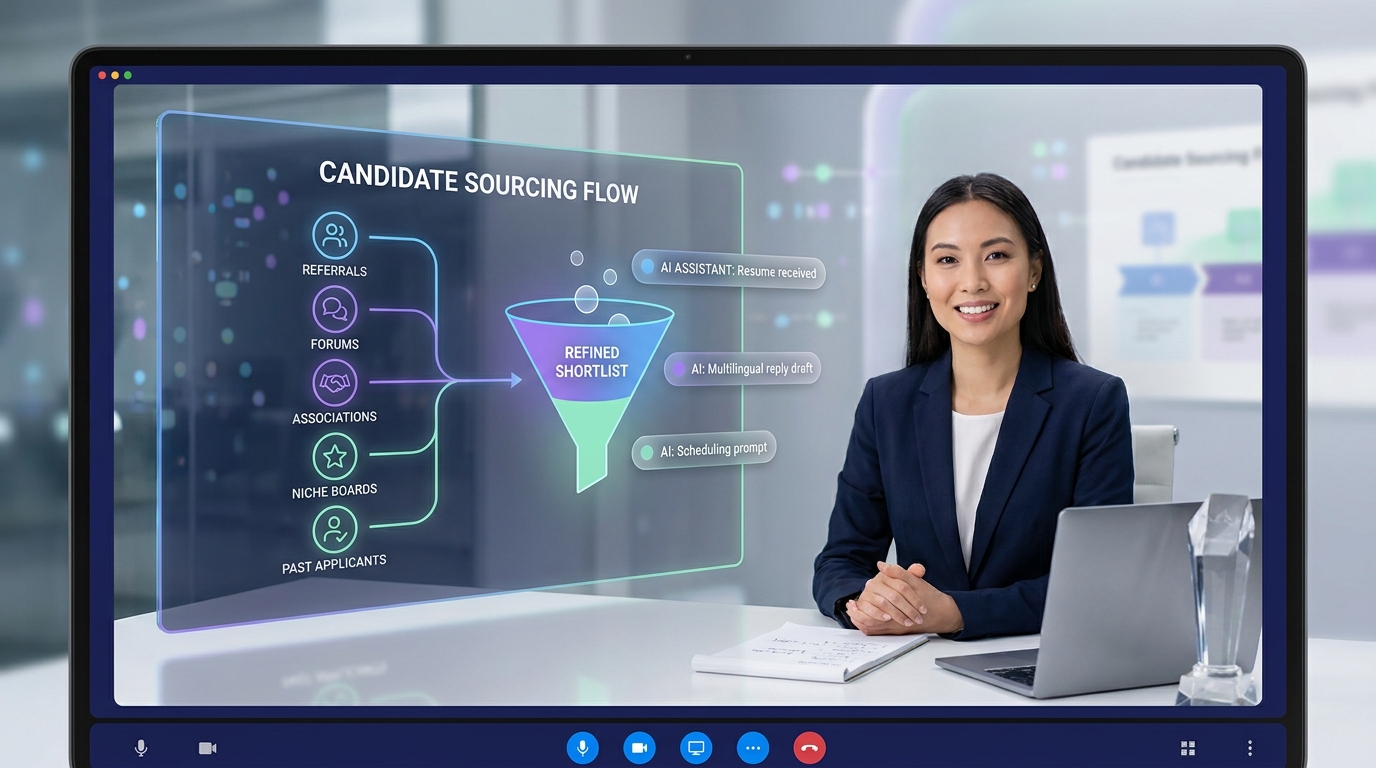
When hr sourcing stalls on vague briefs and one-channel habits, this guide helps recruiters judge role context, choose better channels, and avoid weak shortlists.
That matters because many recruiting teams still lose momentum in familiar ways: the role opens late, the brief is vague, outreach happens in bursts, and candidate conversations sit unattended while hiring managers ask for faster progress. For a solo headhunter, that means evenings spent chasing replies and rebuilding the same search. For a small agency owner, it means wasted researcher hours and uneven delivery. For an in-house recruiter, it can mean a weak shortlist, slower hiring cycles, and a candidate experience that starts to feel transactional.
In that gap between search and follow-up, workflow support helps more than another list of names. I have found that AI Recruiter is most useful when a team needs always-on candidate messaging, multilingual communication, and reliable capture of resumes or contact details after interest is confirmed. It does not replace recruiter judgment; the recruiter still owns final qualification, resume review, and next-step decisions. What it can do is reduce the lag that quietly damages sourcing outcomes.
A useful way to frame this comes from an executive-search conversation with a CFO discussing three linked decisions: what to examine in an acquisition, how to weigh growth capital against debt, and what an effective relationship with the board should look like. None of that is recruiting on the surface, but the operating logic is highly familiar to experienced sourcers. Before a search is productive, someone has to assess the real growth context, understand the trade-offs behind the hiring need, and align stakeholders on what success looks like.
That is exactly where non-LinkedIn sourcing often succeeds or fails. If recruiters do not know whether a role is tied to expansion, restructuring, fundraising pressure, or post-acquisition integration, applicant sourcing becomes too literal and outreach misses the mark. The rest of this guide uses that decision-first lens to show how to source employees beyond LinkedIn, which talent sourcing tools actually support the work, and what process standards make sourcing more durable.
Table of Contents
- Why HR Sourcing Needs Business Context
- Why Non-LinkedIn Sourcing Matters
- Where to Source Candidates Without LinkedIn
- Types of Talent Sourcing Tools
- How to Source Employees Step by Step
- Search Logic and Matching Skills
- ATS, CRM, and Workflow Considerations
- Metrics That Matter in HR Sourcing
- Common Mistakes to Avoid
- FAQ
Why HR Sourcing Needs Business Context
The best sourcing work rarely starts with a keyword string. It starts with context. In the same way a finance leader would review acquisition fit, funding options, and board expectations before committing to a growth path, recruiters need to understand what sits behind the requisition before they start building lists.
HR sourcing is the proactive process of finding, qualifying, and engaging potential candidates before they formally enter the recruiting funnel. But in practice, effective sourcing is also a business interpretation skill. You are not just asking who can do the job. You are asking why this role exists now, what type of background will hold up under the real conditions of the role, and how much flexibility the market will require.
That is why the difference between sourcing and recruiting matters. Recruiting carries the process forward after interest is captured. Sourcing shapes whether the right people ever enter the process in the first place. When recruiters skip the context stage, they often overfit to a title, underuse adjacent talent, and create outreach that sounds generic because it ignores the actual business moment.
Key insight: Better sourcing starts when recruiters understand the growth decision behind the hire, not just the job description in front of them.
Why Non-LinkedIn Sourcing Matters
Most teams do not need to abandon LinkedIn. They need to stop depending on it as the default answer to every search. Non-LinkedIn sourcing improves channel resilience, broadens reach, and reduces the familiar pattern where the same candidates receive the same messages from competing recruiters.
It also changes the quality of the market signal you get. Public professional profiles often show polished positioning. Alternative channels show behavior: who contributes in a technical forum, who speaks at association events, who stays active in alumni groups, who appears in specialist communities, and who may be open to a move without broadcasting it widely.
From an execution standpoint, diversified sourcing supports both active and passive candidate strategies. Active candidates may come through niche boards or event participation. Passive candidates may be easier to identify through referrals, association directories, internal databases, or community footprints. Good hr sourcing blends both instead of overinvesting in one audience pattern.
Where to Source Candidates Without LinkedIn
The best channel mix depends on function, geography, seniority, and hiring urgency. In most searches, the stronger approach is a portfolio of sources rather than one "best" source.
1. Employee referrals
Referrals remain one of the most effective sourcing channels because they add context and trust early. For applicant sourcing, they are especially useful when recruiters give employees a clear role brief, likely backgrounds, and obvious disqualifiers.
Practical takeaway: Ask for referrals against a scorecard, not a vague request for good people.
2. Industry communities and forums
Specialist communities reveal practitioners through their work and thinking, not just their profile formatting. This is particularly useful for technical, operations, creative, and domain-specific searches.
Practical takeaway: Observe first. Outreach lands better when it references real contribution, not just availability.
3. Professional associations
Associations are often underused by recruiters, yet they can be strong sources for regulated, accredited, and specialist roles. They also provide better segmentation by discipline, certification, or region than broad networks.
Practical takeaway: Map your target associations by function and hiring geography before the search starts.
4. Niche job boards
Niche boards are useful when broad distribution creates too much volume and too little relevance. They also help reveal where active candidates in a specific field actually look for work.
Practical takeaway: Compare not just applicant volume, but screening pass rate and interview progression by board.
5. Events, webinars, and meetups
Events combine employer visibility, live qualification, and relationship-building. They work best when treated as part of a pipeline strategy rather than a one-day campaign.
Practical takeaway: Follow up quickly, tag attendees by skill cluster, and separate immediate leads from future-fit talent.
6. Internal talent pools and past applicants
Many teams overlook the fastest source they already own. Previous finalists, silver medalists, contractors, interns, and alumni can all become high-value sourcing channels when records are searchable and well tagged.
Practical takeaway: Build resurfacing habits around skill groups and prior stage data, not memory.
7. Social and content platforms beyond LinkedIn
Different functions gather in different places. Creative work, technical proof, writing samples, field experience, and community participation often show up more clearly outside mainstream professional networks.
Practical takeaway: Source where the work is visible or discussed, not only where resumes live.
Types of Talent Sourcing Tools
When teams search for non-LinkedIn talent sourcing tools, they are usually trying to solve a workflow problem, not just a search problem. Discovery matters, but so do organization, follow-up, resurfacing, and handoff.
| Tool Category | What It Helps With | Best Use |
|---|---|---|
| Candidate discovery tools | Finding profiles across public sources and databases | Building top-of-funnel target lists |
| Matching and search tools | Connecting role intent with skills, synonyms, and adjacent profiles | Hard-to-define or nonstandard searches |
| Candidate resurfacing tools | Re-engaging previous applicants or dormant records | Fast pipeline recovery |
| Outreach workflow tools | Sequencing messages and tracking follow-up | Consistent recruiter execution |
| ATS/CRM systems | Managing records, notes, statuses, and source data | Operational control and reporting |
In my own workflow, I separate sourcing tools into two questions. First, can the tool help me find the right people outside a crowded channel? Second, can it keep candidate communication moving without forcing me to babysit every reply? That second question is where AI Recruiter has been useful in practice. When a search involves international candidates or after-hours responses, the always-on messaging and multilingual communication reduce dead time. I still review resumes myself and decide who advances, but the handoff is cleaner because interested candidates have already shared contact details and basic intent.
The lesson is simple: tools should support recruiter judgment, not disguise weak search strategy. If the role brief is wrong, automation just scales noise. If the brief is strong, the right tool stack makes sourcing more consistent and less fragile.
How to Source Employees Step by Step
If your main search intent is how to source employees, this is the repeatable framework I would use. It reflects both hr sourcing fundamentals and the decision-first logic from the opening example: assess the business situation, choose the right route, align stakeholders, then execute.
Step 1: Clarify the business reason behind the role
Before building a candidate list, understand what created the hiring need. Is the role tied to growth, replacement, integration, cost control, a new market, or a leadership shift? This determines the profile more than the title does.
Practical advice: Ask what changed in the business, not only what appears in the JD.
Step 2: Define the ideal candidate profile with flexibility
Document must-have skills, trainable skills, adjacent backgrounds, likely industries, and realistic substitutes. Strong sourcers avoid brittle briefs and create room for nearby talent.
Practical advice: Ask the hiring manager what they would compromise on after 30 days of no hire. That usually reveals the true brief.
Step 3: Choose channels intentionally
Do not spread effort evenly across every source. Match channels to the role. Referrals for trust-heavy hiring, associations for regulated talent, communities for specialist functions, and internal resurfacing for speed.
Practical advice: Pick three to five channels and define what success looks like for each one.
Step 4: Search with both precision and range
Use exact terms for core requirements, but expand with adjacent titles, neighboring industries, and transferable skills. Great candidates often describe themselves differently from the hiring team.
Practical advice: Build one strict string and one broad string before outreach starts.
Step 5: Personalize the first contact
Outreach should quickly answer why this person, why this role, and why now. Specificity matters more than length.
Practical advice: Reference one credible point of fit rather than trying to summarize the entire role.
Step 6: Keep follow-up disciplined
Many sourcing processes break here. Recruiters send the first message, then lose rhythm when replies come late or across time zones. This is one of the places where workflow automation can help. In searches with large outreach volume, I have used AI Recruiter to maintain candidate conversations after hours, collect resumes from interested prospects, and reduce the manual chasing that usually slows momentum. The recruiter still decides whether the resume actually matches the role.
Practical advice: Separate communication support from qualification. Automation can maintain engagement, but fit assessment stays human.
Step 7: Review source quality and recalibrate
Measure which channels produce replies, qualified screens, interviews, and hires. Sourcing improves when teams stop confusing activity with progress.
Practical advice: Review channel quality with the hiring manager at the end of each search, especially for repeat roles.
Search Logic and Matching Skills
Boolean search still matters, but good modern sourcing is broader than Boolean alone. Matching skills now include title translation, skill adjacency, market interpretation, and evidence-based narrowing.
- Use quotes when exact phrasing matters.
- Use OR logic for title variants and skill synonyms.
- Use AND logic to combine core requirements.
- Use exclusions carefully so you do not cut out adjacent talent too early.
The real skill is knowing when to widen. If your search is tied to a business event like expansion, post-merger integration, or board-level pressure for execution, the candidate profile may need adaptability more than title purity. That is another lesson recruiters can borrow from executive decision-making: evaluate fit against the operating environment, not only the org chart label.
ATS, CRM, and Workflow Considerations
Sourcing breaks down when information lives in too many places. Candidate notes stay in inboxes, outreach history disappears, previous applicants are forgotten, and hiring managers do not know what has already been tried. That is why ATS and CRM design matter to sourcing teams, not just to interview coordination.
When evaluating systems, look for support in five areas:
- Candidate rediscovery and resurfacing
- Searchable notes and skill tagging
- Source tracking by role and channel
- Outreach history visibility across the team
- Clear handoff from sourcing to screening
The advantages of applicant tracking system usage become especially clear when sourcing volume grows. Teams need structure to avoid duplicate outreach, recover older talent, and keep communication consistent across recruiters and hiring managers.
If your process includes external messaging support, integration discipline matters even more. A communication tool can keep candidate conversations active, but the system of record still needs to hold notes, source data, and disposition decisions. That is where many sourcing operations mature: not by finding one miracle source, but by making discovery, outreach, and qualification work together.
Metrics That Matter in HR Sourcing
Good sourcing needs measurement that reflects quality, not just motion. The right metrics help you see whether your process is improving or simply producing more names.
| Metric | What It Shows | Why It Matters |
|---|---|---|
| Response rate | How well targeting and messaging land | Tests channel and outreach quality |
| Qualified screen rate | How many sourced prospects pass initial review | Reveals search accuracy |
| Interview progression | How sourced candidates move through the funnel | Shows fit beyond top-of-funnel interest |
| Source quality | Conversion by channel | Prevents overvaluing noisy sources |
| Time to slate | How quickly a credible shortlist forms | Useful for search execution and stakeholder alignment |
For most recruiting teams, source quality is the healthiest debate to have with hiring managers. A high-volume source with weak progression may look busy but perform poorly. A narrower source that consistently produces relevant screens is usually more valuable.
Common Mistakes to Avoid
Starting with titles instead of business need
When recruiters skip the context behind the role, sourcing becomes too narrow and outreach becomes generic.
Relying on one sourcing channel
Candidate behavior varies by role and market. A one-channel strategy is fragile.
Confusing outreach volume with sourcing quality
More messages do not mean better sourcing. Qualified conversations are the real signal.
Ignoring previous applicants
Past candidates are often the fastest overlooked source. A searchable database is a sourcing asset, not a compliance archive.
Automating without process clarity
Automation helps when the search brief is strong and the workflow is clear. Without that, it simply scales noise and poor targeting.
Failing to align stakeholders early
The opening finance example matters here too: decisions improve when stakeholders agree on what they are evaluating. Recruiting is no different.
FAQ
What is HR sourcing?
HR sourcing is the proactive process of identifying, qualifying, and engaging potential candidates before they formally apply. It focuses on early pipeline creation rather than later-stage recruiting tasks like interviewing and offers.
What is applicant sourcing?
Applicant sourcing refers to the methods used to attract and identify potential applicants from different channels, including referrals, communities, job boards, past applicants, and internal databases.
How do you source employees without LinkedIn?
Use a mix of referrals, professional associations, niche job boards, specialist communities, events, past applicants, and internal talent pools. The right mix depends on role type, geography, and urgency.
How do you source employees effectively?
Start with the business reason behind the role, define a flexible target profile, choose channels intentionally, search with both exact and adjacent logic, personalize outreach, and measure source quality. That is the most reliable answer to how to source employees well.
What tools help with non-LinkedIn sourcing?
Useful tools support candidate discovery, matching, resurfacing, outreach workflow, and ATS or CRM organization. The best setup helps recruiters find people, manage conversations, and preserve hiring context.
Can AI help with sourcing without replacing recruiters?
Yes. AI can help maintain candidate communication, support multilingual outreach, and collect resumes or contact information from interested prospects. Recruiters should still own final qualification, judgment, and hiring decisions.
Conclusion
Strong hr sourcing is not just a matter of where you search. It depends on whether you understand the business context behind the role, choose channels intentionally, and maintain a workflow that turns interest into qualified movement. That is the real lesson behind both executive decision-making and modern sourcing discipline: better outcomes come from better evaluation, not more activity.
If you want more durable applicant sourcing results, diversify beyond LinkedIn, tighten your role calibration, and build a process that supports timely follow-up and source learning. That is how experienced teams improve how to source employees in a market where speed, relevance, and judgment all matter at once.