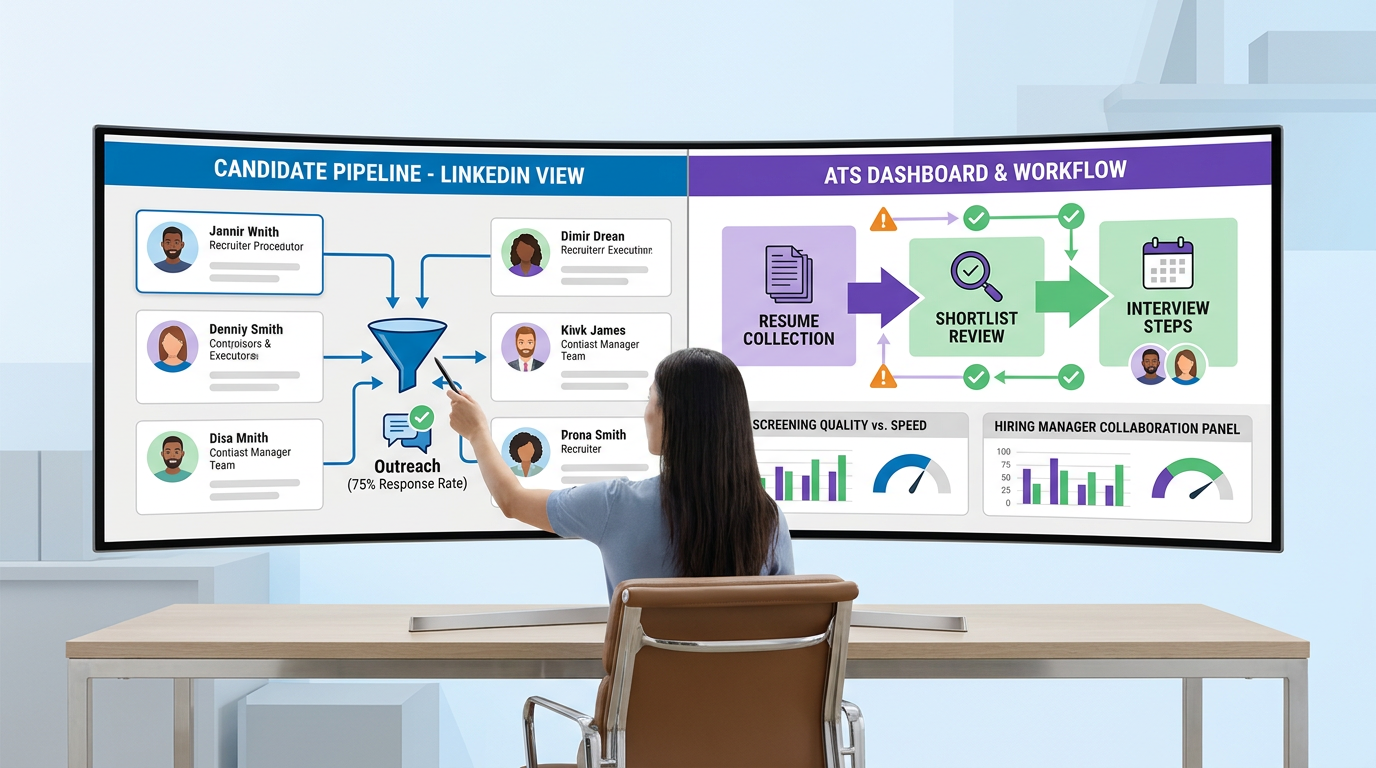
This article shows recruiters how to evaluate an AI hiring platform to improve shortlist quality and avoid faster, messier screening.
That is usually where screening breaks down. Recruiters are asked to move faster, but the real bottleneck is often upstream: unclear intake, inconsistent criteria, scattered candidate communication, and hiring managers who want quality shortlists without investing time in calibration. The result is not just slower hiring. It is duplicated work, weaker candidate follow-up, avoidable friction with clients or internal stakeholders, and too many applicants moving through the funnel without a shared definition of fit.
In that kind of environment, support tools matter most when they reduce repetitive outreach and qualification work without pretending to replace recruiter judgment. I have found that StrategyBrain AI Recruiter is most useful for three practical tasks tied to early screening pressure: keeping candidate conversations moving after hours, handling multilingual outreach when markets cross borders, and collecting resumes and contact details once interest is confirmed. The recruiter still reviews the resume, decides who is truly qualified, and owns the next step.
A useful comparison comes from how teams bring in outside expertise. In finance and accounting, leaders increasingly blend full-time staff with consultants for project periods or skill gaps, but those consultants do not create value just because they are experienced. They still need a proper start: the right people to meet, access to systems, visibility into how the team works, and enough business context to understand why the project matters. Without that setup, even strong talent loses time finding passwords, chasing reports, and guessing where decision authority sits.
The same pattern shows up in recruiting workflows. A screening process can look efficient on paper, yet fail in practice because nobody clarified success, explained the reason for adding support, or aligned the existing team around what the new workflow is meant to solve. When recruiters, hiring managers, and automation tools all enter the process with partial context, screening quality drops. That is exactly why AI candidate screening should be evaluated less as “automation” and more as an onboarding, coordination, and decision-structure problem.
That opening lesson shapes the rest of this article. If you are considering an AI hiring platform, testing interview ai, or adding an ai interview app into your funnel, the real question is not whether the technology sounds advanced. It is whether it fits your team’s operating model, makes role expectations clearer, and helps recruiters deliver better screening decisions inside an ATS-centered workflow.
Table of Contents
- What AI candidate screening really needs to work
- How an AI hiring platform works across the funnel
- Why onboarding the workflow matters as much as the software
- Where interview AI and an AI interview app fit
- Benefits for recruiters, HR, and hiring managers
- How AI screening connects with ATS workflows
- Fairness, compliance, and governance considerations
- How to evaluate an AI hiring platform before rollout
- Common mistakes teams make with AI candidate screening
- FAQ
What AI candidate screening really needs to work
In practice, AI candidate screening works best when hiring teams treat it the way strong operators treat any specialist support: give it clear scope, connect it to the right people and systems, and define success before expecting output. That is the most valuable lesson carried over from consultant onboarding. Expertise helps, but structure is what lets expertise produce results quickly.
For recruiters, that means an AI hiring platform should not be dropped into a vague hiring process and expected to clean it up on its own. If the job requirements are unclear, if hiring managers disagree on must-haves, or if the ATS stages do not reflect real decision points, the technology will simply move confusion faster.
A better definition is this:
AI candidate screening is the use of software to organize applicant information, support role-based qualification, standardize early interactions, and help recruiters decide who should move forward for human review.
That definition matters because it keeps human accountability in the right place. The strongest implementations do not hand over final judgment to software. They use AI to reduce repetitive effort and make early-stage evaluation more consistent.
What experienced recruiters set up first
- Role context: what the job is actually meant to solve for the business
- Access and systems: where resumes, notes, stage changes, and outreach records live
- Stakeholder alignment: who approves movement and what “qualified” means
- Workflow ownership: where the recruiter takes over from automation
- Feedback loops: how managers and recruiters correct weak recommendations early
Those are not abstract governance ideas. They are the operating conditions that separate useful AI support from noisy screening output.
How an AI hiring platform works across the funnel
An AI hiring platform usually creates the most value in the parts of recruiting where teams lose time repeatedly: early outreach, initial qualification, resume collection, scheduling, note capture, and interview preparation. The practical goal is not hands-free hiring. The goal is cleaner inputs and faster movement toward informed human decisions.
Typical workflow
- Candidate intake: applications, profiles, or sourced prospects enter the workflow.
- Initial communication: outreach or response handling starts, often across time zones or outside recruiter working hours.
- Interest confirmation: candidates indicate whether they want to continue.
- Resume and contact collection: interested candidates provide materials for review.
- Qualification review: recruiters or hiring teams evaluate actual fit against the role.
- Shortlist prioritization: likely matches are surfaced for faster review.
- Interview planning: structured questions, scorecards, and scheduling are prepared.
That sequence matters because it corrects a common misconception. Many tools can help determine whether a candidate is willing to engage. Fewer can responsibly determine whether the person is truly qualified for the role. That distinction should remain clear in process design.
In my own work, that is where AI Recruiter has been most realistic as a support layer. It can take over repetitive LinkedIn communication, continue conversations when recruiters are offline, and collect resumes from interested candidates, but I still treat resume review and fit assessment as recruiter-owned tasks. Used that way, it helps create a cleaner screening queue rather than a black-box decision system.
What data is commonly used
- Resume content and employment history
- Application responses and knockout questions
- Candidate messages and availability
- Contact details and submitted documents
- Structured interview responses in phone, voice, or async formats
- Recruiter notes, scorecards, and manager feedback
The most defensible process keeps evaluation anchored to job-related criteria and visible inside the recruiting workflow.
Why onboarding the workflow matters as much as the software
The finance consultant comparison is useful because it highlights a point recruiting teams often skip: before expecting speed, create orientation. When a consultant joins a team, good leaders think about who they should meet first, what systems they need, what internal context matters, and how the rest of the team will work with them. AI-supported screening deserves the same discipline.
If you add automation without explaining the purpose, teams often react badly. Recruiters may assume the tool is monitoring them. Hiring managers may assume shortlist quality will improve automatically. Coordinators may not know which updates belong in the ATS and which happen elsewhere. The software is not the only thing that needs setup; the team relationship around the software needs setup too.
Translate consultant-onboarding logic into recruiting operations
- Who needs to meet first? Define which recruiters, coordinators, sourcers, and hiring managers touch the workflow first.
- What systems need access? Confirm ATS, calendar, email, messaging, and sourcing-tool connections.
- What business context matters? Explain why the role is open, what hiring urgency exists, and what trade-offs are acceptable.
- What does success look like? Decide whether the priority is response speed, shortlist quality, consistency, or reduced manual triage.
- How will feedback be handled? Build regular recruiter-manager reviews to correct drift in screening logic.
This is also where many early AI hiring projects either stabilize or fail. Teams that treat implementation as software installation usually end up disappointed. Teams that treat it as workflow onboarding usually get much better adoption and more trustworthy output.
Practical takeaway: if you would never drop a senior consultant into a project without introductions, system access, role clarity, and KPIs, do not deploy AI candidate screening that way either.
Where interview AI and an AI interview app fit
Interview ai and the broader ai interview app category usually sit after initial candidate interest is confirmed and before a recruiter or hiring manager invests more live time. They can help standardize early questions, support phone or voice screening, capture responses, and prepare structured notes for the team.
For high-volume hiring, this can be useful. For specialist hiring, it can still work, but usually with lighter automation and tighter recruiter oversight. The right fit depends on role complexity, candidate expectations, and the risk of creating a process that feels impersonal or disconnected from the work itself.
Common uses of interview AI
- Phone-based screening: quick checks on availability, baseline requirements, and interest
- Voice AI interviews: standardized early-stage conversations
- Asynchronous screening: candidates respond when convenient, which helps scheduling
- Live interview support: question prompts, note capture, and scorecard assistance during human-led interviews
Used well, these tools can improve consistency. Used poorly, they create another layer candidates have to navigate before they ever speak with a person who understands the role. That is why I advise recruiters to test completion flow and candidate clarity before rolling out an ai interview app broadly.
One useful pattern is to combine conversational sourcing and interest capture on LinkedIn with more structured downstream screening. For example, if an outreach workflow surfaces candidates in multiple languages and gathers resumes overnight, a recruiter can spend the next day reviewing real applicant material instead of chasing replies manually. That is a much better handoff into interview ai than pushing unqualified names straight into automated interview steps.
Benefits for recruiters, HR, and hiring managers
The clearest value of AI candidate screening is operational. It reduces repetitive work, creates more structure, and gives hiring teams a better starting point for human evaluation. But those gains only hold when the workflow is clear enough to support them.
| Stakeholder | Main Pain Point | How an AI hiring platform helps |
|---|---|---|
| Recruiters | Too much manual outreach and screening coordination | Automates repetitive candidate communication, organizes responses, and speeds early review |
| HR leaders | Need for consistent process and oversight | Supports standardized steps, documented screening logic, and more visible workflow controls |
| Hiring managers | Unclear shortlist quality and uneven candidate context | Provides structured summaries and more consistent candidate intake |
| Agency teams and headhunters | High-volume client work and after-hours communication pressure | Extends outreach coverage, improves prioritization, and captures candidate materials faster |
Operational advantages that matter most
- Faster first response: candidates do not wait for every recruiter action to happen during office hours
- Reduced manual follow-up: repetitive conversations can be handled more consistently
- Cleaner handoffs: interested candidates enter recruiter review with more complete information
- Better shortlist discipline: structured screening reduces random movement through stages
- Improved candidate experience: communication can stay active and clearer across time zones
These benefits are strongest when the workflow already has a clear owner. AI does not create accountability; it supports it.
How AI screening connects with ATS workflows
Most teams do not need to replace their recruiting system to use AI effectively. In fact, the better setup is usually an ATS-centered one, where the applicant tracking system remains the source of truth and AI acts as a supporting layer around communication, screening, and prioritization.
This is another place where the opening consultant analogy holds up. A consultant can do strong work, but if reports, records, and decisions live in five different places, the team pays a coordination tax. Screening technology creates the same problem when candidate data, outreach history, interview notes, and stage movement are fragmented.
What good ATS integration should support
- Candidate data synced to the correct requisition
- Resume and contact capture connected to candidate records
- Stage movement visible to recruiters and hiring managers
- Interview scheduling updates linked to the workflow
- Structured notes and scorecards stored with the profile
- Searchable communication history for handoffs and auditability
If those basics are missing, the team will spend more time reconciling data than acting on it. That is why buyers should judge an AI hiring platform by workflow fit as much as by feature depth.
Advice for recruiters evaluating workflow fit
Map your actual funnel before you buy. Look at where response delays happen, where candidates disappear, where recruiters repeat the same tasks, and where managers say shortlist quality is inconsistent. Those are the points AI should help with. If the tool cannot improve those moments inside your existing process, it may add noise rather than value.
Fairness, compliance, and governance considerations
Fairness and compliance are central to any serious discussion of AI screening. Recruiters and HR leaders need to know what data is collected, how recommendations are generated, where human review happens, and whether the process can be explained later.
The same discipline that helps onboard consultants well also applies here: define scope, document expectations, and maintain review points. If your process is inconsistent before AI, automation can scale the inconsistency. If your process is structured and job-relevant, AI can help make that structure easier to maintain.
Key safeguards to look for
- Role-based criteria: screening should reflect the actual requirements of the job
- Human review points: recruiters or managers should validate consequential decisions
- Auditability: the team should be able to review what happened and why
- Access controls: candidate data should be protected and permissions limited
- Data-use clarity: understand whether data is isolated, shared, or used for model training
When reviewing vendor claims, I pay close attention to how customer and candidate data is handled and whether the process design keeps recruiter judgment in the loop. Those are not side questions; they are core buying criteria.
How to evaluate an AI hiring platform before rollout
Choosing an AI hiring platform should be treated like a process design decision, not just a feature comparison. The best evaluations start with the hiring problem, then work backward to the software.
A practical evaluation checklist
- Define the burden point: is the pain in sourcing, outreach, screening, scheduling, or interview prep?
- Clarify the handoff: decide exactly where automation ends and recruiter judgment begins.
- Review system access: make sure the platform fits the tools your team already uses.
- Set success criteria: agree on what better looks like before rollout starts.
- Test candidate flow: check whether instructions, tone, and transitions are clear.
- Assess interview support: if using interview ai or an ai interview app, confirm the format suits the role.
- Check governance: review data protection, permissions, and process traceability.
- Train the team: recruiters and hiring managers need shared expectations on how to use the output.
I also recommend doing a limited pilot around a specific workflow rather than trying to automate everything at once. One of the better use cases is outbound candidate engagement where response timing matters, recruiter hours are limited, and candidates may reply in different languages. That kind of pilot shows quickly whether the software improves throughput without compromising control.
For recruiters who rely heavily on LinkedIn sourcing, a targeted test with StrategyBrain AI Recruiter can be useful because it focuses on a very specific operational gap: ongoing candidate conversation, interest confirmation, and resume capture before recruiter review. That makes it easier to judge the real impact on screening flow instead of trying to evaluate a broad promise all at once.
Common mistakes teams make with AI candidate screening
Most failure points in AI candidate screening are not purely technical. They come from weak setup, unclear ownership, or unrealistic expectations.
1. Treating AI as a substitute for recruiter judgment
AI can prioritize, summarize, and support outreach. It should not become an unquestioned decision-maker on candidate quality.
2. Skipping workflow onboarding
Just as a consultant cannot contribute quickly without context, system access, and stakeholder alignment, AI screening will underperform when teams do not define scope and ownership first.
3. Failing to explain the process to the team
Existing recruiters, coordinators, and hiring managers need to know why the tool is being introduced and how it should help. Otherwise adoption stays shallow.
4. Ignoring candidate experience
An ai interview app may be efficient, but if the process feels confusing or detached from the role, completion quality will suffer.
5. Letting data live outside the core workflow
If resumes, notes, candidate messages, and screening outputs are disconnected from the ATS, the process becomes harder to manage and defend.
6. Measuring novelty instead of usefulness
What matters is whether the tool reduces real recruiter workload, improves handoff quality, and supports better decisions. Impressive language is not the same as operational fit.
FAQ
Can AI screen candidates fairly?
It can support fairer screening when the process uses role-related criteria, structured evaluation, clear oversight, and documented review points. It is not fair by default just because it is automated.
Does interview AI replace recruiters?
No. Interview ai is most useful for early-stage qualification, response capture, scheduling support, and structured note-taking. Recruiters still handle judgment, relationship management, and final movement decisions.
What does an AI interview app usually evaluate?
An ai interview app may collect and organize candidate responses to structured questions, availability, qualification details, and early screening inputs. It is best used to support early evaluation, not to make isolated final hiring decisions.
How does an AI hiring platform work with an ATS?
An AI hiring platform should sync candidate records, screening data, interview steps, and stage changes with the ATS so recruiters can manage the process in one visible workflow.
Is AI candidate screening only useful for high-volume hiring?
No. High-volume teams often feel the gains first, but specialist and agency recruiters can also benefit when the technology is used for targeted tasks like outreach continuity, resume collection, and structured early screening.
What is the biggest implementation mistake?
Usually it is introducing technology before defining criteria, ownership, and team expectations. Process discipline has to come first.
Conclusion
AI candidate screening works best when recruiters borrow a lesson many other professional teams already understand: support resources only perform well when they are onboarded properly. Whether the support is a consultant, an automation layer, or an AI hiring platform, the basics still matter—context, access, expectations, team alignment, and feedback.
That is why the strongest recruiting setups do not chase full automation. They use AI to keep candidate conversations moving, gather better inputs, support structured review, and make human judgment more efficient. Interview ai and an ai interview app can absolutely help, but only when they are part of a workflow the team actually understands and trusts.
For headhunters and hiring teams under constant speed pressure, that is the practical standard worth using: choose tools that improve the handoff to the recruiter, not tools that try to erase the recruiter from the process.