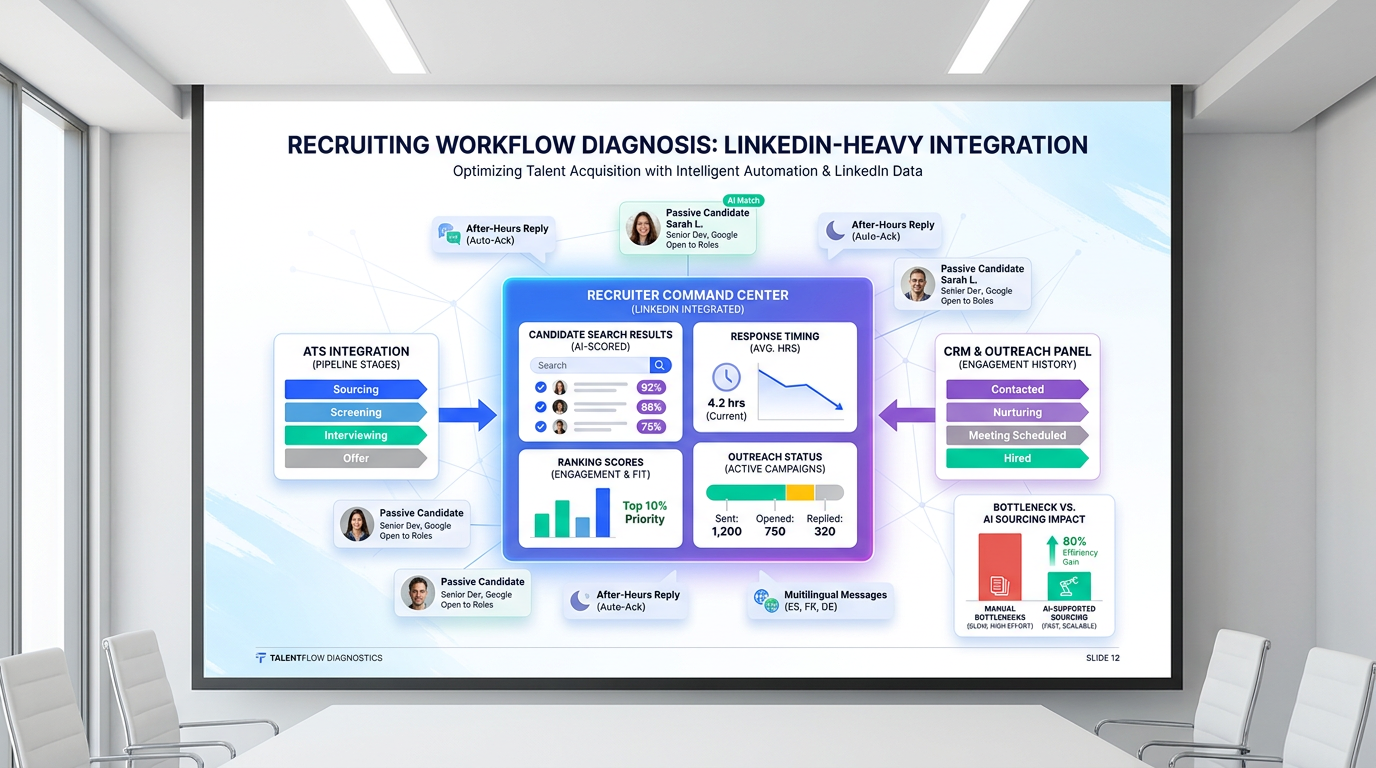
When recruiting sourcing starts slipping, this article helps agency leaders diagnose weak intake and manual bottlenecks before pipelines stall.
That sounds obvious until a live search starts to drift. A boutique agency owner feels it when consultants spend hours rebuilding searches and still miss the right profiles. An in-house recruiter feels it when passive candidates reply after hours and no one answers fast enough. An individual sourcer feels it when too much effort goes into exact-title matching, while strong adjacent talent never even makes the list. The cost is not only time. It shows up in weaker pipelines, slower client updates, candidate drop-off, and a reputation for outreach that feels generic or late.
One reason I have become more practical about AI Recruiter support is that it can ease exactly those top-of-funnel pressure points without removing recruiter accountability. In my own workflow, using StrategyBrain AI Recruiter for LinkedIn outreach support, after-hours candidate replies, and multilingual first-touch communication helped keep conversations moving when manual follow-up would have stalled. It still left the final judgment where it belongs: with the recruiter reviewing resumes, validating fit, and deciding who should move forward.
The framing reminds me of a career lesson from a long motorcycle trip: you can keep going on worn tires for a while, but eventually all your energy goes into staying upright instead of moving well. The smarter move was to prepare earlier, carry what would be needed before the next hard stretch, and stop pretending everything could be solved alone in the moment. The same pattern shows up in sourcing. A recruiter opens a new search, checks the requisition, reviews older LinkedIn replies, and starts rebuilding a target list—only to realize the real problem is not effort but lack of preparation, weak feedback loops, and too much dependence on doing everything manually.
That road lesson goes further. Asking for help mattered more than guessing with imperfect directions, and vulnerability created better outcomes because it made room for clearer decisions and better conversations. In recruiting, the equivalent is admitting that search logic, outreach timing, and candidate context should not live only in one person’s head. Teams that prepare early, ask for support from the right tools, and pick a direction instead of overthinking every string usually run a stronger sourcing engine.
That is the real entry point for ai candidate sourcing. It is not about replacing recruiter instincts. It is about building a more resilient form of recruiting sourcing through better preparation, faster assistance, and smarter feedback. The rest of this article looks at how to turn those road-tested lessons into a strategic candidate sourcing process, which sourcing techniques still matter, and where AI helps most without taking over the parts that require human judgment.
Table of Contents
- What AI candidate sourcing really fixes
- The rules of the road for recruiting sourcing
- Traditional sourcing vs AI-supported sourcing
- A strategic candidate sourcing framework
- A step-by-step recruiting sourcing process
- Best sourcing techniques for active and passive talent
- Using AI support in LinkedIn-heavy workflows
- ATS and CRM workflow integration
- Metrics and ROI
- Common mistakes
- FAQ
What AI Candidate Sourcing Really Fixes
At a practical level, AI candidate sourcing helps recruiters identify, rank, enrich, and prioritize people before they apply. That definition matters, but the operating value matters more: it reduces the strain of running every search on metaphorical bald tires.
In day-to-day recruiting sourcing, the biggest issue is rarely a total lack of candidates. It is usually one of these:
- The search brief is too vague to produce a reliable shortlist
- The team is over-dependent on exact-title Boolean searching
- Candidate replies arrive across time zones and sit too long
- Outreach lacks enough profile context to feel credible
- Old ATS and CRM talent pools are ignored while teams restart from zero
AI can help because it supports:
- Natural-language search that finds relevant adjacent profiles
- Candidate ranking that helps prioritize review
- Profile enrichment for better outreach context
- Multi-source discovery across internal records and public profiles
- Faster communication support when candidate engagement depends on timing
Key insight: The best use of AI candidate sourcing is not to automate recruiter judgment. It is to remove preventable friction before judgment is needed.
The Rules of the Road for Recruiting Sourcing
The motorcycle lesson from the reference story translates surprisingly well into sourcing leadership. Three principles matter most.
1. Prepare before the road gets rough
When recruiters start sourcing without clear intake, the team spends the rest of the search compensating. Preparation means clarifying must-haves, flexible criteria, adjacent backgrounds, likely target companies, and what success looks like in the role six months from now.
2. Ask for help instead of guessing
In the original career lesson, asking other people for directions beat relying blindly on a GPS. In sourcing, the equivalent is using systems, records, and AI support to widen your view instead of trusting one manual search pattern. It also means asking hiring managers better calibration questions earlier.
3. Pick a direction and refine as you go
Many recruiting teams overthink the perfect search string and delay outreach. Experienced sourcers know that the first search should create learning, not perfection. Once early responses and screens come back, the profile gets sharper.
These principles are the base of any durable strategic candidate sourcing workflow. They also explain why AI works best in the top-of-funnel stages: it supports preparation, expands visibility, and helps teams move sooner with better information.
Traditional Recruiting Sourcing vs AI-Supported Sourcing
Traditional recruiting sourcing still has real value. Boolean logic, exact-title search, and manual profile review are useful when the role is tightly defined or heavily regulated. The limitation is that exact-match logic often misses people whose experience fits the work but not the wording.
AI-supported sourcing shifts more of the search from literal phrasing to contextual relevance.
| Area | Traditional recruiting sourcing | AI-supported sourcing |
|---|---|---|
| Search method | Boolean strings and exact keywords | Natural-language and contextual matching |
| Discovery scope | Often one channel at a time | Can combine internal data and public sources |
| Prioritization | Manual review of large result sets | Ranked candidates for faster first-pass review |
| Outreach readiness | Context gathered manually profile by profile | Enrichment helps faster personalization |
| Response handling | Depends on recruiter availability | Can be supported by always-on communication tools |
| Recruiter role | Searcher and list builder | Strategist, validator, and relationship owner |
The practical conclusion is not that traditional methods disappear. It is that AI gives recruiters more room to act like recruiters rather than search-string mechanics.
A Strategic Candidate Sourcing Framework
If you want better results from AI candidate sourcing, build the process around preparation and learning, not just speed.
1. Start with a business outcome, not only a title
What problem is the hire expected to solve? The wider business context matters because sourcing accuracy improves when the team understands impact, not just keywords.
2. Separate must-have criteria from trainable criteria
This is one of the simplest ways to improve signal quality. Too many searches fail because everything is labeled essential.
3. Build a realistic candidate map
Include target titles, adjacent titles, likely industries, company stages, geography, and probable motivators. This makes strategic candidate sourcing more durable than a one-off search sprint.
4. Reuse warm talent before going fully external
Search the ATS, CRM, past finalists, referrals, and re-engageable prospects. Good sourcing teams do not treat every requisition as a blank slate.
5. Add AI where speed and pattern recognition matter most
Use AI for discovery, ranking, outreach assistance, and communication continuity. Keep final shortlisting, resume evaluation, and hiring decisions with human recruiters and hiring managers.
A Step-by-Step Process for AI Candidate Sourcing
- Define the hiring goal. Write the business problem and likely success markers.
- Run intake calibration. Confirm must-haves, tradeoffs, and target backgrounds.
- Search internal systems first. Review ATS and CRM records for warm talent.
- Search broadly across external sources. Use contextual criteria, not only exact titles.
- Review ranked results critically. Validate scope, progression, and relevance before outreach.
- Segment the pool. Group candidates by fit, location, source, and likely outreach angle.
- Personalize first contact. Use actual reasons for contact, not generic praise.
- Capture response patterns. Notice which messages, sources, and profile types convert to conversations.
- Refine quickly. Use recruiter screens and hiring-manager feedback to tighten the search.
That last step is where the road analogy matters again. The best sourcers do not keep pushing the same tired method. They adjust before the search starts slipping.
Best Sourcing Techniques for Active and Passive Talent
The strongest sourcing techniques still depend on market understanding and communication quality. AI helps, but it does not replace credibility.
For active candidates
- Search your existing systems first. Warm talent often converts faster.
- Use role-adjacent search logic. Similar responsibilities can matter more than matching titles.
- Contact quickly. Delayed response is one of the easiest ways to lose active candidates.
- Keep messages clear. Process visibility beats overlong introductions.
For passive candidates
- Lead with relevance. Explain why they fit the conversation.
- Speak to likely motivators. Scope, challenge, leadership path, and flexibility often matter early.
- Use a real follow-up cadence. One message is rarely enough.
- Nurture over time. Not every strong profile is ready now.
Where AI helps these sourcing techniques most
- Surfacing candidates with non-standard titles
- Finding similar talent from known benchmark profiles
- Pulling forward forgotten internal candidates
- Supporting outreach context and follow-up timing
- Keeping candidate conversations moving outside recruiter working hours
Using AI Support in LinkedIn-Heavy Workflows
Because much of modern recruiting sourcing still happens around LinkedIn, it is worth being specific about where AI support helps and where it should stop.
In my own testing of LinkedIn-heavy outbound work, the most useful setup was not full replacement. It was using AI Recruiter to handle repetitive front-end tasks that typically drain recruiter time: initial outreach, candidate replies that arrive late at night, and early communication in the candidate’s preferred language. That support reduced lag in the conversation and made it easier to keep momentum with passive talent. When someone showed interest, I still reviewed the resume myself, checked the actual career story, and decided whether the profile belonged in front of a hiring manager.
That distinction matters. A tool such as StrategyBrain AI Recruiter can support LinkedIn sourcing by automating repetitive messaging, maintaining 24/7 multilingual communication, and collecting resumes or contact details from interested candidates. But a responsible workflow still requires recruiter validation. Interest is not the same as fit, and sourcing support is not the same as selection.
For agency recruiters, this is especially useful in three situations:
- After-hours inbound replies from passive candidates
- Cross-border searches where language slows first contact
- High-volume LinkedIn outreach where consultants need consistency
For in-house teams, the same model works when recruiters need more continuity in outreach but cannot justify expanding headcount only to maintain first-touch messaging.
How to Integrate AI Candidate Sourcing Into ATS and CRM Workflows
The moment sourcing starts producing signal, the next risk is fragmentation. Strong search results do not help much if the team cannot track source, stage, and context cleanly.
A durable workflow should include:
- Single-record discipline: avoid duplicate candidate records
- Source tracking: log whether talent came from ATS, CRM, LinkedIn, referral, or public web search
- Stage definitions: separate sourced lead, engaged prospect, screened candidate, and applicant
- Feedback capture: use recruiter and hiring-manager feedback to improve future searches
- Nurture logic: store silver-medalist context for future roles
This is another place where the opening case matters. When recruiters try to hold all context in memory, the process becomes exhausting. Better systems create the equivalent of carrying the right supplies before the next rough patch.
| Workflow step | What the sourcer does | What the team needs next |
|---|---|---|
| Intake | Defines target profile and search plan | Clear must-haves and tradeoffs |
| Search | Builds and refines candidate list | Shared fit criteria |
| Enrichment | Adds source notes and context | Stronger screening prep |
| Outreach | Tests message and cadence | Status visibility and follow-up control |
| Review | Reports quality signals and blockers | Faster recalibration |
How to Measure Recruiting Sourcing Performance and ROI
AI candidate sourcing should be judged like any other recruiting process change: by workflow quality and hiring outcomes, not hype.
Useful metrics include:
- Qualified-profile rate
- Outreach response rate
- Interested-to-screen rate
- Submission-to-interview rate
- Time saved in search and follow-up
- Source quality by channel
For talent leaders, the better question is not “Did AI reduce recruiter effort?” but “Did it improve how the team prepares, prioritizes, and follows through?” That is closer to the real operating value.
Common Mistakes in AI Candidate Sourcing
Over-trusting ranked results
Ranking helps triage. It does not remove the need to assess scope, level, and career logic.
Skipping intake quality
If the brief is weak, even strong search technology creates noise.
Automating generic outreach
Speed without relevance damages response rates and recruiter credibility.
Ignoring internal talent pools
Many teams overlook candidates they already know before expanding external search.
Confusing candidate interest with candidate fit
This is especially important in LinkedIn-supported workflows. A candidate may be open to a conversation and still not be right for the role.
Failing to review privacy and bias implications
Any AI-supported workflow should be monitored for fair treatment, data discipline, and consistent human oversight.
FAQ
What is AI candidate sourcing?
AI candidate sourcing uses contextual search, candidate ranking, enrichment, and communication support to help recruiters identify likely-fit talent before application.
How is AI candidate sourcing different from traditional recruiting sourcing?
Traditional recruiting sourcing depends more on exact keywords and manual review. AI adds natural-language search, contextual matching, and prioritization support that can uncover relevant adjacent profiles.
Does AI candidate sourcing replace recruiters?
No. It reduces repetitive work and improves prioritization, but recruiters still need to calibrate the search, review resumes, assess fit, and manage candidate relationships.
Which sourcing techniques work best for passive candidates?
Target-company mapping, relevant outreach, follow-up cadence, and clear positioning remain the strongest sourcing techniques for passive talent.
Where does LinkedIn AI support fit best?
It is most useful for repetitive top-of-funnel tasks such as initial outreach, after-hours response handling, multilingual communication, and resume collection from interested candidates.
How do you measure ROI in AI candidate sourcing?
Track qualified-profile rate, response rate, screen conversion, submission-to-interview rate, and time saved. Focus on process quality and pipeline quality rather than broad automation claims.
Conclusion
The strongest form of ai candidate sourcing is less about novelty than operating discipline. Prepare early, ask for support before the workflow breaks down, and move with enough direction to learn quickly. That is the practical lesson underneath both good road travel and good sourcing.
If you want to improve recruiting sourcing, start with one upgrade this week: tighten intake, revisit your passive outreach, search your warm talent first, or add AI support where communication delay is hurting yield. That is how strategic candidate sourcing becomes repeatable, and how better sourcing techniques translate into better hiring conversations.