When recruiting sourcing starts to waste recruiter time or weaken shortlist quality, this article helps agency leaders judge where AI supports outreach without lowering fit, reply rates, or hiring control.
That matters because most sourcing problems do not begin with search volume. They begin when recruiters spend hours chasing people who are unlikely to move, send rushed outreach that damages reply rates, or build shortlists without enough context to protect quality. For a solo headhunter, that means lost billable time. For a growing agency, it means weaker delivery and avoidable margin pressure. For in-house teams, it often shows up as slower hiring, frustrated managers, and candidate experience issues that linger longer than a single requisition.
In my own workflow, tools like StrategyBrain AI Recruiter are most useful when they reduce the repetitive front end of sourcing rather than pretending to replace recruiter judgment. Used well, it can keep candidate conversations moving across time zones, support multilingual outreach, and collect resumes or contact details from interested prospects while I still handle final resume review, role judgment, and whether someone should move into a real recruiting conversation.
The logic is similar to the old debate around working notice. When a company lets people go, paying a large severance amount at once can create financial strain, so some employers choose a period where affected employees keep working until a defined end date. On paper, that gives both sides something valuable: the employer avoids a heavier immediate cost, and the employee gets time to look for a new role before the exit date arrives.
But anyone who has worked around that situation knows the tradeoff is not theoretical. Morale can drop, output can slip, and the risk rises when someone is frustrated, carries a grudge, or still has access to sensitive information. The lesson for AI candidate sourcing is straightforward: an option that looks efficient at the top level can fail if you ignore motivation, timing, and risk at the human level. That is exactly why understanding what is sourcing in recruitment process and the real ways of sourcing candidates matters before you automate anything.
Table of Contents
- Why Judgment Still Matters in AI Sourcing
- What Is Sourcing in Recruitment Process?
- Sourcing vs. Recruiting
- Ways of Sourcing Candidates
- Where AI Helps Most in Recruiting Sourcing
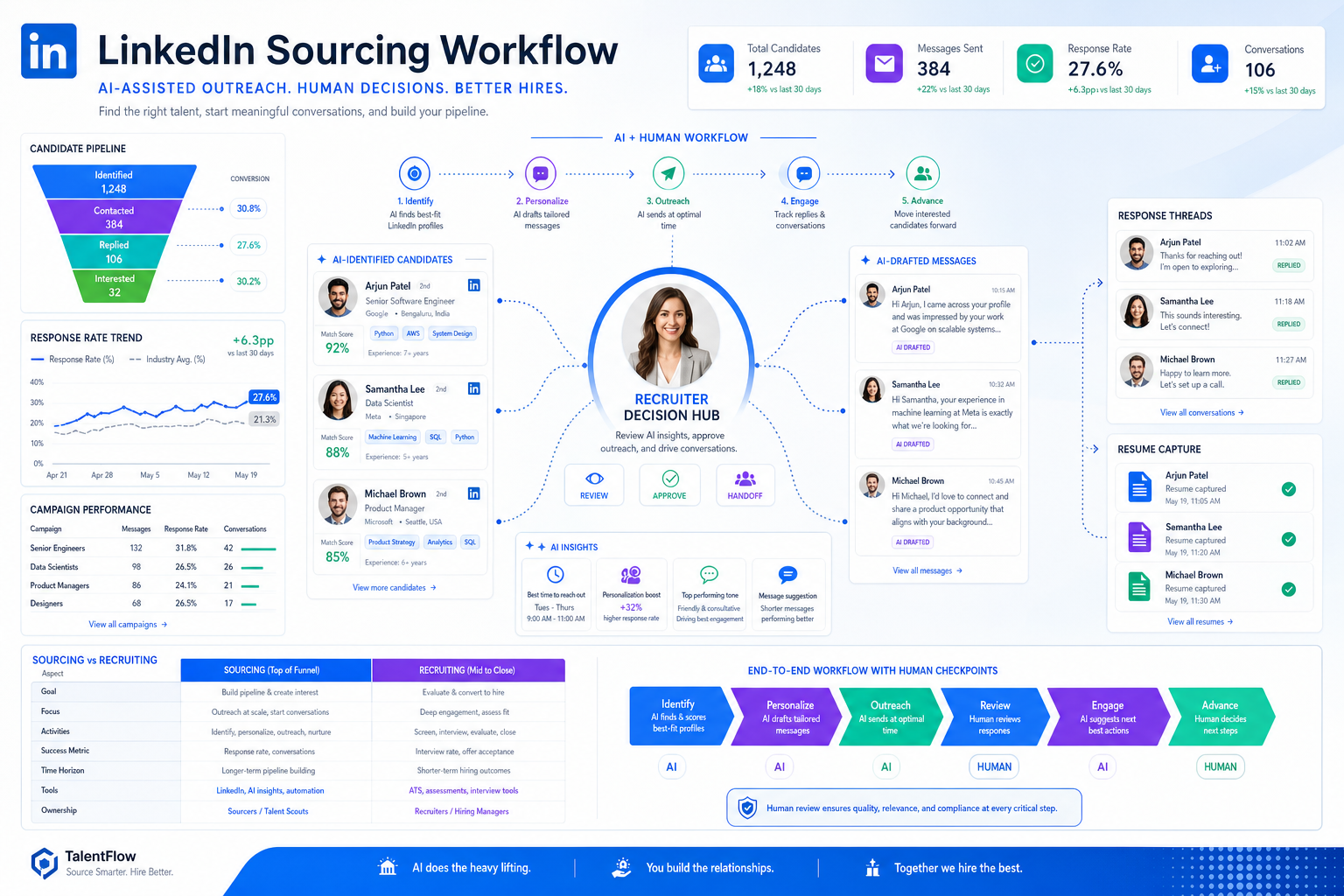
- A Practical LinkedIn Sourcing Workflow
- What the Working Notice Analogy Teaches Recruiters
- Metrics That Actually Matter
- Common Mistakes to Avoid
- FAQ
Why Judgment Still Matters in AI Sourcing
AI candidate sourcing is often described as a speed tool, but experienced recruiters know the real value is not raw speed. It is better coverage with fewer blind spots. Good sourcing has always been about finding relevant people, understanding why they may or may not move, and reaching out in a way that respects their context. AI can help with discovery and follow-up, but it cannot fully assess candidate motivation, internal politics, manager quality, or whether a career move is genuinely right for the person.
That is why the best recruiting sourcing processes still start with recruiter judgment. If the intake is weak, automation only scales confusion. If the outreach is generic, faster sending just creates faster rejection. And if the shortlist is not grounded in role reality, the recruiter downstream still has to clean up the list.
Practical takeaway: AI is strongest when it supports search breadth, message continuity, and admin-heavy follow-up while the recruiter keeps ownership of fit, risk, and next-step decisions.
What Is Sourcing in Recruitment Process?
If someone asks what is sourcing in recruitment process, the most practical answer is this: sourcing is the proactive stage of hiring where recruiters identify, research, attract, and engage people before they formally enter the assessment pipeline.
It usually includes the following steps:
- Role calibration: confirm must-haves, nice-to-haves, deal-breakers, compensation limits, and likely adjacent backgrounds.
- Search design: decide which titles, skills, industries, target companies, and locations are relevant.
- Channel strategy: choose where to look first based on role type, urgency, and market reality.
- Profile review: examine evidence of fit, scope, trajectory, and likely interest.
- Initial outreach: contact prospects with enough personalization to justify the message.
- Interest check: learn whether the candidate is open, curious, unavailable, or better kept for later.
- Recruiter handoff: move qualified and engaged people into screening, interviews, and the rest of recruiting.
This is where many teams lose efficiency. They treat sourcing as list building when it is really a judgment process. A list of names is not a pipeline. A pipeline starts when the right people engage for the right reasons.
Sourcing vs. Recruiting
One reason sourcing gets misunderstood is that teams often blur it with recruiting. They are related, but they solve different problems.
| Area | Sourcing | Recruiting |
|---|---|---|
| Main purpose | Find and engage talent | Evaluate, guide, and close talent |
| Timing | Before or at pipeline entry | After someone is in process |
| Core work | Search, research, outreach, talent mapping | Screening, coordination, interview process, offers |
| Typical audience | Passive or lightly engaged talent | Active applicants and qualified prospects |
| Success signal | Qualified interest | Interview progress and hires |
In agency settings, the distinction affects productivity and revenue. In-house, it affects hiring speed and hiring manager trust. If nobody owns sourcing properly, recruiters end up reacting to inbound activity instead of shaping the market.
Ways of Sourcing Candidates
When clients or junior recruiters ask about the best ways of sourcing candidates, I usually tell them to stop looking for one magic channel. Strong sourcing is usually a blended approach. The right mix depends on the role, urgency, and candidate market.
1. ATS and internal database rediscovery
This is still one of the most underused sourcing channels. Previous finalists, silver medalists, and old applicants often become relevant again when the role changes, timing improves, or the market shifts. AI-supported matching makes this even more useful because it can surface adjacent candidates who were buried by older keyword logic.
In practice, I check internal history before expanding outbound work. It is often the fastest path to conversations with people who already know the employer story.
2. LinkedIn sourcing and direct outreach
LinkedIn remains central in many white-collar and specialist searches because it combines role history, skill visibility, network context, and direct messaging. It is also where repetitive recruiter work can pile up fast: profile review, connection requests, follow-ups, after-hours replies, and collecting resumes from interested people.
I have used StrategyBrain AI Recruiter in LinkedIn-heavy workflows specifically to keep those early conversations moving when prospects answer late at night or from another region. My experience is that it helps most with repetitive first-touch communication, follow-up consistency, and resume collection from interested candidates. It does not remove the need for recruiter review, and that is a good thing. I still want to decide who is genuinely qualified, who is only curious, and who should never have been approached in the first place.
3. Employee referrals
Referrals work well when employees understand the target profile and trust the hiring process. They can be especially effective with passive talent, where a warm introduction carries more weight than a cold message.
4. Niche communities and specialist forums
For technical, scientific, or highly specialized functions, niche communities often provide better signal than broad professional networks. They can reveal hands-on interest, credibility, and peer reputation in ways a standard profile cannot.
5. Email sourcing
Email is still valuable, especially when you have a clear reason for the outreach. The best messages are short, specific, and based on a real signal. Generic templates remain one of the fastest ways to hurt response rates.
6. Job boards
Job boards are not only for posting roles. They also help recruiters understand market language, salary expectations, and candidate self-description, all of which improve sourcing accuracy.
7. Alumni groups, associations, and events
These channels are useful when trust and reputation matter, especially for senior, regional, and relationship-led hiring.
Where AI Helps Most in Recruiting Sourcing
AI is not equally useful across every part of sourcing. In my experience, the strongest applications are the ones that reduce repetitive effort without weakening candidate judgment.
Broader search logic
AI can spot related skills, parallel titles, and career patterns more flexibly than exact-match searching. That helps uncover candidates who would otherwise be missed.
Always-on communication
One practical advantage in LinkedIn-heavy sourcing is that candidates often respond outside business hours. A recruiter cannot realistically maintain every conversation live around the clock. An AI-supported workflow can keep that exchange moving until the recruiter is ready to review the real opportunity fit.
Multilingual outreach support
Cross-border hiring often breaks down because language slows trust and creates misunderstandings. AI-supported messaging can help reduce that friction while keeping the recruiter in control of the actual hiring decision.
Resume and contact capture
When candidates are interested, collecting resumes and contact details quickly sounds simple, but it is one of the easiest admin tasks to let slip. Support here improves workflow hygiene more than most teams expect.
For teams exploring automation, a practical example is AI Recruiter, which is built around outbound candidate communication, multilingual follow-up, and collecting key candidate information once interest is confirmed. The recruiter still owns final qualification, resume review, and interview decisions, which keeps the process aligned with real recruiting standards.
A Practical LinkedIn Sourcing Workflow
Because this topic often turns into a LinkedIn operations problem, here is the workflow I find most useful when balancing AI efficiency with recruiter control.
- Start with a scorecard. Write down non-negotiables, likely adjacent profiles, and disqualifiers before searching.
- Search internal talent first. Revisit prior applicants and dormant prospects before going fully outbound.
- Build a targeted LinkedIn search. Use title variations, skill clusters, and target-company logic.
- Prioritize manually. Review a shortlist for scope, level, and likely motivation before outreach begins.
- Use AI for repetitive first-touch work. Let the system support connection, basic role introduction, time-zone coverage, and follow-up continuity.
- Review replies personally. Once interest appears, assess real fit, ask deeper questions, and decide whether to move forward.
- Collect resumes and contact details cleanly. Keep records organized so handoff is easy.
- Refine based on outcomes. Use response quality and hiring-manager feedback to improve the next round.
That sequence matters because it prevents a common mistake: automating before you know what good looks like. In sourcing, speed only helps when direction is already right.
What the Working Notice Analogy Teaches Recruiters
The reference case behind this discussion was not about AI at all. It was about a working notice, where employees are informed that their employment will end on a stated future date and continue working in the meantime. The appeal is obvious: it can lower immediate cost for the employer and give employees time to secure another opportunity.
That framework is useful for recruiters because it highlights a familiar pattern in talent decisions:
- An option can look efficient on paper but create softer operational risks underneath.
- Both parties may gain something if timing and communication are handled well.
- Some populations carry higher risk, especially where motivation is damaged or access is sensitive.
- Backup plans matter because a process that seems practical can fail in execution.
Those same principles apply to AI candidate sourcing. If your workflow is optimized only for volume, you may save effort at first and still lose quality later. If your outreach is scaled without considering candidate motivation, your team may look efficient while hurting reply rates and employer reputation. And if you automate contact with high-sensitivity profiles without enough review, you can create unnecessary risk.
So when recruiters evaluate AI sourcing, the right question is not just, “Can this send messages faster?” The better question is whether the workflow protects quality, respects candidate context, and gives the recruiter a clear backup plan when automation is not the right move.
Metrics That Actually Matter
AI-supported sourcing should be measured by downstream quality, not by how many names enter a spreadsheet.
- Response rate: Are relevant candidates replying?
- Positive interest rate: Are they open to a real conversation?
- Qualified pipeline rate: How many interested prospects actually meet the bar?
- Resume capture rate: Are engaged candidates converting into usable next-step records?
- Recruiter handoff quality: Can the recruiting side move forward confidently?
- Time to credible shortlist: How quickly can you present a slate with real quality?
- Channel yield: Which sourcing methods produce the best balance of speed and fit?
If response is high but qualification is weak, your search may be too broad. If qualification is strong but response is poor, the issue is often outreach quality, timing, or employer positioning. Those are the kinds of distinctions recruiters need if they want AI to improve sourcing instead of just accelerating noise.
Common Mistakes to Avoid
- Confusing sourcing with recruiting: the handoff breaks when ownership is vague.
- Automating before calibrating: a weak intake makes every later step worse.
- Over-trusting exact titles: adjacent talent is often where the best sourcing wins come from.
- Ignoring candidate motivation: relevance on paper is not the same as move likelihood.
- Sending generic outreach at scale: automation can multiply poor messaging quickly.
- Skipping internal rediscovery: many teams underuse the talent they already know.
- Using AI without a backup plan: just like a working notice, a process can look practical until execution problems show up.
FAQ
What is sourcing in recruitment process?
Sourcing is the proactive hiring stage where recruiters identify, research, and engage potential candidates before they formally enter interviews or broader assessment. It is the top-of-funnel work that creates qualified pipeline.
How is sourcing different from recruiting?
Sourcing focuses on finding and attracting relevant talent. Recruiting usually begins once a candidate is engaged and moves through screening, interviews, coordination, and offer stages.
What are the best ways of sourcing candidates?
The best ways of sourcing candidates usually include internal ATS rediscovery, LinkedIn outreach, referrals, niche communities, email, job boards, and professional associations. The strongest teams combine channels instead of relying on one.
How does AI improve recruiting sourcing?
AI improves recruiting sourcing by expanding search breadth, supporting always-on communication, helping with multilingual outreach, and capturing resumes or contact details from interested candidates. Human review is still essential for actual qualification and hiring decisions.
Should recruiters automate candidate outreach?
Some outreach tasks can be supported by automation, especially repetitive first-touch messaging and follow-up. But recruiters should still control targeting, personalization standards, resume review, and next-step decisions.
When is AI candidate sourcing most useful?
It is most useful when roles require broad market coverage, passive outreach, cross-border communication, or high message volume that would otherwise consume too much recruiter time.
Conclusion
AI candidate sourcing works best when recruiters treat it as a structured support layer inside real recruiting sourcing, not as a shortcut around judgment. The working notice example is a useful reminder that efficient-looking decisions still need human risk assessment, role context, and a backup plan. If you started with the question what is sourcing in recruitment process, think of sourcing as the proactive engine that creates qualified candidate momentum. And if you are evaluating the best ways of sourcing candidates, the winning approach is usually a balanced one: internal rediscovery, smart outbound search, disciplined outreach, and AI support where repetition is high but recruiter judgment still matters most.