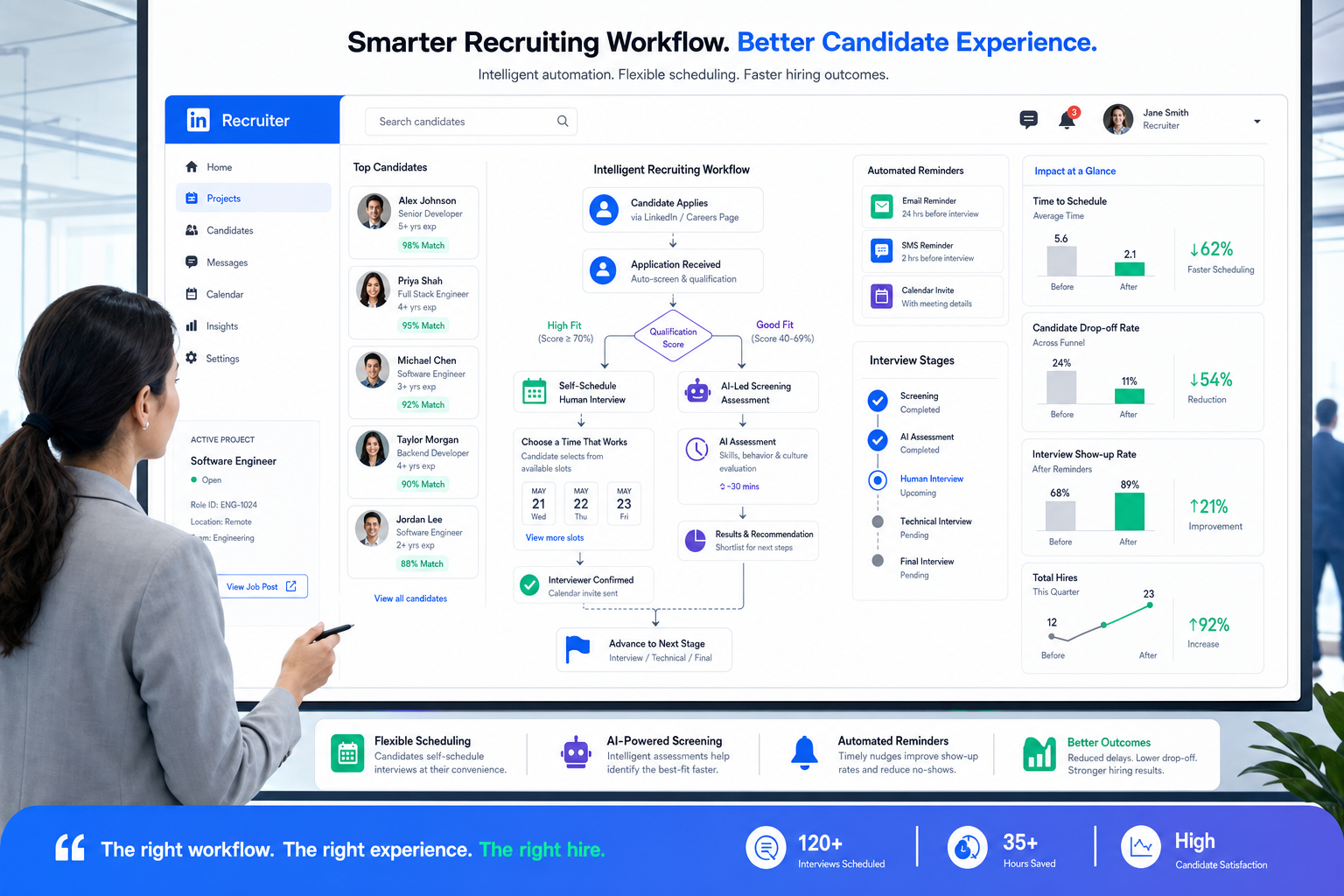
This article helps headhunters judge whether an ai hiring platform can cut scheduling delays, admin drag, and candidate drop-off.
That sounds simple until a midsize agency or in-house recruiting team has to balance candidate expectations, hiring manager availability, and the practical limits of a lean operation. The damage is usually broader than a slow inbox. Recruiters lose productive sourcing time, hiring managers drift out of rhythm, candidates question how organized the employer really is, and smaller firms feel the gap between their service promise and their actual coordination capacity.
In my own workflow, tools such as StrategyBrain AI Recruiter have been most useful when they remove the repetitive communication around outreach, candidate interest checks, and after-hours follow-up before the interview stage begins. That matters here because automated scheduling only works well when the pipeline entering it is already organized. The AI can keep candidate conversations moving in multiple languages and collect resumes and contact details, but the recruiter still has to review the profile, decide who should advance, and choose the right interview path.
A useful way to think about this comes from how midsize employers handle employee appreciation when they cannot match enterprise-scale perks. They do not usually win by spending like a giant. They win by structuring decisions better: setting a budget, letting a committee choose what matters most, and making sure the experience fits the people involved rather than forcing one default format on everyone.
The same pattern shows up in interview scheduling. One candidate may want a self-serve booking link for a live manager screen, another may need after-hours flexibility, and another stage may not need a scheduled human call at all if an ai interview application or live interview ai step can handle early screening. Once you see scheduling as a decision framework instead of a calendar utility, it becomes easier to evaluate what an ai hiring platform should actually do.
That is the lens for this article: not just how to automate interview bookings, but how to design scheduling choices the way smart midsize operators design any limited resource, with the right ownership model, the right candidate experience, and the right level of automation for each stage.
- How automated interview scheduling reduces recruiter admin without weakening process control
- Why midsize hiring teams should treat scheduling like an operating decision, not a plug-in
- When to use self-scheduled human interviews versus AI-led interview flows
- What to check in calendar, reminder, ATS, and workflow design before buying software
Table of Contents
- What Automated Interview Scheduling Means in an AI Hiring Platform
- What Midsize Teams Can Learn From Structured Choice
- Why Interview Scheduling Breaks Hiring Momentum
- How Automated Interview Scheduling Works
- Self-Scheduling vs AI-Led Interview Models
- What to Look for in an AI Hiring Platform
- Implementation Tips for Recruiters and Hiring Managers
- Common Mistakes to Avoid
- FAQ
What Automated Interview Scheduling Means in an AI Hiring Platform
Automated interview scheduling is the use of software to coordinate interview times, participant availability, reminders, and updates without depending on repeated manual email exchanges.
Inside a modern ai hiring platform, scheduling should not sit off to the side as a generic calendar widget. It needs to connect directly to stage progression, interviewer assignment, scorecards, reminders, and the candidate record. Otherwise, recruiters save a few clicks on booking but still lose time repairing the workflow around it.
In practice, teams are usually trying to solve three operational problems at once:
- Coordination: reducing back-and-forth across calendars and time zones
- Candidate experience: letting people book or complete next steps in a way that feels convenient
- Process visibility: ensuring stage movement, ownership, and feedback stay visible
This is also where search intent can get muddy. Some buyers searching ai interview application want a faster route from application to screening. Others are really looking for AI to participate in or even conduct the interview itself. Those are related needs, but they are not the same buying decision.
Key insight: Scheduling improves hiring speed most when it is designed as a governed workflow, not as a standalone booking page.
What Midsize Teams Can Learn From Structured Choice
The reference point from midsize business management is useful here because it reflects a real operating constraint recruiters know well: you rarely have infinite interviewer time, unlimited coordinator support, or one candidate journey that fits every role.
In the employee-appreciation example, management sets boundaries, then gives a smaller group the authority to decide what creates the best experience within those limits. The lesson for recruiting is not about holiday perks. It is about governance. Good hiring operations define the rules first, then automate execution inside those rules.
That same logic applies to interview scheduling in at least three ways:
- Set the budget equivalent: define interview capacity, time windows, and stage rules before automation goes live.
- Let the right people shape the experience: recruiters, coordinators, and hiring managers should decide where self-scheduling helps and where it creates risk.
- Avoid one default format: not every hiring stage should lead to a live calendar booking.
Another useful lesson from the reference material is that a celebration does not always have to be a party. In hiring terms, an interview step does not always have to be a live scheduled meeting either. For some workflows, a human conversation is the right next step. For others, an asynchronous screen or live interview ai option may fit better.
And just as some employers create paid volunteering options because employees value meaning and flexibility, recruiting teams increasingly need candidate-friendly paths that respect work schedules, family obligations, and international time differences. Automated scheduling is at its best when it reflects those realities rather than forcing everyone through one rigid process.
Why Interview Scheduling Breaks Hiring Momentum
Experienced recruiters know delays often start in the quiet middle of the funnel. Sourcing may be healthy and applicants may be active, but once a candidate is ready to speak with a hiring manager, the process starts leaking time through coordination.
For recruiters
Manual scheduling consumes hours that should go toward screening, stakeholder management, and closing. In one of my own LinkedIn-heavy workflows, I found that using StrategyBrain AI Recruiter to handle initial outreach follow-up and collect candidate details made the scheduling stage cleaner because fewer half-qualified conversations reached the booking step. That did not replace recruiter judgment, but it reduced noise before calendars were involved.
For hiring managers
Managers usually feel scheduling pain as disruption. Interviews appear without enough prep time, panels get assembled inconsistently, and scorecards arrive too late to support structured evaluation.
For candidates
Candidates mostly experience the problem as friction. If they have to wait for several rounds of proposed times, chase updates, or negotiate simple reschedules, they read that as a signal about the employer's process quality.
For midsize firms and agencies
Smaller organizations face a particular challenge. They often want to provide a high-touch experience but do not have the coordinator layer or administrative depth of a large enterprise. That is why the operating model matters so much. A midsize team cannot out-email the problem forever.
| Hiring challenge | Manual approach | Better automated approach |
|---|---|---|
| Finding available times | Recruiter checks calendars and proposes slots | Calendar sync with governed availability rules |
| Candidate booking | Email back-and-forth | Self-scheduling link with limits |
| Rescheduling | Recruiter restarts the chain | Controlled self-service changes |
| Panel alignment | Multiple manual confirmations | Shared availability logic and role-based setup |
| Stage tracking | Updates entered later | Booking activity logged in workflow automatically |
How Automated Interview Scheduling Works
Most useful systems follow a sequence that mirrors actual recruiting operations rather than generic appointment software.
1. Trigger the right interview path
The candidate moves into an interview stage based on recruiter action or a workflow rule. In a capable ai hiring platform, this step should connect to role-specific interview formats, interviewer pools, and candidate communication templates.
2. Present valid booking options
The platform checks interviewer availability and offers only the slots that fit the rules. Candidate self-scheduling is valuable here because it removes avoidable coordination work while still respecting notice periods, duration rules, and timezone logic.
3. Confirm and document the event
Once the interview is booked, the system should issue reminders, update the candidate record, and link the meeting to the relevant workflow stage. Strong setups also connect scorecards so feedback is easier to collect while the conversation is still fresh.
If your process starts earlier on LinkedIn or another outbound channel, this sequence works better when sourcing communication is already organized. That is where AI Recruiter can support the front end of the funnel by handling repetitive outreach conversations, gathering resumes, and keeping after-hours responses moving until a recruiter decides who should enter the interview pipeline.
Self-Scheduling vs AI-Led Interview Models
One of the most common mistakes in this category is treating all interview automation as the same thing.
Model 1: Self-scheduling for human interviews
This is still the best fit when a recruiter, hiring manager, or panel needs to speak with the candidate directly. The automation removes coordination work, but the interview itself remains human-led.
This model is strongest when:
- The interview is evaluative and relationship-driven
- Panel coordination matters
- You want consistency without removing recruiter control
- The next step depends on structured human assessment
Model 2: AI-led or asynchronous interview flow
Here, the candidate may not need to book a live slot at all. Depending on the role and stage, the process may use an ai interview application, asynchronous video or voice prompts, or a live interview ai interaction for real-time screening.
This approach is usually solving a different problem: not easier scheduling, but less scheduling.
| Use case | Best fit | Why |
|---|---|---|
| Recruiter screen for nuanced roles | Self-scheduled human interview | Judgment and relationship building matter |
| Hiring manager interview | Self-scheduled human interview | Role fit needs direct discussion |
| Late-stage panel | Self-scheduled human interview | Multiple stakeholders must align |
| High-volume early screening | AI interview application | Removes delay before human review |
| Global after-hours access | Live interview ai or asynchronous flow | Improves flexibility across time zones |
The practical takeaway is simple: if your bottleneck is human calendar coordination, invest in better scheduling. If your bottleneck is the volume of early-stage screening, evaluate AI-led interview options separately.
What to Look for in an AI Hiring Platform
When you evaluate software, the question is not just whether the candidate can book time. The real question is whether the platform supports the operating model your team needs.
1. Rule-based candidate self-scheduling
Look for controls around booking windows, notice periods, interview length, reschedule limits, and interviewer assignment. Flexibility for candidates should not mean chaos for recruiters.
2. Calendar sync that handles real recruiting complexity
Basic syncing is table stakes. More important is support for panel interviews, role-based workflows, and exception handling that does not force the recruiter back into manual coordination.
3. Clear distinction between live interviews and AI interview steps
A strong platform should help you decide when to use a scheduled human conversation and when an ai interview application or live interview ai step is more efficient.
4. Workflow continuity with ATS records
Scheduling data should update the candidate record automatically. Bookings, cancellations, reminders, and stage changes should not need duplicate entry.
5. Communication support before scheduling begins
Many teams overlook this, but the quality of the pre-interview pipeline affects scheduling performance. If your recruiters are sourcing actively on LinkedIn, a support layer such as StrategyBrain AI Recruiter can help keep candidate replies moving, answer common questions, and collect resumes before the recruiter makes the final advancement decision.
6. Candidate experience across different preferences
Remember the midsize-business lesson from the opening: one format does not suit everyone. Good systems support different candidate needs without fragmenting internal control.
Practical takeaway: The best platform is not the one with the flashiest booking page. It is the one that lets a lean recruiting team offer the right next step to the right candidate without losing process discipline.
Implementation Tips for Recruiters and Hiring Managers
Even strong software will disappoint if the workflow behind it is vague. These are the principles I would set first.
- Define interview types before automation. Separate recruiter screens, manager interviews, panel rounds, and AI-led steps so each has the right rules.
- Assign ownership clearly. Someone should decide which stages are candidate self-serve, which need coordinator control, and which can be replaced by AI-led screening.
- Standardize interviewer availability. Automation depends on reliable inputs. If calendars are inaccurate, the booking tool becomes a cleanup tool.
- Keep pre-interview communication organized. If your team sources heavily through LinkedIn, using AI Recruiter for repetitive outreach and interest qualification can reduce friction before the scheduling stage.
- Connect scorecards to meetings. Scheduling is only one part of interview operations. Feedback timing is where many teams still lose momentum.
- Review candidate-facing messaging. Confirmations, reminders, and reschedule instructions should feel clear and respectful, not robotic or confusing.
My own experience is that automation works best when recruiters stay close to decision points and let the software handle repetition around them. That is true for outbound communication, for scheduling, and for reminder flows. The AI should carry the admin load, while the recruiter keeps the judgment.
Common Mistakes to Avoid
Treating all automation as one category
Scheduling automation, asynchronous screening, and real-time AI interviewing solve different problems. Evaluate them separately.
Automating an undefined process
If your stages, owners, or feedback expectations are inconsistent, software will only make that inconsistency move faster.
Ignoring the needs of midsize operations
Smaller teams should not copy enterprise process for its own sake. They need workflow design that fits lean staffing and still protects candidate experience.
Overlooking upstream communication
Poor sourcing follow-up creates weak interview pipelines. If candidate conversations are disorganized before the interview invite, scheduling will feel harder than it needs to.
Using AI-led interviews where human trust matters most
For some roles and stages, real conversation is still the signal candidates and hiring teams need. Not every step should be reduced to zero scheduling.
FAQ
How does automated interview scheduling work inside an ai hiring platform?
It uses workflow triggers, calendar integrations, booking rules, and automated reminders to coordinate interview times without manual email chains. In a good ai hiring platform, those actions also update the candidate record and connect to scorecards or stage progression.
What is the difference between self-scheduling and an ai interview application?
Self-scheduling is usually for a human-led interview where the candidate books a live time slot. An ai interview application may let the candidate complete a screening step without arranging a live meeting first.
When should recruiters use live interview ai?
Live interview ai makes the most sense when a team wants real-time interaction without relying fully on human interviewer availability, usually in high-volume or globally distributed screening workflows.
Can automated scheduling improve candidate experience for midsize firms?
Yes, especially when the team offers clear self-serve booking, reliable reminders, and sensible rescheduling options. Midsize firms often gain the most when they use structured process to deliver a more consistent experience without adding administrative headcount.
Where does StrategyBrain AI Recruiter fit if the main topic is scheduling?
It fits earlier in the funnel. It can support LinkedIn outreach, candidate communication, multilingual follow-up, and resume collection before the recruiter decides who should move into the interview stage. That makes the scheduling workflow cleaner, but the recruiter still owns final review and progression decisions.
Conclusion
Automated interview scheduling is most valuable when you treat it like an operating choice, not a convenience feature. That means defining which interview experiences deserve live human coordination, which can be self-booked, and which may be better handled through an ai interview application or live interview ai workflow.
The midsize-business lesson behind this article is straightforward: when resources are limited, thoughtful structure matters more than brute force. A modern ai hiring platform should help recruiters create that structure, reduce avoidable admin, and preserve judgment where it matters.
If your current process still depends on inbox choreography, start by mapping where the delay truly begins. It may be in scheduling itself, or it may start earlier in sourcing and candidate communication. In many teams, the best results come from combining disciplined interview scheduling with upstream support such as StrategyBrain AI Recruiter so the right candidates reach the calendar in the first place.