See where AI recruiting companies really help: recruiters can use this article to compare workflow fit, avoid handoff gaps, and prevent candidate drop-off.
In practice, those gaps show up long before a shortlist is weak. A recruiter loses momentum because candidate replies arrive after hours, hiring managers are not aligned on first-week expectations, paperwork stalls, or a remote starter reaches day one without the right introductions, tools, or meeting cadence. For a solo recruiter, that means extra admin and slower placements. For a small search firm, it can mean avoidable drop-off, delayed starts, and a client who starts questioning process discipline rather than market difficulty.
One place I have seen AI-supported workflow help is AI Recruiter from StrategyBrain. I would not use it as a substitute for recruiter judgment, resume review, or final qualification, but it can take pressure off repetitive outreach, after-hours candidate communication, and resume collection on LinkedIn. In searches where timing matters, that kind of support helps keep conversations moving while the recruiter still owns fit assessment, stakeholder calibration, and the next decision.
Think about a remote employee who is about to join a team. Two weeks before the start date, people need to introduce themselves, the new hire needs to know what to expect, hardware has to arrive configured, access has to work, forms need to be completed, and someone has to explain how the team actually communicates when nobody is in the same office. If that preparation is uneven, the problem is not just a messy first day. The employee starts disconnected, managers lose time answering preventable questions, and the team spends the first week recovering from avoidable process misses.
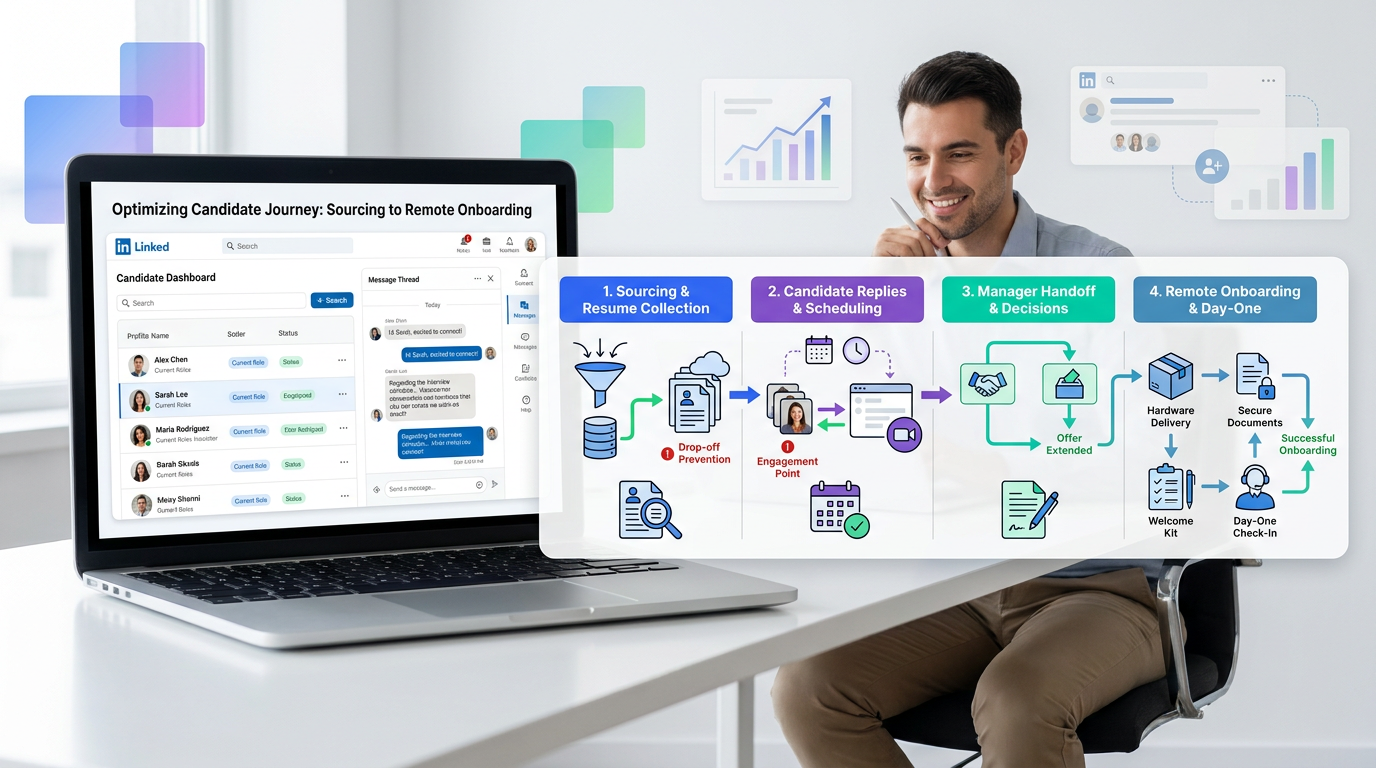
The recruiting side of that same scenario usually breaks earlier, during sourcing and pre-start coordination. A recruiter is chasing LinkedIn replies, collecting resumes, confirming interest, passing updates to the hiring manager, and trying to maintain a consistent handoff into onboarding. That is why evaluating AI recruiting companies is not only about matching algorithms. It is also about whether the workflow supports a unified start, clear expectations, open communication, and reliable follow-through for recruiters, an artificial intelligence recruitment agency, or specialist ml recruiters hiring remote technical talent.
Table of Contents
- What Buyers Are Really Comparing
- The First Problem Is Not Always Sourcing
- AI Recruiting Software vs a Regular ATS
- AI Recruiting Companies vs an Artificial Intelligence Recruitment Agency
- Features That Matter in Real Recruiting Work
- Why Remote Hiring Exposes Workflow Weaknesses
- How ML Recruiters Use AI Recruiting Software
- How to Choose the Right System
- Common Mistakes Buyers Make
- FAQ
What Buyers Are Really Comparing
When employers search for AI recruiting companies, they are often mixing together three different buying decisions:
- software that improves sourcing, screening, and coordination
- an AI-enhanced ATS that becomes the operating system for hiring
- a service partner that adds recruiter capacity
Those are related categories, but they solve different problems. A lot of disappointment in AI recruiting software starts when teams buy for the wrong bottleneck. If your hiring process is losing candidates between outreach and handoff, better matching alone will not solve it. If your issue is onboarding readiness for remote hires, a fancy sourcing layer will not fix missing equipment, weak manager communication, or unclear first-week goals.
That is why experienced recruiters usually start with process mapping instead of feature comparison. We ask where the handoff breaks: at first reply, at shortlist review, at scheduling, at offer close, or between accepted offer and start date. The right software choice should make those failure points less frequent and easier to manage.
The First Problem Is Not Always Sourcing
Recruiting technology is usually sold on the promise of finding candidates faster. Sometimes that is the right entry point. But many teams are not losing searches because they cannot find enough profiles. They are losing them because communication is inconsistent, remote-start logistics are improvised, or hiring managers and recruiters are not working from one shared process.
The remote onboarding lens is useful here because it highlights what strong recruiting operations already know. Good hiring is not only about generating interest. It is about preparing a person to enter a team successfully. That means:
- early introductions and expectation-setting
- a unified day-one process
- hardware and software readiness
- clear documentation and paperwork follow-up
- a buddy or point of contact
- regular check-ins after the start date
If your recruiting stack cannot support those handoffs, then the problem is bigger than candidate generation. It is an operating model issue.
Key insight: The best AI recruiting software often earns its value by removing coordination risk, not by pretending to replace recruiter judgment.
AI Recruiting Software vs a Regular ATS
Many teams still ask whether they need a new ATS or simply better automation around the one they already have. That is the right question, because a regular ATS and an AI-enabled system serve different purposes.
| Category | Regular ATS | AI-Enabled Recruiting System |
|---|---|---|
| Primary role | Stores candidate records, stages, and approvals | Stores records and adds search, summaries, communication support, and automation |
| Search | Keyword and filter based | Semantic matching and contextual search |
| Communication | Often manual or lightly templated | Drafting, follow-up support, and message continuity |
| Handoff quality | Depends heavily on recruiter discipline | Can standardize notes, reminders, and next-step visibility |
| Remote readiness | Tracks stages but rarely fixes cross-functional gaps | Can help coordinate documents, status, scheduling, and pre-start communication |
| Decision control | Human-led | Still should remain human-led |
The distinction matters because an ATS is usually the system of record, while AI recruiting software is the layer that helps people act on that record faster and more consistently. If a recruiter needs to rediscover talent, keep candidate communication moving, summarize conversations, and hand off cleaner information to the hiring manager, those are the areas where AI can be useful.
What it should not do is quietly become a black box for rejection decisions. Final assessment still belongs to the recruiter and hiring team.
AI Recruiting Companies vs an Artificial Intelligence Recruitment Agency
Search intent around AI recruiting companies often overlaps with interest in an artificial intelligence recruitment agency, but those are not the same purchase.
Software gives your internal team leverage. An artificial intelligence recruitment agency gives you delivery capacity, external market reach, and recruiter execution. Some businesses need process infrastructure; others need extra hands. Some need both.
Software is usually the better fit when
- your team can already run intake, screening, and stakeholder communication
- you want repeatable process improvement across many roles
- you need better remote coordination, faster follow-up, and cleaner candidate records
- you want your recruiters to spend less time on repetitive admin
An artificial intelligence recruitment agency may be the better fit when
- you lack in-house recruiter bandwidth
- you are hiring for niche or senior roles with limited internal expertise
- you need short-term search delivery rather than long-term process change
- your hiring managers need outside market mapping and outreach support
In my own work, the hybrid model is often the most practical. Use software to strengthen process control and communication rhythm, then bring in outside search capacity for narrow or urgent roles. That keeps the core workflow consistent while preserving flexibility where the market is hardest.
Features That Matter in Real Recruiting Work
Once you look past marketing language, the most useful features are usually the ones that protect continuity from first message through start date.
1. Candidate matching that handles adjacent skills
Exact keywords are rarely enough, especially for technical, cross-functional, or emerging roles. Contextual search is valuable when candidates do the right work under different titles.
2. Communication support that keeps momentum
Recruiters lose good candidates when replies sit too long or handoffs become patchy across time zones. This is one reason I tested AI Recruiter in LinkedIn-heavy searches. My experience was that always-on message handling and resume capture were most useful when candidates responded outside working hours. It did not remove the need for recruiter oversight, but it reduced the stop-start effect that often slows a search.
3. Resume and contact collection without manual chase
If a candidate is interested, the workflow should make the next step easy. Collecting resumes and contact details cleanly matters because delays here create avoidable drop-off before real evaluation even starts.
4. Summaries that improve recruiter-to-manager handoff
Hiring managers do better when the recruiter passes structured context, not just a forwarded profile. Notes, summaries, and status visibility are especially useful when the role will be remote and the manager needs to define success early.
5. Workflow visibility around start readiness
The remote onboarding reference matters here. Good systems should help teams confirm who has completed paperwork, who has sent welcome communication, whether equipment and software are ready, and whether first-week check-ins are scheduled. That is not just HR administration. It affects candidate confidence and early retention.
6. Human-in-the-loop controls
Any system worth buying should let recruiters inspect outputs, override rankings, edit communications, and document final decisions. AI assistance is useful; unreviewable automation is not.
Why Remote Hiring Exposes Workflow Weaknesses
Remote hiring forces discipline because the new employee cannot pick up information casually. They cannot overhear team norms, walk over for help, or discover missing tools by being physically present. That means the recruiting and onboarding workflow has to carry more of the load.
Borrowing from remote onboarding best practice, there are several process checkpoints that recruiting software should help support:
- Pre-start communication: introductions, welcome notes, and practical expectations should be clear before day one.
- Unified process: remote hires should not feel they received a lower-quality start because the team improvised.
- Hardware and access readiness: equipment, permissions, and software setup must be confirmed before the employee begins.
- Paperwork completion: forms should be tracked and easy to complete electronically.
- Buddy and manager cadence: the new hire needs named support and regular one-on-ones.
- Open communication channels: documentation, team communication norms, and feedback rhythm should be visible early.
These are onboarding principles, but they also become selection criteria for AI recruiting software. If the tool improves outreach but contributes nothing to handoff quality, you are only solving the first third of the hiring journey.
How ML Recruiters Use AI Recruiting Software
The keyword ml recruiters usually points to specialist technical recruiting, where skill adjacency matters and exact-title search performs poorly. That is one of the clearer use cases for AI-supported recruiting workflows.
Good ml recruiters are not just matching buzzwords. They are interpreting capability: model deployment, data pipelines, infrastructure maturity, experimentation depth, production tradeoffs, and technical leadership. AI can help surface candidates with related context, but domain-aware recruiter judgment is still what determines whether a profile is genuinely relevant.
This is also where remote hiring pressure can intensify. Technical hires may be distributed across regions, respond after hours, and ask detailed questions before they share a resume. In those cases, communication support becomes just as important as matching logic. I have found that LinkedIn automation is most helpful when it keeps those initial exchanges alive while I focus on qualification. With StrategyBrain AI Recruiter, the value was not that it decided who was technically strong. The value was that it handled repetitive messaging, gathered candidate details, and let me spend my time on actual recruiter work.
For technical hiring managers, the practical lesson is to define the role by capabilities and business context rather than title alone. That gives both the recruiter and the software a better chance of finding the right people.
How to Choose the Right System
The best recruiting software is the one that improves the part of your hiring process that currently breaks under real volume or complexity. Use a selection process like this:
- Identify the failure point. Is the issue sourcing, reply speed, resume collection, manager handoff, or pre-start coordination?
- Map the remote workflow. For roles with distributed teams, test whether the tool supports communication continuity before and after offer acceptance.
- Review human controls. Recruiters should remain responsible for shortlist judgment and final progression decisions.
- Check ATS fit. If the software does not improve your existing recordkeeping and stage management, adoption will suffer.
- Test on one role family. Start with a pilot in technical, remote, or high-volume hiring where the workflow problem is easy to observe.
- Evaluate based on team behavior. Better tools should reduce chasing, improve handoff quality, and make manager expectations clearer.
That last point matters. The right buying decision should show up in the way recruiters and hiring managers work, not just in a demo environment.
Common Mistakes Buyers Make
Buying for novelty instead of workflow pain
If the team cannot name the process failure they are trying to fix, the tool often ends up as shelfware.
Confusing software with recruiter capacity
Many buyers compare AI recruiting companies with an artificial intelligence recruitment agency as though both do the same job. They do not.
Ignoring pre-start handoff
Remote hiring often fails because offer acceptance is treated as the finish line. In reality, the transition into day one is where candidate confidence is either reinforced or weakened.
Automating messages without protecting tone
Communication support should reduce lag, not make candidate experience feel robotic or careless.
Assuming technical searches are just broader keyword problems
Specialist hiring, especially the work done by ml recruiters, needs stronger intake, better capability mapping, and more recruiter interpretation than generalist workflows.
FAQ
What are AI recruiting companies?
They are vendors offering recruiting technology that uses AI for sourcing, search, communication, screening support, summaries, or workflow automation. Some focus on ATS enhancement, while others focus on outreach or specialist workflows.
How is AI recruiting software different from a regular ATS?
A regular ATS stores the hiring record. AI recruiting software adds intelligence and automation around that record, such as matching, communication support, summaries, and workflow visibility.
When should a company use an artificial intelligence recruitment agency instead of software?
Use an artificial intelligence recruitment agency when you need outside delivery capacity or specialist search expertise. Use software when your main goal is improving your own internal process at scale.
Can AI recruiting software help with remote hiring?
Yes, especially when the main issues are communication delay, handoff consistency, document collection, and workflow visibility before the start date. It helps most when paired with clear recruiter and manager ownership.
How do ml recruiters benefit from AI tools?
Ml recruiters can use AI tools for semantic search, candidate rediscovery, outreach continuity, and faster summaries. The best results come when the software supports specialist judgment rather than trying to replace it.
Will AI replace recruiters?
No. It can reduce repetitive work, but recruiters still own intake quality, evaluation, stakeholder alignment, and the relationship work that closes strong hires.
Conclusion
The real test for AI recruiting companies is not whether they promise smarter hiring. It is whether they help recruiters prevent the small execution failures that damage candidate experience, slow decisions, and weaken remote starts. That is why the best systems do more than search. They support follow-up, handoff, visibility, and consistent process.
If you are evaluating software now, start where the workflow breaks first. For some teams that will be sourcing. For others it will be communication rhythm, manager handoff, or remote-start readiness. Make that distinction early, and you will be far more likely to choose software that actually helps recruiters do better work.