This article helps recruiting leaders judge artificial intelligence for recruiting before unclear roles create faster hiring mistakes.
That matters because many hiring problems start earlier than most teams admit. A search can look active on paper while the actual role remains blurry: success measures are vague, authority is unclear, reporting lines are shifting, and the first 90 days have never been translated into something a recruiter can test in market. The result is familiar to agency owners, solo recruiters, and in-house talent teams alike: slower shortlists, candidate drop-off, hiring manager friction, and avoidable rework after interviews begin.
In that situation, I have found that structured automation helps most when it supports intake discipline and candidate communication rather than pretending to replace recruiter judgment. Tools such as StrategyBrain AI Recruiter can keep outreach moving, respond to candidate questions around the clock, and collect resumes and contact details from interested prospects, which is especially useful when a role needs repeated market conversations before the brief is truly calibrated. The recruiter still has to decide whether the resume matches the mandate, whether the role itself is well designed, and what to do next.
The issue shows up clearly in executive recruiting. A leadership search opens, the written description looks polished, and the market outreach begins. Then the intake calls go deeper. The hiring lead cannot fully explain what the new executive should accomplish by 3, 6, and 12 months, peers describe overlapping responsibilities, and nobody agrees on how much decision-making authority comes with the title. The map exists, but the terrain is still unsettled.
At that point, the recruiter is not just filling a requisition. They are clarifying goals, testing whether the workload is realistic, checking who this person will report to, and finding out what support actually exists after day one. That is exactly where ai in recruitment process conversations become practical. Before comparing features, teams need to ask whether their ai recruiting software can help surface role ambiguity, organize stakeholder input, and support more consistent market feedback inside ai in hr recruitment workflows.
Table of Contents
- Why Role Design Comes Before Automation
- What AI Recruiting Software Actually Does
- How AI Fits Into the Recruitment Process
- Using AI to Improve Intake and Role Clarity
- Where AI Helps HR Recruitment Most
- AI Recruiting Software vs ATS
- Benefits of AI Recruiting Software
- Risks, Bias, and Compliance
- How to Choose the Best Tool
- Implementation Best Practices
- Common Mistakes to Avoid
- FAQ
Why Role Design Comes Before Automation
One of the most useful lessons from retained search work is that a strong hire depends on more than a job description. A role can be documented accurately and still fail in market if the underlying design is weak. Recruiters see this when responsibilities sound impressive but success measures are undefined, when accountability is high but authority is low, or when a leadership role is expected to fix structural problems without clear support.
That distinction matters when evaluating artificial intelligence for recruiting. If the role itself is misaligned, software may help you move faster, but it will not solve the core problem. In some cases it only helps teams scale confusion.
A better starting point is to treat the search brief as a working model that needs validation. Before the funnel grows, recruiters should pressure-test:
- What outcomes matter in the first 90 days
- How success will be measured in 3, 6, and 12 months
- Where the role has real decision authority
- Who the person reports to and who depends on them
- What resources, team support, and systems are already in place
- Which cultural or political dynamics may affect execution
When those questions are answered early, AI becomes more useful. It can organize the work, speed candidate engagement, and preserve feedback patterns that help refine the search.
Key insight: The best use of AI in hiring is not accelerating a weak brief. It is giving a well-scoped search better structure, faster communication, and clearer feedback loops.
What AI Recruiting Software Actually Does
AI recruiting software applies automation, language analysis, and pattern recognition to recruiting work such as sourcing, messaging, screening support, interview coordination, and reporting. In practical terms, it helps recruiters reduce repetitive effort and process information more consistently.
In my experience, the most credible version of artificial intelligence for recruiting is decision support. It can surface likely matches, keep candidate communication moving, summarize recurring patterns, and reduce admin load. It should not be treated as an autonomous hiring authority.
That is especially true in senior hiring, where candidates are evaluating the opportunity as much as the company is evaluating them. If the role is still being defined through market conversations, the software should help capture and organize those conversations, not force a false sense of certainty.
How AI Fits Into the Recruitment Process
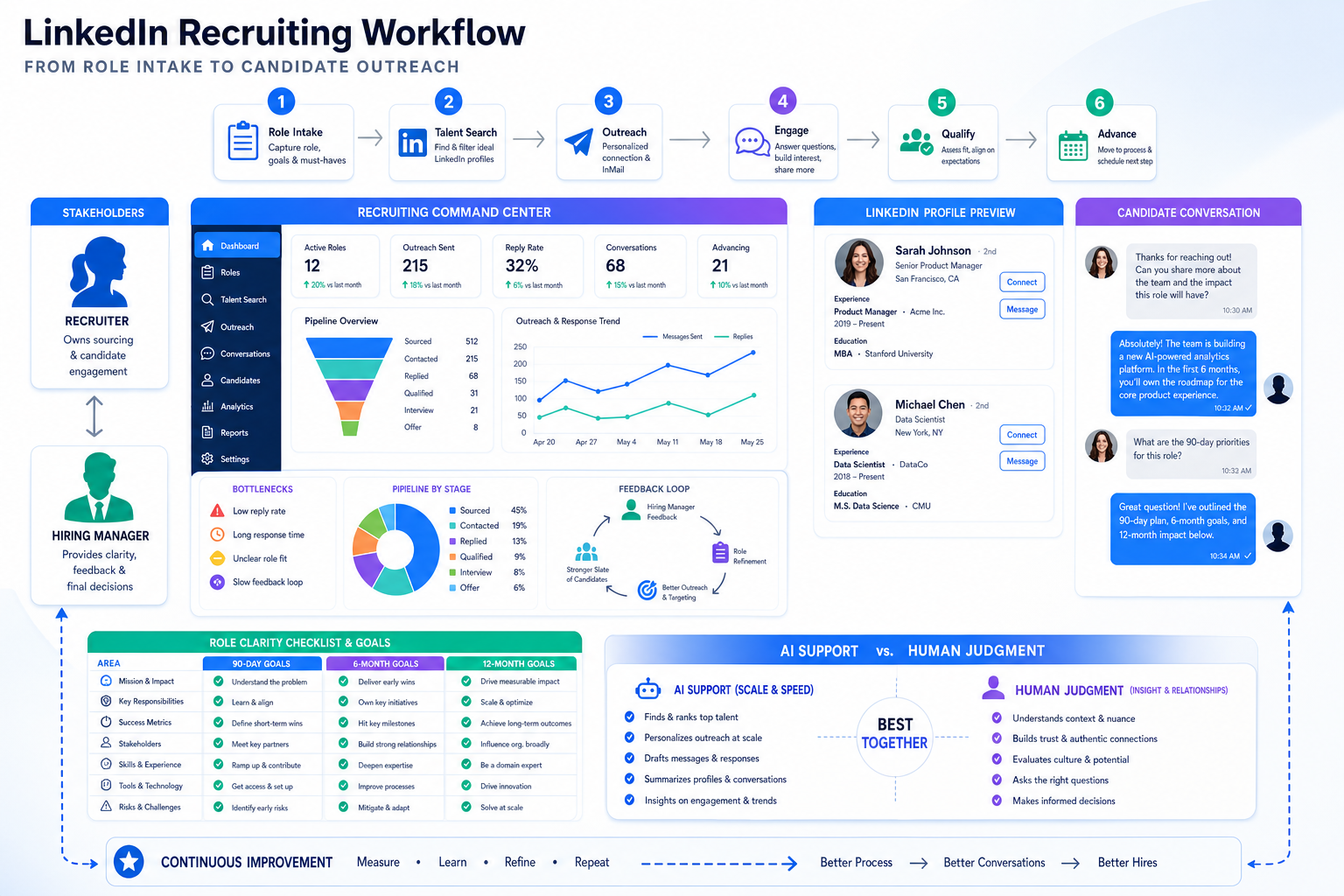
When buyers search for ai in recruitment process, they usually want to know where the tool fits from intake to offer, not just what the vendor says on a feature page. A practical review maps AI to each stage of the workflow.
1. Intake and search calibration
Before sourcing begins, AI can help recruiters document intake notes, organize stakeholder feedback, and standardize the brief. This is where the role-design lesson matters most. If one stakeholder expects transformation, another expects stability, and a third wants a team builder, that gap needs to be visible early.
I have used AI Recruiter in searches where the market had to teach the client as much as the client brief taught the market. The practical benefit was not magic matching. It was steady candidate engagement, quick collection of resumes, and fewer lost conversations while I was refining the search narrative with the hiring team.
2. Sourcing and talent discovery
At the top of the funnel, AI can search broader talent pools, group profiles by likely fit, and help recruiters identify adjacent backgrounds worth considering. This is useful when the ideal candidate may not have an exact title match but clearly overlaps on outcomes, scale, or operating context.
3. Candidate outreach and interest capture
Outreach is where AI can save meaningful recruiter time, especially on platforms built around direct candidate messaging. Systems can support initial outreach, answer common questions, follow up after hours, and collect contact details or resumes from people who want to continue the conversation. For distributed searches or multilingual hiring, that can remove a lot of friction.
Used well, this is one of the stronger operational examples of ai in hr recruitment. Used poorly, it becomes volume for volume's sake. The recruiter still has to read the profile, understand motivation, and judge whether interest equals fit.
4. Application review and screening support
Screening support is one of the most common uses of AI recruiting software. The system may highlight relevant skills, missing qualifications, and patterns across incoming applications. That can help recruiters prioritize attention, but it should not replace review where nuance matters.
5. Scheduling and coordination
Interview scheduling remains one of the easiest places to apply automation. AI can reduce back-and-forth communication, suggest time slots, and keep candidates updated, freeing recruiters to spend more time on candidate preparation and hiring manager alignment.
6. Feedback capture and analytics
AI also supports recruiting operations by identifying bottlenecks, surfacing common objections, and showing where processes break down. In searches with multiple stakeholders, this can reveal a role-design issue rather than a candidate-market issue.
| Recruiting Stage | How AI Helps | Human Role |
|---|---|---|
| Intake | Organizes notes and stakeholder inputs | Resolve conflicting expectations |
| Sourcing | Broadens search and clusters likely fits | Validate relevance and positioning |
| Outreach | Automates messages and captures interest | Judge motivation and credibility |
| Screening | Highlights skills and profile patterns | Review context and avoid over-filtering |
| Scheduling | Automates coordination | Handle exceptions and candidate care |
| Analytics | Spots trends and bottlenecks | Decide what to change in process or role design |
Using AI to Improve Intake and Role Clarity
The reference case at the start of this article points to a common mistake: teams often treat the written job description as final truth when it is really a starting hypothesis. That is where AI can be useful earlier than many buyers expect.
Recruiters can use AI-supported workflows to improve role clarity in four ways:
Capture repeated candidate questions
If strong prospects keep asking the same things about authority, reporting lines, team size, resources, or strategic mandate, that is market feedback, not administrative noise. Those questions often reveal where the role is underspecified.
Compare stakeholder versions of the role
HR, the direct manager, peers, and business leaders may all describe the role differently. AI tools can help consolidate those inputs so recruiters can identify overlaps, contradictions, and assumptions before too many candidates enter process.
Document first-90-day expectations
When success is framed around outcomes rather than abstract duties, sourcing and screening improve. Candidates also make better decisions because they can assess whether the role is genuinely executable.
Preserve market calibration feedback
In difficult searches, the market often pushes back before internal stakeholders do. A system that captures objections, motivations, and recurring hesitation gives the recruiter evidence to refine the brief.
This is one place where I have seen StrategyBrain AI Recruiter help in a grounded way. When conversations are coming in across time zones and after work hours, it keeps the dialogue moving, answers baseline role questions, and gathers resumes from interested prospects. That continuity makes it easier to compare signals across candidates while I focus on evaluating actual fit and pressure-testing the mandate with the client or hiring manager.
Where AI Helps HR Recruitment Most
The strongest uses of ai in hr recruitment usually appear where the process is repetitive, collaborative, and time-sensitive. In teams with a defined workflow, AI can improve speed and consistency without weakening accountability.
High-volume hiring
When applications arrive in large numbers, AI can support triage and prioritization. The benefit is not blind rejection. It is helping recruiters focus human review where it matters most.
Executive and specialist search support
In senior hiring, the volume may be lower, but the ambiguity is often higher. AI helps by organizing communication, preserving market feedback, and making it easier to track whether candidate objections point to compensation, scope, authority, or role design itself.
Multi-stakeholder coordination
Searches slow down when hiring teams are working from different assumptions. AI-supported documentation and reminders can improve alignment across recruiters, hiring managers, and interviewers.
Global and after-hours candidate communication
When outreach spans countries and time zones, response speed drops unless the team has round-the-clock coverage. That is one of the more practical places AI can keep candidate interest from fading between messages.
Recruiter productivity
If automation reduces manual messaging, repetitive follow-up, and admin work, recruiters can spend more time on intake quality, stakeholder management, and candidate assessment. That is usually the most believable return from artificial intelligence for recruiting.
AI Recruiting Software vs ATS
Many teams blur the difference between AI recruiting software and an applicant tracking system, but they serve distinct purposes.
An ATS is the system of record. It tracks candidates, jobs, stage movement, approvals, and documentation. AI recruiting software adds intelligence and automation to those steps.
That means the real question is rarely ATS or AI. It is whether the AI layer makes the existing workflow sharper. If the tool improves communication, prioritization, and visibility while preserving records and auditability, it usually adds value. If it creates a disconnected second process, adoption drops quickly.
| Category | Applicant Tracking System | AI Recruiting Software |
|---|---|---|
| Core role | Manage records and workflow | Support decisions and automate tasks |
| Main value | Control, structure, documentation | Speed, consistency, productivity |
| Best use | End-to-end candidate tracking | Intake support, sourcing, outreach, screening, analytics |
| Risk if weak | Poor reporting and compliance gaps | Opaque recommendations or workflow noise |
Benefits of AI Recruiting Software
The biggest gains are usually operational rather than dramatic. Buyers should look for measurable improvements in execution quality.
1. Faster communication
AI can keep outreach and follow-up moving when recruiters are tied up in interviews, client calls, or time-zone gaps.
2. Better role calibration
When candidate responses are captured consistently, teams can see whether low conversion is caused by poor outreach, weak compensation, or a role that is not fully designed.
3. More recruiter capacity
Less admin work means more time for intake calls, candidate prep, debrief quality, and closing conversations.
4. Improved consistency
Standardized workflows, messaging support, and structured notes reduce variation across recruiters and hiring managers.
5. Stronger operational visibility
Analytics can show where hiring is slowing down and whether the root problem is process design, stakeholder delay, or market mismatch.
- Best fit: repetitive communication, sourcing support, scheduling, workflow visibility
- Needs caution: ranking, screening, fit scoring, interview interpretation
- Needs human ownership: role design, final shortlist decisions, fairness review, hiring choice
Risks, Bias, and Compliance
No serious discussion of artificial intelligence for recruiting is complete without bias, explainability, and data governance. These are not side topics anymore.
Bias and adverse impact
If a system influences screening or ranking, teams need to review whether it could disadvantage certain groups. Speed is not a defense if the logic is flawed.
Transparency
Recruiters should be able to understand what the tool is doing well enough to challenge it. If recommendations cannot be explained, trust and accountability break down.
Auditability
Hiring decisions need records. Recruiters, HR, and legal teams should be able to review what happened, what inputs were used, and where human judgment was applied.
Data handling
Candidate contact details, resumes, and communication history are sensitive. Any team using AI in hiring should review privacy controls, access permissions, and where data is stored and processed.
Human-in-the-loop rule: AI should support recruiter throughput and documentation, but people remain responsible for evaluating resumes, interpreting context, and making hiring decisions.
How to Choose the Best Tool
If you are comparing options, start with workflow fit rather than feature volume. The best tool for a solo headhunter working LinkedIn pipelines is different from the best tool for an enterprise TA team managing internal approvals and high applicant volume.
Questions to ask during evaluation
- What problem are we solving first?
Be specific. Is the bottleneck intake clarity, outreach response, screening load, scheduling friction, or reporting?
- Can the tool help us validate role design, not just process volume?
If the brief is still evolving, the system should help capture market feedback rather than hide it.
- How does it connect to our existing workflow?
Look for continuity with your ATS, reporting, and internal approvals.
- Where does human review remain mandatory?
Any serious use of ai in recruitment process should preserve recruiter and hiring manager checkpoints.
- How transparent is the output?
Users should know what recommendations mean and when they should be overridden.
- How does it handle candidate data?
Privacy, access control, and documentation should be baseline requirements.
Short evaluation checklist
- Clear use case tied to a real recruiting bottleneck
- Ability to support role calibration and stakeholder alignment
- Strong integration with current workflow and ATS records
- Useful communication support for candidates
- Human review and override options
- Transparent logic around screening or ranking
- Reporting that helps improve process, not just count activity
Implementation Best Practices
Even strong software underperforms when rollout is rushed. If your team wants practical gains from ai in hr recruitment, implementation should be disciplined.
Start with one recruiting pain point
Choose an area where the team already feels friction: sourcing response, application review, or scheduling.
Document decision boundaries
Write down what the system can automate, what it can recommend, and what always requires recruiter or hiring manager approval.
Train around real searches
Generic demos do not change recruiter behavior. Use live or recently closed roles to show how the workflow actually improves.
Track quality as well as speed
Time saved matters, but so do shortlist quality, candidate clarity, and stakeholder trust.
Review role-design signals regularly
If candidates repeatedly question authority, scope, support, or success measures, treat that as search intelligence. Do not leave the brief untouched.
Common Mistakes to Avoid
Automating a weak brief
If the role is poorly designed, AI may simply help the team produce faster confusion.
Treating AI as recruiter replacement
The software can support tasks, but final fit decisions still depend on recruiter and hiring manager judgment.
Ignoring stakeholder misalignment
When different leaders want different things from the same hire, the problem is upstream. No tool fixes that by itself.
Buying without workflow integration
Disconnected tools create duplicate work and weak adoption.
Measuring only activity volume
More outreach or more responses do not guarantee better hiring. Role clarity, conversion quality, and candidate experience still matter.
FAQ
What is AI recruiting software?
AI recruiting software supports hiring tasks such as sourcing, outreach, screening support, scheduling, and reporting. Its strongest use is improving execution and consistency while keeping people responsible for final decisions.
How does AI fit into the recruitment process?
AI in recruitment process typically supports intake documentation, sourcing, candidate communication, application review, scheduling, and analytics. The best systems remove repetitive work while preserving human review where fairness and judgment matter.
Where does AI help HR teams the most?
AI in HR recruitment helps most with repetitive coordination, high-volume communication, workflow visibility, and process bottleneck detection. It is especially useful when teams already have a defined hiring process.
Can AI improve role clarity before hiring starts?
Yes, if it helps capture stakeholder inputs, candidate questions, and market feedback in a structured way. That can reveal gaps between the written job description and the real role.
Does AI reduce bias in recruiting?
Not automatically. It can improve consistency, but it can also introduce risk if recommendations are opaque or based on flawed patterns. Human oversight and auditability are essential.
How is AI recruiting software different from an ATS?
An ATS manages records, workflows, and documentation. AI recruiting software adds automation and decision support to sourcing, communication, screening, and analytics.
What should companies look for when comparing tools?
Look for workflow fit, role-calibration support, ATS compatibility, candidate communication quality, transparency, and clear human review points.
Conclusion
AI recruiting software delivers the most value when it strengthens the real work of hiring rather than masking weak process design. That starts with role clarity.
The practical lesson from executive search applies broadly: a polished description is not enough. Recruiters need to understand outcomes, authority, support, and team realities before they scale sourcing or screening.
The smartest approach to artificial intelligence for recruiting is balanced. Use AI to keep communication moving, capture market feedback, and reduce admin load, but keep recruiters and hiring managers responsible for role definition, resume evaluation, and final hiring decisions.