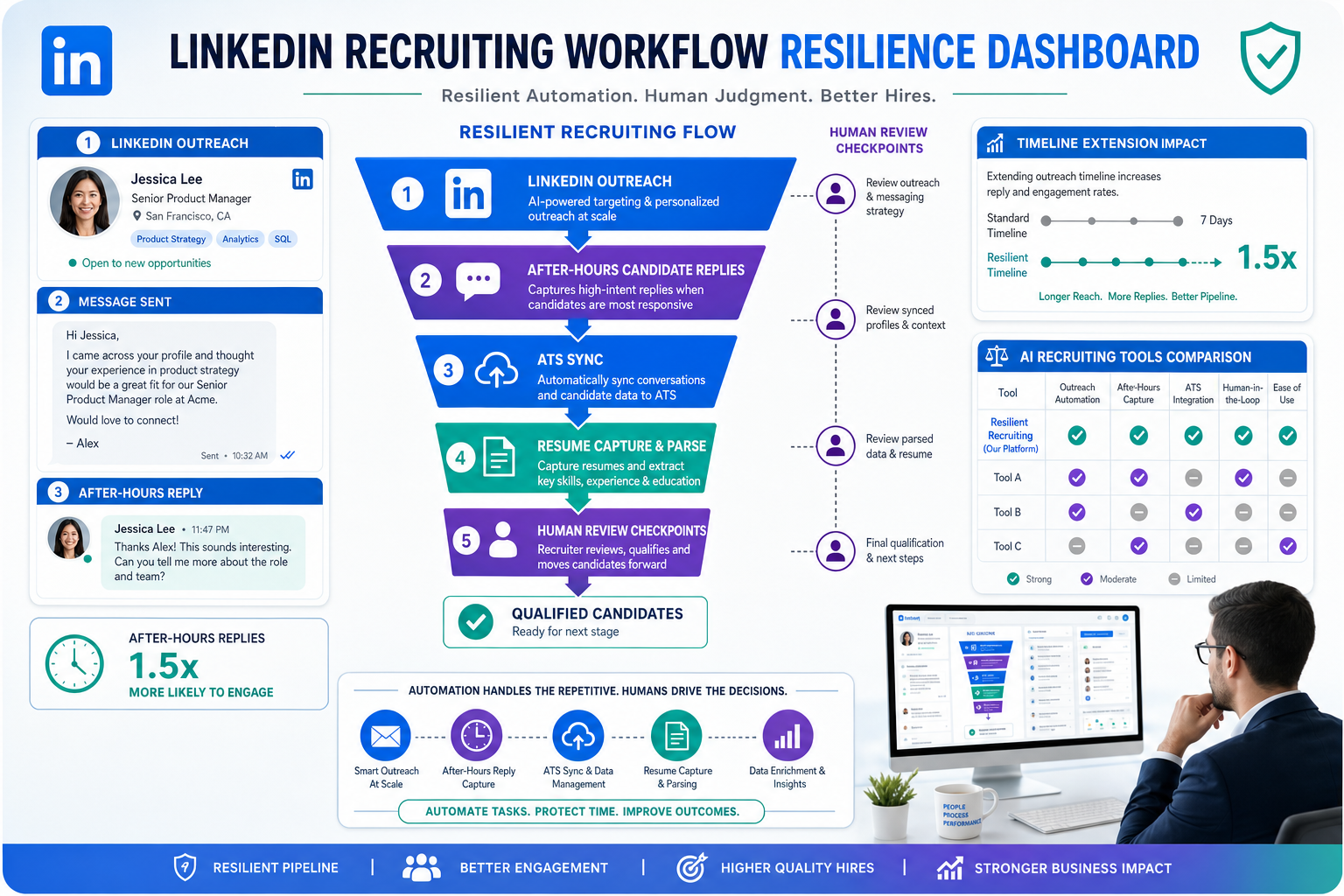
When searches slip, this article helps recruiting leaders evaluate ai recruiting companies by workflow resilience, so they avoid tools that add drag.
That matters because recruiting delays rarely come from one dramatic failure. They usually come from small misses that stack up: a role that seemed easy but stays open, a contractor or specialist search that quietly extends, candidate replies that arrive after hours, incomplete notes in the ATS, and too much recruiter time disappearing into follow-up instead of qualification. For agency owners, solo recruiters, and in-house talent teams, the cost shows up in lost responsiveness, weaker candidate experience, strained hiring-manager trust, and avoidable revenue leakage.
In that kind of workflow, an automation layer such as StrategyBrain AI Recruiter can help with the part that most often slips first: repetitive LinkedIn outreach, after-hours candidate replies, and early interest capture across time zones. I have found that this kind of tool is most helpful when it keeps conversations moving, collects resumes or contact details from interested candidates, and supports multilingual communication without pretending to replace recruiter judgment. The recruiter still decides who is truly qualified, which resume deserves review, and what the next hiring step should be.
That logic becomes easier to see if you think about hiring the same way people think about renovation work or project contractors. A team brings in a specialist because the workload is too heavy or because a project needs a skill set the current group does not have. At first, the scope looks manageable. A two-week plan feels like two weeks. A three-month contract feels like three months. Then the hidden work appears: a missing dependency, a delayed handoff, a stakeholder who answers late, a requirement that was less standardized than expected.
Recruiting teams run into the same pattern with hard-to-fill roles and contract hiring. A recruiter opens the req, checks the ATS for past applicants, searches LinkedIn, responds to an interested candidate, updates stages, and nudges a hiring manager for feedback. None of those actions looks huge in isolation, but together they expose the real evaluation question behind ai recruiting software: which tools reduce that accumulation of drag, which ones simply add another tab, and which workflows hold up when the search runs 1.5 times longer than the team expected?
AI recruiting software sits right inside that reality. When buyers search for ai recruiting companies, they are usually not looking for a generic vendor list. They are trying to understand which systems can support sourcing, screening, scheduling, rediscovery, and recruiter workflow design without breaking process discipline. They also want clarity on where ai staffing fits, what a machine learning recruiter workflow can actually improve, and how to evaluate software before it touches a live hiring process.
Table of Contents
- Why recruiting timelines run longer than expected
- What are AI recruiting companies?
- What does AI recruiting software actually do?
- How does ai staffing differ from traditional staffing?
- Where do machine learning recruiter tools help most?
- How does an applicant tracking system fit into AI hiring?
- How should buyers evaluate ai recruiting companies?
- Red flags and common buying mistakes
- A practical LinkedIn workflow with AI support
- FAQ
Why recruiting timelines run longer than expected
One of the most useful lessons from contract hiring is that teams usually underestimate duration. They know they need extra help because the team is overloaded or because a role requires specialist capability, but they still assume the work will finish on the original timeline. In recruiting, that shows up when a hiring team believes a search is a quick replacement, a straightforward accounting contract role, or an easy backfill, only to discover that candidate supply, response rates, stakeholder delays, and calibration issues stretch the process.
A practical rule many experienced recruiters use is a rough 1.5 multiplier. If a search looks like it should take two months, build your process as if it could take three. If a contract requirement seems likely to close in six weeks, assume multiple rounds of rediscovery, re-outreach, and manager alignment may pull it longer. This does not mean recruiting teams should accept slow execution. It means the software and workflow should be evaluated against the real hiring path, not the optimistic version of it.
That is exactly why buyers need to judge software on workflow resilience. The best tools are not only good during a polished demo. They are useful when searches run longer, replies arrive late, resumes come in through different channels, and recruiters need to keep momentum without losing control of qualification standards.
What are AI recruiting companies?
AI recruiting companies generally provide software or services that use artificial intelligence to support recruiting work such as candidate discovery, resume parsing, matching, outreach, scheduling, conversation management, interview support, and workflow automation. The category often overlaps with sourcing automation, AI-powered ATS tools, recruiting CRM enhancement, and outreach assistants for channels like LinkedIn.
That overlap creates confusion for buyers. Some platforms mainly help in-house talent acquisition teams. Some are built for agency recruiters running high-volume ai staffing desks. Others focus on one narrow pain point, such as outbound messaging or candidate rediscovery, and are best used alongside an existing ATS rather than as a replacement.
From a recruiting-operations perspective, the useful starting point is not the label. It is the hiring problem. If your team is missing candidates at the top of funnel, you need sourcing and outreach help. If the issue is admin drag, scheduling, follow-up, and slow response handling, then workflow automation may matter more than broad “AI” positioning.
What does AI recruiting software actually do?
The clearest answer is that it handles repeatable recruiting work and helps recruiters decide where to spend attention first. In real hiring environments, that usually means:
- Sourcing automation to identify potential candidates from internal and external pools
- Resume and profile parsing to structure candidate data for search and review
- Matching and ranking based on skills, experience, location, and role requirements
- Outreach support for messages, follow-ups, and candidate engagement at scale
- Scheduling and coordination to reduce back-and-forth with candidates and managers
- Interview support for note capture, summaries, and scorecard consistency
- Pipeline visibility for stale stages, aging candidates, and req risk signals
In my experience, the strongest use case is not “fully automated hiring.” It is controlled acceleration. A recruiter still calibrates the search, reviews resumes, spots nuance, and decides whether interest equals fit. The software does the repetitive parts that consume hours but add little strategic value when done manually.
That distinction matters especially in LinkedIn-heavy workflows. For example, a recruiter may want an AI layer to initiate outreach, answer common role questions, capture resume submissions, and keep conversations active after hours, but still reserve final screening for a human review. That is a realistic model of AI recruiting software, and it is where many buyers see value fastest.
How does ai staffing differ from traditional staffing?
AI staffing changes the operating model more than the business goal. Traditional staffing depends heavily on recruiter memory, manual search, spreadsheet tracking, personal books of business, and one-to-one communication. AI staffing tries to systematize early-stage work so recruiters can move more searches without losing visibility.
Used well, AI staffing helps teams:
- Search a larger talent universe faster
- Reactivate past applicants already inside the ATS or CRM
- Run more consistent first-touch outreach
- Handle candidate replies outside normal working hours
- Standardize early qualification signals before manual review
- Reduce administrative drag on high-volume or repeatable reqs
What it does not do is remove the hard parts of recruiting. Client calibration, stakeholder management, candidate reassurance, negotiation, and final judgment still belong to people. If anything, AI staffing makes that human layer more important, because the top of funnel can move faster and generate more decisions that need real recruiting skill.
For staffing firms, one practical test is to compare a standardized contract role with a nuanced consultative search. If the software performs well only on the first, that is not necessarily a failure. It simply tells you the tool should be bought for that lane.
Where do machine learning recruiter tools help most?
A machine learning recruiter workflow tends to work best where teams make repeated decisions across enough structured data for patterns to matter. In recruiting, that usually means prioritization support rather than final selection.
Candidate matching
Machine learning can surface possible fits across resumes, profiles, old applicants, and job requirements. This is especially useful when a recruiter needs to rediscover talent already sitting in the database but hidden under inconsistent titles, old req IDs, or weak tagging.
Pipeline prioritization
One of the most valuable uses is showing recruiters where delay is building. Which candidates have gone quiet? Which reqs are aging? Which interested prospects need follow-up now? This directly addresses the timeline-drift problem from the opening case.
Conversation support
In outbound recruiting, machine learning can help classify intent, route responses, and identify which candidates have moved from passive interest to active engagement. That is especially useful when LinkedIn messages arrive at different times and recruiters cannot respond immediately.
Interview process consistency
AI can support note capture and structured summaries, helping teams compare feedback more consistently. It should support interviewer judgment, not replace it.
When evaluating any machine learning recruiter capability, ask to see how it performs with messy recruiting conditions: incomplete profiles, title variation, skill synonyms, location ambiguity, and inconsistent historical notes. Clean demos hide exactly the problems recruiters need software to solve.
How does an applicant tracking system fit into AI hiring?
For most teams, the ATS is still the operating center of recruiting. AI tools may sit inside it, connect to it, or work beside it, but reqs, candidates, stages, dispositions, and compliance records usually live there. That means ATS integration is not secondary. It is a core buying criterion.
The main advantages of applicant tracking system workflows in an AI context include:
- Centralized history so recruiters can see previous applications and outreach
- Structured stages for consistent movement and accountability
- Searchable records that make rediscovery and matching more useful
- Reporting continuity across source quality, funnel conversion, and time-to-fill
- Compliance support through recordkeeping and reviewability
One of the most practical applicant tracking system benefits is that it prevents software sprawl from turning into process sprawl. If your AI recruiting software cannot write back notes, statuses, or candidate details reliably, recruiters often end up doing duplicate work. That is exactly the kind of hidden delay that stretches hiring timelines.
Ask every vendor how it handles stage updates, resume attachments, communication records, candidate consent, disposition reasons, and recruiter overrides. Those details matter more than polished category language.
How should buyers evaluate ai recruiting companies?
If you are comparing ai recruiting companies, avoid starting with feature count. Start with use case, duration pressure, and workflow fit. The opening lesson here is simple: hiring work often runs longer than expected, so the right tool is the one that remains useful when the process becomes less tidy.
1. Define the real bottleneck
Is the issue sourcing volume, slow LinkedIn outreach, after-hours reply handling, weak rediscovery, interview coordination, or poor ATS discipline? Buyers often overbuy because they shop by label instead of workflow pain.
2. Judge the tool under realistic timelines
Use the 1.5 multiplier mindset. If a vendor only looks good when the search is straightforward and stakeholders respond instantly, the tool may not hold up in live hiring.
3. Check integration depth
Ask whether the platform reads and writes core data reliably. Recruiters should not have to copy resumes, notes, or stage changes across systems manually.
4. Understand the decision boundary
Which actions are automated, which are rules-based, which are machine learning-driven, and which still depend on recruiter review? Strong teams know exactly where judgment stays human.
5. Review fairness and oversight
Ask how the tool supports transparency, override controls, documentation, and defensible process design. Hiring is not a category where black-box confidence should be accepted casually.
6. Test for recruiter adoption
The best system is the one that removes real work. If the workflow adds clicks, extra tabs, or vague recommendations, adoption will slip fast.
7. Assess implementation effort
Some teams need a lightweight add-on. Others need deeper process redesign. Ask what internal setup, training, and operational ownership will be required.
| Evaluation Area | What to Ask | Why It Matters |
|---|---|---|
| Use case fit | What hiring problem does the tool solve first? | Prevents broad but shallow buying decisions |
| Timeline resilience | Does it still help when a search runs longer than expected? | Reflects real recruiting conditions |
| ATS integration | Can it sync candidate data, notes, and stages reliably? | Protects process continuity |
| Recruiter workflow | Does it reduce manual effort in live req activity? | Improves adoption and throughput |
| Governance | How are review, bias risk, and human oversight handled? | Supports defensible hiring |
| Data quality tolerance | How does it handle incomplete or inconsistent records? | Shows real-world usefulness |
Red flags and common buying mistakes
The same way recruiters watch for risk when hiring contract talent, buyers should watch for warning signs when evaluating recruiting software.
Red flags in the buying process
- Vague claims about automation: if no one can explain where human review begins, risk is being hidden.
- Weak integration answers: “We can probably connect” is not the same as a proven workflow.
- Only polished data demos: tools should be tested against messy real recruiting records.
- No discussion of compliance or privacy: that is a serious gap in a hiring context.
- Overpromising on replacement: software that claims to remove recruiter judgment should be treated carefully.
Common mistakes teams make
- Buying a category instead of a workflow
- Ignoring current ATS hygiene
- Expecting instant value without process discipline
- Forgetting after-hours candidate behavior
- Underestimating change management
There is also a direct parallel to contractor hiring here. In the same way consistently short contracts, irrelevant industry background, or long unexplained resume gaps can signal fit issues in talent, consistently vague implementation stories can signal fit issues in software. Buyers should evaluate the vendor the way recruiters evaluate a resource: how quickly can it ramp, how relevant is the experience, and will it hold up in an environment of similar complexity?
A practical LinkedIn workflow with AI support
Because many teams exploring ai recruiting software are really trying to improve LinkedIn sourcing and response handling, it helps to ground the discussion in one practical workflow. I have used AI Recruiter most effectively not as a replacement for sourcing strategy, but as a way to keep the top of funnel moving when searches become repetitive or stretch across time zones.
In one typical flow, I set the search criteria, clarified the role basics recruiters are repeatedly asked about, and let the tool handle first-touch communication and follow-up on LinkedIn. Interested candidates could continue the conversation, ask role questions, and share resumes or contact details. What mattered operationally was not the novelty of AI; it was that conversations kept moving while I focused on evaluating actual fit. That division of labor felt right: the software handled repetitive messaging, and I handled judgment.
Two capabilities stood out in that workflow. First, after-hours continuity matters more than many teams expect. Candidate replies often come in the evening, especially from employed prospects. Second, multilingual communication is genuinely useful for cross-border hiring because it reduces avoidable friction early in the conversation. Recruiters still need to assess suitability, but smoother first contact expands the reachable market. Teams looking at this use case can review the broader product background at StrategyBrain or see additional workflow material through the conversation examples.
Where I would be careful is exactly where experienced recruiters are usually careful anyway: willingness to reply is not the same as qualification. A candidate can be engaged, responsive, and even excited, but the resume still has to be reviewed against the req. That is why AI-supported outreach works best inside a controlled recruiter workflow, not as an automatic hiring decision engine.
How to compare tool categories without getting distracted
One reason buyers struggle in this market is that they compare unlike things. Broadly speaking, there are three buckets:
- ATS-centered AI tools that improve search, screening, and workflow inside the system of record
- Outreach-centered AI tools that focus on channels like LinkedIn, messaging, and early candidate engagement
- Analytics or interview tools that focus on downstream decision support and process consistency
These are not interchangeable. A team that mainly needs top-of-funnel responsiveness may get more value from outreach automation than from a heavier analytics layer. A high-volume staffing desk may need speed and rediscovery first. A more mature enterprise team may care most about integration, governance, and reporting continuity.
The practical lesson is to align the software category to the exact stage where work starts slipping. In the opening case, the issue was not simply “we need AI.” It was that the search expanded, hidden work surfaced, and small delays multiplied. Good evaluation starts there.
FAQ
What does AI recruiting software do?
AI recruiting software supports repeatable hiring tasks such as sourcing, outreach, parsing, matching, scheduling, and pipeline prioritization. Its best role is reducing admin and helping recruiters focus on judgment-heavy work.
How is ai staffing different from traditional staffing?
AI staffing uses automation to systematize early recruiting work that would otherwise depend on manual search, memory, and repetitive coordination. It improves scale and speed, but it does not remove the need for recruiter skill.
Where does a machine learning recruiter workflow help most?
Usually in matching, rediscovery, prioritization, and conversation support. It is most effective when there is enough structured data and enough repeated recruiting activity for patterns to matter.
Can AI replace recruiter qualification?
No practical buyer should assume that. AI can identify interest, organize information, and support prioritization, but recruiters still need to review resumes, assess nuance, and decide next steps.
Why do hiring timelines matter when evaluating ai recruiting companies?
Because many tools look strong in ideal conditions but fail when searches run longer than expected. Software should be tested against real hiring friction, not only against fast-path demos.
How should AI tools fit with an ATS?
They should read from and write back to the ATS cleanly, including candidate records, notes, stage updates, and reporting fields. Strong integration preserves process control and reduces duplicate work.
Conclusion
The real challenge with ai recruiting companies is not understanding the marketing language. It is understanding which tools still help when a search becomes longer, messier, and more collaborative than expected. That is the lesson behind both contract hiring and modern recruiting operations: optimistic timelines hide workflow risk.
For most teams, the right AI recruiting software will not replace recruiters. It will reduce repetitive outreach, improve response handling, support rediscovery, and keep activity moving inside a disciplined process. If you evaluate the market through that lens, you will make better decisions about ai staffing, stronger use of ATS data, and more realistic adoption of any machine learning recruiter workflow.