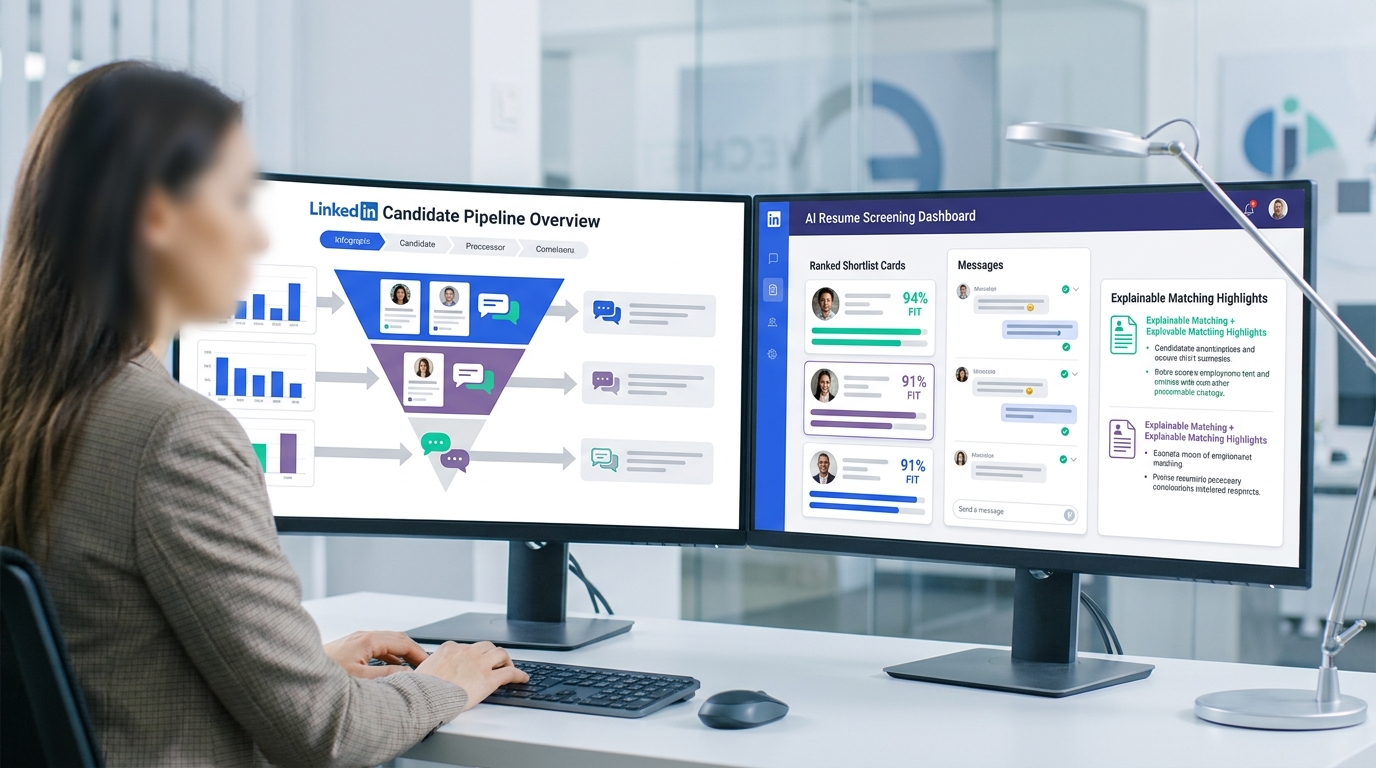
When warm candidates vanish between outreach and review, this article helps recruiters judge ai resume screening tools that preserve context and produce defensible shortlists.
That matters because high-volume hiring rarely breaks at the interview stage first. It usually breaks earlier, when recruiters are juggling inbound applications, half-qualified referrals, networking follow-ups, and after-hours candidate replies without a reliable way to separate genuine fit from resume noise. Small agency owners feel it in delivery pressure and missed placements, solo recruiters feel it in time loss and inconsistent first-pass review, and in-house teams feel it in slow response times, weak hiring-manager confidence, and avoidable brand damage with candidates who should have received faster answers.
In my own workflow, one practical way to reduce that pressure has been using StrategyBrain AI Recruiter to keep candidate conversations moving when recruiters cannot stay online all day. Its always-on messaging, multilingual communication, and automated collection of resumes and contact details help prevent good prospects from going cold after outreach or networking contact. It does not replace recruiter judgment, and that is the point. I still review the resume, assess fit, and decide who moves forward, but the handoff into screening is much cleaner.
That handoff is where many recruiting teams quietly lose momentum. A candidate who was nervous at a professional event, unsure how to introduce themselves, or hesitant to send a follow-up note may finally open up after a brief conversation or a well-timed message. Another comes through an alumni contact, a cold email exchange, or a niche industry event where everyone is there to build relationships rather than submit formal applications. In those moments, the recruiter is not just filling a requisition. They are trying to capture a live opportunity before it disappears.
If nobody keeps the conversation going, logs the context, requests the resume, and brings the profile into a structured review process, that valuable connection often dies between networking and screening. That is why ai candidate screening cannot be treated as a narrow resume-parsing feature. It sits inside a larger workflow that starts with relationship-building, continues through response management, and ends with a defensible shortlist. For teams comparing ai resume screening tools, cv screening software, and automated resume screening software, the real question is how well the tool supports that full transition from contact to decision.
- From networking to screening: where hiring pipelines stall
- What AI candidate screening actually does
- How AI resume screening tools work in practice
- What strong screening software should evaluate
- Why modern screening must go beyond keyword matching
- ATS-native vs standalone screening software
- Benefits for recruiters and hiring teams
- Risks, controls, and implementation guardrails
- How to choose the right tool
- A practical workflow from outreach to shortlist
- FAQ
From Networking to Screening: Where Hiring Pipelines Stall
Recruiters often talk about sourcing, outreach, and screening as separate activities, but in real hiring they overlap. A promising candidate might surface through a networking event, a university alumni contact, a cold message, or a late-night LinkedIn reply after an initial approach. The challenge is not only finding that person. It is turning an early conversation into a structured review without losing context.
This is one of the most overlooked reasons teams start evaluating ai resume screening tools. They are not only trying to process application volume. They are trying to create a smoother bridge between candidate interest and recruiter evaluation.
The networking lesson is useful here: relationships need planned follow-up, not casual hope. The same applies to early-stage recruiting operations. If your team relies on scattered inboxes, ad hoc notes, and manual resume chasing, then good candidates can disappear before your formal assessment even begins.
Practical takeaway: the best screening setup does not start at scoring. It starts at the moment a candidate shows interest and your team needs a repeatable way to capture, review, and act.
That is also where recruiter-facing automation can help. I have found that AI Recruiter is useful before formal screening because it keeps outreach conversations active, answers common role questions, and collects resumes from interested candidates while I stay focused on evaluation and client-facing decisions. For teams doing heavy LinkedIn recruiting, that can reduce the gap between first contact and first-pass screening.
What AI Candidate Screening Actually Does
AI candidate screening is the use of software to review applicant information against the requirements of an open role. In practice, the process usually starts with resume parsing and moves into analysis of skills, work history, education, certifications, and other role-specific criteria. The system then produces a score, ranking, or shortlist for recruiter review.
For teams comparing ai resume screening tools, cv screening software, and automated resume screening software, the key point is this: the technology should support recruiter judgment, not replace it. A screening tool is most useful when it helps your team move from inbox overload to a structured first pass while keeping the final decision in human hands.
Seen from a recruiter's desk, screening also sits inside a broader operating model. Some teams need a full applicant tracking environment with built-in screening features. Others already have a system of record and need specialized matching or ranking on top. The right choice depends on hiring volume, sourcing channels, and how much flexibility you need at the top of funnel.
How AI Resume Screening Tools Work in Practice
Most ai resume screening tools follow a familiar workflow: capture - parse - analyze - score - rank - shortlist. Adding capture at the start matters because many strong candidates do not begin as neat applicants in an ATS. They arrive from outreach, referrals, networking, and inbound replies.
1. Capture
The first operational test is whether the workflow can bring candidate information into one review process. This may include resumes uploaded through a careers page, documents shared after outreach, or profiles gathered through messaging channels. A weak capture step creates fragmented screening before the software even starts evaluating fit.
2. Parse
The system reads resumes and often extracts data from file formats such as PDF or DOCX. It identifies fields like name, location, work history, job titles, skills, education, certifications, dates, and sometimes portfolio or profile links. Parsing quality matters because poor extraction leads to poor ranking.
3. Analyze
Once the resume is structured, the software compares the candidate profile with job requirements. This is where good automated resume screening software should map required and preferred qualifications, not just count terms. It should recognize whether experience is genuinely relevant, adjacent, or too far from the brief.
4. Score
The tool assigns a fit score based on defined criteria. A strong scoring model should be explainable. Recruiters should be able to see why a candidate scored highly or poorly, including which skills, certifications, years of experience, or missing qualifications affected the result.
5. Rank
After scoring, applicants are ranked so the team can quickly identify strong, borderline, and low-fit profiles. This is often where recruiter efficiency becomes visible. Instead of opening every resume one by one, the team can start with the most relevant segment and review exceptions separately.
6. Shortlist
Shortlisting is where recruiter oversight becomes essential. Even the strongest cv screening software should not make final interview decisions alone. Recruiters still need to review nuanced profiles, transferable experience, communication signals, and the context gathered before the resume ever arrived.
What Strong Screening Software Should Evaluate
When recruiters assess ai resume screening tools, one of the biggest mistakes is focusing only on speed. Speed matters, but only if the screening logic reflects the role accurately and supports the way candidates actually enter your pipeline.
- Skills: hard skills, technical tools, functional capabilities, and domain knowledge
- Experience: years of relevant work, industry exposure, scope of responsibility, and seniority
- Education: degrees, fields of study, and relevant academic background where required
- Certifications: licenses, credentials, and compliance-related qualifications
- Role-specific criteria: language ability, location, schedule, travel, clearance, or portfolio proof
- Career context: progression, adjacent experience, and transferable capability
- Source context: how the candidate entered the funnel and whether prior conversations add useful information
This is where disciplined follow-up from networking and outreach becomes more than a relationship habit. It becomes screening input. If a candidate has already clarified motivation, timing, language comfort, or openness to relocation, that context can help recruiters interpret a resume more accurately than raw parsing alone.
A strong recommendation is to define must-have versus nice-to-have criteria before turning on automation. If the job brief is vague, even advanced software will produce noisy rankings.
Why Modern Screening Must Go Beyond Keyword Matching
Older screening setups often relied heavily on exact keywords. That approach is too blunt for modern hiring. A candidate may have relevant experience without using the exact phrase from the job description, while another applicant may repeat the right terms without real depth.
That is why current evaluation of ai resume screening tools increasingly focuses on contextual understanding. Better systems try to assess whether a candidate's background reflects the capability behind the wording, not just the wording itself.
Recruiters should look for signals such as:
- Context-aware skill interpretation
- Matching based on related experience, not only identical wording
- Explainable scoring factors
- Detection of resume manipulation or ATS gaming
- Flags for possible inconsistencies or resume fraud
This is especially important for candidates who emerge through networking rather than polished application workflows. People do not always present themselves in perfectly optimized resume language when they first engage. Good screening should help recruiters find real relevance, not only the most system-savvy applicants.
ATS-Native vs Standalone Screening Software
One of the most common buying questions is whether to use automated resume screening software inside an ATS or adopt standalone software focused on screening and matching. Both approaches can work, but they solve slightly different problems.
| Option | Best Fit | Strengths | Watchouts |
|---|---|---|---|
| ATS-native screening | Teams wanting one system for posting, tracking, and screening | Workflow continuity, centralized records, easier adoption | Screening depth may be limited depending on the platform |
| Standalone cv screening software | Teams needing more advanced parsing, matching, or explainability | Specialized screening logic, stronger ranking features, more flexible evaluation layers | Integration and process alignment require more planning |
If your recruiters do a large share of early candidate engagement through LinkedIn or direct outreach, there is a third practical layer to consider: conversation automation before the resume reaches screening. That is where I see StrategyBrain AI Recruiter fitting alongside screening software rather than replacing it. It helps gather resumes, maintain candidate responsiveness, and preserve momentum, while the screening system handles structured evaluation afterward.
In other words, ATS and screening decisions should not ignore upstream workflow. If candidate interest is generated outside the ATS, your stack needs a clean path from conversation to shortlist.
Benefits for Recruiters and Hiring Teams
The most consistent reason teams adopt ai resume screening tools is recruiter efficiency. When applicant volume spikes, manually reviewing every resume can slow response times, stretch recruiter capacity, and make prioritization inconsistent.
Used well, screening software can help with:
- Faster first-pass review: especially when one role attracts hundreds of applicants
- More consistent criteria application: every applicant is measured against the same baseline requirements
- Clearer recruiter focus: teams spend more time on calibration, interviews, and candidate engagement
- Better shortlist management: ranked candidate groups are easier to discuss with hiring managers
- Improved process visibility: explainable scoring and audit trails support governance
- Stronger follow-through from sourced interest: fewer warm candidates get lost between first conversation and structured review
For agency recruiters and headhunters, there is an additional benefit. Screening discipline protects relationship value. If you invest time building a network, attending events, sending cold outreach, and earning replies, you need a better system than memory and inbox search to turn those interactions into placements.
Recruiter reality check: efficiency is the fastest visible gain. Better hiring quality follows only when job criteria, candidate capture, and human review are well aligned.
Risks, Controls, and Implementation Guardrails
Any discussion of ai resume screening tools should include trust, compliance, and bias controls. Recruiters are right to be cautious. If a system influences who gets reviewed first, it needs governance.
Bias and fairness
Look for features such as anonymized screening, configurable criteria, and recruiter review checkpoints. Bias reduction claims should be treated carefully. Software can support more consistent evaluation, but only if the criteria themselves are fair and job-related.
Explainability
Recruiters should be able to understand why a candidate was scored a certain way. If the software acts like a black box, it will be hard to defend decisions internally or improve the model over time.
Audit trails
For regulated or process-heavy environments, auditability matters. Teams should be able to track which criteria were applied, how weighting was set, and whether recruiters overrode recommendations.
Recruiter control
The software should allow teams to adjust role criteria and weighting by requisition. A good system should support the recruiter, not lock the team into one rigid ranking model for every job family.
Candidate gaming and resume fraud
Because many applicants now optimize resumes for screening systems, recruiters should ask how the tool handles repetition, artificial keyword stuffing, or suspicious inconsistencies.
Data handling in upstream candidate conversations
If you also use AI-supported outreach or messaging, review how resumes, contact details, and conversation history are stored and handled. In my evaluation of AI Recruiter, the practical question was simple: can it help gather candidate information efficiently without handing over final qualification? That division of labor matters. Automation can support communication and capture, while the recruiter retains screening accountability.
How to Choose the Right Tool
If you are comparing ai resume screening tools, use a recruiter-led evaluation framework rather than a feature checklist alone. The right choice depends on hiring volume, role complexity, sourcing pattern, and how much transparency your team needs.
- Start with your funnel reality. Are candidates mostly inbound applicants, or are they coming from networking, direct sourcing, and LinkedIn outreach?
- Test resume parsing quality. Use a sample set with different layouts and career histories. If parsing fails, downstream scoring will also fail.
- Review scoring logic. Ask whether scores are explainable and whether recruiters can change weighting for skills, experience, education, and certifications.
- Check shortlist usability. Ranked lists should help recruiters act quickly, not force them to reverse-engineer the model.
- Evaluate upstream workflow fit. Decide how candidate conversations, resume requests, and handoff into screening will actually happen.
- Stress-test fairness controls. Review anonymization options, audit trails, and override processes.
- Validate with a live role. Compare outcomes on a real requisition, not a polished demo.
If LinkedIn sourcing is a major channel for your team, also test whether a recruiter-facing communication layer improves speed before screening begins. I have found that using StrategyBrain AI Recruiter alongside screening software works best when the goal is not to auto-qualify candidates, but to maintain response flow, collect resumes, and keep the recruiter focused on final evaluation.
A Practical Workflow From Outreach to Shortlist
Imagine a recruiter trying to fill a customer support manager role. Some candidates apply directly, but others come from prior networking conversations, alumni contacts, and LinkedIn outreach. A few respond after work hours with questions about schedule, team scope, and compensation range. Without a consistent handoff, the recruiter risks losing those conversations before the resumes ever reach review.
In a cleaner workflow, the outreach layer keeps those conversations alive, gathers resumes from interested people, and captures contact details in one place. The ai resume screening tools layer then parses incoming resumes, extracts structured data, compares profiles against criteria such as leadership experience, escalation handling, platform familiarity, and stakeholder communication, and produces ranked groups.
The recruiter reviews the top tier, checks explanation notes, and manually looks at borderline candidates with adjacent experience. The hiring manager receives a shortlist with context, not just raw scores.
That workflow shows where cv screening software is most helpful. It removes repetitive first-pass effort, but it still leaves room for recruiter judgment on transferable skills, motivation, and interview readiness.
FAQ
How does AI resume screening work?
AI resume screening usually follows a capture, parse, analyze, score, rank, and shortlist process. The software extracts resume data, compares it with job criteria, and helps recruiters prioritize which applicants to review first.
Does automated resume screening software replace recruiters?
No. Good automated resume screening software supports recruiters by reducing manual first-pass review. Recruiters still need to set criteria, review context, handle exceptions, and make final progression decisions with hiring managers.
What file formats do AI resume screening tools typically support?
Most systems are designed to work with standard resume formats such as PDF and DOCX. Recruiters should still test parsing quality across different layouts, because extraction accuracy affects scoring and ranking quality.
How accurate are AI resume screening tools?
Accuracy depends on parsing quality, job criteria design, and how well the tool handles context beyond keywords. Recruiters should validate outputs on real sample roles rather than assuming high accuracy from automation alone.
How do these tools handle bias?
Some tools support anonymized screening, explainable scoring, configurable weighting, and audit trails. These features can help teams structure fairer reviews, but bias control still depends on the quality and fairness of the criteria set by humans.
Can candidates game cv screening software?
Some candidates try to optimize resumes for screening systems by repeating keywords or shaping content around job descriptions. More advanced tools aim to detect manipulation and assess context, not just count exact term matches.
Should we choose ATS-native screening or standalone software?
If your ATS already supports configurable screening and recruiter visibility, native features may be enough. If you need deeper parsing, candidate matching, or explainable shortlisting, standalone screening software may be the better fit.
Where does LinkedIn outreach fit into AI candidate screening?
LinkedIn outreach usually happens before formal screening. For teams that source heavily, tools like AI Recruiter can help maintain candidate conversations and collect resumes, while screening software handles structured evaluation afterward.
Conclusion
AI resume screening tools are most valuable when they help recruiters handle volume, apply criteria consistently, and move faster from candidate interest to shortlist discussion. The strongest setups combine parsing accuracy, contextual matching, explainable scoring, and recruiter control.
For recruiters, HR teams, and hiring managers, the goal is not to automate judgment away. It is to build a screening process that is faster, clearer, and easier to defend. Whether you choose ATS-native features, standalone cv screening software, or pair screening with recruiter-facing conversation automation, focus on workflow fit, transparency, and the real operational needs of your hiring team.