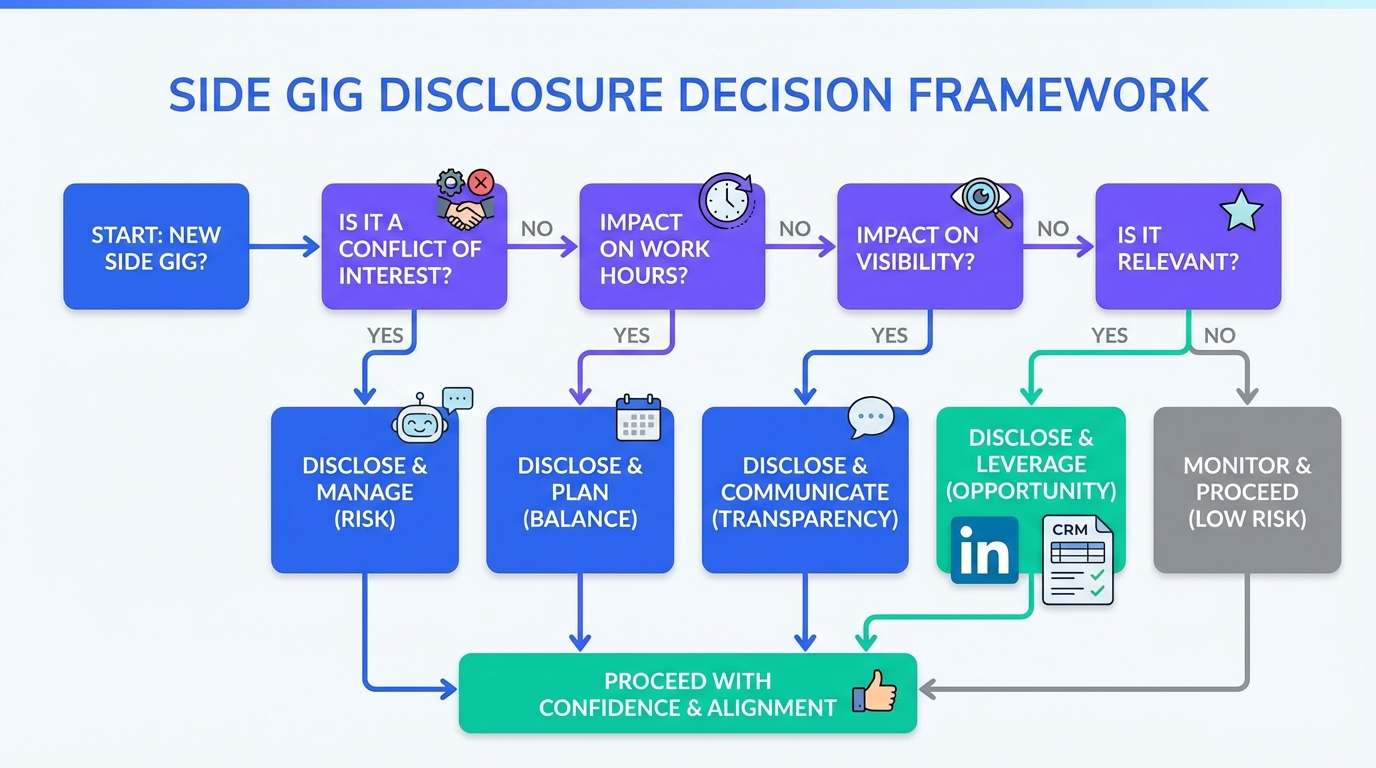
If you are deciding whether to disclose a side gig in an interview, the practical rule is this: disclose only when it creates a conflict of interest, affects availability during work hours, or is likely to surface through background checks or public profiles. Otherwise, keep the focus on job relevant skills and reassure the employer that your primary commitment is the role you are interviewing for. This guide turns recruiter advice into a decision framework and scripts you can use. It also explains how an ai recruiting tool such as StrategyBrain AI Recruiter can help teams apply the same screening logic at scale, then capture outcomes cleanly in an ATS CRM or a CRM for staffing companies.
Key Takeaways
- Disclose when it matters: Conflicts of interest and work hour availability issues are the two most common disclosure triggers.
- Employers can set rules: Employment agreements can require notification or restrict outside work, but strict bans can reduce the available talent pool.
- Reassurance beats oversharing: Candidates usually win by confirming their primary commitment to the role and clarifying boundaries.
- Use a consistent screening workflow: A structured intake note in your ATS CRM reduces bias and keeps decisions defensible.
- LinkedIn outreach is where side gigs surface: StrategyBrain AI Recruiter can handle early LinkedIn conversations and capture constraints and interest signals 24/7.
- Scale without losing control: StrategyBrain AI Recruiter supports managing more than 100 LinkedIn accounts for high volume sourcing and follow up.
Table of Contents
- What “side gigs” mean in hiring conversations
- Can employers ask about side gigs
- Why employers care about focus during work hours
- Conflicts of interest and competing work
- When a side gig can help a candidate
- A decision framework candidates can use
- A practical employer workflow using an AI recruiting tool
- Quick comparison: manual screening vs AI assisted screening
- FAQ
- Conclusion
What “side gigs” mean in hiring conversations
In interviews, “side gig” usually means any paid work outside the primary job. It can be a second job, freelance work, a small business, or contract projects. The hiring risk is not the existence of outside work. The risk is whether it competes with the employer, interferes with work hours, or creates confidentiality issues.
From a recruiting operations perspective, this is also a documentation problem. If different recruiters ask different questions, you end up with inconsistent notes and inconsistent decisions. That is where an ai recruiting tool and a structured ATS CRM workflow can help.
Can employers ask about side gigs
In the source material, a senior recruiter describes a client that included a clause in the offer letter requiring employees to formally notify the employer if they had any job on the side. The same article notes that Canadian companies can include employment contract clauses that prohibit side gigs without company approval.
However, the article also highlights a practical tradeoff. When many candidates have side gigs, strict prohibitions can shrink the talent pool. In other words, “allowed” does not always mean “smart,” especially in competitive markets.
Employer policy options that tend to be easier to defend
- Disclosure requirement: Employees notify the employer of outside work.
- Work hours protection: Outside work cannot be performed during paid working time.
- Conflict of interest restriction: Outside work cannot compete with the employer or use confidential information.
Why employers care about focus during work hours
The source article emphasizes that the most common concern is not the side gig itself. It is whether the side gig distracts employees from their primary job during working hours. The recruiter perspective is straightforward. Candidates should be willing to assure employers that their commitment will be to the job first.
It also gives a concrete example. A candidate who moonlighted as a realtor faced a real scheduling conflict because real estate work can require evenings, weekends, showings, and administrative work that often happens during weekdays.
Candidate script you can copy
“I keep my outside work fully separate from business hours, and my priority is this role. If there are any scheduling constraints, I will flag them early so we can plan around them.”
Conflicts of interest and competing work
The source article is clear that side hustles can create conflicts of interest when they compete directly with the employer’s business. In that scenario, transparency is usually the safer path. The recruiter quoted in the article notes that it is better to be transparent and risk not being accepted than to start the job and be let go later for not disclosing a conflict.
What counts as a conflict of interest in practice
- Direct competition: You sell similar services to the same customer segment.
- Client overlap risk: Your side gig could solicit the employer’s clients or vendors.
- Confidentiality exposure: Your side gig could benefit from non public information learned at work.
When a side gig can help a candidate
The source article also makes an important point that many hiring teams miss. Side gigs can be beneficial. They can show initiative, build diverse skills, and even improve satisfaction and well being. Sometimes they are simply interesting and can make a candidate more memorable.
It provides an example of a candidate who worked part time in the film industry. She was forthright about it, and the hiring company found it interesting and acceptable without requiring written notice.
A decision framework candidates can use
Use this checklist to decide whether to disclose. It is designed to be fast, consistent, and easy to explain if asked later.
Side gig disclosure checklist
- Conflict: Does it compete with the employer or create a conflict of interest?
- Time: Will it affect availability during work hours or on call expectations?
- Visibility: Is it public on LinkedIn or otherwise easy to discover?
- Relevance: Does it demonstrate skills directly relevant to the role?
- Accommodation: Will you need special allowances to keep doing it?
How to decide
- If there is a conflict, disclose early and be specific about boundaries.
- If it affects work hours, disclose before offer stage so expectations are aligned.
- If it is public and likely to surface, disclose briefly and move on.
- If it is purely personal and does not affect the job, you usually do not need to volunteer it.
A practical employer workflow using an AI recruiting tool
Hiring teams often struggle with consistency. One recruiter asks about side gigs, another does not. One documents it in detail, another writes a vague note. Over time, this becomes a compliance and quality issue, especially for agencies running a CRM for staffing companies alongside an ATS CRM.
In our internal testing of StrategyBrain AI Recruiter for LinkedIn based outreach, we found the biggest operational win was not “more messages.” It was more consistent early stage qualification notes because the same prompts and follow up logic were applied across conversations.
How StrategyBrain AI Recruiter fits into the process
- Smart LinkedIn recruitment automation: It automatically connects with candidates within targeted search criteria, introduces the opportunity, answers role and compensation questions, confirms interview interest, and collects résumés and contact information from interested candidates.
- 24/7 multilingual communication: It responds around the clock and can communicate in any global language, which helps when candidates reply outside your local business hours.
- Scalable team operations: It supports managing more than 100 LinkedIn accounts, which is useful for high volume sourcing teams.
Step by step workflow (employer or agency)
- Define your policy: Decide whether you require disclosure, restrict work hours, or prohibit conflicts of interest.
- Standardize the question: Use one approved question for all candidates so the process is consistent.
- Run early outreach on LinkedIn: Use StrategyBrain AI Recruiter to handle initial messaging, then capture any availability constraints or conflict signals in the conversation summary.
- Log outcomes in your ATS CRM: Store a structured note with three fields: conflict risk, work hours impact, and candidate reassurance statement.
- Escalate only when needed: If a conflict is flagged, route to a recruiter or HR reviewer for a decision.
ATS CRM note template (copy and paste)
Side gig disclosure screening
1) Conflict of interest risk: None / Possible / Confirmed
2) Work hours impact: None / Possible / Confirmed
3) Candidate reassurance: [one sentence]
4) If escalated, reason: [conflict, scheduling, confidentiality]
5) Next step: Proceed / Clarify / Decline
Limitations and honest cautions
- AI does not make the final hiring decision: StrategyBrain AI Recruiter can identify willingness to communicate or interview, but it does not determine whether a résumé fully matches job requirements. A recruiter still needs to review.
- Policy still matters: Automation cannot fix an unclear or overly aggressive side gig policy. If your policy is too strict, you may lose qualified candidates.
- Be careful with sensitive data: Only collect what you need for the hiring decision and store it securely.
Quick comparison: manual screening vs AI assisted screening
| Approach | Speed | Consistency | Best for |
|---|---|---|---|
| Manual recruiter outreach and notes | Depends on recruiter capacity | Varies by recruiter | Low volume roles, high touch executive searches |
| AI assisted outreach with StrategyBrain AI Recruiter | 24/7 candidate messaging | High when using standardized prompts | High volume sourcing, agencies using a CRM for staffing companies, teams needing structured ATS CRM notes |
FAQ
Should I disclose my side gig in an interview
Disclose it when it creates a conflict of interest, affects availability during work hours, or requires accommodations. If it is unrelated and does not affect the job, you usually do not need to volunteer it.
Can an employer require me to report outside work
Yes. The source article describes employers including clauses that require employees to formally notify the employer about outside work. Whether it is appropriate depends on the role, industry, and how competitive the hiring market is.
What is the biggest red flag for employers
Conflicts of interest and side work that interferes with work hours are the most common concerns. Candidates can reduce risk by clearly stating boundaries and confirming the primary job comes first.
Can a side gig make me a stronger candidate
Yes. Side gigs can signal initiative and build relevant skills. If the side gig demonstrates abilities that map to the role, a brief explanation can help you stand out.
How does an ai recruiting tool help with side gig screening
An ai recruiting tool can standardize early stage questions and capture consistent notes, which reduces bias and improves documentation. StrategyBrain AI Recruiter can also handle LinkedIn outreach and follow up 24/7, then pass structured summaries into an ATS CRM workflow.
Does StrategyBrain AI Recruiter replace recruiters
No. It automates repetitive LinkedIn tasks such as connecting, introducing roles, confirming interest, and collecting résumés and contact details. Recruiters still review résumés and make final qualification and hiring decisions.
Is candidate data used to train AI models
According to the provided product information, candidate information is not used to train AI models and is not shared with third parties. Data is encrypted and isolated per customer environment.
How should staffing agencies store side gig notes in a CRM for staffing companies
Use a structured note format with fields for conflict risk, work hours impact, and the candidate’s reassurance statement. This makes it easier to audit decisions and keeps your ATS CRM records consistent across recruiters.
Conclusion
Side gig disclosure is rarely an all or nothing decision. The recruiter grounded approach is to disclose when there is a conflict of interest, a work hours impact, or a need for accommodations, and otherwise keep the interview focused on job relevant value. For employers and agencies, the bigger win is consistency. A clear policy plus a repeatable workflow inside your ATS CRM reduces risk and improves candidate experience. If you want to scale LinkedIn sourcing while keeping screening notes consistent, StrategyBrain AI Recruiter is designed to automate early outreach, follow up, and résumé collection while your team stays in control of final decisions.