When evaluating artificial intelligence for recruiting, recruiting leaders can use this article to spot workflow gaps that slow response, weaken trust, and cost placements.
That distinction matters more than most demos admit. In agency search, in-house talent acquisition, and lean HR teams, the real damage rarely comes from a lack of software labels. It comes from small breakdowns that compound: delayed replies after candidate outreach, inconsistent follow-up across time zones, unclear handoffs between sourcing and screening, weak notes in the system, and candidate conversations that lose momentum because no one is available when interest is highest. For a solo recruiter, that can mean missed placements and tired evenings. For a boutique firm owner, it can mean lower consultant productivity and uneven delivery. For a corporate recruiting lead, it can mean slower hiring, frustrated managers, and a candidate experience that quietly weakens employer trust.
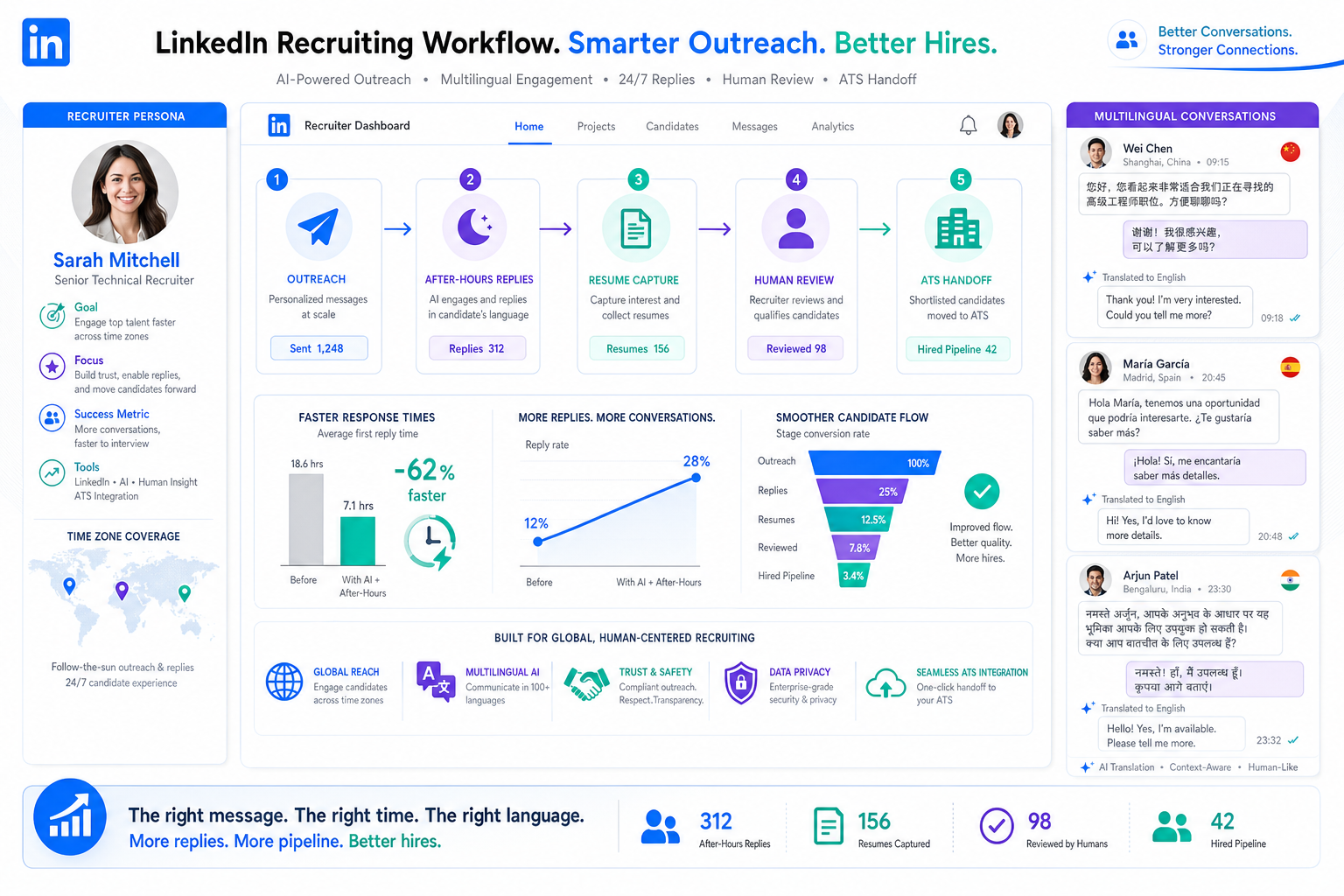
That is the operational gap where AI Recruiter can help. In my own review of recruiter-side AI tools, I found its value was clearest not in replacing recruiter judgment, but in handling two stubborn workflow problems well: continuous candidate messaging on LinkedIn and multilingual communication outside recruiter working hours, while also collecting resumes and contact details from interested candidates. The recruiter still owns resume review, final qualification, and next-step decisions, but the administrative drag around early outreach and reply management becomes much lighter. For teams that depend heavily on LinkedIn, that is a meaningful practical use of artificial intelligence hiring.
Think about the candidate side of the process for a moment. A skilled foreign worker entering a new market often does not fail because of lack of ability. The friction starts earlier. They are trying to read unfamiliar workplace expectations, understand how formal or informal first contact should be, judge whether a quick apology is courtesy or liability, and work out how punctuality and tone will be interpreted. In Canada, for example, norms around personal space, a straightforward handshake, light social apologies, and arriving five to ten minutes early can all shape first impressions even when nobody says so directly. Many employers are polite enough not to correct a misstep in the moment, which means misunderstanding lingers quietly in the background.
Now place that same reality inside recruiting operations. A recruiter sourcing internationally on LinkedIn is not only sending messages; they are opening a relationship where timing, tone, language, and clarity matter before the first interview is even booked. If the candidate replies late at night in their own time zone, asks practical questions in their native language, or hesitates because local workplace etiquette feels unfamiliar, a slow or awkward response can cool interest fast. That is why ai in hr recruitment is not just about sorting resumes. It is also about whether your workflow can support cross-border conversations with the right pace, recordkeeping, and human follow-through.
That opening case exposes the buying issue behind this topic: good AI recruiting software should be judged not only by automation claims, but by how well it supports real recruiter work at the moment interest, uncertainty, and cultural friction meet. The rest of this article looks at that standard closely, including where artificial intelligence for recruiting helps most, where it can create risk, how it differs from an ATS, and what recruiting teams should test before they trust it.
- What good AI recruiting software actually looks like
- Why recruiting teams are moving now
- Where AI helps most in daily recruiting work
- Why candidate experience and global hiring change the equation
- AI recruiting software vs ATS
- How different recruiting software categories compare
- How to evaluate artificial intelligence hiring tools
- Governance, fairness, and compliance risks
- How to implement AI in HR recruitment well
- FAQ
What good AI recruiting software actually looks like
AI recruiting software is most useful when it removes repetitive recruiter work while keeping assessment, relationship judgment, and hiring accountability with people. That sounds simple, but it is the line many buyers lose in practice.
In recruiting operations, a good tool should help with tasks such as sourcing support, outreach drafting, response handling, candidate rediscovery, screening assistance, scheduling, workflow prioritization, and reporting. But the strongest systems do something more subtle: they preserve context. They help a recruiter understand where a candidate is in the process, what has already been discussed, what language or communication style may matter, and what should happen next.
That is why the opening example about foreign workers and workplace etiquette is relevant here. Recruiting often breaks before formal assessment begins. If a candidate is unsure how to respond, how quickly to reply, or how a hiring market expects them to behave, the recruiter needs a workflow that can support early trust-building, not just application processing.
So when evaluating artificial intelligence for recruiting, I recommend thinking in three layers:
- Execution layer: Can it handle repetitive outreach, replies, scheduling, and data capture?
- Context layer: Can it support multilingual, cross-time-zone, or culturally sensitive communication without flattening everything into generic templates?
- Control layer: Can recruiters review, override, document, and explain what happened?
If a tool only does the first layer, it may save some time. If it supports all three, it has a stronger chance of fitting real-world recruiting.
Why recruiting teams are moving now
Teams are not exploring AI because they suddenly stopped valuing recruiter skill. They are doing it because modern hiring creates more communication load than most teams can cover manually.
Several forces are driving interest:
- Global sourcing is now normal: recruiters increasingly work across languages, cultures, and time zones.
- LinkedIn workflows are labor-heavy: outreach, follow-up, and qualification consume recruiter attention quickly.
- Candidate expectations have changed: slow replies and vague status updates damage trust faster than they used to.
- Lean teams need leverage: agencies and in-house functions are expected to deliver more without equivalent headcount growth.
- Skills-based hiring is widening the funnel: more candidate profiles need thoughtful interpretation, not just title matching.
In that environment, artificial intelligence hiring becomes attractive when it gives recruiters more time for calibration calls, stakeholder management, and final assessment rather than trapping them in message management all day.
Where AI helps most in daily recruiting work
The best use cases tend to be practical and close to the recruiter desk, especially where communication timing and repetitive actions matter.
1. LinkedIn outreach and follow-up
For many recruiters, LinkedIn is where time disappears. Writing first-touch messages, following up after silence, answering basic role questions, and keeping track of who has shown interest can become a full-time side job. This is exactly where an AI-supported workflow can earn its place.
Tools built for this environment can automate first contact, keep conversation momentum moving, and gather resumes or contact details once candidates express interest. From a usability perspective, that is often more valuable than flashy prediction features because it solves a visible bottleneck.
When I tested the logic behind AI Recruiter, the practical advantage was straightforward: it could continue recruiter-side LinkedIn communication, introduce the opportunity, answer common role questions, and collect contact information while I remained responsible for actual fit assessment. For headhunters and agency consultants, that division of labor makes sense.
2. Multilingual and after-hours candidate communication
This use case is often underestimated. Cross-border hiring does not only create sourcing complexity; it creates response-window complexity. Candidates reply when they are free, not when your office is staffed. If your search depends on international talent, delayed replies can lower conversion without ever showing up as a neat dashboard problem.
AI can help here by maintaining communication continuity in the candidate's language and at the candidate's time. That matters especially when the candidate is already uncertain about local norms, employer expectations, or whether an opportunity is credible.
3. Resume and contact capture
One overlooked benefit of ai in hr recruitment is that it can reduce handoff failure. If an interested candidate shares a resume, email, or phone number in a message thread and that information is not captured cleanly, the recruiter may lose speed at exactly the wrong moment. Software that gathers and centralizes those details can reduce that risk.
4. Candidate rediscovery and list prioritization
Beyond outreach, AI can help recruiters resurface older candidates, group profiles by relevant skills themes, and organize longlists more efficiently. This is useful for hard-to-fill roles and repeat hiring patterns where the right person may already exist in prior outreach history.
5. Recruiter-side screening support
Screening support can be valuable when it highlights skills alignment, adjacent experience, or likely fit patterns. But this is also where caution matters most. AI suggestions should inform recruiter review, not replace it.
Practical takeaway: In recruiting, the clearest AI wins usually happen before final evaluation: outreach, communication continuity, data capture, rediscovery, and prioritization.
Why candidate experience and global hiring change the equation
The reference case about foreign workers in Canada points to a broader truth: candidates often navigate hiring with incomplete knowledge of local workplace etiquette. They may not know whether a short delay looks disinterested, whether a direct question about pay is welcome early, or whether a brief apology is expected in routine friction points. Recruiters who hire internationally see versions of this all the time.
That means AI recruiting software should not be judged only by internal efficiency. It should also be judged by whether it supports better candidate communication in ambiguous moments. Can it respond promptly? Can it reduce misunderstandings? Can it keep a conversation warm without making the recruiter sound robotic? Can it support multilingual exchange while preserving a clear handoff to human review?
When buyers skip those questions, they often end up with automation that speeds up tasks but weakens trust. When they ask them early, they evaluate artificial intelligence for recruiting the way experienced recruiters do: through the lived reality of candidate interaction.
AI recruiting software vs ATS
Many teams already have an applicant tracking system and wonder whether AI will replace it. In most cases, it will not.
| Category | Applicant Tracking System | AI Recruiting Software |
|---|---|---|
| Primary purpose | Manage requisitions, stages, records, and compliance | Support outreach, prioritization, automation, and recruiter productivity |
| Best at | Process control and documentation | Reducing repetitive work and surfacing likely next actions |
| Key users | Recruiters, coordinators, hiring managers, HR | Recruiters, sourcers, recruiting ops, talent leaders |
| Strength in global communication | Usually limited | Can be strong, depending on the tool |
| Main risk if overused | Administrative burden | Bias, over-automation, weak transparency |
An ATS remains the system of record. It stores candidate stages, feedback, and compliance documentation. AI software usually works best as a layer around communication, matching, and prioritization.
From experience, if your process is already messy in the ATS, AI will not save it. But if your ATS is reasonably stable and your bottlenecks sit in outreach volume, candidate response management, or international communication, an AI layer can be useful.
How different recruiting software categories compare
Because this article is about software, it helps to compare the major categories recruiters actually weigh in the market. Rather than naming niche tools, I would break the landscape into three familiar software paths: ATS platforms, CRM/sourcing suites, and LinkedIn-focused AI outreach tools.
1. ATS platforms
Typical strengths: stage tracking, audit trail, hiring manager visibility, structured workflow, reporting consistency.
Typical weaknesses: limited flexibility in early candidate engagement, weak after-hours communication, and little support for multilingual messaging in first-touch sourcing.
Best for: companies that need process discipline, approvals, and compliance documentation across multiple stakeholders.
How they work with AI Recruiter: well, if you use the ATS as the record system and let AI Recruiter handle early LinkedIn outreach, reply flow, and resume capture before recruiter review.
2. CRM and sourcing suites
Typical strengths: talent pooling, campaign management, nurture workflows, segmentation, and rediscovery of prior candidates.
Typical weaknesses: they can become system-heavy for small teams, and some still rely on recruiters to do too much manual message work.
Best for: mid-sized or enterprise teams building long-term pipelines and internal talent communities.
How they work with AI Recruiter: use the CRM for pipeline strategy and use AI Recruiter for conversation handling where LinkedIn activity is high and recruiter capacity is stretched.
3. LinkedIn-focused AI outreach tools
Typical strengths: speed, sourcing throughput, candidate conversation continuity, and operational relief in outbound recruiting.
Typical weaknesses: they can be risky if they overpromise autonomous qualification or produce generic communication that harms trust.
Best for: headhunters, agencies, growth-stage companies, and in-house teams that rely on direct sourcing rather than inbound applications alone.
How they work with AI Recruiter: this is the category where it sits most naturally. Based on its described workflow, the strongest fit is for teams that want recruiter-side automation of connection requests, role introduction, candidate interest checks, multilingual communication, and contact collection while keeping final qualification with the recruiter.
I would avoid pretending there is a universal winner across all five comparison dimensions of experience, results, cost, fit, and collaboration. The right choice depends on whether your pain lives in system control, talent relationship management, or LinkedIn execution volume. But if LinkedIn sourcing is your biggest drag, a focused AI layer often delivers more visible value than another broad platform module.
How to evaluate artificial intelligence hiring tools
Strong evaluation starts with workflow diagnosis, not feature excitement.
Start with the actual breakdown
Ask where your process loses momentum. Is it outreach volume? Candidate replies arriving after hours? Resume collection? Hand-off speed? Time-zone delay? Candidate hesitation in cross-border hiring?
Test communication realism
If a tool supports messaging, review the quality closely. Does it sound natural? Can it handle common candidate questions? Does it stay clear without sounding scripted? This matters even more when candidates are already navigating unfamiliar professional norms.
Check recruiter control points
You want clear moments where the recruiter takes over: fit assessment, resume review, shortlist decisions, and interview movement.
Review data capture and system handoff
Can resumes and contact details be gathered cleanly? Can records move back into the ATS or recruiter workflow without messy manual repair?
Evaluate multilingual and time-zone usefulness
For globally distributed hiring, this is not a luxury feature. It is often core workflow infrastructure.
Ask whether the tool helps real users
- Agency recruiters: does it reduce repetitive sourcing admin and improve consultant capacity?
- Corporate recruiters: does it maintain candidate quality while cutting response lag?
- HR leaders: does it support more hiring activity without immediate headcount growth?
In my own working standard, a useful artificial intelligence hiring tool should make recruiter effort more valuable, not merely more automated.
Governance, fairness, and compliance risks
Any credible discussion of AI in recruiting has to include risk.
Bias and adverse impact
If models are too heavily trusted in screening or ranking, they may reinforce narrow historical patterns. That is especially dangerous in cross-border or nontraditional candidate markets.
Low transparency
If recruiters cannot explain why a candidate was prioritized or filtered, the software is hard to defend internally and risky to scale.
Over-automation in communication
A fast reply is helpful. A misleading or tone-deaf one is not. Candidate trust can drop quickly if automation feels careless.
Data protection and privacy handling
Buyers should review how candidate data, conversation history, resumes, and credentials are stored and used. If a tool is being considered seriously, security and privacy review should happen early, not after rollout decisions are emotionally made. For teams researching this area, the vendor materials around AI Recruiter conversation handling and its privacy claims are worth examining directly rather than taking summary claims at face value.
Rule of thumb: If the software can influence candidate flow, you should be able to explain its role in plain language to candidates, managers, and compliance stakeholders.
How to implement AI in HR recruitment well
Implementation works best when it starts narrow and stays honest about human ownership.
1. Begin with one clear use case
For many teams, that will be LinkedIn outreach, after-hours messaging, or multilingual candidate communication.
2. Keep recruiters responsible for fit
Let AI handle repetitive message flow and data gathering, but keep human review at the point of resume evaluation and decision-making.
3. Write handoff rules
Decide exactly when a conversation moves from automated handling to recruiter ownership. That prevents awkward duplication and missed context.
4. Document what good looks like
If your candidates include international talent, define response expectations, escalation paths, and acceptable communication tone. The workplace etiquette lesson from the Canadian example applies here too: silence does not always mean comfort, and politeness does not always mean understanding.
5. Measure workflow quality, not just volume
Look beyond activity counts. Check whether recruiters are spending less time on repetitive tasks, whether candidates are replying faster, whether resumes are captured more cleanly, and whether handoffs to interview stages are smoother.
For teams that rely on outbound sourcing, I would also encourage a small pilot using AI Recruiter before broader rollout. The point is not blind adoption; it is seeing whether the workflow fit is real in your environment.
FAQ
What is AI recruiting software?
AI recruiting software uses automation, language tools, and pattern recognition to support hiring tasks such as sourcing, outreach, screening support, scheduling, matching, and recruiting analytics.
How does artificial intelligence for recruiting help headhunters?
It helps most when it removes repetitive work such as outreach, follow-up, candidate response handling, and resume collection, so headhunters can spend more time on qualification, client calibration, and closing.
What is the difference between artificial intelligence hiring tools and an ATS?
An ATS manages process records and hiring stages. AI hiring tools usually improve how work gets done inside that process, especially around communication, prioritization, and recruiter efficiency.
Where is ai in hr recruitment most useful?
It is often most useful in LinkedIn sourcing, multilingual candidate communication, after-hours response handling, candidate rediscovery, scheduling, and recruiter-side workflow prioritization.
Can AI replace recruiters?
No. It can support recruiter productivity, but final judgment, fit assessment, stakeholder alignment, and hiring accountability still belong with people.
What should teams watch for when hiring internationally?
They should pay attention to timing, tone, language, candidate trust, and local professional norms. Early misunderstandings can slow hiring even before formal interviews begin.
Is AI recruiting software mainly about screening resumes?
No. Some of the most valuable use cases happen earlier, especially in sourcing communication, candidate engagement, and data capture.
Conclusion
AI recruiting software is most valuable when it helps recruiters manage the messy, human, time-sensitive parts of hiring without pretending those parts can be fully automated away. The lesson from the foreign-worker etiquette example is simple but important: hiring friction often starts in small, polite, easy-to-miss moments. Candidates are reading signals. Recruiters are managing timing. And software either supports that reality or gets in the way.
For teams evaluating artificial intelligence for recruiting, the practical standard is clear. Choose tools that reduce repetitive communication work, support global and multilingual outreach, capture candidate information reliably, and leave final judgment where it belongs. That is the difference between empty AI positioning and artificial intelligence hiring that actually improves recruiter performance.