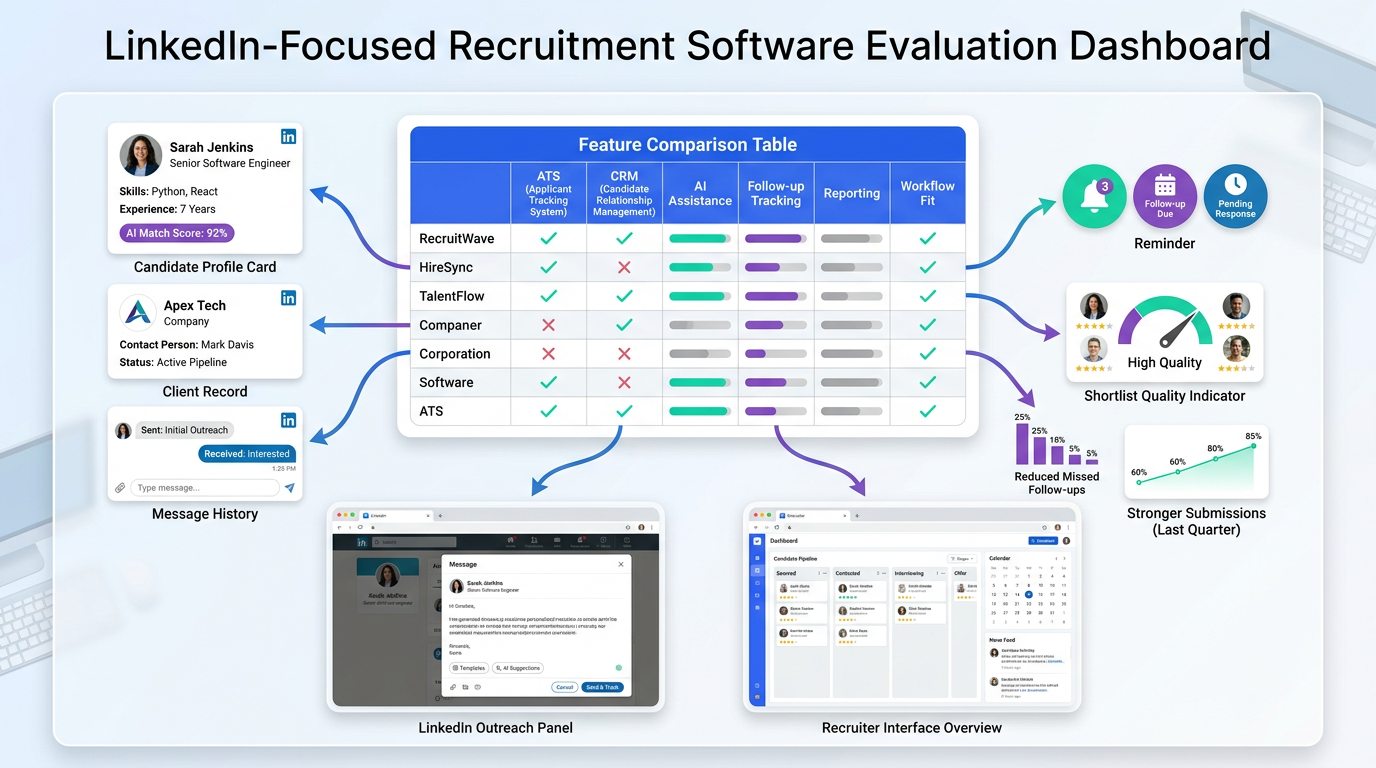
See how agency leaders can assess recruitment agency software to avoid missed follow-ups, weaker shortlists, and lost client trust.
When that system fit is wrong, the damage is rarely limited to inconvenience. Small agency owners lose visibility across desks, individual recruiters miss the second follow-up that keeps a candidate warm, and in-house talent teams start judging software by dashboards while the real loss shows up in weaker shortlists, slower submissions, and client trust that is harder to rebuild once it slips.
That is why I increasingly treat AI-supported workflow as part of software evaluation, not a separate extra. In practice, tools such as StrategyBrain AI Recruiter can take repetitive LinkedIn outreach, after-hours candidate replies, and résumé collection off a consultant’s plate while the recruiter still makes the final judgement on fit, CV quality, and next steps. Used properly, that kind of support does not replace recruiting craft; it protects time for it.
A useful way to think about this starts with the candidate side rather than the software side. The strongest finance candidates are usually not just technically capable. They show tenacity when a brief is difficult, adapt when priorities move, communicate well with non-specialists, and work with enough commercial awareness to act as real business partners instead of narrow specialists.
Now put that into a live desk scenario. A recruiter has to identify people with grit, communication range, ethical judgement, and the ability to handle changing priorities, then keep every conversation, note, and follow-up aligned across the client, the candidate, and the vacancy. That is exactly where the best recruiting software earns its place. If your recruitment software UK shortlist cannot support that judgement process cleanly, it is not the best recruitment software UK option for an agency environment, no matter how polished the demo looks.
- Why recruitment agency software fit matters more than feature volume
- What top-candidate traits reveal about software needs
- Practical comparison table
- How to evaluate the features that actually affect placements
- ATS vs CRM for agency recruiters
- Where AI support genuinely helps recruiters
- What UK agencies should test before buying
- Common mistakes when choosing software
- FAQ
Why recruitment agency software fit matters more than feature volume
If you are comparing the best recruiting software, the real buying decision is not about who has the longest feature list. It is about whether the platform supports how recruiters actually judge, engage, and move candidates through a process without losing context.
Recruitment agency software should function as the operating system for candidate records, client relationships, vacancies, communication history, notes, tasks, and recruiter activity. In reality, buyers often look for an ATS first, then realise they also need CRM depth, workflow automation, search quality, and stronger visibility across desks.
That gap matters because great placements are not made from data storage alone. They come from being able to recognise qualities that are not obvious in a keyword search: resilience, business partnering ability, adaptability, leadership signals, communication range, and self-direction. Software has to help surface, organise, and preserve those signals.
Key insight: Agencies do not win by storing more profiles. They win by keeping high-value candidate judgement connected to client delivery, follow-up discipline, and team visibility.
That is why the strongest systems usually combine ATS, CRM, search, communication tracking, reporting, and some level of automation in one workflow. When those elements are disconnected, recruiters tend to work around the system rather than inside it.
What top-candidate traits reveal about software needs
The reference point I come back to is simple: if your recruiters are trying to identify exceptional candidates, your software should support the same judgement structure. In finance hiring, for example, standout candidates are often differentiated by tenacity, business partnering, adaptability, leadership, continuous improvement, analytical skill, technical confidence with data, communication skill, ethics, and the ability to work independently.
Those are candidate traits, but they create very practical software requirements.
- Tenacity and follow-through mean recruiters need timelines, conversation history, and reminders that stop good candidates from going cold.
- Business partnering and communication mean recruiters need a connected CRM, not just an applicant list, so client context stays close to candidate discussion.
- Adaptability and leadership signals mean notes must be easy to capture, update, and share quickly as the brief evolves.
- Analytical strength and data fluency mean search, filtering, and reporting must be strong enough to support judgement instead of burying it.
- Ethics and self-direction mean the system should preserve clean records, ownership, and accountability across the desk.
This is why I would not reduce recruitment agency software to a database choice. It is a decision about whether your team can consistently identify and act on higher-quality candidate signals.
Practical comparison table
If you are reviewing best recruiting software options, use a scorecard that reflects actual recruiter work rather than generic product marketing.
| Evaluation Area | What Good Looks Like | Why It Matters |
|---|---|---|
| ATS workflow | Fast stage changes, clear ownership, visible notes, complete activity history | Keeps candidate movement accurate and easy to maintain |
| CRM depth | Linked client records, contacts, vacancy history, sales activity | Supports business development and delivery in one system |
| Search and matching | Relevant filtering, quick shortlist building, usable database search | Helps recruiters reuse existing talent instead of sourcing from zero |
| Communication tracking | Email, call, message, and note history in one place | Protects relationship continuity and handover quality |
| Automation | Reminders, workflow triggers, follow-up prompts, admin reduction | Reduces missed actions and low-value manual work |
| AI assistance | Useful drafting, summarising, outreach support, and message handling | Can save recruiter time if tied to real tasks |
| Reporting | Pipeline, activity, submissions, interviews, placements, bottlenecks | Gives leaders visibility into output and process health |
| Mobile usability | Quick updates, notes, tasks, and record access on the move | Important for consultants not working from one desk all day |
| Workflow fit | Perm, temp, contract, or search support that matches your model | Prevents costly workarounds after launch |
| Commercial clarity | Transparent licensing and realistic implementation expectations | Improves decision quality during procurement |
How to evaluate the features that actually affect placements
Agencies evaluating recruitment software UK options often focus too heavily on surface presentation. Daily use tells you more than a polished walkthrough ever will.
1. Candidate tracking should support judgement, not just stage movement
A good ATS makes it easy to answer four questions quickly: where is this candidate now, what happened last, what matters about them, and what should happen next?
That matters especially when you are recruiting for roles where candidate quality is defined by more than technical skill. If recruiters are trying to assess communication ability, adaptability, leadership potential, or commercial judgement, the software must make qualitative notes easy to record and retrieve.
Useful checks include:
- Can a recruiter update stages in seconds?
- Are interview notes, calls, and messages visible in one record?
- Can the team capture soft-signal observations without clutter?
- Does the system preserve history clearly during handovers?
2. CRM capability should reflect how agencies actually win work
Many teams buy a basic ATS and only later realise they are still managing clients elsewhere. That is one of the fastest ways to create duplicate admin and fragmented reporting.
If your consultants are expected to build relationships, manage live accounts, and brief candidates with real commercial context, CRM is not optional. It is part of the same judgement chain.
3. Search quality decides whether your database is an asset or a graveyard
When recruiters are handling nuanced roles, they need to find not just people with the right labels, but people whose records show persistence, stakeholder management, adaptability, or growth potential. Strong search and structured notes help surface those patterns.
A practical test is to run one real vacancy in each system and see how quickly the recruiter can create a credible shortlist from existing records. That is a better buying test than asking whether the platform has an AI badge.
4. Reporting should support action, not just management comfort
Agency leaders need clean visibility into submissions, interviews, placements, time-to-stage movement, and bottlenecks. But they also need enough context to understand why certain searches convert and others stall.
If your reporting can count activity but cannot explain where judgement quality breaks down, it is only doing half the job.
5. Mobile access matters more than many buyers admit
Recruiters are constantly between calls, meetings, candidate conversations, and client updates. If your system works well only when someone is sitting at a desktop with plenty of time, adoption usually suffers.
ATS vs CRM for agency recruiters
This remains one of the most common points of confusion in software selection.
| System | Main Focus | Agency Benefit |
|---|---|---|
| ATS | Candidates, applications, stage tracking, vacancy workflow | Improves candidate organisation and process visibility |
| CRM | Clients, contacts, account activity, sales pipeline | Supports business development and relationship management |
| Combined platform | ATS + CRM + workflow + reporting + automation | Connects candidate and client activity in one operating system |
For most agency environments, a combined approach is the best fit. Recruiters do not experience candidates and clients as separate worlds. The software should not force them to.
That is particularly true for firms assessing best recruitment software UK options, where daily workflow often blends candidate sourcing, account management, and fast-moving communication across the same desk.
Where AI support genuinely helps recruiters
AI is now part of almost every best recruiting software conversation, but the useful question is not whether AI exists. It is whether it improves the steps that waste recruiter time without weakening recruiter judgement.
In my own workflow, the most practical use of AI Recruiter has been around outbound messaging on LinkedIn, keeping conversations moving after hours, and collecting candidate details from people who are interested but would otherwise sit in an inbox until the next day. The strong point is that it keeps the top of funnel active while I still decide who is worth shortlisting, who matches the brief, and who should move to interview.
For recruiters working cross-border or outside normal office hours, the multilingual and always-on message handling described in the user workflow notes is especially useful. It helps prevent the familiar problem where candidate intent appears in a LinkedIn reply long before a recruiter has time to pick it up.
Where I would stay disciplined is this: AI can improve speed in outreach, follow-up, and admin-heavy steps, but the recruiter still needs to evaluate résumé quality, interpret soft signals, and decide whether someone truly has the tenacity, communication range, adaptability, or ethical judgement the role requires.
Useful AI evaluation questions include:
- Does it reduce repetitive outreach or coordination work?
- Can it help maintain momentum when recruiters are offline?
- Does it collect and organise information cleanly for human review?
- Does it support, rather than replace, final recruiter judgement?
- Does it fit the workflows your team actually uses on LinkedIn and beyond?
What UK agencies should test before buying
For buyers searching recruitment software UK or best recruitment software UK, the practical test is not “which system looks most advanced?” It is “which system best supports our recruiters in judging, engaging, and delivering high-quality candidates consistently?”
For UK agency teams, I would test the following in live demos:
- Add a candidate and capture meaningful qualitative notes quickly
- Match that candidate to a live role using search and filters
- Submit them to a client with clear context and communication history
- Create follow-up tasks so no next step depends on memory alone
- Check reporting from recruiter, team lead, and business owner views
- Test mobile actions such as notes, updates, and contact review
- Assess LinkedIn workflow support if outbound sourcing is a major part of your desk
If LinkedIn outreach is central to your model, it is also worth testing how software works alongside specialised tools. In my experience, a recruiter can use a core ATS/CRM platform for records, reporting, and delivery while using StrategyBrain AI Recruiter to keep sourcing conversations active and organised before final review inside the main system.
Common mistakes when choosing software
Choosing for features instead of workflow fit
The most common buying error is confusing product breadth with operational fit. Agencies need systems that support recruiter behaviour under pressure, not just broad functionality on a slide.
Buying an ATS when the desk really needs ATS plus CRM
If consultants own both candidates and clients, separating those records creates friction almost immediately.
Underestimating the role of qualitative judgement
Many systems can track process stages. Far fewer help recruiters preserve the real reasons a candidate stood out, such as leadership in difficult conditions, strong business partnering, or the ability to work through ambiguity.
Testing AI only as a novelty
If AI is being considered, test it on real recruiter tasks: outreach, follow-up, message handling, summarisation, and data capture. Fancy language means very little if it does not improve day-to-day flow.
Ignoring adoption risk
The best recruiting software is not the one with the most features. It is the one your team will actually use consistently enough to improve delivery.
FAQ
What is recruitment agency software?
Recruitment agency software is the system agencies use to manage candidates, clients, jobs, communication, and recruiter workflow in one place. It often combines ATS and CRM functions.
What makes the best recruiting software for agencies?
The best recruiting software helps recruiters move quickly without losing context. In practice, that usually means strong ATS workflow, CRM capability, search, reporting, automation, and mobile usability.
Why do soft candidate traits matter when choosing software?
Because great recruiters do not hire from keywords alone. They assess qualities such as tenacity, communication, leadership, ethics, and adaptability. Good software helps capture and use those signals rather than losing them in scattered notes.
What is the difference between ATS and CRM in recruitment?
An ATS manages candidates and hiring stages. A CRM manages clients, contacts, and commercial activity. Most agencies need both connected.
What should UK buyers look for in recruitment software?
Buyers comparing recruitment software UK options should test end-to-end workflow support, search quality, CRM depth, reporting, mobile use, and practical recruiter adoption.
What is the best recruitment software UK teams should prioritise?
The best recruitment software UK buyers should shortlist is the system that best fits their desk model, recruiter behaviour, and client delivery process. There is rarely a universal answer across all agency types.
How can AI help without replacing recruiters?
AI is most useful when it handles repetitive outreach, after-hours replies, and information capture while recruiters remain responsible for qualification, résumé review, and final decisions.
Conclusion
The strongest software decisions start with a simple truth: exceptional candidates are judged on more than hard skills, and recruiters need systems that help them preserve and act on that fuller picture. That is why recruitment agency software should be chosen around workflow fit, judgement support, and relationship continuity rather than feature volume alone.
If you are reviewing the best recruiting software, especially within the recruitment software UK market, test every option against real recruiter actions. Can the team capture nuance, keep follow-ups moving, link candidate and client context, and use AI support where it removes admin without replacing judgement? If yes, you are getting closer to the best recruitment software UK choice for your desk.