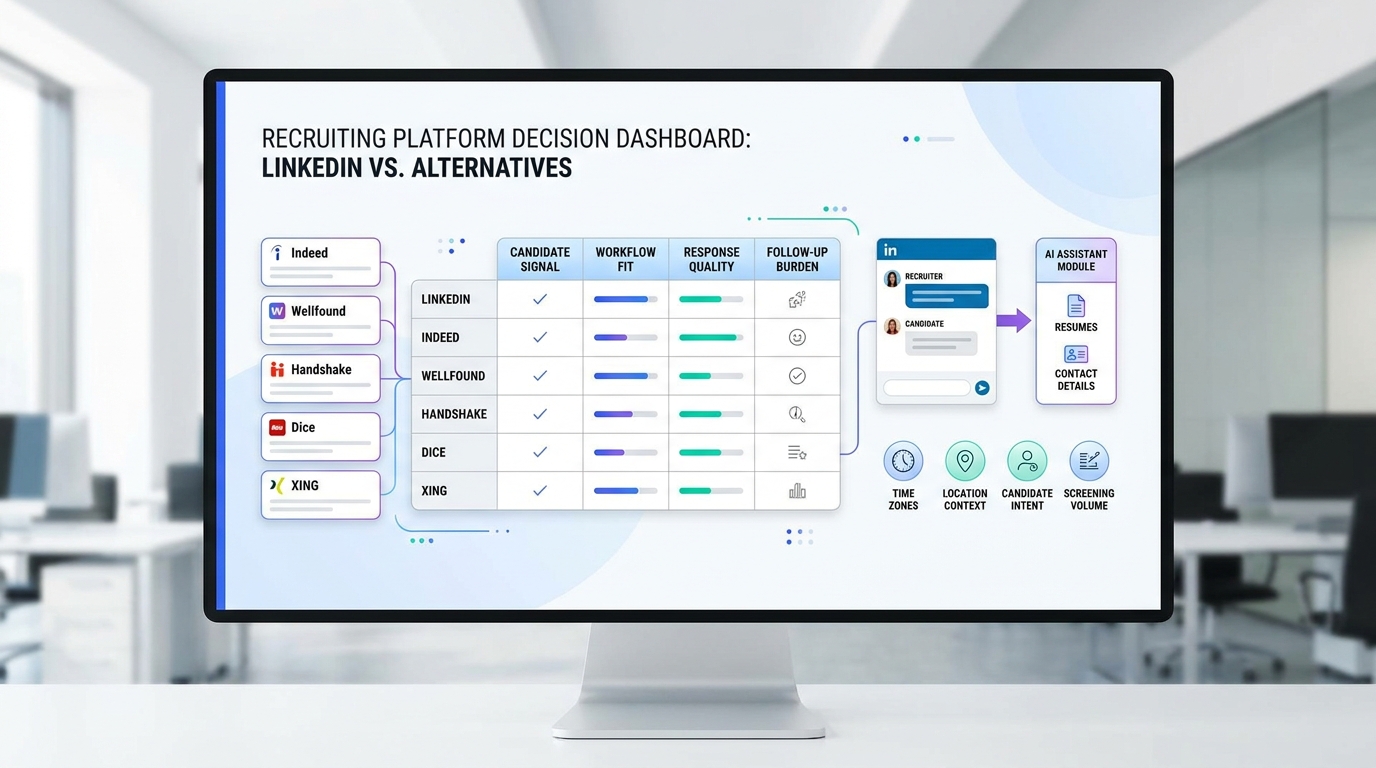
This article helps recruiters judge websites like LinkedIn by candidate signal and workflow fit so they avoid slow, noisy hiring.
That sounds simple, but it is exactly where hiring teams lose time. A platform that looks strong in a comparison table can create weak response rates, extra screening work, poor follow-up discipline, and messy handoffs to hiring managers. For agency recruiters, that means slower placements and more manual chasing. For in-house teams, it means longer time-to-fill, inconsistent candidate experience, and less confidence in which source is actually working.
In my own sourcing work, I have found that the bottleneck is rarely just “finding another site.” It is managing the conversations that follow. That is why tools like AI Recruiter can help in a practical way: it can handle first-touch LinkedIn outreach, keep candidate replies moving across time zones, and collect resumes or contact details from interested people while the recruiter still makes the final judgment on fit, resume quality, and next steps.
You can see the same problem in the kind of advice that circulates on LinkedIn itself. One week the loudest voices say nobody should list an address on a resume. The next week someone else says cover letters are pointless or two-page resumes are always wrong. Then a candidate applies across markets with no location context, and the recruiter is left doing detective work: are they local, relocating, eligible to work in that area, or likely to drop when commute reality sets in?
That is the real transition point for this topic. The issue is not just whether LinkedIn advice is good or bad. It is that recruiters need channels and workflows that surface usable context fast, reduce unnecessary back-and-forth, and match the hiring goal. So when people search for job platforms other than LinkedIn or more websites like LinkedIn, the useful question is not “what replaces LinkedIn?” but “which platform helps me get the right candidate signal for this role?”
Practical takeaway: The best alternative to LinkedIn is usually not a single destination. It is a sourcing mix that combines one broad channel, one targeted channel, and a disciplined follow-up process.
Table of Contents
- Why LinkedIn alternatives are hard to judge
- What counts as websites like LinkedIn?
- Quick comparison of major alternatives
- Best options by recruiting use case
- Using LinkedIn better before replacing it
- How recruiters should choose job platforms other than LinkedIn
- A practical platform stack for hiring teams
- Common mistakes recruiters make
- FAQ
Why LinkedIn Alternatives Are Hard to Judge
Recruiters do not evaluate platforms the same way job seekers do. A candidate may only care about whether a site has relevant openings. A recruiter has to think about response quality, location clarity, profile depth, candidate intent, search behavior, and how much admin the channel creates after posting or outreach begins.
That is why generic LinkedIn advice can be misleading. In the resume-address debate, the strongest point was not that every employer needs a full address. It was that hiring decisions still depend on practical context: commute risk, local hiring preference, compliance, relocation uncertainty, and whether the recruiter can move forward without guessing. The same logic applies when comparing websites like LinkedIn. A platform is only useful if it reduces uncertainty rather than adding more of it.
In practice, I look at three signals first:
- How much context the candidate provides
- How quickly the recruiter can qualify intent
- How much manual follow-up the channel creates
Those three factors matter more than hype, list rankings, or one-off opinions from people who have not run hiring workflows themselves.
What Counts as Websites Like LinkedIn?
The search intent behind websites like LinkedIn is mixed. Some users want another professional network. Others want a job board with broader candidate reach. Others are looking for niche communities for startup, tech, remote, student, or local-market hiring.
From a recruiting standpoint, it helps to split alternatives into three groups:
- Professional networking platforms: strongest when identity, profile visibility, and relationship-based sourcing matter.
- General job boards: best when you need broad exposure and active applicants.
- Niche talent platforms: better when the hiring problem is specialized by industry, candidate stage, geography, or work model.
This distinction matters because recruiters often ask for a LinkedIn replacement when the real need is more specific. They may need more startup candidates, more local candidates, better engineering reach, or a stronger early-career funnel. Different problems require different channels.
Quick Comparison of Major Alternatives
| Platform | Best For | Main Strength | Main Limitation | How It Differs from LinkedIn |
|---|---|---|---|---|
| Indeed | General hiring and active applicants | Broad visibility at scale | Can create high screening volume | Job-board first, little networking depth |
| ZipRecruiter | Fast distribution and SMB hiring | Speed and job reach | Less useful for relationship-led sourcing | More posting and matching oriented |
| Wellfound | Startup jobs and startup talent | Higher startup intent | Narrower audience | More specialized than LinkedIn |
| Handshake | Students and early-career hiring | Campus relevance | Limited for experienced roles | Built for education-to-work transitions |
| Dice | Tech recruiting | Concentrated technical audience | Not broad across all functions | More role-specific for technical hiring |
| Glassdoor | Employer brand and job research | Candidate research behavior | Not a full sourcing engine | Stronger company-review context |
| Monster | Traditional broad job search | Established job board familiarity | Less profile depth | Listings first, networking second |
| Regional professional networking | Useful in select markets | Limited global relevance | Regional rather than universal |
Best Options by Recruiting Use Case
1. Indeed for broad reach
Indeed remains one of the strongest answers when the goal is volume and visibility. If your team is hiring for common functions, recurring roles, or operational positions, Indeed can be one of the most practical job platforms other than LinkedIn.
Best for: broad-market hiring, active job seekers, repeated hiring needs.
Watch out for: high applicant volume without enough qualification detail.
Recruiter view: Strong top-of-funnel source, but only if your screening process is ready.
2. ZipRecruiter for faster distribution
ZipRecruiter is useful when speed matters more than networking depth. It is often a fit for smaller businesses or teams that need to push openings out quickly and start generating responses from active applicants.
Best for: urgent hiring, SMB recruiting, rapid job visibility.
Watch out for: weaker fit for executive search or highly consultative recruiting.
Recruiter view: Good for velocity, less useful if success depends on nuanced sourcing conversations.
3. Wellfound for startup hiring
When the talent question is really about startup intent, Wellfound is often more relevant than broad channels. It gives recruiters a better chance of reaching candidates who already understand startup environments, risk tolerance, and growth-stage tradeoffs.
Best for: startup jobs, founder-led hiring, early-stage teams.
Watch out for: less reach for non-startup roles.
Recruiter view: Better signal quality when startup fit matters as much as title match.
4. Handshake for students and graduates
Handshake is often more useful than LinkedIn for internships, campus recruiting, and graduate entry roles. If the target audience is still in school or very early in career, a purpose-built student platform usually performs better than a broad professional network.
Best for: student hiring, campus recruiting, intern classes.
Watch out for: limited relevance for mid-career and senior roles.
Recruiter view: Best when the candidate journey starts before traditional professional networking.
5. Dice for technical talent
Dice is one of the clearest examples of why niche sourcing matters. For software engineering, infrastructure, data, and related roles, it can reduce some of the noise that recruiters often see on broader platforms.
Best for: engineering and technical recruiting.
Watch out for: too narrow for broader hiring programs.
Recruiter view: Use it as a specialized source, not a universal replacement.
6. Glassdoor for employer-brand-aware candidates
Glassdoor plays a different role. It matters when candidates are actively researching companies, comparing workplace reputation, and deciding whether an application is worth their time.
Best for: employer brand support, informed applicants, conversion support.
Watch out for: weak value as a standalone sourcing channel.
Recruiter view: Better as part of a wider channel mix than as the main hiring engine.
7. Monster for traditional coverage
Monster still has value for employers that benefit from mainstream job-board behavior and broad listing visibility. It is not usually the first choice for modern networking-led sourcing, but it can still contribute to broad applicant flow.
Best for: general job advertising and additional broad reach.
Watch out for: overlap with other broad job boards.
Recruiter view: Additive source, but source quality needs tracking.
8. XING for market-specific hiring
XING is a reminder that geography matters. Some markets have regional networking behavior that differs from what recruiters expect in the US or UK. In those markets, a local platform can outperform a larger global brand.
Best for: specific regional markets with strong local usage.
Watch out for: low relevance outside its strongest geographies.
Recruiter view: Useful when local professional visibility matters more than global scale.
Using LinkedIn Better Before Replacing It
Before adding more sites, it is worth fixing one of the biggest problems inside LinkedIn recruiting itself: poor context capture. The resume-address example is useful here because it shows what happens when surface-level advice outruns hiring reality. Recruiters do not always need a full street address, but they do need enough location context to judge local fit, commute practicality, relocation, and work eligibility questions.
The same principle applies to outreach. If recruiters are spending hours sending messages and then losing track of replies, the problem is not solved by adding more platforms. It gets worse.
I have used StrategyBrain AI Recruiter specifically for that part of the workflow. What stood out in practice was not some magical auto-hiring promise. It was the operational relief: the system could keep candidate conversations moving after first contact, answer routine role questions, and collect resumes from interested people without me needing to monitor every reply in real time. For cross-border or after-hours recruiting, the multilingual and 24/7 response capability is especially useful. The recruiter still reviews the resume, decides whether the background actually matches the role, and controls the next step, but the repetitive front-end work becomes much easier to manage.
For teams that rely heavily on LinkedIn, that kind of support can matter more than adding yet another profile database, because it closes the gap between sourcing effort and candidate follow-through.
How Recruiters Should Choose Job Platforms Other Than LinkedIn
When evaluating job platforms other than LinkedIn, I recommend five filters.
- Candidate intent: Are you trying to reach active applicants, passive candidates, students, startup talent, or technical specialists?
- Context quality: Will the platform surface enough information about location, work model, career stage, or professional background to reduce guesswork?
- Workflow burden: How much manual follow-up, qualification, and tracking will this channel create?
- Geographic fit: Is the platform strong in the market where the role sits?
- Outcome measurement: Can you tell whether the source produces interviews and hires, not just clicks and applications?
This is where many teams make the wrong call. They compare traffic or popularity instead of comparing usable recruiting signal. A platform that creates more admin and less clarity is not actually helping, even if it looks strong at the top of the funnel.
A Practical Platform Stack for Hiring Teams
Most employers should not look for one perfect substitute. They should build a stack based on hiring type.
| Hiring Need | Recommended Stack Logic |
|---|---|
| General hiring | One broad job board plus structured recruiter follow-up |
| Startup hiring | One startup-focused platform plus one broad channel |
| Student hiring | One campus-focused source plus employer-brand support |
| Tech hiring | One technical niche platform plus selective broader sourcing |
| Regional hiring | One local-market network plus market-specific outreach process |
If LinkedIn remains part of that mix, the real gain often comes from making LinkedIn execution more reliable. A workflow supported by AI Recruiter on LinkedIn can keep early outreach consistent, capture candidate resumes and contact information, and reduce the lag that often causes interested prospects to disappear. That works especially well for agency recruiters, in-house talent teams, and individual headhunters who already know that initial engagement is where too much manual time gets lost.
Common Mistakes Recruiters Make
Expecting one site to do everything
Networking, active applications, niche talent discovery, and employer research are different behaviors. No single platform handles all of them equally well.
Following internet advice without checking hiring reality
The resume-address debate is a good example. Blanket advice sounds neat, but real recruiting depends on role type, location, compliance, and candidate context. The same is true when comparing websites like LinkedIn.
Choosing reach over relevance
Broad reach is useful only if your team can process the volume and the candidates are reasonably matched to the role.
Ignoring operational follow-through
If candidate replies arrive at night, across markets, or in large numbers, recruiters need a way to respond and capture details consistently. Otherwise, sourcing effort leaks away before screening even starts.
Measuring applicants instead of hires
The best source is not the one with the biggest top-of-funnel. It is the one that creates qualified conversations and real hiring progress.
FAQ
What are the best websites like LinkedIn for recruiters?
The best answer depends on the role. Indeed is strong for broad reach, Wellfound for startups, Handshake for students, Dice for technical hiring, and XING for some regional markets.
What are the best job platforms other than LinkedIn for startup jobs?
Wellfound is one of the most relevant options because the candidate pool is more startup-oriented than what you usually get on broad job boards.
Can one website fully replace LinkedIn?
Usually not. LinkedIn combines networking, professional identity, and job discovery. Most alternatives are stronger in one area rather than all three.
Are websites like LinkedIn better than LinkedIn for all roles?
No. They can be better for specific use cases, such as student hiring, startup recruiting, or niche technical roles, but not as a universal replacement.
What should recruiters fix before adding more platforms?
They should fix context capture, follow-up speed, and response management first. If candidate information and outreach replies are not handled well, more channels usually create more noise rather than better hiring.
Where does AI Recruiter fit if a team still uses LinkedIn?
It fits on the execution side. Recruiters can use AI Recruiter to automate first-touch outreach, maintain candidate communication around the clock, and collect resumes and contact details from interested prospects, while the recruiter keeps control of evaluation and interview decisions.
Conclusion
If you are comparing websites like LinkedIn, start with the recruiting problem, not the platform brand. Broad hiring, startup hiring, graduate hiring, technical sourcing, and local-market recruiting all require different channel choices.
The deeper lesson from the LinkedIn advice example is that recruiter decisions depend on usable context, not slogans. Whether the issue is an address on a resume, local candidate preference, or a candidate reply that arrives after hours, the real question is always the same: does this channel help you qualify people faster and with less guesswork?
That is why the strongest approach is usually a mix of job platforms other than LinkedIn, paired with better workflow discipline on LinkedIn itself. When the sourcing channel and the response process work together, recruiters make better decisions and lose fewer good candidates in the gap between outreach and review.