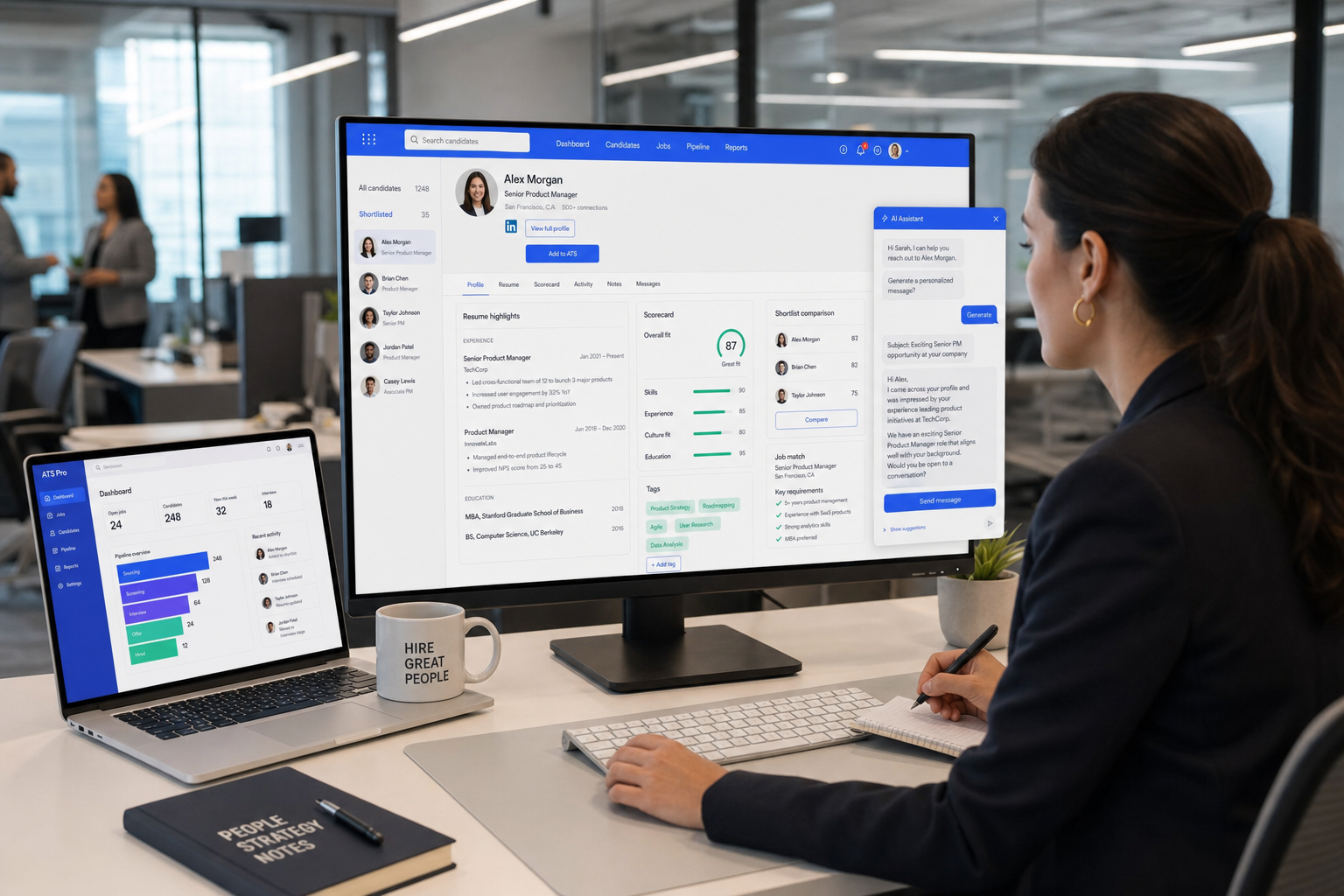
Use this guide to judge which ats recruitment tool will speed shortlists, surface real candidate evidence, and avoid costly resets.
That sounds simple until a live search turns messy. Recruiters lose time chasing resumes across inboxes, comparing incomplete profiles, and explaining weak shortlists to hiring managers who want evidence, not vague enthusiasm. For a small search firm, that means slower placements and more rework. For an in-house talent team, it means stalled requisitions, frustrated stakeholders, and a candidate experience that starts to feel disjointed.
In that gap between outreach and real evaluation, I have found that StrategyBrain AI Recruiter can be useful as workflow support rather than as a decision-maker. It helps with repetitive LinkedIn outreach, after-hours candidate replies, and collecting resumes or contact details from interested people, which is valuable when a recruiter is managing multiple searches at once. The recruiter still owns the final judgment, resume review, and next-step decision, but the admin burden gets lighter when early communication does not depend on one person being online every hour.
The pattern is easy to recognize if you have ever worked a finance search. A candidate may look polished on LinkedIn, but when the resume arrives, the real questions begin. Can they show systems depth beyond broad claims about Excel or ERP tools? Do the bullet points show outcomes under pressure, not just responsibilities? Does the career path show progression, adaptability, and increasing scope? Those are not cosmetic details. They are often the difference between a credible shortlist and a reset on the search.
That is exactly why evaluating the best recruiting software cannot stop at resume storage or pipeline stages. The better question is whether an ats recruitment tool helps recruiters capture, compare, and act on the evidence that matters most. In this guide, I will use that lens to assess the top applicant tracking systems and what actually separates the best applicant tracking options for recruiters, agency teams, and hiring managers.
Key takeaway: The best recruiting software does more than organize applicants. It helps recruiters see technical fit, outcome-based achievements, and career progression fast enough to improve shortlist quality and hiring speed.
- Why resume signal quality matters in ATS selection
- What an ATS recruitment tool should actually help you judge
- How the top applicant tracking systems are really compared
- Must-have features for better shortlists
- Where AI helps and where recruiters still decide
- Best applicant tracking by team type
- How recruiting software improves hiring KPIs
- Buyer checklist for choosing the right platform
- Common mistakes when buying recruiting software
- FAQ
Why resume signal quality matters in ATS selection
One lesson recruiters learn quickly is that not all candidate information is equally useful. A profile may be active, responsive, and well written, yet still fail to answer the core hiring questions. In finance hiring especially, I look for three signals early: systems information, accomplishments, and progression. That same logic becomes a practical framework for evaluating recruiting software.
If your ATS makes it hard to surface technical skills, compare outcomes across candidates, or see how a career has developed over time, your team ends up screening manually in too many places. The system may be tracking applicants, but it is not helping recruiters judge applicant quality.
This is where the seed keyword matters in a real operational sense. A strong ats recruitment tool should not just collect resumes. It should help recruiters separate candidates with specific, credible evidence from those with generic summaries and inflated claims.
What an ATS recruitment tool should actually help you judge
An applicant tracking system is often described as the central hub for hiring activity. That is true, but for experienced recruiters the more important question is what the system helps you judge quickly and consistently.
At minimum, a useful ATS should help you answer three evaluation questions:
- Can this candidate do the work? That means capturing systems knowledge, domain skills, certifications, and role-specific evidence clearly.
- Has this candidate delivered results? Recruiters need a way to compare achievements, project ownership, and business outcomes, not just job descriptions.
- Is there credible progression? Growth in responsibility, scope, and adaptability often matters as much as current title.
Those are hiring judgments, not software features, but the best recruiting software supports them through structured profiles, searchable fields, resume parsing, notes, scorecards, and reporting. That is one of the most practical differences between a basic database and a strong applicant tracking system for recruiters.
When I have used LinkedIn-heavy sourcing workflows, this is also where AI Recruiter can fit into the stack. It can keep conversations moving, gather resumes from interested candidates, and reduce the lag between first response and recruiter review. What it does not do, and should not pretend to do, is replace recruiter judgment on whether the resume actually proves fit.
How the top applicant tracking systems are really compared
Most lists of the top applicant tracking systems treat every buyer as if they are solving the same problem. In practice, recruiters compare software by bottleneck.
A more grounded comparison framework includes these five areas:
- Signal clarity: how well the system shows technical skills, achievements, and progression in one view.
- Workflow speed: how quickly recruiters can move candidates, leave notes, request feedback, and schedule next steps.
- Collaboration quality: whether hiring managers can review evidence and respond without slowing the process.
- Reporting value: whether the team can track source quality, conversion points, and delay patterns.
- Integration fit: whether the system connects cleanly with email, calendar, HR systems, sourcing tools, and outreach workflows.
If your team’s main challenge is identifying stronger candidates earlier, prioritize candidate record quality and searchability. If your issue is response delay, look harder at automation and communication workflow support. If hiring managers keep disagreeing on who is qualified, structured scorecards and visible evidence matter more than a long feature list.
Must-have features for better shortlists
The best applicant tracking platforms usually share a core foundation. The difference is not whether they have features in a brochure. It is whether those features help recruiters build a better shortlist with less wasted motion.
1. Resume parsing that preserves useful detail
Resume parsing should create clean, searchable candidate records without flattening the very details recruiters need. If a system cannot reliably surface tools used, projects led, or progression across roles, it adds screening work instead of reducing it.
2. Structured candidate profiles
Good recruiting software turns scattered information into profiles that are easy to compare. That matters when you are assessing outcomes, not just titles. A strong system helps recruiters spot who led a process improvement, delivered under tight timelines, or managed increasing responsibility.
3. Search and filtering for real recruiter questions
Recruiters do not search for candidates in abstract terms. They look for combinations like systems exposure plus measurable accomplishments plus industry background. An ATS should support that logic.
4. Pipeline stages with context
Moving a candidate from screen to interview is easy. Preserving why they moved forward is harder. The best recruiting software keeps stage movement tied to notes, feedback, and candidate evidence.
5. Hiring team scorecards
Scorecards matter most when they are tied to decision criteria. If progression and accomplishments are important for a role, the system should make it easy for interviewers to score against those dimensions consistently.
6. Communication and follow-up automation
Recruiters lose more time than they admit to outreach repetition and inbox maintenance. For that part of the workflow, tools such as StrategyBrain AI Recruiter can support LinkedIn communication, candidate follow-up, and resume collection across time zones, while the ATS remains the system of record for review and movement.
7. Reporting that reflects shortlist quality
Source volume alone is not enough. Teams need to know which channels produce qualified candidates, which hiring managers delay decisions, and where pipeline fallout starts.
8. Clean handoff to onboarding or HR operations
A strong ATS does not stop at offer accepted. It reduces duplicate entry and keeps key candidate information moving into the next stage of employment operations.
Where AI helps and where recruiters still decide
AI belongs in this conversation, but not as a substitute for recruiter judgment. It is most useful when it removes repetitive work around communication, organization, and first-pass workflow support.
| AI-supported area | Practical value | What still needs recruiter review |
|---|---|---|
| Candidate outreach | Keeps initial contact and follow-up moving | Whether the candidate is truly relevant to the role |
| After-hours communication | Reduces delay across time zones and busy schedules | How to position the role and handle nuanced concerns |
| Resume and contact capture | Collects documents from interested candidates faster | Whether the resume proves capability and fit |
| Profile organization | Makes records easier to search and revisit | Final prioritization and shortlist decisions |
In my own workflow, the most realistic benefit from AI Recruiter has been coverage. Candidates often reply when recruiters are off the clock, especially in cross-border searches. Having a tool keep the conversation active, answer common role questions, and prompt resume submission can prevent good prospects from going cold. But once that resume lands, I still want a recruiter reading for substance: systems depth, accomplishments, and progression.
That balance is important. The best applicant tracking setup is not fully automated hiring. It is a workflow where AI reduces friction and recruiters remain accountable for quality.
Best applicant tracking by team type
Not every team needs the same setup, even if they all search for the top applicant tracking systems.
Small search firms and independent recruiters
These teams need speed first. Candidate searchability, simple pipelines, fast outreach, and low admin overhead matter most. They often benefit from pairing a lean ATS with AI-supported messaging for LinkedIn-heavy sourcing.
What to prioritize: usability, resume capture, searchable notes, and quick shortlist building.
Mid-market in-house talent teams
These teams usually need more structure: approvals, hiring manager visibility, reporting, and better consistency in evaluation.
What to prioritize: scorecards, stage reporting, source tracking, and integrations with HR operations.
Enterprise TA organizations
Enterprise teams often need permission controls, process governance, advanced analytics, and standardized workflows across regions or business units.
What to prioritize: implementation planning, reporting logic, and change management.
Staffing agencies and executive search teams
Agency recruiters need both applicant tracking and relationship management. Rediscovery, communication history, and talent pool quality matter as much as active requisition workflow.
What to prioritize: CRM-style searchability, recruiter speed, candidate communication support, and strong resume handling.
How recruiting software improves hiring KPIs
The advantages of applicant tracking system adoption become easier to defend when tied to operating metrics.
- Time to shortlist: recruiters can compare candidate evidence faster when profiles are structured well.
- Time to hire: scheduling, communication, and clearer ownership reduce preventable delays.
- Source quality: teams can see which channels produce credible candidates, not just more applications.
- Pipeline efficiency: stage data helps identify where promising candidates stall or drop out.
- Hiring manager responsiveness: visible feedback expectations reduce decision lag.
One of the most underrated applicant tracking system benefits is consistency of judgment. When recruiters evaluate candidates through common evidence fields and hiring teams review the same criteria, it becomes easier to improve process quality over time.
That said, software only amplifies the process underneath it. If recruiters are unclear on what counts as proof of fit, even the best recruiting software will not fix weak shortlist discipline.
Buyer checklist for choosing the right platform
If you are comparing the best recruiting software, use this checklist before getting impressed by a polished demo.
- Define your evidence model. What does a strong candidate record need to show for your core roles?
- Map your workflow. Document where sourcing, screening, scheduling, and feedback slow down.
- Check profile quality. Can the system display systems knowledge, accomplishments, and progression clearly?
- Test search logic. Make sure recruiters can filter candidates the way they actually think.
- Review hiring manager experience. If managers avoid the system, recruiter efficiency still suffers.
- Evaluate communication support. Decide what belongs inside the ATS and what may be better supported by tools like AI Recruiter for LinkedIn outreach and follow-up.
- Validate reporting definitions. Source, stage, and conversion metrics need to match your operating questions.
- Separate automation from judgment. Save time where possible, but protect recruiter review where quality matters.
- Plan implementation early. Ownership, migration, permissions, and training matter as much as product choice.
- Ask the weekly-use question. Will this platform make real recruiting work easier every week?
Common mistakes when buying recruiting software
Even experienced recruiting leaders make avoidable mistakes when evaluating an ats recruitment tool.
Buying for feature count instead of hiring judgment
A long product checklist does not guarantee better recruiting. If the system does not help teams assess candidate substance quickly, the extra features will not matter much.
Ignoring recruiter workflow speed
Every extra click in screening, note-taking, or stage movement adds up. Slow systems create quiet resistance.
Assuming AI replaces evaluation
AI can support outreach, follow-up, and organization, but recruiters still need to review resumes honestly and avoid overselling candidate fit. That discipline mirrors the same principle candidates should follow on their own resumes: be specific, outcome-focused, and truthful.
Overlooking progression as a hiring signal
Some teams over-focus on current title and miss the value of visible growth. Your ATS should make progression easy to see, not bury it.
Skipping implementation planning
Selection is only half the project. A poorly configured platform will underperform even if it looked excellent in evaluation.
FAQ
What is an ATS recruitment tool?
An ATS recruitment tool is software that centralizes hiring activity such as job posting, applicant tracking, resume review, interview coordination, team feedback, and reporting. The best systems also help recruiters compare candidate evidence more clearly.
What makes the best applicant tracking platform different from a basic ATS?
The best applicant tracking platforms do more than store resumes. They make candidate information easier to search, compare, and act on, especially around skills, accomplishments, and career progression.
How should recruiters compare the top applicant tracking systems?
Start with your team’s bottlenecks. If your issue is poor shortlist quality, focus on profile structure and searchability. If your issue is delay, focus on communication workflows, automation, and hiring team responsiveness.
Where does AI fit into recruiting software?
AI fits best in repetitive workflow tasks such as outreach, candidate replies, and resume collection. Recruiters should still own final judgment, qualification, and hiring recommendations.
Can StrategyBrain AI Recruiter replace an ATS?
No. It is better viewed as a support layer for LinkedIn communication and early workflow tasks, while the ATS remains the main system for candidate tracking, evaluation, and hiring process management.
Final thoughts
The best recruiting software is the one that helps your team judge candidates better, not just organize them faster. If a platform cannot help recruiters identify technical depth, real accomplishments, and credible progression, it will struggle to improve hiring quality no matter how modern the interface looks.
That is why the smartest way to assess an ats recruitment tool is through practical recruiter work. Use the same lens you would use on a strong finance resume: what systems knowledge is visible, what outcomes are proven, and what progression is clear. From there, comparing the top applicant tracking systems and choosing the best applicant tracking option becomes a much more grounded decision.