When interview notes are scattered and decisions stall, this article helps hiring leaders evaluate candidate tracking software to avoid weaker judgment, delays, and candidate drop-off.
That conclusion usually comes after a team has already felt the cost of weak process control. A recruiter loses time chasing feedback that should have been captured in one place. A small agency owner sees consultants handle candidate conversations differently, which weakens client trust and makes performance hard to compare. An in-house talent lead notices that strong applicants complete the application, enter the pipeline, and then sit too long because interview notes are scattered across inboxes, calendars, and spreadsheets. The result is not just slower hiring. It is poorer decision quality, inconsistent candidate experience, avoidable drop-off, and a less credible employer brand.
In my own workflow, I have found that StrategyBrain AI Recruiter is most useful when the bottleneck is repetitive outreach and initial response handling rather than final selection. For teams using LinkedIn heavily, it can automate first-contact messaging, continue conversations across time zones, and collect resumes or contact details from interested people without forcing recruiters to stay online around the clock. What matters is that the recruiter still owns resume review, interview judgment, and the final move into the live hiring process. Used that way, AI Recruiter helps protect the quality of the interview stage by reducing the admin noise that builds before it.
The pressure becomes obvious at the interview stage, where the hiring process stops being a stack of resumes and turns into a two-way evaluation. Once a candidate has been attracted by a job description and screened into the funnel, the interview is where the recruiter and hiring manager try to confirm more than qualifications. They are testing judgment, communication, adaptability, motivation, and alignment with the role. At the same time, every question signals something back to the candidate about what the company values, how the team thinks, and whether the workplace feels thoughtful or transactional.
If that interview data is not structured, the entire hiring story starts to break. One interviewer asks open-ended behavioral questions, another rushes through competency checks, and a hiring manager leaves vague feedback two days later. The team has conversations, but not usable comparison. Candidates are assessed, but not consistently. That is exactly why the best recruiting software is not only about sourcing or posting jobs. It is about whether your candidate tracking software, online job application software, and applicant tracking system software can carry a reliable thread from application intake to structured interview evaluation and final decision.
Table of Contents
- What the best recruiting software should really solve
- Why interviews expose software weaknesses fast
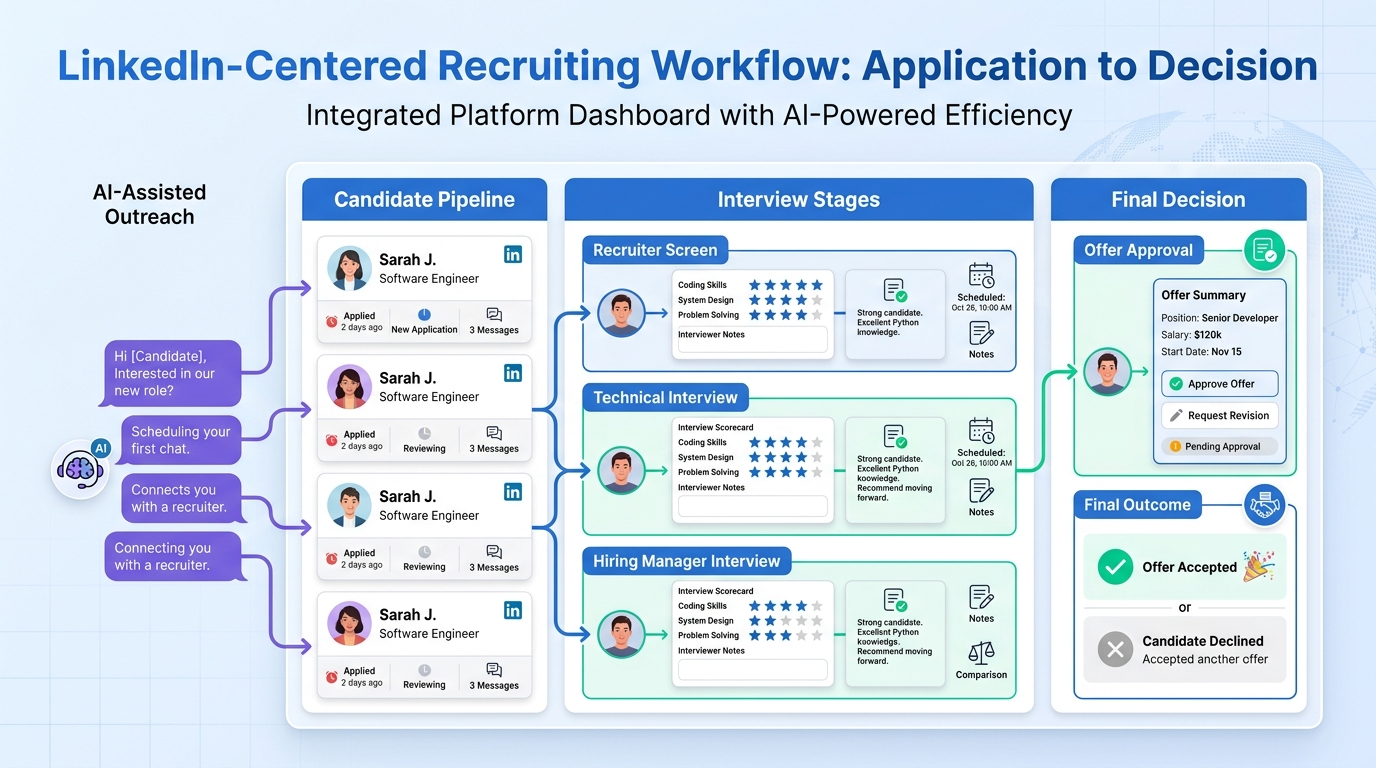
- The hiring workflow your system should connect end to end
- Features that matter in applicant tracking system software
- How to choose by hiring model and team size
- A practical evaluation process for recruiting teams
- Costs, tradeoffs, and hidden friction
- Common mistakes when buying recruiting software
- FAQ
What the Best Recruiting Software Should Really Solve
Many buyers enter this category thinking they need better organization. In reality, they usually need better hiring judgment at scale. That is an important distinction. Basic organization alone will not fix inconsistent interviews, weak hiring manager participation, or candidate communication gaps. The best recruiting software should help a team run a complete and comparable hiring process, where each stage produces usable information for the next one.
That is why candidate tracking software now overlaps heavily with broader applicant tracking system software. Recruiters may search with one term, HR leaders with another, but the operational need is similar: capture applicants, move them through stages, record interactions, coordinate interview activity, and support final decisions with enough structure to reduce guesswork.
The strongest systems do three things well:
- Create continuity from first application through offer, so data does not break apart between tools
- Support structured evaluation, especially in interviews, where subjective judgment can easily become inconsistent judgment
- Protect candidate experience by making communication, scheduling, and feedback handling more dependable
When software fails in those areas, recruiters end up with a polished funnel at the top and messy decisions in the middle.
Why Interviews Expose Software Weaknesses Fast
The interview stage is where many recruiting systems reveal whether they are genuinely useful or just decent record-keeping tools. Good interview practice depends on a few things going right at the same time: the role has to be clearly defined, interviewers need aligned priorities, questions should map to competencies or values, and feedback needs to be captured quickly enough to support fair comparison.
That logic mirrors a truth most experienced recruiters learn early: interview questions do not only test candidates. They also tell candidates what the company cares about. If your team asks thoughtful, open-ended questions about problem solving, setbacks, collaboration, and motivation, candidates infer that hiring is deliberate. If the process feels improvised, repetitive, or impersonal, they draw conclusions about the company just as quickly.
From a software perspective, this means your platform should help with more than stage labels. It should make it easier to:
- Set structured interview plans before meetings begin
- Brief interviewers so they avoid duplication and stay aligned
- Capture scorecards or notes in a format that supports comparison
- Track which competencies, behaviors, or motivations have actually been evaluated
- Preserve candidate communication so the process feels transparent rather than opaque
Practical takeaway: If a system cannot help your team move from interview conversation to usable hiring evidence, it is not among the best recruiting software options for a serious hiring function.
The Hiring Workflow Your System Should Connect End to End
One of the easiest mistakes in software selection is treating hiring as a series of isolated tasks. Strong recruiting operations work better when they are treated as a connected system. The interview article behind this discussion makes that clear: interviews sit inside a longer arc that begins with attraction and screening, and ends with comparison, alignment, and onboarding readiness. Your software should reflect that full arc.
1. Job creation and posting
Before interview quality matters, candidate quality has to enter the funnel. The best recruiting software should make job creation, approvals, and distribution straightforward. This is where online job application software matters more than many teams expect. A confusing or overly long application flow creates drop-off before recruiters ever get a chance to evaluate talent.
2. Application intake and early screening
Once candidates apply, recruiters need clean profiles, resume parsing, and visible source data. This stage should reduce manual handling, not add to it. If your team also relies on outbound sourcing, this is where I have seen StrategyBrain AI Recruiter fit alongside the main ATS most effectively. It can continue initial LinkedIn conversations, answer candidate questions about the opportunity, and collect resumes from interested prospects, while the recruiter stays focused on qualification and next-step decisions.
3. Pipeline movement with clear ownership
Pipeline stages only help when ownership is obvious. Recruiters should know who is waiting for review, which manager owes feedback, and how long candidates are sitting between steps. Good candidate tracking software reduces hidden delay by making those handoffs visible.
4. Interview design and execution
This is where the strongest recruiting systems separate themselves. Interviews should not feel like disconnected conversations. Your platform should support competency questions, behavioral prompts, values alignment checks, motivational exploration, and candidate-led questions in a consistent framework. That does not mean robotic interviews. It means structured comparison with room for follow-up.
5. Feedback capture and team alignment
After the interview, good questions only matter if the answers are captured well. A strong system enables scorecards, comments, and debrief workflows while impressions are still fresh. If the software makes feedback hard to enter or hard to review, teams revert to side conversations and memory-based decision making.
6. Offer management and close
Final approvals, offer coordination, and status updates should stay in the same operating system. When the close happens outside the platform, reporting accuracy usually suffers.
7. Reporting and process improvement
The best systems help recruiting leaders see not only source performance and time to fill, but also where interviews fail to produce alignment. If one role type repeatedly stalls after final panel review, that is a process signal worth seeing, not just a scheduling issue worth tolerating.
Features That Matter in Applicant Tracking System Software
Feature lists are easy to inflate, so I prefer to judge applicant tracking system software by whether it improves the actual work of recruiters, hiring managers, and coordinators. These are the features that usually matter most.
| Feature | Why It Matters | What to Test |
|---|---|---|
| Job posting and multi-channel distribution | Supports top-of-funnel reach without duplicate admin | Check how easily roles can be updated after posting |
| Online application flow | Directly affects candidate conversion and perception | Apply to a role yourself on desktop and mobile |
| Resume parsing and profile organization | Reduces manual sorting and speeds screening | Test different resume formats, not just ideal ones |
| Pipeline visibility | Shows stage movement and waiting points clearly | Look for aging views and ownership clarity |
| Structured interview kits | Improves consistency across interviewers | See whether questions, scorecards, and notes connect well |
| Feedback workflows | Turns conversations into comparable data | Test how fast managers can submit feedback |
| Candidate communication tools | Supports trust and reduces confusion | Review templates, status updates, and audit history |
| Analytics dashboards | Enables process improvement and stakeholder reporting | Focus on funnel and stage insights, not vanity metrics |
| Integrations | Keeps recruiting data from fragmenting | Map your HRIS, calendar, background check, and sourcing stack |
If your team does significant outbound recruiting on LinkedIn, one additional capability to consider is whether your ATS can work smoothly with a sourcing assistant layer. In practice, I have seen AI Recruiter help where internal teams struggle with after-hours replies, multilingual first-touch communication, and repetitive outreach follow-up. That does not replace the ATS. It supports the top of the funnel so the ATS receives better-qualified, better-documented interest.
How to Choose by Hiring Model and Team Size
The right software depends less on abstract feature depth and more on hiring context. A platform that feels ideal for a lean recruiting team may feel rigid or underpowered in a larger environment.
Small and growing teams
Smaller teams usually need speed, simplicity, and enough structure to stop hiring from living in spreadsheets. Prioritize intuitive candidate tracking software, clean online job application software, and interview workflows that do not require an operations specialist to maintain them.
Mid-market hiring teams
Once multiple recruiters and managers are involved, consistency becomes more important. At this level, applicant tracking system software should support approvals, interview scorecards, feedback deadlines, and better reporting. If outbound sourcing is also a major channel, adding a dedicated LinkedIn workflow assistant can relieve recruiter workload before candidates even enter formal interviews.
Enterprise environments
Large organizations need configurability, permissions, integration maturity, and auditability. The challenge is preserving structure without making the system too slow for everyday use. Interview alignment is especially important here because more interviewers usually means more variation in evaluation style.
Agency and search firms
Agencies need pipeline control, communication speed, and strong record-keeping across clients and roles. In these environments, recruiter productivity often depends on separating repeatable outreach tasks from high-value judgment work. That is one reason AI-supported sourcing layers can be useful, especially when recruiters are balancing candidate conversations across markets and time zones.
Key insight: The best recruiting software for your team is the one that preserves structured evaluation while removing the admin load that prevents recruiters from doing real recruiting.
A Practical Evaluation Process for Recruiting Teams
When I help teams shortlist tools, I suggest evaluating them in the same sequence a real candidate would experience your hiring process.
- Start with the application. Test the online job application software on mobile and desktop. Count the number of avoidable steps.
- Run a real screening scenario. Upload resumes, review profiles, and see how easily a recruiter can decide who moves forward.
- Build an interview plan. Check whether the system supports competency, behavioral, values, and motivational questions in a usable structure.
- Test hiring manager participation. Ask a manager to review candidates and leave feedback without coaching. Their adoption matters as much as recruiter adoption.
- Measure comparison quality. After mock interviews, see whether the platform helps you compare candidates fairly or just stores disconnected notes.
- Review communication history. Candidates should not feel like they are entering a black box between interview stages.
- Check integrations and sourcing fit. If LinkedIn outreach is central to your hiring model, test how top-of-funnel activity will connect to your ATS process.
- Audit total operating effort. Ask how much admin time the system will require every week, not just how many features it offers.
One lesson from using AI-supported sourcing tools alongside ATS platforms is that handoff discipline matters. In my own use, AI Recruiter conversation workflows were most helpful when I defined exactly when a LinkedIn conversation should stay automated and when it should move to human review. That boundary kept the process efficient without lowering judgment quality.
Costs, Tradeoffs, and Hidden Friction
Software selection often goes wrong because buyers compare subscription prices instead of operating friction. A lower-cost platform can still be expensive if it creates extra admin, weak manager adoption, or poor interview comparison.
Common cost factors include:
- Base platform fees
- User-based licensing
- Implementation and onboarding
- Advanced reporting or automation modules
- Integration setup and maintenance
- Training time for recruiters and managers
- Workflow administration after launch
The more important tradeoff is between flexibility and discipline. A highly configurable system may fit complex hiring needs, but if it requires too much maintenance, recruiters may work around it. On the other hand, a simpler platform may drive better adoption but fail when interview workflows or reporting expectations become more sophisticated.
For teams with heavy outbound sourcing, another cost question is whether recruiter time is being used on work that software can reasonably assist. If a tool helps handle repetitive LinkedIn outreach, multilingual replies, and resume collection, it may improve the economics of the hiring process even if it is not the system of record. The key is to keep final qualification and selection with the recruiter.
Common Mistakes When Buying Recruiting Software
- Confusing tracking with evaluation. A system can move candidates through stages and still fail to support good hiring decisions.
- Ignoring interview structure. Teams often test posting and pipeline views but neglect scorecards, question guides, and feedback usability.
- Overlooking candidate signals. Interviews are a two-way assessment, so clumsy communication damages employer perception.
- Buying around feature hype. Broad claims about automation matter less than whether the workflow actually reduces recruiter effort.
- Skipping real manager testing. If hiring managers do not engage with the tool, the process breaks in the middle.
- Failing to define human judgment boundaries. Automation can support sourcing and follow-up, but recruiters still need to own qualification, interview assessment, and final selection.
The best buying teams evaluate software the same way they evaluate candidates: against clear criteria, with consistent comparison, and with enough evidence to support a confident decision.
FAQ
What is the difference between candidate tracking software and applicant tracking system software?
Candidate tracking software usually refers to tools that help organize applicants and pipeline stages. Applicant tracking system software often refers to the broader platform that also covers job posting, interview coordination, collaboration, reporting, and offer tracking. In practice, the categories overlap heavily.
Why does interview workflow matter when choosing the best recruiting software?
Because interviews are where hiring decisions become most subjective. If the system does not support consistent questions, feedback capture, and side-by-side comparison, teams make slower and less reliable decisions.
Why is online job application software important?
The application flow is the candidate’s first real interaction with your hiring process. If online job application software is slow, confusing, or too long, candidates may drop off before the interview stage even begins.
Can AI tools replace recruiters in the hiring process?
No responsible recruiting team should treat them that way. AI-supported tools can help with outreach, message handling, scheduling support, or resume collection, but final qualification, interview judgment, and hiring decisions should remain with recruiters and hiring managers.
How can StrategyBrain AI Recruiter fit into a broader hiring stack?
It can support LinkedIn-heavy sourcing workflows by automating first-touch communication, handling candidate replies across languages and time zones, and collecting resumes from interested prospects before recruiters move them into the formal ATS process. That makes it a support layer, not a replacement for the main system of record.
What should small recruiting teams prioritize first?
They should prioritize ease of use, fast adoption, a clean application experience, and enough interview structure to compare candidates fairly without adding heavy process overhead.
Conclusion
The best recruiting software is not defined by how many features it lists. It is defined by whether it helps your team carry a clear hiring narrative from application to interview to final decision. In that sense, strong candidate tracking software should do more than track. It should support structured evaluation, stronger candidate communication, and cleaner collaboration with hiring managers.
That is also why the interview stage deserves more weight in software selection than many buyers give it. Interviews reveal whether your system can turn conversation into evidence, and whether your process helps candidates feel evaluated fairly rather than processed mechanically. When you assess tools through that lens, applicant tracking system software and online job application software stop being separate checkboxes. They become parts of the same hiring system.
If your team also relies on heavy outbound sourcing, adding a workflow support layer such as StrategyBrain AI Recruiter can help reduce repetitive pre-screening admin while leaving final judgment where it belongs: with the recruiter.