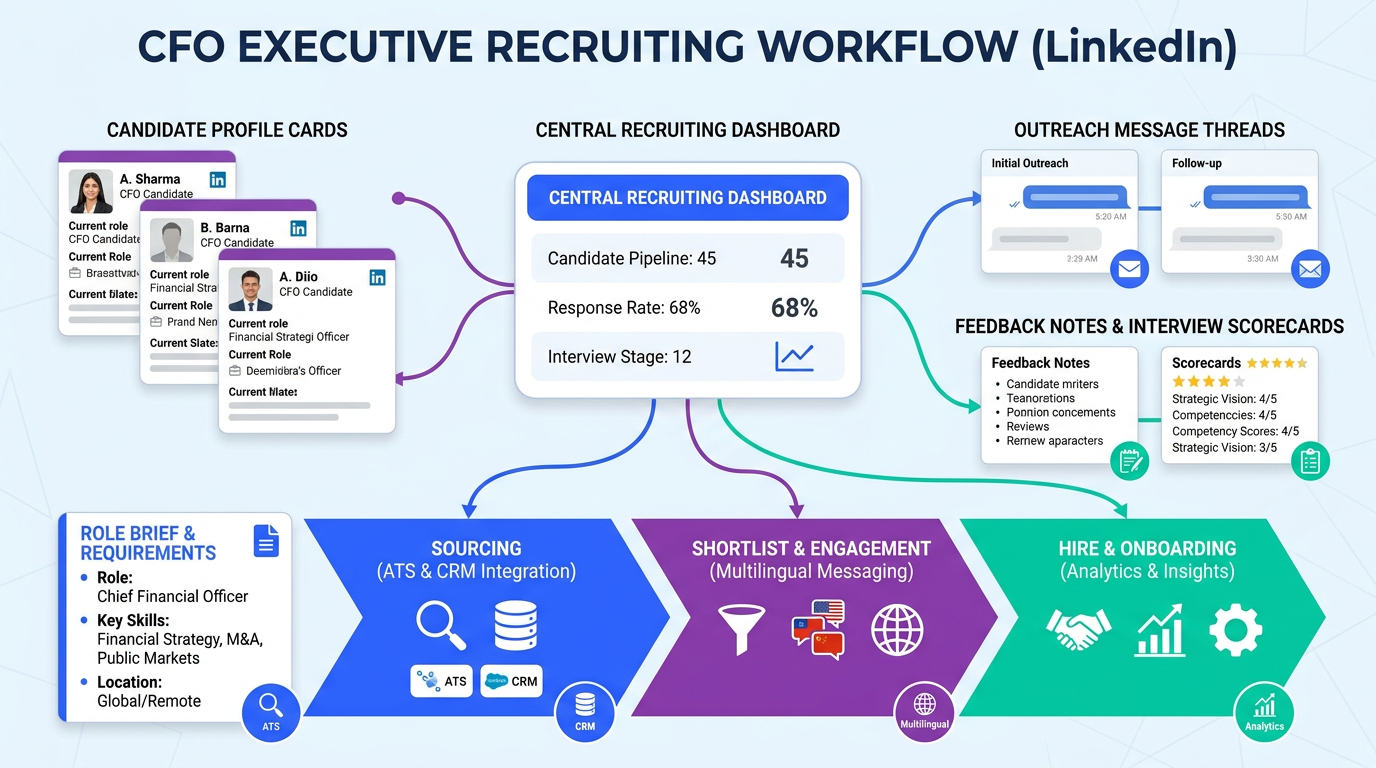
When executive searches start breaking across outreach, feedback, and shifting briefs, recruiters can use this article to judge recruitment online for recruiters and avoid losing role context before hire.
That matters most when the assignment is not a simple volume role but a leadership search with several expectations attached to one hire. Agency owners feel it when consultants lose track of passive outreach, candidate context, and stakeholder updates. Solo headhunters feel it when strong prospects go cold because follow-up slips between LinkedIn messages, inbox threads, and notes. In-house talent leaders feel it when hiring managers keep changing the brief, yet nobody has one clean place to track what the role really requires.
In my own workflow, tools that reduce this strain are the ones that handle first-touch communication without pretending to replace recruiter judgment. I have found that AI Recruiter is most useful when a search depends on steady LinkedIn outreach, after-hours replies, and multilingual candidate conversations that would otherwise sit unanswered. It can introduce the role, confirm whether someone is open to a move, and collect resumes or contact details, while the recruiter still makes the final call on fit, shortlist quality, and next steps.
You see why this matters most in executive recruiting. A modern CFO search, for example, rarely targets a finance leader who is only a steward of reporting. The brief often stretches across several faces of the role at once: protecting assets, running an effective finance function, shaping strategy, and acting as a catalyst for change across the business. When a recruiter starts mapping that search, the real work is not just finding finance titles. It is identifying candidates who can move from operational control to enterprise leadership without dropping the core responsibilities that still matter.
The process gets harder as soon as outreach begins. Recruiters review the requisition, refine the value proposition, message passive candidates, log what each person is open to, and then translate candidate feedback back to the client or hiring team. If those steps live in disconnected tools, the search loses precision fast. That is the transition point into the best recruiting software discussion, because recruitment online for recruiters, recruiters who find work for recruiters, and even comparisons with top recruiting and staffing companies all depend on one question: can your system preserve role complexity while helping recruiters execute quickly?
- The best recruiting software is not the one with the biggest feature list, but the one that preserves search context across sourcing, outreach, interviews, and decision-making.
- Complex roles such as CFO searches expose whether your ATS, CRM, and collaboration workflows are actually connected.
- Recruitment online for recruiters increasingly includes recruiter marketplaces and LinkedIn-led outreach workflows, not just internal applicant tracking.
- Recruiters who find work for recruiters usually need network access plus disciplined ATS or CRM processes, not one or the other alone.
- Some teams need software ownership; others should compare outside support from top recruiting and staffing companies before buying more tech.
- Why complex searches expose weak recruiting tools
- What the best recruiting software means now
- A four-layer way to evaluate recruiting software
- Why an applicant tracking system for recruiters still matters
- Why CRM and outreach workflow matter more in recruiter-led search
- Structured hiring for multi-stakeholder roles
- How recruitment online for recruiters is changing
- When software is enough and when outside recruiting support is better
- Selection checklist
- FAQ
Why complex searches expose weak recruiting tools
The reference point for this article is simple: difficult searches reveal the truth about your recruiting stack faster than easy ones do. If you are hiring a finance leader who must manage risk, run operations, guide strategy, and help drive transformation, every part of the workflow needs to hold the same story. Recruiters need to understand the larger business context. Hiring managers need to evaluate against consistent criteria. Candidates need timely, credible communication. And leadership needs visibility into where the search is getting stuck.
That is why the old way of comparing tools by resume storage or job-post reach is too shallow. The best recruiting software for modern teams has to preserve context, not just candidates. In practice, that means the system should carry the role brief, search notes, outreach history, interview structure, and stakeholder feedback forward without forcing the recruiter to rebuild the story at every stage.
In retained search, agency recruiting, and high-touch internal hiring, this is where systems usually fail. The outreach is in one place, the candidate record is somewhere else, and the strategic rationale for the hire sits in a slide deck no recruiter wants to reopen. Once that happens, the process starts drifting away from the original mandate.
What the best recruiting software means now
Today, recruiting software should be understood as a connected operating system for hiring rather than a static applicant database. At minimum, it should support sourcing, applicant tracking, candidate relationship management, interview coordination, communication logging, reporting, and compliance. For many recruiting teams, it also needs to support recruiter-to-recruiter collaboration, agency handoffs, or LinkedIn-led sourcing motions tied to recruitment online for recruiters.
That broader definition matters because buyers often compare the wrong categories. An ATS manages active applicants. A CRM helps recruiters build and revisit relationships over time. Marketplace-style tools can help recruiters access job flow or delivery partners. External staffing firms provide execution as a service. These are related, but they are not interchangeable.
| Category | Main purpose | Best fit |
|---|---|---|
| ATS | Track applicants through stages | Teams needing process control and auditability |
| Recruiting CRM | Organize and nurture talent relationships | Search firms, agency desks, and proactive in-house teams |
| Outreach automation layer | Support recruiter messaging and response handling | Teams doing large volumes of LinkedIn or direct sourcing |
| Recruiter marketplace or split-fee network | Connect recruiters to work, partners, or shared delivery | Independent recruiters and agencies seeking collaboration |
| Staffing or search partner | Deliver recruiting work as a service | Companies lacking internal recruiting bandwidth |
When readers search for the best recruiting software, they are often trying to solve several different problems at once. The right answer starts with category clarity.
A four-layer way to evaluate recruiting software
One useful lesson from executive search is that strong hiring rarely depends on one trait. The same logic applies to software. Just as a CFO search may require stewardship, operational strength, strategic judgment, and enterprise influence, software evaluation works better when buyers assess multiple layers instead of one feature class.
1. Stewardship: control, records, and risk management
This is the foundation layer. Can the system maintain clean records, preserve candidate history, log stage changes, and support consistent process control? These are classic advantages of applicant tracking system adoption, and they still matter.
2. Operator strength: workflow efficiency
Can recruiters move quickly without duplicating work? Can the team coordinate interviews, collect feedback, and monitor bottlenecks without chasing people manually? Software that slows recruiter execution will be abandoned no matter how advanced it looks in a demo.
3. Strategic support: context and planning
Can the platform hold the bigger business context of the role? This matters especially for leadership searches, confidential hiring, or niche roles where the recruiter needs to track not just skills but mandate, succession context, and stakeholder expectations.
4. Catalyst value: driving action
Does the software help the team act on insight? Good systems do more than store information. They prompt follow-up, improve visibility, surface stalled candidates, and help the team push a search forward.
Key insight: The best recruiting software behaves less like a filing cabinet and more like a search operating system that protects context while accelerating action.
Why an applicant tracking system for recruiters still matters
An applicant tracking system for recruiters is still the operational core of a hiring process. Even the most sourcing-heavy or relationship-driven desk needs one source of truth for candidate status, feedback, ownership, and next steps. Without that, recruiters fall back into spreadsheets, email chains, and memory.
The most practical applicant tracking system benefits are usually basic but essential: stage clarity, collaboration, accountability, reporting visibility, and documented follow-through. Those are not flashy gains, but they are what keep a search from breaking down as it becomes more complex.
For CFO or other leadership searches, the ATS matters even more because stakeholders often revisit the brief mid-process. If the recruiter cannot trace why a candidate advanced, what concerns emerged, or how the role definition shifted, the process becomes harder to defend.
Applicant tracking system benefits that matter in real recruiting
- Stage clarity: Everyone can see whether a prospect is sourced, engaged, screened, interviewing, or closing.
- Shared record: Recruiters and hiring stakeholders work from one history instead of separate notes.
- Process consistency: Each role follows a repeatable structure instead of ad hoc decisions.
- Reporting visibility: Leaders can identify stall points and workload pressure.
- Candidate follow-through: Fewer strong prospects disappear because status and next actions are documented.
That said, an ATS alone is usually not enough for teams doing proactive search or recruiter-led sourcing.
Why CRM and outreach workflow matter more in recruiter-led search
The biggest gap between average tools and the best recruiting software is often what happens before someone applies. Search firms, agency teams, and many internal recruiters spend most of their time building interest, not just processing inbound candidates. That is where recruiting CRM and outreach workflow become decisive.
A recruiting CRM helps teams maintain long-term talent pools, revisit prior candidates, segment relationships, and preserve the history behind why someone might move now versus later. For leadership roles, this is especially important because the strongest candidates are often passive and selective.
I have also found that direct outreach gets stronger when recruiters use a separate support layer for repetitive messaging work. In searches where LinkedIn is central, StrategyBrain AI Recruiter can help maintain response speed across time zones, handle initial candidate questions, and collect resumes from people who express interest. My own view is that it works best as a workflow assistant rather than a replacement for recruiter craft. I still review the resume, assess relevance against the mandate, and decide whether the person belongs in the shortlist. But having those first conversations covered consistently can remove a lot of dead time from sourcing-heavy searches.
What to look for in CRM-plus-outreach workflow
- Searchable talent pools organized by function, level, geography, or client
- Clear communication history tied to each record
- Nurture and rediscovery workflows for prior prospects
- Ownership controls to avoid duplicate outreach
- Fast handling of candidate replies outside recruiter working hours
- Simple transfer from sourced interest to recruiter review and next-step decision
If your process depends on outbound sourcing, software that treats CRM or outreach as a side feature will usually underperform in practice.
Structured hiring for multi-stakeholder roles
Complex searches also expose weak interview discipline. When a role carries several mandates at once, such as risk oversight, operational control, strategic planning, and change leadership, interviewers need a shared framework. Otherwise, one stakeholder evaluates technical skill, another reacts to communication style, and a third moves the goalposts halfway through the process.
That is why structured hiring should be part of any shortlist for the best recruiting software. Interview kits, scorecards, standardized stages, and reminder workflows help teams compare candidates against the actual shape of the role instead of whoever made the best impression in one conversation.
| Structured hiring feature | Why it matters | Practical impact |
|---|---|---|
| Interview kits | Align question themes to the mandate | Better comparison across interviewers |
| Scorecards | Capture consistent evaluation criteria | Cleaner debriefs and less subjective drift |
| Standardized stages | Clarify progression and ownership | Fewer handoff errors |
| Feedback reminders | Reduce delays | Faster decisions and stronger candidate experience |
| Stage analytics | Reveal bottlenecks | Better process improvement over time |
In real recruiting, the value of structure is not bureaucracy. It is preserving decision quality when several people are trying to define one hire.
How recruitment online for recruiters is changing
The phrase recruitment online for recruiters now covers more than job advertising or applicant databases. It increasingly includes recruiter marketplaces, split-fee networks, collaboration platforms, and outbound sourcing systems that help recruiters find work, partners, candidates, or candidate conversations online.
This is also where recruiters who find work for recruiters enters the picture. In agency and independent recruiting, the phrase typically points to networks where recruiters share openings, split fees, pass delivery capacity, or collaborate on hard-to-fill searches. These can be useful, but they solve a different problem from internal hiring software.
For example, if you are an independent recruiter trying to expand job flow, a recruiter network may help you get access to assignments. But once you begin executing the search, you still need a reliable ATS or CRM workflow to track outreach, submissions, candidate movement, and client communication. The marketplace finds the opportunity; the software keeps the work from falling apart.
When recruiter marketplaces make sense
- You need access to outside job flow or niche assignments
- You operate in split-fee or shared-delivery models
- You want partner capacity on specialized searches
- You need flexible collaboration without building a larger internal team
When they do not replace core recruiting software
- You still need internal stage tracking and candidate records
- You need hiring manager or client-side process visibility
- You need interview workflows and submission discipline
- You need your own funnel analytics and communication history
The practical takeaway is that online recruiter networks can expand opportunity, but they rarely replace the systems needed to execute a search well.
When software is enough and when outside recruiting support is better
One of the most common buying mistakes is treating software and recruiting services as substitutes in every case. They are not. Sometimes the issue is workflow discipline, and software helps. Sometimes the issue is capacity or specialization, and the better comparison is with top recruiting and staffing companies.
If your team already knows how to recruit and simply needs better process control, pipeline management, and communication support, then investing in the best recruiting software makes sense. If your organization lacks the recruiter time, market knowledge, or executive search capability to run the assignment, software alone will not close that gap.
| If your situation is... | You likely need... | Why |
|---|---|---|
| Recurring internal hiring with recruiter capacity already in place | Recruiting software | You need workflow scale and visibility |
| Searches depend heavily on LinkedIn outreach | ATS/CRM plus outreach support | You need sourcing consistency and fast response handling |
| Little internal recruiting bandwidth | External staffing or search support | You need execution, not just infrastructure |
| Independent recruiter seeking more assignments | Recruiter marketplace plus ATS/CRM | You need opportunity access and delivery discipline |
| Multi-stakeholder leadership hiring | Structured hiring software | You need role clarity and comparable evaluations |
This distinction matters because readers comparing software often discover that their real problem is resourcing, not tooling.
Selection checklist
When I help teams think through recruiting technology, I recommend a workflow-first scorecard. Start with the hardest role you recruit, not the easiest one. If the system can support a layered search with passive outreach, stakeholder alignment, and structured evaluation, it will usually handle simpler hiring as well.
Selection checklist
- Define your category need. Decide whether you need ATS only, ATS plus CRM, outreach support, recruiter marketplace access, or external recruiting help.
- Map a hard search. Use a real leadership, niche, or stakeholder-heavy role as the evaluation model.
- Test how context travels. Check whether the role brief, outreach history, feedback, and candidate notes remain connected throughout the process.
- Review CRM depth. Confirm the team can nurture, search, and rediscover prior talent in practical ways.
- Assess outbound workflow. If LinkedIn sourcing is central, evaluate whether communication can continue reliably outside normal hours and across languages.
- Check structured hiring tools. Scorecards and interview kits should be easy enough for busy stakeholders to use.
- Separate network needs from software needs. If you need recruiters who find work for recruiters, treat that as a distinct buying decision.
- Choose for adoption. The best recruiting software is the one your recruiters and stakeholders will actually use under pressure.
FAQ
What is the best recruiting software for executive or complex hiring?
The strongest option is usually a system that combines ATS discipline, CRM capability, structured hiring, and communication workflow support. Complex hiring breaks down when context is lost between sourcing, stakeholder feedback, and candidate follow-up.
How does recruitment online for recruiters work?
It usually refers to digital workflows where recruiters source candidates, build candidate interest, collaborate with other recruiters, or access assignment flow online. That can include ATS platforms, CRM systems, recruiter marketplaces, split-fee networks, and sourcing tools.
Who are recruiters who find work for recruiters?
The phrase usually describes recruiter networks, marketplaces, or partner relationships where recruiters help other recruiters access assignments, clients, or collaboration opportunities. It is common in agency and independent recruiting models.
Why is an applicant tracking system for recruiters still important?
Because it creates a shared record of candidate status, feedback, ownership, and next steps. The main advantages of applicant tracking system use are consistency, visibility, and cleaner collaboration.
What are the main applicant tracking system benefits?
The most valuable applicant tracking system benefits are stage clarity, better handoffs, repeatable workflows, reporting visibility, and stronger follow-through with candidates and hiring stakeholders.
When should a company compare software with top recruiting and staffing companies?
When the organization lacks internal recruiter capacity, executive search expertise, or specialized market reach. In that situation, outside recruiting support may solve the problem faster than buying another tool.
Where does AI Recruiter fit into the process?
It fits best as a support layer for sourcing-heavy teams using LinkedIn, especially when recruiters need help maintaining prompt outreach, handling candidate replies, and collecting resume or contact information before the recruiter takes over for evaluation and next-step decisions.
Conclusion
The best recruiting software is the system that can hold complexity without slowing execution. That becomes obvious in searches for multifaceted roles, where recruiters must preserve business context, candidate history, stakeholder expectations, and structured evaluation at the same time.
If your process also depends on recruitment online for recruiters, be especially clear about which problem you are solving. You may need an ATS, a CRM, a recruiter network, an outreach support layer, or outside recruiting capacity. Once those categories are separated, it becomes much easier to choose the right system, support model, or combination for how your team actually hires.